Cabo Verde
Capital: Praia. Cabo Verde is one of the 54 countries in the Africa quiz.
Quick answers: What is the capital of Cabo Verde? · Which countries border Cabo Verde?
Facts about Cabo Verde
- CapitalPraia
- Population527,326
- Area4,033 km²
- RegionsAfrica, West Africa
- LanguagePortuguese
- CurrencyCape Verdean escudo (CVE)
Cabo Verde is the 52nd most populous of the 54 countries in Africa and the 50th largest by area. Worldwide it ranks 170th by population and 168th by area.
Where is Cabo Verde?
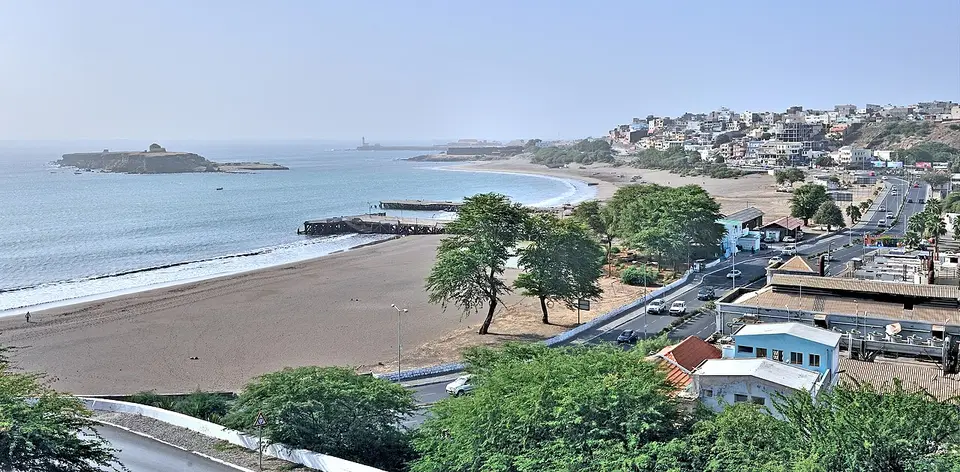
Cabo Verde, also written Cape Verde in English, is an island country in the Atlantic Ocean, several hundred kilometres west of Senegal and the westernmost point of mainland Africa. It consists of ten main volcanic islands, grouped into a northern Barlavento (windward) group and a southern Sotavento (leeward) group. The capital, Praia, is on Santiago, the largest and most populous island in the southern group.
On a world map, find the bulge of West Africa where Senegal and the Gambia sit. Then look out to sea to the west. Cabo Verde is the small scatter of dots in open ocean, well clear of the coast.
How to find Cabo Verde on the map
- Start from Senegal. Cabo Verde lies due west of Dakar, out in the Atlantic.
- Look for a horseshoe of islands. The archipelago is arranged in a rough crescent opening towards the west.
- Don't confuse it with the Canary Islands. The Canaries are Spanish and sit much closer to the coast of Morocco and Western Sahara, further north.
- It's not São Tomé and Príncipe. That is the other small Atlantic island nation off Africa, but it lies in the Gulf of Guinea, near the equator.
Flag
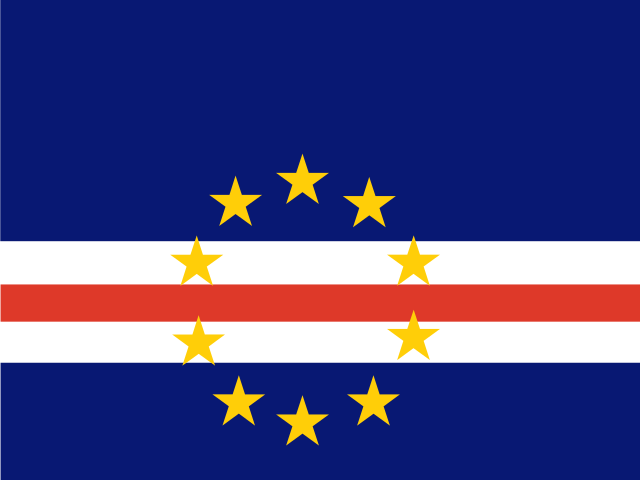
The flag is a blue field crossed by a horizontal band of white, red and white in the lower half, with a ring of ten yellow five-pointed stars set towards the hoist side. The blue stands for the ocean and sky, the white and red band for the road towards progress, and the ten stars for the ten main islands.
In the Flags quiz, the circle of stars is the giveaway. It is sometimes confused with the European Union flag because of the ring of stars, but the EU flag has twelve stars on plain blue with no stripes.
A short history of Cabo Verde
Cabo Verde's history begins with empty islands. Portuguese and Genoese navigators reached them around 1456–1462, and settlers founded Ribeira Grande on Santiago in 1462. It was the first permanent European town in the tropics. Today it is called Cidade Velha and is a UNESCO World Heritage site.
The islands sat at a perfect crossroads between Europe, Africa and the Americas, and they became a key base in the Atlantic slave trade. Enslaved Africans were brought from the coast of Guinea, held on Santiago and shipped onwards to Brazil and the Caribbean. The mixing of Portuguese settlers and Africans created a new Creole people and culture. The wealth of Ribeira Grande attracted pirates, and Francis Drake raided the town in 1585. Over time the capital moved to Praia, which was easier to defend.
Life on the islands was often desperate. Rain is rare and unreliable, and terrible droughts and famines struck many times, killing a large share of the population. This drove a long tradition of emigration: islanders joined American whaling ships in the 1800s, and many settled in New England. In the late 1800s the port of Mindelo on São Vicente boomed as a coaling station for steamships crossing the Atlantic.
In the 20th century Cabo Verde was tied politically to Guinea-Bissau. Amílcar Cabral, born in Guinea-Bissau to Cabo Verdean parents, led a joint movement, the PAIGC, which fought an armed struggle against Portugal on the mainland. Independence came in 1975 after Portugal's own revolution. Plans to unite the two countries ended after a coup in Guinea-Bissau in 1980.
Cabo Verde was a one-party state until 1991, when it held free multi-party elections. Since then it has been one of Africa's most stable democracies. The economy rests on tourism, services and money sent home by the large diaspora.
Culture and daily life in Cabo Verde
Portuguese is the official language, but at home almost everyone speaks Kriolu, a Creole that grew out of Portuguese and West African languages. Each island has its own variety, and the version from Santiago sounds quite different from the one in Mindelo. Most people are Catholic, and saints' days are celebrated with processions and music.
Music is the national passion. Alongside morna, there is the lively coladeira, the accordion-driven funaná from Santiago, which was once frowned upon by colonial authorities, and batuque, sung by women who beat rhythms on cloth bundles. The word sodade, a feeling of longing for home and absent loved ones, runs through many songs and speaks to the history of emigration.
The islands are surprisingly varied. Sal and Boa Vista have long sandy beaches, Santo Antão has deep green valleys for hiking, and Fogo's volcanic soil grows grapes and coffee. Football is the most popular sport, and the national team has qualified for the Africa Cup of Nations several times.
Five facts worth knowing
- The islands were uninhabited when the Portuguese arrived in the 1450s, and the country gained independence from Portugal in 1975.
- The official name changed in 2013, when the government asked other countries to use the Portuguese form "Cabo Verde" rather than translating it.
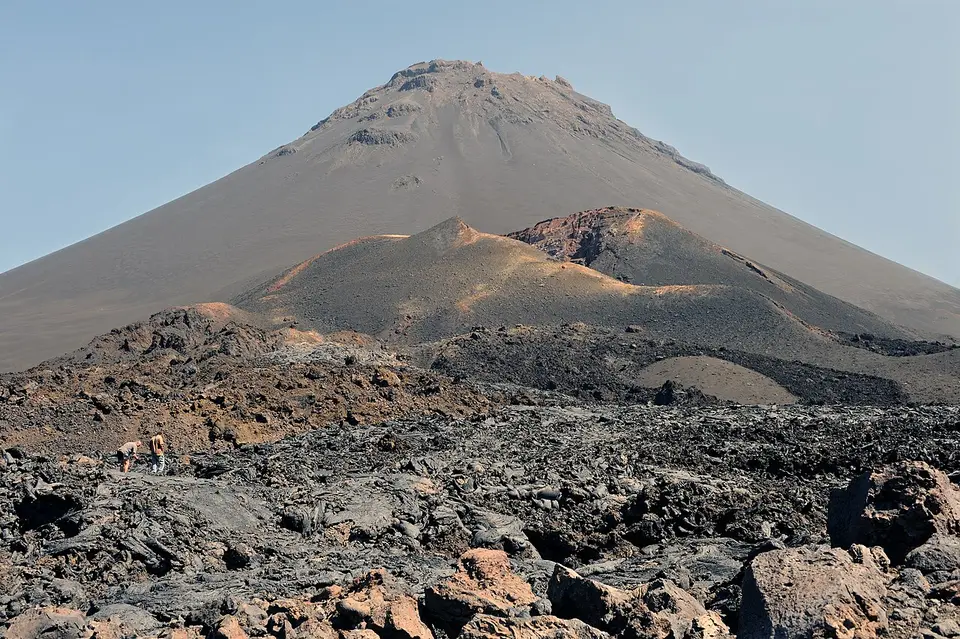
- Pico do Fogo, on the island of Fogo, is an active volcano and the highest point in the country at around 2,800 metres.
- More Cabo Verdeans live abroad than at home, with large communities in the United States, Portugal and the Netherlands.
- Morna, a melancholy style of music made famous by singer Cesária Évora, was added to UNESCO's intangible heritage list in 2019.
Culture and traditions in Cabo Verde
- Saying hello
"Bom dia" in Portuguese, or a greeting in Cape Verdean Creole (Kriolu).
- Food and drink
Cachupa, the national dish, a slow-cooked stew of corn, beans and fish or meat.
- Festivals and traditions
The Mindelo Carnival in February or March, and the Baia das Gatas music festival in August.
- Everyday life
Islanders take pride in "morabeza", a warm and welcoming hospitality.
- Did you know?
Morna, the soulful music made famous by Cesaria Evora, is on UNESCO's intangible heritage list.
Common mistakes
- Tapping the Canary Islands, which are closer to Africa and belong to Spain.
- Tapping São Tomé and Príncipe in the Gulf of Guinea.
- Expecting the islands to sit right against the coast of Senegal; they are further out than most people think.
Practise with Cabo Verde
- Africa quiz – a tiny target in the Atlantic, so zoom in before tapping.
- West Africa quiz – the islands appear off the left edge of the region, west of Senegal.
- Africa flags – the ring of ten stars is one of the easier African flags to remember.
- Africa capitals quiz – Praia.
- Mystery Country – an island cluster shaped like a loose horseshoe.
Quick check: how well do you know Cabo Verde?
3 questions, no sign-up. Tap an answer.
1. Which flag belongs to Cabo Verde?
That's the flag of Cabo Verde.
2. What is the capital of Cabo Verde?
The capital of Cabo Verde is Praia.
3. Which is bigger by area?
Tunisia (163,610 km²) is bigger than Cabo Verde (4,033 km²).
Keep going on the Africa quiz – Cabo Verde is one of 54 countries there.
More ways to practise: find Cabo Verde on the blank map with no borders (hard mode), or play today's Globe and the other daily puzzles.
Frequently asked questions about Cabo Verde
What language is spoken in Cabo Verde?
Portuguese is the official language, used in government, schools and the media. In daily life almost everyone speaks Cabo Verdean Creole, Kriolu, a Portuguese-based creole with West African influences that varies from island to island.
What currency does Cabo Verde use?
Cabo Verde uses the Cabo Verdean escudo (CVE). It is pegged to the euro at a fixed rate of 110.265 escudos to one euro, and prices are written with the escudo sign placed where a decimal point would be, as in 1$00.
What time zone is Cabo Verde in?
Cabo Verde is on UTC−1 all year round and does not use daylight saving time. That puts it one hour behind Senegal and the rest of the West African coast that uses GMT.
Which side of the road do they drive on in Cabo Verde?
People drive on the right in Cabo Verde. Many roads are paved with cobblestones laid by hand, and shared minibuses called aluguers are the main way to travel around the islands.
What is the highest point in Cabo Verde?
The highest point is Pico do Fogo, about 2,829 metres, an active volcano on the island of Fogo. Its last eruption, in 2014–15, destroyed villages inside the caldera, Chã das Caldeiras.
Why is Cabo Verde called Cabo Verde?
The name means "Green Cape" in Portuguese. It comes from Cap-Vert, the headland near Dakar in Senegal, the westernmost point of mainland Africa, which lies about 600 kilometres east of the islands.
Quizzes with Cabo Verde
Guides that help with this
- Learn all 54 African countries in a weekLearn the coastline in order, region by region.
- Flags that look alike (and how to tell them apart)Chad or Romania? Australia or New Zealand? The flag pairs that cost quiz points.
- The 25 hardest countries to find on a mapPacific islands, Caribbean islands and landlocked Africa – where they are.