Maldives
Capital: Malé. The Maldives is one of the 48 countries in the Asia quiz.
Quick answers: What is the capital of the Maldives? · Which countries border the Maldives?
Facts about the Maldives
- CapitalMalé
- Population529,676
- Area300 km²
- RegionsAsia, Central & South Asia
- LanguageDhivehi
- CurrencyMaldivian rufiyaa (MVR)
The Maldives is the 47th most populous of the 48 countries in Asia and the 48th largest by area. Worldwide it ranks 169th by population and 189th by area.
Where is the Maldives?
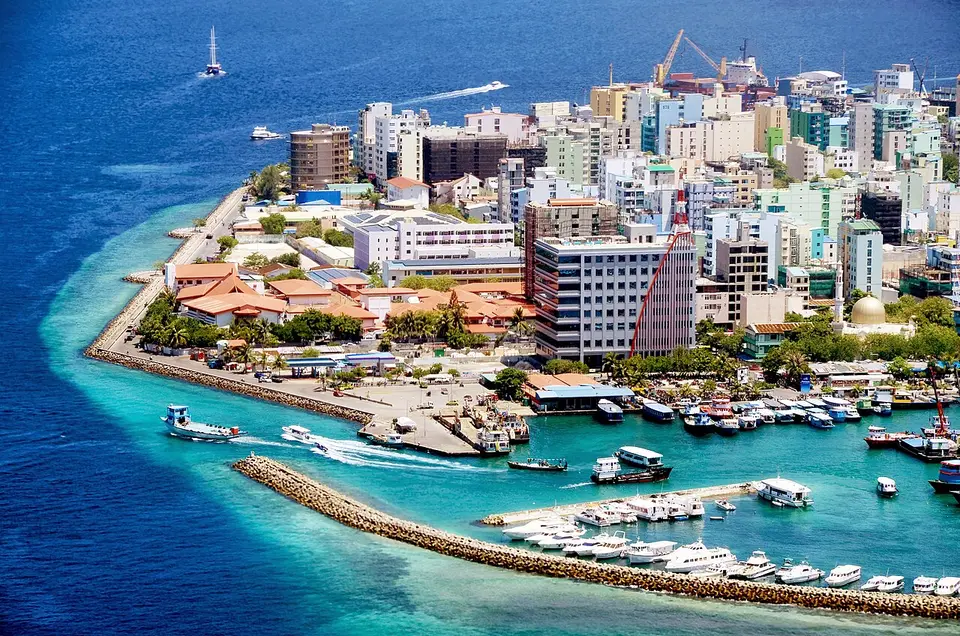
The Maldives is a chain of coral atolls in the Indian Ocean, south-west of India and Sri Lanka. The islands run in a north-south line for about 800 km, crossing the equator at the southern end. There are around 1,200 islands in 26 natural atolls, and fewer than 200 are inhabited. The capital, Malé, is on a small island near the middle of the chain and is one of the most densely built-up cities in the world.
On a world map, find the southern tip of India. Sri Lanka is the teardrop just off it. The Maldives is the thin string of dots further south-west, out in open ocean, often drawn as a dashed line because the islands are too small to show.
How to find the Maldives on the map
- Start from India. Drop south-west from the tip of the subcontinent, past Sri Lanka, into the ocean.
- Look for a vertical line of dots. The atolls form a near-straight north-south chain.
- Find the equator. The southernmost atolls lie just below it, the only part of South Asia to do so.
- Don't confuse it with Sri Lanka. Sri Lanka is one large island next to India. The Maldives is a scattered chain much further out.
Flag
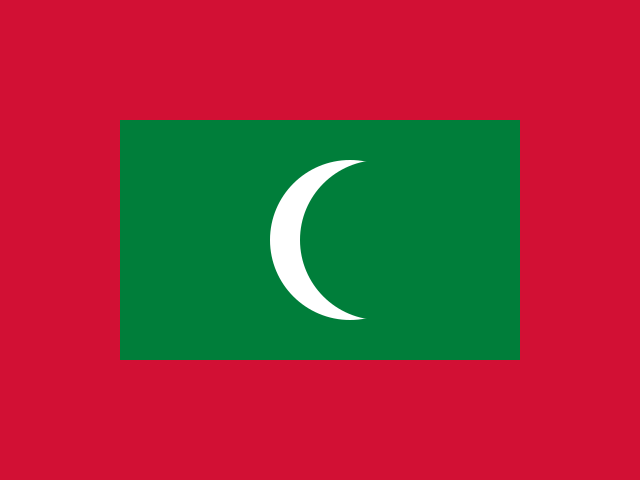
The flag of the Maldives is a red field with a green rectangle in the centre and a white crescent inside the green, opening towards the fly. The red recalls the old national flag and the sacrifices of the nation's heroes, the green stands for peace and palm trees, and the crescent for Islam. It was adopted in 1965 at independence from Britain.
Separate it from Bangladesh – green with a red disc – and Pakistan, which has a crescent and star on green. Red border, green centre, white crescent is the Maldives.
A short history of the Maldives
The first settlers probably reached the Maldives from southern India and Sri Lanka well over 2,000 years ago. For centuries the islanders followed Buddhism, and the ruins of stupas and monasteries have been found on several atolls. The islands sat on the sea routes between Arabia, India and Southeast Asia, and they were famous for exporting cowrie shells, which were used as money as far away as Africa and China, as well as coir rope made from coconut fibre.
According to tradition, the king converted to Islam in 1153 after a visiting Muslim scholar, and the whole kingdom followed. A line of sultans ruled for the next eight centuries. The Moroccan traveller Ibn Battuta stayed in the islands in the 1340s, served as a judge in Malé and wrote one of the earliest detailed accounts of Maldivian life.
The Portuguese seized Malé in 1558 and held it for about 15 years, until a local hero, Muhammad Thakurufaanu, drove them out with a guerrilla campaign using small boats. His victory is still celebrated as National Day. Afterwards the Dutch, based in Ceylon, had some influence, and in 1887 the sultan accepted British protection. Britain handled foreign affairs but left the islands largely to run themselves. During and after the Second World War the British kept an air base on Gan in the far southern Addu Atoll, which they used until 1976.
The Maldives became fully independent on 26 July 1965. In 1968 the sultanate was abolished and the country became a republic. Maumoon Abdul Gayoom ruled from 1978 to 2008, and the first multi-party elections were held in 2008. Since then politics has often been turbulent, but power has changed hands at the ballot box.
The first tourist resort opened in 1972. Tourism now dominates the economy, alongside tuna fishing, and the country has become a leading voice on climate change because of its low-lying islands.
Culture and daily life in the Maldives
Islam is at the heart of national life, and all Maldivian citizens are required to be Muslim. The call to prayer rings out across every inhabited island, and the old Hukuru Miskiy, Malé's Friday Mosque, was built in 1658 from carved coral stone. Dhivehi has borrowed words from Arabic, Hindi, Urdu and English, and older inscriptions were written in earlier scripts before Thaana came into use.
Life revolves around the sea. Many families are linked to pole-and-line tuna fishing, a traditional method that catches fish one by one, and the wooden dhoni boat is a national symbol. Island life is close-knit, and most people outside Malé live in small communities where everyone knows each other.
The best-known music is bodu beru, "big drum", in which drummers and singers build to a fast rhythm while dancers move faster and faster. Traditional crafts include lacquerwork, mat weaving and carving on coral stone. Football is by far the most popular sport, followed by volleyball and bashi, a traditional game played by women.
Five facts worth knowing
- The Maldives is the lowest-lying country in the world. Its highest natural point is only a couple of metres above sea level, making it one of the countries most exposed to rising seas.
- It is the smallest country in Asia by both area and population.
- Tourism is the backbone of the economy, with many resorts occupying their own private islands.
- Malé covers only a few square kilometres, and a new island, Hulhumalé, was built on reclaimed reef to relieve the overcrowding.
- Dhivehi, the national language, is related to Sinhala and is written in its own script, Thaana, from right to left.
Culture and traditions in the Maldives
- Saying hello
"Assalaamu alaikum" is the usual greeting, often followed by a handshake between men.
- Food and drink
Mas huni, shredded tuna with coconut, onion and chilli eaten with roshi flatbread for breakfast, and garudhiya, a clear fish broth.
- Festivals and traditions
Independence Day on 26 July features parades and celebrations; the end of Ramadan (Kuda Eid) is also widely celebrated.
- Everyday life
Local islands follow conservative dress norms and alcohol is only served in resorts. Friday is the weekly day off.
- Did you know?
The Maldives is the world's lowest-lying country, with an average ground level of about 1.5 m above sea level.
Common mistakes
- Tapping Sri Lanka – the large island nearer India.
- Missing the target because the islands are too small at continent zoom.
- Picking the Bangladesh or Pakistan flag.
Practise with the Maldives
- Central & South Asia quiz – the map zooms in, so the chain of atolls is visible south-west of India.
- Asia quiz – difficult at full zoom. Aim just south-west of Sri Lanka.
- Asia flags – red with the green box and white crescent.
- Asia capitals quiz – Malé.
- Mystery Country – a column of tiny dots, unlike any other outline in Asia.
Quick check: how well do you know the Maldives?
3 questions, no sign-up. Tap an answer.
1. Which flag belongs to the Maldives?
That's the flag of the Maldives.
2. What is the capital of the Maldives?
The capital of the Maldives is Malé.
3. Which is bigger by area?
Saudi Arabia (2,149,690 km²) is bigger than the Maldives (300 km²).
Keep going on the Asia quiz – Maldives is one of 48 countries there.
More ways to practise: find the Maldives on the blank map with no borders (hard mode), or play today's Globe and the other daily puzzles.
Frequently asked questions about the Maldives
What language is spoken in the Maldives?
The official language is Dhivehi, an Indo-Aryan language related to Sinhala in Sri Lanka. It is written in Thaana, a script that runs from right to left. English is widely spoken, used in secondary education and essential in the tourist resorts.
What currency does Maldives use?
The Maldives uses the rufiyaa (MVR), divided into 100 laari. In tourist resorts prices are almost always set in US dollars, and dollars are widely accepted, but the rufiyaa is the legal currency for everyday purchases on local islands.
What time zone is the Maldives in?
The Maldives is on UTC+5 all year and does not use daylight saving time, so it is half an hour behind India and Sri Lanka. Some resorts set their own "island time" an hour ahead to give guests longer evenings.
Which side of the road do they drive on in the Maldives?
The Maldives drives on the left. There are very few roads outside Malé and Addu City, and most travel between islands is by boat, speedboat or seaplane rather than by car.
What is the highest point in the Maldives?
The Maldives is the lowest country on Earth. Its highest natural point is usually given as about 2.4 metres, on Villingili in Addu Atoll, and most of the land is barely a metre above sea level.
How many islands does Maldives have?
The Maldives is made up of around 1,190 coral islands grouped into 26 natural atolls, stretching about 870 kilometres from north to south. Only around 200 islands are inhabited by local communities, and well over 150 others are used as resorts.
Quizzes with the Maldives
Guides that help with this
- Oceans, seas, rivers and mountainsThe physical map: seas around each continent, the big rivers and ranges.
- Flags that look alike (and how to tell them apart)Chad or Romania? Australia or New Zealand? The flag pairs that cost quiz points.
- The 25 hardest countries to find on a mapPacific islands, Caribbean islands and landlocked Africa – where they are.