Mauritius
Capital: Port Louis. Mauritius is one of the 54 countries in the Africa quiz.
Quick answers: What is the capital of Mauritius? · Which countries border Mauritius?
Facts about Mauritius
- CapitalPort Louis
- Population1.2 million
- Area2,040 km²
- RegionsAfrica, Southern Africa
- LanguageEnglish
- CurrencyMauritian rupee (MUR)
Mauritius is the 49th most populous of the 54 countries in Africa and the 51st largest by area. Worldwide it ranks 158th by population and 171st by area.
Where is Mauritius?
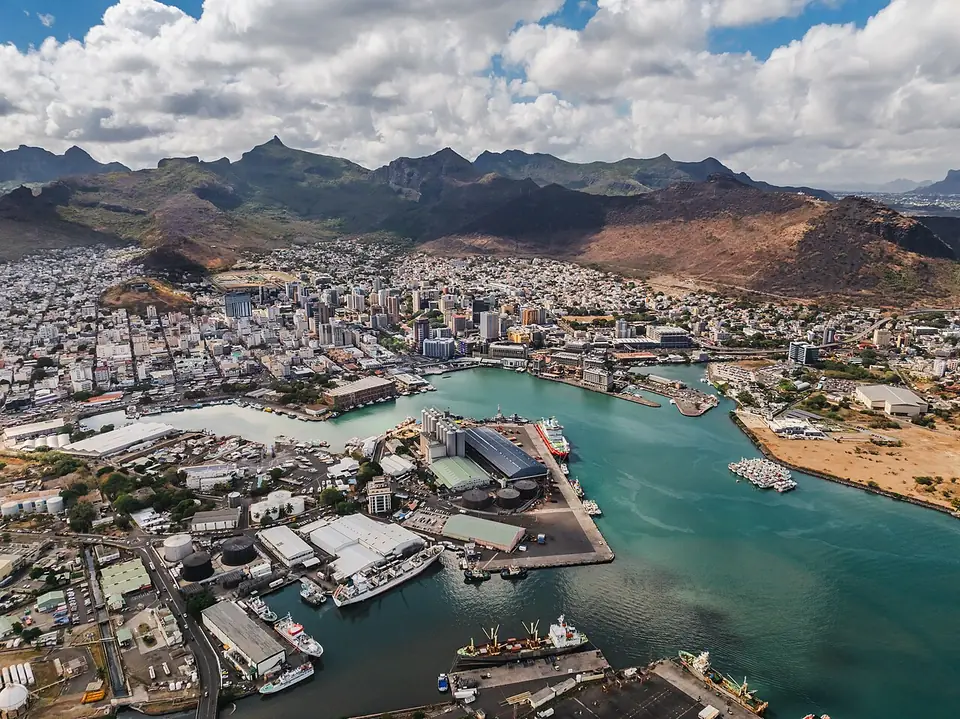
Mauritius is a small island nation in the Indian Ocean, about 2,000 km off the south-east coast of Africa and roughly 900 km east of Madagascar. The main island is volcanic, ringed by coral reefs and about 65 km long. The country also includes Rodrigues, some 560 km further east, and the Agaléga islands to the north. The French island of Réunion lies just to the south-west. The capital, Port Louis, is on the north-west coast of the main island.
On a world map, find Madagascar. Mauritius is the dot out in the ocean to its east, level with Madagascar's middle. It is small enough that most maps show only a name and a point.
How to find Mauritius on the map
- Start from Madagascar. Go east across open water; after Réunion, the next island is Mauritius.
- Look for the Mascarene pair. Réunion and Mauritius sit close together; Mauritius is the one further north-east.
- Stay in the southern hemisphere. Mauritius is at about 20° south.
- Don't confuse it with the Seychelles or the Maldives. Both are much further north, near or above the equator.
Flag
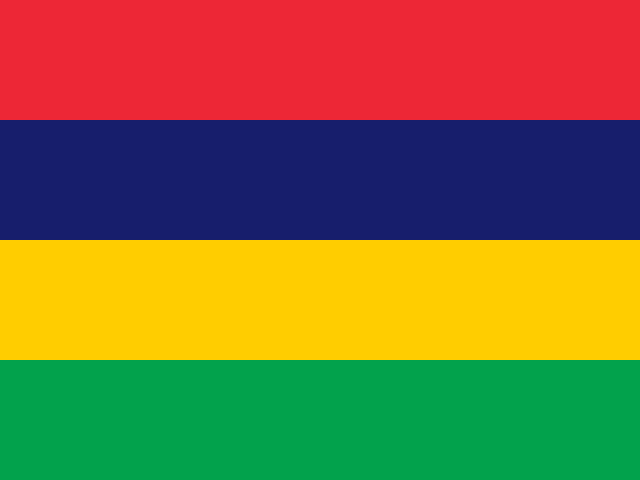
Mauritius has one of the few four-colour horizontal flags in the world: red, blue, yellow and green stripes of equal width, top to bottom. The red stands for the struggle for freedom, the blue for the Indian Ocean, the yellow for the light of independence and the green for year-round vegetation. It was adopted at independence in 1968.
Nothing else has four plain horizontal stripes in those colours, so once you know it, it cannot be mistaken.
A short history of Mauritius
Arab and Swahili sailors probably knew of the island, and Portuguese ships stopped there in the early 1500s, but nobody stayed. The Dutch landed in 1598 and named it after Prince Maurice of Nassau. They tried to settle twice in the 1600s, cut down ebony forests and brought in deer, pigs and enslaved workers, but they abandoned the island in 1710.
France took over in 1715 and renamed it Île de France. Under the governor Mahé de La Bourdonnais in the 1730s and 1740s, Port Louis became a busy harbour and naval base. Sugar plantations spread across the island, worked by enslaved people brought from Madagascar and mainland Africa. Mauritius also became a base for French privateers attacking British ships in the Indian Ocean.
Britain captured the island in 1810, just months after the French had won a naval battle at Grand Port, and kept it under the 1814 Treaty of Paris. The British let the French settlers keep their language, laws and property, which is why French still runs so deep. Slavery was abolished in 1835, and planters turned to indentured labourers from India. Hundreds of thousands arrived through the immigration depot at Aapravasi Ghat in Port Louis, now a World Heritage site, and their descendants became the majority of the population.
Mauritius gained independence in 1968 and became a republic in 1992. Shortly before independence, Britain separated the Chagos Archipelago and later allowed the United States to build a military base on Diego Garcia, expelling the islanders. Mauritius spent decades pressing its claim, and in 2025 the two governments agreed that sovereignty would pass to Mauritius while the base stays under a long lease.
After independence the country moved from relying on sugar to textiles, tourism and financial services. It is now one of the most stable democracies in Africa and a link between Africa and Asia.
Culture and daily life in Mauritius
Hinduism is the largest religion, followed by Christianity, mainly Catholic, and Islam, with smaller Buddhist and Chinese traditions. Temples, churches, mosques and pagodas often stand on the same street. Each September, thousands of people of many faiths visit the tomb of Père Laval, a 19th-century priest, in Sainte-Croix.
Languages overlap in the same way. Mauritian Creole is the language almost everyone shares, while Bhojpuri is still spoken in many Indo-Mauritian families, and newspapers and television are mostly in French. The island has inspired literature for centuries, from the 18th-century French novel Paul et Virginie to the work of J. M. G. Le Clézio, the Nobel Prize winner whose family roots are Mauritian.
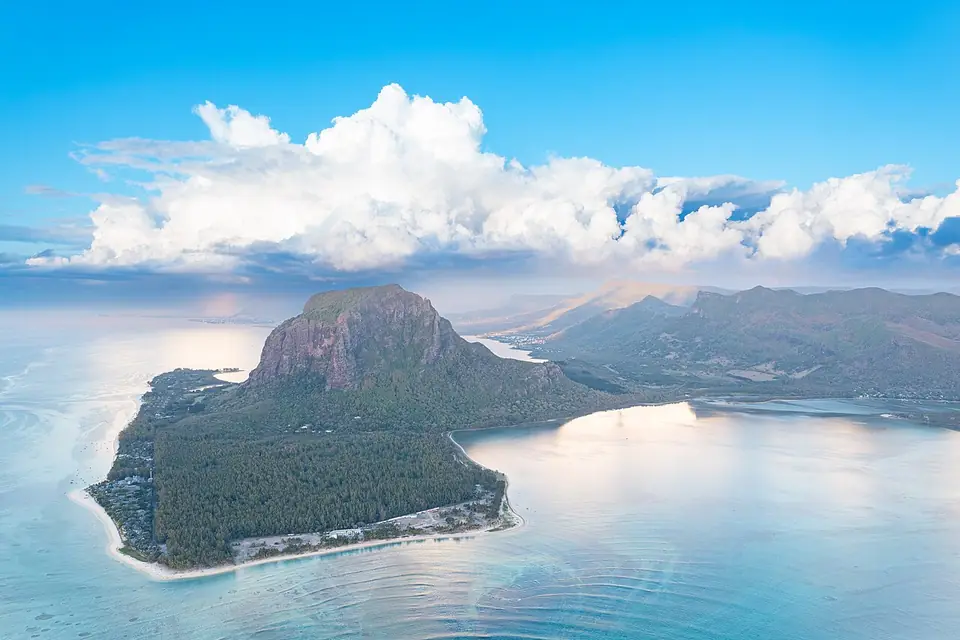
Food mixes the same influences. Street stalls sell gâteaux piments, spicy split-pea fritters, and alouda, a sweet milk drink with basil seeds, while biryani is a favourite at weddings. Horse racing at the Champ de Mars in Port Louis, dating from the early 1800s, draws big crowds. The mountain of Le Morne Brabant, where escaped slaves once hid, is a World Heritage site and a symbol of resistance.
Five facts worth knowing
- The dodo lived only on Mauritius and was hunted to extinction within a century of settlement in the 1600s. It appears on the national coat of arms.
- Mauritius had no permanent inhabitants before European colonisation. The Dutch, French and British ruled it in turn, and today's population descends mainly from Indian, African, Chinese and European arrivals.
- Mauritius is consistently ranked as the best-governed country in Africa, and one of the wealthiest per person on the continent.
- The Blue Penny and Red Penny stamps of 1847 are among the rarest in the world; two are displayed in a museum in Port Louis.
- English is the official language of parliament, but French and Mauritian Creole are far more widely spoken.
Culture and traditions in Mauritius
- Saying hello
"Bonzour" in Mauritian Creole is common, though people switch easily to English or French.
- Food and drink
Dholl puri, thin flatbreads stuffed with yellow split peas, and rougaille, a tomato-based Creole sauce with fish or sausage.
- Festivals and traditions
Maha Shivaratri (Feb/March) sees a pilgrimage to the Grand Bassin lake; Independence Day is 12 March.
- Everyday life
Mauritius is very multicultural, with Hindu, Muslim, Christian and Chinese festivals all public holidays. Sega music and dance is a beloved tradition.
- Did you know?
Mauritius was the only home of the dodo, which became extinct in the late 1600s.
Common mistakes
- Tapping Réunion, the French island next door.
- Tapping Madagascar, the big island to the west.
- Looking near the Seychelles or Maldives, much further north.
Practise with Mauritius
- Africa quiz – a dot east of Madagascar. Zoom in and aim just north-east of Réunion.
- East Africa quiz – included with the Indian Ocean islands of the region.
- Africa flags – four horizontal stripes, red at the top.
- Africa capitals quiz – Port Louis.
- Mystery Country – a small, rounded island, slightly taller than it is wide.
Quick check: how well do you know Mauritius?
3 questions, no sign-up. Tap an answer.
1. Which flag belongs to Mauritius?
That's the flag of Mauritius.
2. What is the capital of Mauritius?
The capital of Mauritius is Port Louis.
3. Which is bigger by area?
Chad (1,284,000 km²) is bigger than Mauritius (2,040 km²).
Keep going on the Africa quiz – Mauritius is one of 54 countries there.
More ways to practise: find Mauritius on the blank map with no borders (hard mode), or play today's Globe and the other daily puzzles.
Frequently asked questions about Mauritius
What language is spoken in Mauritius?
English is used in parliament, law and government documents, but it is rarely spoken at home. Mauritian Creole, based on French, is the shared everyday language of almost all Mauritians, while French dominates the media. Bhojpuri, Hindi, Tamil and other Asian languages are kept alive in many families.
What currency does Mauritius use?
Mauritius uses the Mauritian rupee (MUR), divided into 100 cents. Its banknotes carry text in English, Tamil and Devanagari script, reflecting the island's Indian heritage, and the Bank of Mauritius in Port Louis issues them.
What time zone is Mauritius in?
Mauritius is on UTC+4 all year round. It tried daylight saving time once, in the summer of 2008–09, but dropped it after a single season.
Which side of the road do they drive on in Mauritius?
Mauritius drives on the left, a legacy of British rule. A motorway runs north to south through the middle of the island, linking Port Louis with the airport at Plaisance, and a light-rail Metro Express now connects the capital with the central towns.
What is the highest point in Mauritius?
Piton de la Petite Rivière Noire, in the south-west of the island, is the highest point at about 828 metres. It rises above Black River Gorges National Park, which protects much of the island's remaining native forest.
What are the Seven Coloured Earths?
At Chamarel in the south-west, an area of bare sand dunes shows bands of red, brown, violet, green, blue, purple and yellow. The colours come from volcanic rock weathered into clay, and the different-coloured sands are said to separate again even when mixed together.
Quizzes with Mauritius
Guides that help with this
- Learn all 54 African countries in a weekLearn the coastline in order, region by region.
- Flags that look alike (and how to tell them apart)Chad or Romania? Australia or New Zealand? The flag pairs that cost quiz points.
- The 25 hardest countries to find on a mapPacific islands, Caribbean islands and landlocked Africa – where they are.