Philippines
Capital: Manila. The Philippines is one of the 48 countries in the Asia quiz.
Quick answers: What is the capital of the Philippines? · Which countries border the Philippines?
Facts about the Philippines
- CapitalManila
- Population116.8 million
- Area342,353 km²
- RegionsAsia, Southeast Asia
- LanguagesEnglish, Tagalog
- CurrencyPhilippine peso (PHP)
The Philippines is the 7th most populous of the 48 countries in Asia and the 18th largest by area. Worldwide it ranks 14th by population and 63rd by area.
Where is the Philippines?
The Philippines is an island country in the western Pacific, north of Indonesia and east of Vietnam across the South China Sea. It is made of more than 7,000 islands grouped into three regions: Luzon in the north, the Visayas in the middle and Mindanao in the south. Manila, the capital, is on Luzon, facing Manila Bay on the island's west coast. Taiwan lies just to the north, across the Luzon Strait, and Borneo to the south-west.
On a world map, find the big island of Borneo, then look up and to the right. The compact cluster of islands sitting between Borneo and Taiwan is the Philippines.
How to find the Philippines on the map
- Start from Taiwan. The Philippines is the island group directly south of it.
- Find Luzon. The largest island, in the north, has a distinctive shape with a long, thin peninsula trailing off to the south-east.
- Don't confuse it with Indonesia. Indonesia is a far wider spread of islands further south, along the equator. The Philippines is a tighter cluster above it.
- Don't confuse it with Japan. Japan is much further north, off the coast of Korea.
Flag
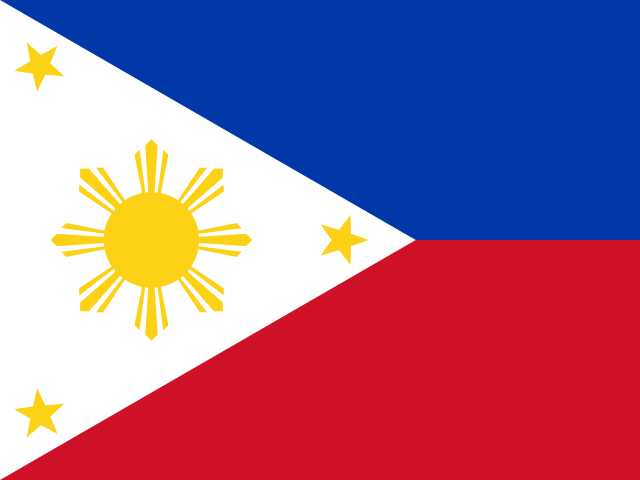
The Philippine flag has a white triangle at the hoist with a horizontal band of blue above and red below. Inside the triangle is a golden sun with eight rays and three small stars, one in each corner. The eight rays stand for the first eight provinces that rose against Spanish rule, and the three stars for Luzon, the Visayas and Mindanao.
In wartime the flag is flown upside down, with red on top; in peacetime, blue is always on top. The Czech flag also combines a hoist triangle with blue, white and red, but its triangle is blue and there is no sun. If you see a sun and three stars in a white triangle, it's the Philippines.
A short history of the Philippines
The first known inhabitants of the islands arrived tens of thousands of years ago. Later, Austronesian seafarers spread through the archipelago, living in small communities called barangays, named after the boats that carried them. Long before Europeans arrived, the islands traded with China, Borneo and the rest of South-east Asia. Islam reached the south from the 1300s, and sultanates grew up in Sulu and Mindanao.
In 1521 Ferdinand Magellan, sailing for Spain, landed in the Visayas. He was killed on Mactan in a clash with the local chief Lapu-Lapu, now a national hero. Spain returned in 1565 and founded Manila in 1571. For 250 years, the Manila galleons sailed to Acapulco in Mexico, carrying Chinese silk and porcelain in exchange for American silver. Spain converted most of the north and centre to Catholicism, but never fully conquered the Muslim south or parts of the mountainous north.
In the late 1800s, Filipino reformers pushed for change. The writer José Rizal was executed by the Spanish in 1896, which fuelled a revolution. Filipinos declared independence in 1898, but Spain sold the islands to the United States after the Spanish–American War. A bloody war against American rule followed. The US introduced English and public schools and promised eventual independence.
Japan invaded in December 1941, and the occupation and the battles to retake the islands, including the destruction of Manila in 1945, were devastating. Full independence came in 1946. Ferdinand Marcos ruled from 1965 and declared martial law in 1972. The peaceful People Power Revolution of 1986 removed him and inspired similar movements elsewhere. In 2019 a new autonomous region, Bangsamoro, was set up for Muslim Mindanao after a long conflict.
Today the Philippines has one of the fastest-growing economies in Asia, powered by services, call centres and millions of Filipinos working overseas who send money home.
Culture and daily life in the Philippines
The national language, Filipino, is based on Tagalog, while Cebuano, Ilocano and Hiligaynon are among the many others. Spanish loanwords fill everyday speech, especially for numbers, days and food, and English is used in business, law and education. Most people are Catholic, with a sizeable Muslim minority in Mindanao.
Rizal's novels Noli Me Tángere and El Filibusterismo are required reading in schools. The Banaue rice terraces, carved into the mountains of northern Luzon by the Ifugao, are a UNESCO World Heritage site, and old baroque churches such as Paoay are famous for their earthquake-resistant walls.
Basketball is by far the most popular sport, played on courts in almost every village. Boxer Manny Pacquiao became a national icon, and karaoke is a favourite pastime. The colourful jeepney, a stretched and decorated version of old US army jeeps, is a symbol of the streets. Filipinos abroad, from nurses to sailors, keep strong ties with home, and the balikbayan box, a large carton of gifts sent to relatives, is a familiar sight. Bayanihan, the spirit of neighbours helping each other, is often described as a core national value.
Five facts worth knowing
- The country is named after King Philip II of Spain. It was a Spanish colony for more than 300 years, then an American territory, and became independent in 1946.
- It is the only majority-Christian country in Southeast Asia, mostly Roman Catholic, a legacy of Spanish rule.
- Filipino and English are both official languages, alongside more than 100 regional languages.
- Mount Pinatubo on Luzon erupted in 1991, one of the largest volcanic eruptions of the twentieth century.
- The Philippines is one of the most typhoon-exposed countries in the world, with around twenty tropical cyclones a year.
Culture and traditions in the Philippines
- Saying hello
A handshake or "Kumusta"; younger people show respect by pressing an elder's hand to their forehead (mano).
- Food and drink
Adobo, meat braised in vinegar and soy sauce, and lechon, roast pig.
- Festivals and traditions
Sinulog in Cebu and Ati-Atihan in Kalibo, both in January, feature street dancing and colourful costumes.
- Everyday life
Family is central, and hospitality is warm. Filipinos often eat rice at every meal.
- Did you know?
The Philippines has one of the world's longest Christmas seasons, starting in September.
Common mistakes
- Tapping Indonesia – the two countries' islands run close together around the Celebes Sea.
- Tapping Taiwan – a single island directly north, easy to hit on a small screen.
- Picking the Czech flag in the Flags quiz because of the triangle.
Practise with the Philippines
- Asia quiz – the island cluster between Taiwan and Borneo.
- Southeast Asia quiz – a closer view, so Luzon, the Visayas and Mindanao are easy to pick out.
- Asia flags – look for the sun and three stars in the white triangle.
- Asia capitals quiz – Manila.
- Mystery Country – the loose cluster of islands with the big one at the top is a distinctive outline.
Quick check: how well do you know the Philippines?
3 questions, no sign-up. Tap an answer.
1. Which flag belongs to the Philippines?
That's the flag of the Philippines.
2. What is the capital of the Philippines?
The capital of the Philippines is Manila.
3. Which is bigger by area?
Kazakhstan (2,724,900 km²) is bigger than the Philippines (342,353 km²).
Keep going on the Asia quiz – Philippines is one of 48 countries there.
More ways to practise: find the Philippines on the blank map with no borders (hard mode), or play today's Globe and the other daily puzzles.
Frequently asked questions about the Philippines
What language is spoken in the Philippines?
Filipino, a standardised form of Tagalog, and English are the two official languages. English is widely used in government, business and higher education, and well over 100 regional languages are spoken at home, the largest being Cebuano, Ilocano and Hiligaynon.
What currency does the Philippines use?
The Philippines uses the Philippine peso, code PHP, divided into 100 centavos. It is a freely floating currency and is not pegged to the US dollar. Its symbol is ₱, and money sent home by Filipinos working abroad is a major source of pesos.
What time zone is the Philippines in?
The whole country uses Philippine Standard Time, UTC+8, the same as China, Singapore and Western Australia. Daylight saving time is not observed, so clocks stay the same all year.
Which side of the road do they drive on in the Philippines?
Filipinos drive on the right, and most vehicles are left-hand drive. Right-hand-drive imports are restricted by law, and the famous jeepneys, first built from American army jeeps, follow the same layout.
What is the highest point in the Philippines?
Mount Apo, a dormant volcano on the island of Mindanao, is the highest peak at about 2,954 metres. It overlooks the city of Davao and is a protected natural park, home to the rare Philippine eagle.
What is the Philippines famous for?
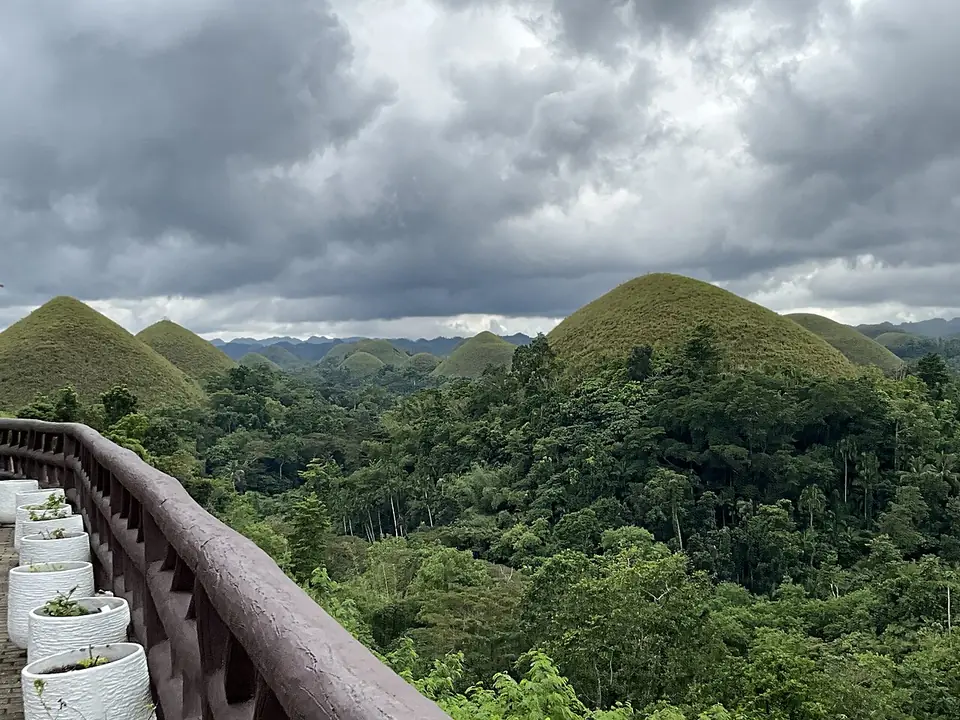
Beyond its beaches, the Philippines is known for the Banaue rice terraces carved into the mountains of northern Luzon by the Ifugao people, the Chocolate Hills of Bohol, which turn brown in the dry season, and the coral reefs of Tubbataha, a UNESCO site.
Quizzes with the Philippines
Guides that help with this
- Oceans, seas, rivers and mountainsThe physical map: seas around each continent, the big rivers and ranges.
- Flags that look alike (and how to tell them apart)Chad or Romania? Australia or New Zealand? The flag pairs that cost quiz points.
- The 25 hardest countries to find on a mapPacific islands, Caribbean islands and landlocked Africa – where they are.