Seychelles
Capital: Victoria. The Seychelles is one of the 54 countries in the Africa quiz.
Quick answers: What is the capital of the Seychelles? · Which countries border the Seychelles?
Facts about the Seychelles
- CapitalVictoria
- Population122,730
- Area452 km²
- RegionsAfrica, Southern Africa
- LanguagesFrench, English
- CurrencySeychellois rupee (SCR)
The Seychelles is the 54th most populous of the 54 countries in Africa and the 54th largest by area. Worldwide it ranks 181st by population and 183rd by area.
Where is the Seychelles?
Seychelles is an island nation in the western Indian Ocean, north-east of Madagascar and about 1,500 kilometres east of the African mainland. The country is made up of more than 100 islands, but almost everyone lives on three of them: Mahé, Praslin and La Digue. The capital, Victoria, is on Mahé and is one of the smallest capital cities in the world.
With a total land area of around 450 square kilometres, the Seychelles is the smallest country in Africa by both land area and population.
How to find the Seychelles on the map
- Start from Madagascar. Seychelles is well to the north-east of Madagascar's northern tip, out in open ocean.
- Draw a line from Kenya out to sea. Head east from the Kenya–Tanzania coast and you reach the Seychelles before you reach anything else.
- It is a dot above Madagascar, not beside it. Mauritius and Réunion are east of Madagascar; Comoros is between Madagascar and Mozambique. Seychelles is the one furthest north.
- Don't confuse it with the Maldives. The Maldives are much further north-east, south of India. Seychelles is on the African side of the Indian Ocean.
Flag
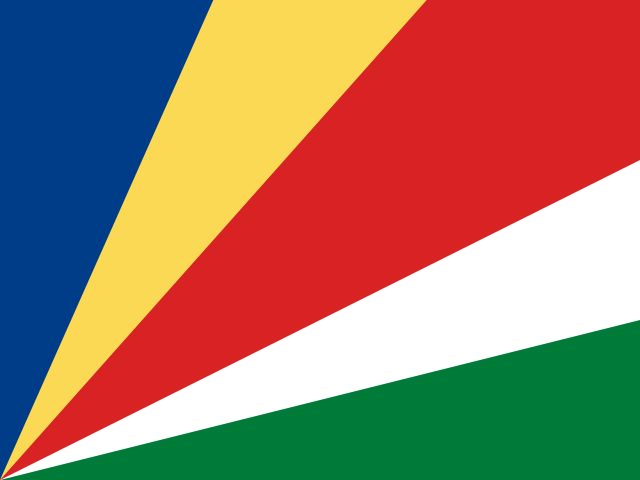
The Seychelles flag is unusual: five bands of colour – blue, yellow, red, white and green – radiating out as wedges from the bottom-left corner. The design, adopted in 1996, is meant to suggest a country moving into the future. Blue stands for the sea and sky, yellow for the sun, red for the people, white for justice and green for the land.
No other national flag uses diagonal rays fanning out from one corner, so once you've seen it, it is one of the easiest flags in the Africa quiz.
A short history of the Seychelles
For most of history these islands were empty of people. Arab traders and Portuguese sailors probably passed them, and Vasco da Gama's fleet sighted the outer Amirantes in the early 1500s, but nobody stayed. In the 1600s the islands were occasionally used by pirates and passing ships to collect water, tortoises and timber.
France claimed the archipelago in 1756 and named it after Jean Moreau de Séchelles, a finance minister of Louis XV. The first settlers arrived on Ste Anne Island in 1770: a small group of French colonists with enslaved Africans and Indians, sent from Mauritius, which was then France's main colony in the Indian Ocean. They grew spices, cotton and food crops. During the Napoleonic Wars Britain captured the islands, and in 1814 the Treaty of Paris confirmed British rule. The French-speaking planters stayed, which is why French place names and a French-based creole survive alongside English.
After Britain abolished slavery in the 1830s, the plantations turned to coconuts and cinnamon. Ships of the Royal Navy brought Africans freed from slave ships to the islands in the later 1800s, adding to the population. Seychelles was governed from Mauritius until 1903, when it became a separate crown colony. For much of the 1900s it was remote and quiet, until an international airport opened on Mahé in 1971 and tourism began to transform the economy.
Independence came in 1976. Just a year later, in 1977, Prime Minister France-Albert René took power in a coup, and the country became a one-party socialist state. A group of mercenaries tried to overthrow the government in 1981 but was discovered at the airport and fled. Multi-party democracy returned in 1993. In 2020 an opposition candidate won the presidency for the first time, a peaceful transfer of power widely seen as a milestone.
Today Seychelles has one of the highest incomes per person in Africa, based on tourism and tuna fishing, and it has protected a large share of its ocean territory.
Culture and daily life in the Seychelles
Seychellois society is a true blend of African, European, Indian and Chinese roots, and most families have ancestors from several continents. Seychellois Creole, or Kreol Seselwa, grew out of French and is the first language of almost everyone; it gained official status after independence and is used in early schooling. Most people are Roman Catholic, with Anglican, Hindu and Muslim minorities.
Traditional music shows these mixed roots. The moutya is a slow, drum-led dance that dates back to the days of slavery, when people gathered by firelight to sing about their hardships. Sega, shared with Mauritius, is faster and more playful, and the kanmtole is a country dance based on old European quadrilles. Moutya was added to UNESCO's Intangible Cultural Heritage list in 2021.
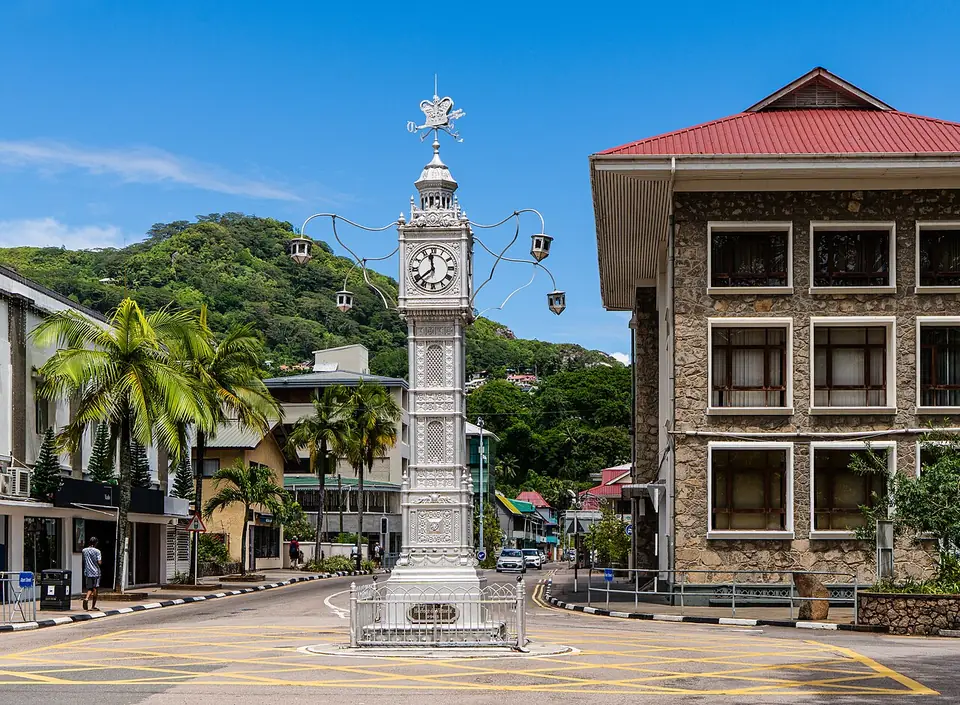
Victoria's small clock tower, modelled on one in London, and the colourful Sir Selwyn Selwyn-Clarke market are landmarks of the capital, and a Hindu temple stands a few streets away. Fishing and boat-building remain important in daily life, and on islands like La Digue, ox carts and bicycles were long the main transport.
Five facts worth knowing
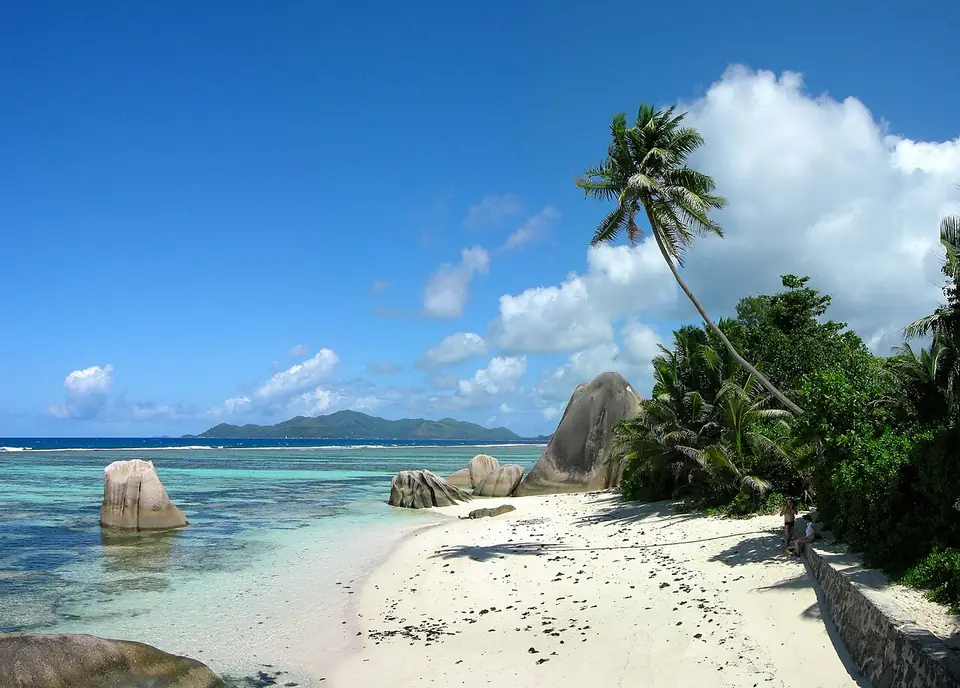
- The inner islands are granite, which is rare for oceanic islands – most are volcanic or coral. The granite boulders on beaches such as Anse Source d'Argent on La Digue are famous.
- The coco de mer palm, found on Praslin, produces the largest seed in the plant world. The Vallée de Mai where it grows is a UNESCO World Heritage Site.
- Aldabra Atoll, in the far south-west of the country, is home to a huge population of giant tortoises and is also UNESCO-listed.
- The islands were uninhabited until the 18th century, when French settlers arrived; Britain took over in the early 1800s and the Seychelles became independent in 1976.
- Creole, English and French are all official languages.
Culture and traditions in the Seychelles
- Saying hello
People greet each other warmly with "Bonzour" in Seychellois Creole, or in English or French.
- Food and drink
Fish and octopus curries cooked in coconut milk; ladob, a sweet dish of plantain or breadfruit simmered in coconut milk.
- Festivals and traditions
Festival Kreol, held every October, celebrates Creole music, dance, food and language.
- Everyday life
Life moves at a relaxed island pace. Swimwear is fine on the beach, but people cover up in towns and shops.
- Did you know?
The coco de mer palm, which produces the world's largest seed, grows naturally only on the islands of Praslin and Curieuse.
Common mistakes
- Tapping Mauritius, which is east of Madagascar rather than north-east.
- Tapping Comoros, the islands in the channel between Madagascar and Mozambique.
- Looking for the Seychelles near the Maldives on the Asian side of the ocean.
Practise with the Seychelles
- Africa quiz – the small marker far out in the Indian Ocean, north of Madagascar.
- East Africa quiz – a tighter zoom on the region makes the island nations easier to tell apart.
- Africa flags – the fan of five colours is unique; a quick win.
- Africa capitals quiz – Victoria.
- Mistake Bank – island nations off Africa are easy to mix up, so revisit Seychelles, the Comoros and Mauritius together.
Quick check: how well do you know the Seychelles?
3 questions, no sign-up. Tap an answer.
1. Which flag belongs to the Seychelles?
That's the flag of the Seychelles.
2. What is the capital of the Seychelles?
The capital of the Seychelles is Victoria.
3. Which is bigger by area?
Guinea (245,857 km²) is bigger than the Seychelles (452 km²).
Keep going on the Africa quiz – Seychelles is one of 54 countries there.
More ways to practise: find the Seychelles on the blank map with no borders (hard mode), or play today's Globe and the other daily puzzles.
Frequently asked questions about the Seychelles
What language is spoken in the Seychelles?
Seychelles has three official languages: Seychellois Creole, English and French. Creole, which is based on French, is the first language of almost everyone, while English is used most in government and business and French remains common in church and media.
What currency does Seychelles use?
Seychelles uses the Seychellois rupee, code SCR, divided into 100 cents. It has floated freely since 2008, when the country moved away from a fixed exchange rate during an economic crisis.
What time zone is the Seychelles in?
Seychelles uses Seychelles Time, UTC+4, the same as Mauritius and the United Arab Emirates. It does not observe daylight saving time, and being close to the equator its days are almost the same length all year.
Which side of the road do they drive on in the Seychelles?
Seychelles drives on the left, a legacy of British rule. Roads on Mahé are narrow and winding as they cross the mountainous spine of the island, and on La Digue most people get around by bicycle.
What is the highest point in the Seychelles?
Morne Seychellois, on the island of Mahé, is the highest point at about 905 metres. It rises behind the capital, in a national park that covers a large part of the island's forested interior.
What is Aldabra?
Aldabra is a remote coral atoll in the far south-west of the Seychelles and one of the largest atolls in the world. A UNESCO site, it is home to roughly 100,000 Aldabra giant tortoises, the largest population of giant tortoises on Earth.
Quizzes with the Seychelles
Guides that help with this
- Learn all 54 African countries in a weekLearn the coastline in order, region by region.
- Flags that look alike (and how to tell them apart)Chad or Romania? Australia or New Zealand? The flag pairs that cost quiz points.
- The 25 hardest countries to find on a mapPacific islands, Caribbean islands and landlocked Africa – where they are.