Sri Lanka
Capital: Sri Jayawardenepura Kotte. Sri Lanka is one of the 48 countries in the Asia quiz.
Quick answers: What is the capital of Sri Lanka? · Which countries border Sri Lanka?
Facts about Sri Lanka
- CapitalSri Jayawardenepura Kotte
- Population21.8 million
- Area65,610 km²
- RegionsAsia, Central & South Asia
- LanguagesSinhala, Tamil
- CurrencySri Lankan rupee (LKR)
Sri Lanka is the 24th most populous of the 48 countries in Asia and the 35th largest by area. Worldwide it ranks 63rd by population and 120th by area.
Where is Sri Lanka?
Sri Lanka is an island nation in the Indian Ocean, just off the southern tip of India. The narrow Palk Strait separates it from the Indian state of Tamil Nadu, and a chain of shoals called Adam's Bridge almost links the two. The island is roughly the shape of a teardrop or pear, about 65,000 square kilometres, with a mountainous centre and flat coastal plains.
The commercial capital, Colombo, is on the west coast. The official legislative capital is Sri Jayawardenepura Kotte, a suburb of Colombo – a detail that trips up many quiz players.
How to find Sri Lanka on the map
- Start from India. Sri Lanka is the island hanging just below India's southern point, slightly to the east.
- Look for the teardrop. Its shape is distinctive: rounded at the bottom, narrowing towards the north where it almost touches India.
- It is in the Indian Ocean, not the Arabian Sea. Sri Lanka is on the eastern side of India's tip, closer to the Bay of Bengal.
- Don't confuse it with the Maldives, which are a line of tiny atolls further south-west, or with Madagascar, which is a much bigger island off Africa.
Flag
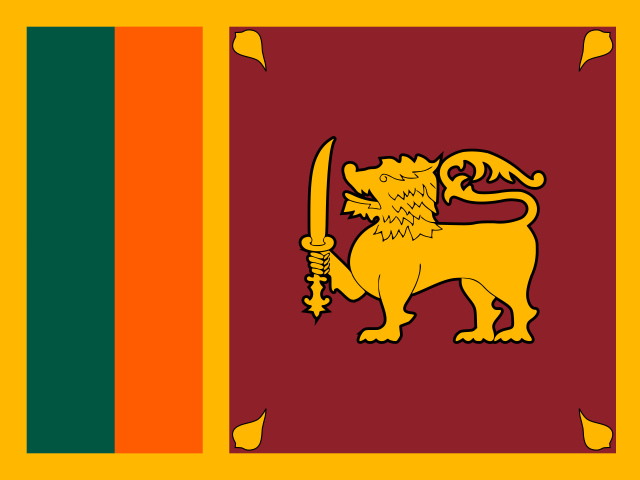
Sri Lanka's flag is one of the most detailed in Asia. A golden lion holding a sword stands on a dark red (maroon) field, with four bo-leaves in the corners. To the left of the lion panel are two vertical stripes, green and orange, representing the Muslim and Tamil communities. The whole design has a yellow border.
The lion makes it unmistakable in the Flags quiz. No other flag combines a lion with a sword on red beside green and orange stripes.
A short history of Sri Lanka
According to the Mahavamsa, a chronicle written by Buddhist monks, the Sinhalese trace their origin to Prince Vijaya, who is said to have sailed from northern India in the 500s BC. Buddhism arrived in the 200s BC, brought by Mahinda, a son of the Indian emperor Ashoka. The first great kingdom grew up at Anuradhapura in the dry north, where kings built vast reservoirs, called tanks, to store monsoon rain for rice fields, and huge brick stupas that were among the tallest buildings in the ancient world. A cutting from the tree under which the Buddha gained enlightenment was planted there and is still revered.
Invasions from South India, especially by the Chola empire around 1000 AD, led the kings to move their capital to Polonnaruwa. Tamil communities settled in the north and east, and a Tamil kingdom based at Jaffna existed by the 1200s. The old irrigation systems gradually broke down, and the centre of Sinhalese power drifted south-west, to Kotte and later the hill kingdom of Kandy.
From 1505 Europeans arrived, drawn by cinnamon. The Portuguese took the coastal lands and spread Catholicism, and the Dutch drove them out in the mid-1600s. Britain seized the coast in 1796 and, in 1815, conquered Kandy, bringing the whole island under one ruler for the first time in centuries. The British cleared hillsides for coffee and then tea, bringing in workers from southern India whose descendants, the Hill Country Tamils, still live on the estates.
Ceylon became independent peacefully in 1948. In 1960 Sirimavo Bandaranaike became the world's first woman prime minister. But tension grew between the Sinhalese majority and the Tamil minority, especially after a 1956 law made Sinhala the sole official language. From 1983 the country was torn by a civil war between the government and the Liberation Tigers of Tamil Eelam, who wanted a separate state in the north and east. The war ended with the defeat of the Tigers in 2009, at a heavy cost in civilian lives, and questions about accountability remain. The 2004 Indian Ocean tsunami also killed tens of thousands, and an economic crisis in 2022 led to mass protests.
Today Sri Lanka's economy rests on tea, clothing exports, tourism and money sent home by workers abroad.
Culture and daily life in Sri Lanka
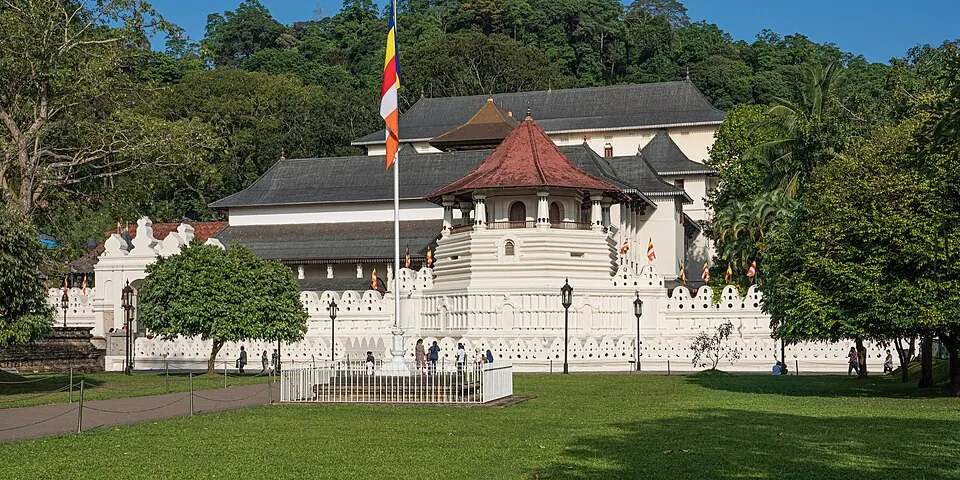
Sinhala and Tamil are both official languages, and English links the two communities in business. Sinhala has its own rounded script, descended from the ancient Brahmi writing of India. About seven in ten people are Theravada Buddhists, most of them Sinhalese; Hindus are mainly Tamil, and there are significant Muslim and Christian minorities. The Temple of the Tooth in Kandy, which holds a relic of the Buddha, is the country's most sacred Buddhist site.
The island's art includes the painted women on the rock at Sigiriya, the cave temples of Dambulla and the restored ruins of Polonnaruwa. Geoffrey Bawa, the architect behind "tropical modernism", designed buildings that blur the line between indoors and out, including the parliament complex at Kotte. Kandyan dancers, with their drums and silver headdresses, perform at festivals and weddings.
Cricket is close to a religion. Sri Lanka won the World Cup in 1996, and Muttiah Muralitharan took more Test wickets than any other bowler in history. Michael Ondaatje, born in Colombo, wrote The English Patient, which won the Booker Prize.
Five facts worth knowing
- Sri Lanka was known as Ceylon until 1972, and the name is still used for its tea, one of the country's biggest exports.
- The island has two capitals: Colombo for commerce and Sri Jayawardenepura Kotte for parliament. Quiz sites usually accept Kotte as the official capital.
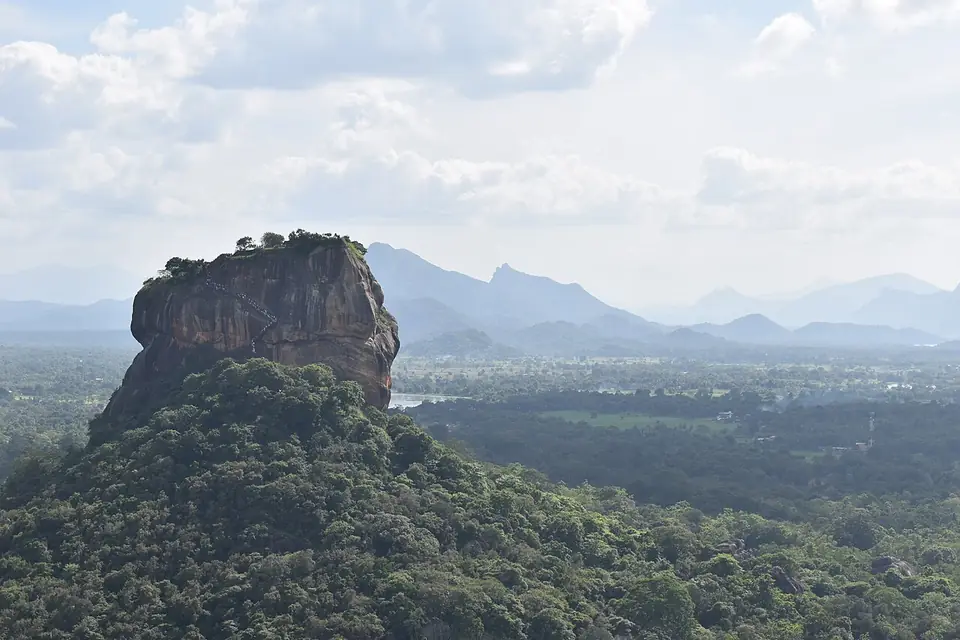
- Sigiriya, the Lion Rock, is a fortress built on top of a 200-metre rock column in the fifth century and is a UNESCO World Heritage Site.
- Adam's Peak is sacred to Buddhists, Hindus, Muslims and Christians alike, and thousands climb it each year to see the footprint-shaped mark at the summit.
- Sri Lanka is one of the best places in the world to see wild elephants and leopards, with Yala National Park famous for leopard density.
Culture and traditions in Sri Lanka
- Saying hello
"Ayubowan" (may you live long), said with palms pressed together and a slight bow.
- Food and drink
Rice and curry with many small side dishes; hoppers, bowl-shaped rice-flour pancakes; Ceylon tea.
- Festivals and traditions
Sinhala and Tamil New Year in mid-April; the Esala Perahera in Kandy (July/August) with decorated elephants.
- Everyday life
Shoes and hats come off at temples, and shoulders and knees should be covered. A side-to-side head wobble often means yes.
- Did you know?
Tea was first planted commercially in Sri Lanka in 1867, and the country is now one of the world's largest tea exporters.
Common mistakes
- Answering "Colombo" in the Capitals quiz when the official capital is Sri Jayawardenepura Kotte.
- Tapping the Maldives in the ocean to the south-west.
- Placing the island on the wrong side of India's tip – it sits to the south-east, not south-west.
Practise with Sri Lanka
- Central & South Asia quiz – the teardrop below India, with the Maldives further out for comparison.
- Asia quiz – once you've found India, Sri Lanka is the island at its tip.
- Asia flags – the lion with the sword is a quick win.
- Asia capitals quiz – Sri Jayawardenepura Kotte; practise the spelling.
- Indian States – learn Tamil Nadu and you'll always know where Sri Lanka sits.
Quick check: how well do you know Sri Lanka?
3 questions, no sign-up. Tap an answer.
1. Which flag belongs to Sri Lanka?
That's the flag of Sri Lanka.
2. What is the capital of Sri Lanka?
The capital of Sri Lanka is Sri Jayawardenepura Kotte.
3. Which is bigger by area?
Sri Lanka (65,610 km²) is bigger than Israel (20,770 km²).
Keep going on the Asia quiz – Sri Lanka is one of 48 countries there.
More ways to practise: find Sri Lanka on the blank map with no borders (hard mode), or play today's Globe and the other daily puzzles.
Frequently asked questions about Sri Lanka
What language is spoken in Sri Lanka?
Sinhala and Tamil are the two official languages. Sinhala is spoken by the majority, while Tamil is the main language in the north and east and among Muslim communities. English is widely used in business, government and higher education and acts as a link language.
What currency does Sri Lanka use?
Sri Lanka uses the Sri Lankan rupee, code LKR, divided into 100 cents. Its value fell sharply during the economic crisis of 2022, when the country ran short of foreign currency for fuel and food imports.
What time zone is Sri Lanka in?
Sri Lanka uses UTC+5:30, the same as India. It has no daylight saving time. The country briefly changed to other offsets in 1996 and 2006 before returning to UTC+5:30.
Which side of the road do they drive on in Sri Lanka?
Sri Lanka drives on the left, a legacy of British rule, like India. Three-wheeled tuk-tuks are a common sight, and the scenic hill-country railway from Kandy to Ella is popular with visitors.
What is the highest point in Sri Lanka?
Pidurutalagala, near Nuwara Eliya in the central highlands, is the highest point at about 2,524 metres. Adam's Peak, the famous pilgrimage mountain, is lower, at around 2,243 metres.
What is Ceylon tea?
Ceylon tea is the name still used for tea grown in Sri Lanka. Plantations were laid out across the central hills in the late 1800s after a fungus destroyed the island's coffee crops. Sri Lanka is now one of the world's largest tea exporters.
Quizzes with Sri Lanka
Guides that help with this
- Oceans, seas, rivers and mountainsThe physical map: seas around each continent, the big rivers and ranges.
- Flags that look alike (and how to tell them apart)Chad or Romania? Australia or New Zealand? The flag pairs that cost quiz points.
- The 25 hardest countries to find on a mapPacific islands, Caribbean islands and landlocked Africa – where they are.