Name all 32 world peaks
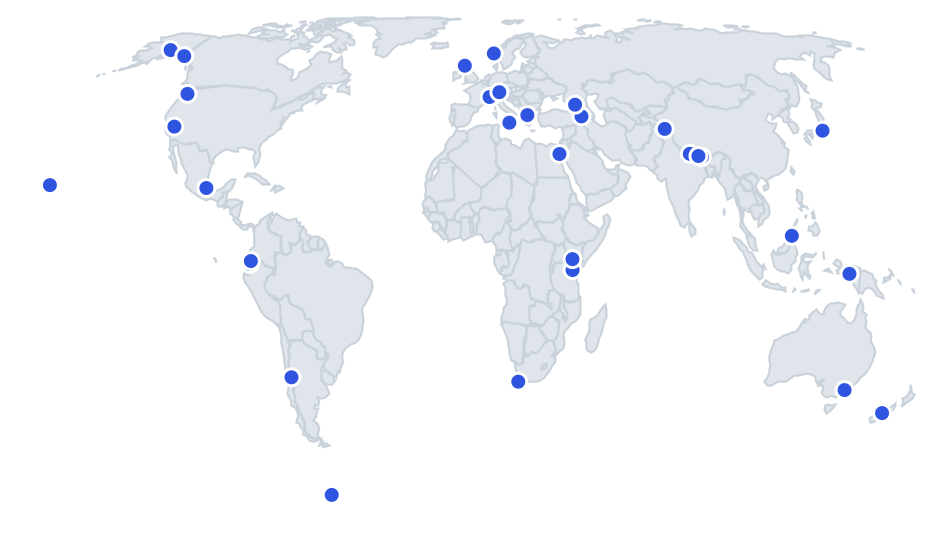
No map hints and no multiple choice: just type every one you can remember. Each correct answer lights up on the map, and the clock keeps running until you give up or get all 32.
Top scores
- The five fastest 100% rounds on this quiz.
Finish with 100% and post your time to get on the board – here or in full screen. All leaderboards
Your next quiz
 Oceans & seas quiz40 oceans & seas
 Lakes quiz39 lakes
 World Rivers quiz41 rivers
What's on this map
Thirty-two peaks to type from memory. The list mixes the seven summits, the highest point on each continent, with the giants of the Himalaya and a handful of famous national peaks. The seven summits are Everest (Asia), Aconcagua (South America), Denali (North America), Kilimanjaro (Africa), Elbrus (Europe), Vinson Massif (Antarctica) and either Puncak Jaya or Mount Kosciuszko for Australia and Oceania; both are on the list, so you get both.
Many of the names carry history. Everest was named in 1865 after George Everest, a former Surveyor General of India; in Nepal the mountain is Sagarmatha and in Tibet Chomolungma. K2 is simply the survey label for the second peak measured in the Karakoram. Denali, "the high one" in the Koyukon language, was officially Mount McKinley from 1917 until 2015; the US federal government restored the McKinley name in 2025, while Alaska still uses Denali. Aoraki / Mount Cook carries a dual Māori and English name. Kosciuszko was named by the explorer Paweł Strzelecki after the Polish-Lithuanian hero Tadeusz Kościuszko.
The places people miss
- Galdhøpiggen – Norway's highest peak at 2,469 m. The ø and the double g trip people up.
- Kangchenjunga – the third highest mountain in the world, on the Nepal–India border. The name is usually translated as "five treasures of the snow".
- Zugspitze – Germany's highest peak, on the Austrian border.
- Mount Sinai and Table Mountain – both famous but not high; people forget them because they think only of tall mountains.
- Mauna Kea – measured from its base on the ocean floor, over 10,000 m tall, taller than Everest. Above sea level it reaches 4,207 m.
- Chimborazo – because the Earth bulges at the equator, its summit is the point on the surface farthest from the Earth's centre.
How to learn it
- Start with the seven summits as a block.
- Then add the four Asian giants: Everest, K2, Kangchenjunga, Annapurna. K2 is strictly in the Karakoram, not the Himalaya.
- Sweep Europe: Mont Blanc, Matterhorn, Zugspitze, Ben Nevis, Galdhøpiggen, Olympus, Etna.
- Finish with the volcanoes of the Pacific (Fuji, Rainier, Mauna Kea) and the Andes (Chimborazo, Cotopaxi).
- Then mop up the six most often left out: Mount Logan, Mount Whitney, Pico de Orizaba, Mount Kenya, Mount Ararat and Mount Kinabalu.
Guides that help with this
- Oceans, seas, rivers and mountainsThe physical map: seas around each continent, the big rivers and ranges.
- Why you forget countries – and how spaced repetition fixes itThe forgetting curve, and how the Mistake Bank and flashcards use it.
- Flags that look alike (and how to tell them apart)Chad or Romania? Australia or New Zealand? The flag pairs that cost quiz points.
How it works
Type a name and press enter. Spelling is forgiving: accents, capital letters and common alternative names are all accepted. When you stop, the ones you missed are shown on the map so you know which to practise next time.
Most people get well under half on the first try. Play the map quiz a few times first, then come back and see how many you can name.
Answer list (32 peaks)
Show all 32 answers (spoilers)
- Aconcagua
- Annapurna
- Aoraki / Mount Cook
- Ben Nevis
- Chimborazo
- Cotopaxi
- Denali
- Galdhøpiggen
- K2
- Kangchenjunga
- Kilimanjaro
- Matterhorn
- Mauna Kea
- Mont Blanc
- Mount Ararat
- Mount Elbrus
- Mount Etna
- Mount Everest
- Mount Fuji
- Mount Kenya
- Mount Kinabalu
- Mount Kosciuszko
- Mount Logan
- Mount Olympus
- Mount Rainier
- Mount Sinai
- Mount Whitney
- Pico de Orizaba
- Puncak Jaya
- Table Mountain
- Vinson Massif
- Zugspitze