Australia
Capital: Canberra. Australia is one of the 14 countries in the Oceania quiz.
Quick answers: What is the capital of Australia? · Which countries border Australia?
Facts about Australia
- CapitalCanberra
- Population27.6 million
- Area7,692,024 km²
- RegionOceania
- LanguageEnglish
- CurrencyAustralian dollar (AUD)
Australia is the most populous of the 14 countries in Oceania and the largest by area. Worldwide it ranks 55th by population and 6th by area.
Where is Australia?
Australia is a country, a continent and an island all at once. It lies in the Southern Hemisphere between the Indian Ocean to the west and the Pacific to the east, south of the islands of Indonesia and Papua New Guinea. New Zealand is about 2,000 km to the south-east across the Tasman Sea. Antarctica is the next land to the south. Australia has no land borders with anyone. Canberra, the capital, is inland in the south-east, between Sydney and Melbourne – the two bigger cities it was built to keep the peace between.
The island of Tasmania, off the south-east corner, is an Australian state and part of the outline.
How to find Australia on the map
- Start from Indonesia. The chain of islands below Southeast Asia leads south-east to the big landmass on its own. That's Australia.
- Look for the lone continent. No other country fills an entire continent, so Australia is the large, isolated block at the bottom right of a standard world map.
- Don't confuse it with New Zealand. New Zealand is two narrow islands well to the south-east; Australia is roughly 30 times larger.
- Tasmania counts. The triangular island below the south-east coast is part of Australia.
Flag
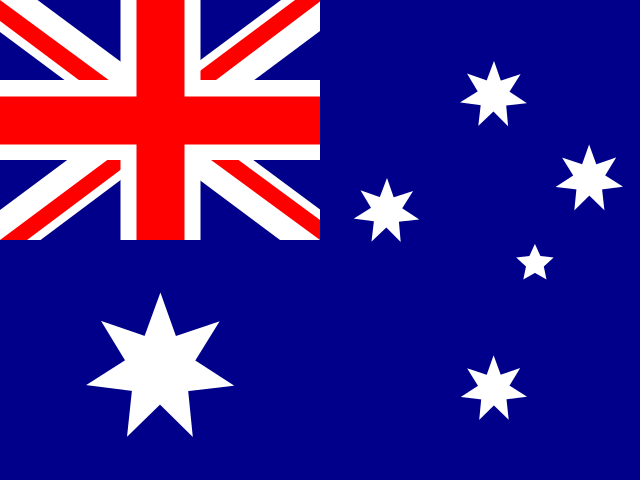
A blue ensign with the Union Jack in the upper hoist, a large seven-pointed Commonwealth Star beneath it, and the five stars of the Southern Cross on the fly. The seven points stand for the six states and the territories.
New Zealand's flag is the one you will confuse it with. Both are blue with the Union Jack and the Southern Cross, but New Zealand has only four stars, they are red with white borders, and there is no big star under the Union Jack. Count the stars: six white stars means Australia, four red stars means New Zealand.
A short history of Australia
People reached Australia by sea from South-East Asia at least 50,000 years ago, at a time when lower sea levels joined the mainland to New Guinea and Tasmania. Over thousands of generations they formed hundreds of distinct nations, each with its own language, laws and deep connection to particular land, managed partly through skilled use of fire.
Dutch sailors charted parts of the west and north coasts in the 1600s and called the land New Holland, and Abel Tasman reached Tasmania in 1642. In 1770 James Cook sailed up the east coast and claimed it for Britain. The First Fleet arrived at Sydney Cove in January 1788 to set up a penal colony. Over the next eighty years Britain sent around 160,000 convicts. As settlers spread inland, frontier violence and introduced diseases devastated Aboriginal communities.
Gold rushes in the 1850s, especially in Victoria, brought a flood of new arrivals and made Melbourne one of the richest cities in the world. The six separate colonies united as the Commonwealth of Australia on 1 January 1901, and their borders became today's states. The new nation restricted non-European immigration under the White Australia policy, which was not fully dismantled until the 1970s.
The landing at Gallipoli in 1915 became a defining memory of the First World War. In the Second World War, Japanese aircraft bombed Darwin in 1942, and Australia turned towards the United States as its main ally. After the war, a large immigration programme brought people from Britain, Italy, Greece and later Asia. In 1967 a referendum allowed Aboriginal people to be counted in the census, and the 1992 Mabo case recognised native title to land. A referendum to become a republic failed in 1999.
Australia today is prosperous, with an economy built on services and on exports of iron ore, coal, gas and farm goods, much of it to Asia.
Culture and daily life in Australia
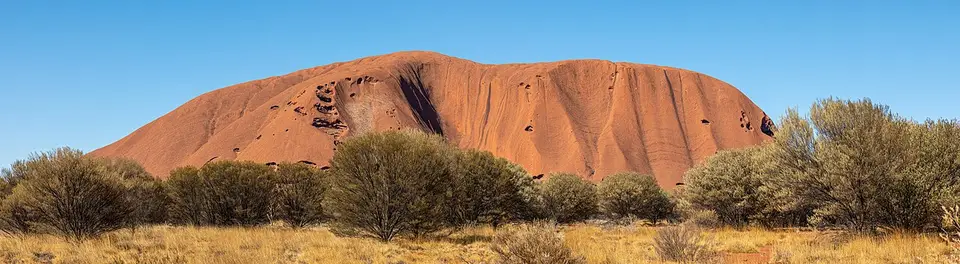
English is the national language, spoken with a distinctive accent and a love of shortened words like "arvo" for afternoon. Hundreds of Aboriginal place names, from Uluru to Wollongong, survive on the map, and many Aboriginal languages are still spoken. A large share of Australians were born overseas, which shows in the food and festivals of every big city. Christianity is the largest religion, but more and more people say they have none.
Sport is close to a religion. Cricket's greatest batsman, Don Bradman, was Australian, and Australian rules football, with its oval field and high marks, draws huge crowds. The Melbourne Cup horse race is known as "the race that stops a nation", and the Australian Open opens the tennis year.
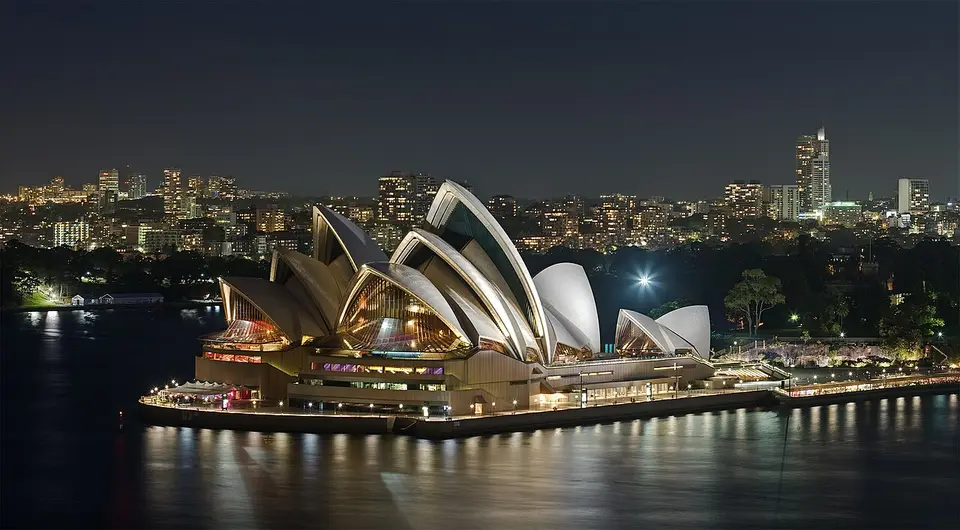
The Sydney Opera House, designed by the Danish architect Jørn Utzon, is the country's best-known building. Banjo Paterson wrote "Waltzing Matilda", the unofficial anthem, and Patrick White won the Nobel Prize in Literature in 1973. Aboriginal art, from Albert Namatjira's watercolours to the dot paintings that began at Papunya in the 1970s, is admired worldwide. Beach life, with volunteer surf lifesavers in red and yellow, is part of the national image.
Five facts worth knowing
- Australia is the sixth-largest country in the world and the only one to cover a whole continent.
- It has six states and two mainland territories – New South Wales, Victoria, Queensland, South Australia, Western Australia, Tasmania, plus the Northern Territory and the Australian Capital Territory. They have their own quiz.
- Canberra was purpose-built as the capital, chosen in 1908 as a compromise between Sydney and Melbourne. Parliament moved there in 1927.
- The Great Barrier Reef, off the Queensland coast, is the largest coral reef system in the world and stretches more than 2,000 km.
- Most of the population lives on the edge. The interior – the Outback – is mostly desert and semi-desert, so the big cities are all on the coast.
Culture and traditions in Australia
- Saying hello
A casual "G'day" or "Hi, how are you going?" with a handshake.
- Food and drink
Meat pies, Vegemite on toast and lamingtons (sponge squares in chocolate and coconut).
- Festivals and traditions
ANZAC Day on 25 April; Sydney's New Year's Eve fireworks over the Harbour Bridge.
- Everyday life
Tipping is not expected, many restaurants are BYO (bring your own wine), and friends take turns buying a round, a "shout".
- Did you know?
Aboriginal and Torres Strait Islander cultures are among the oldest continuous cultures on Earth, going back tens of thousands of years.
Common mistakes
- Typing "Sydney" in the Capitals quiz. The capital is Canberra.
- Tapping New Zealand when the quiz zooms out and both appear.
- Picking the New Zealand flag – count the stars.
- Tapping Papua New Guinea; the big island above Australia is not Australian.
Practise with Australia
- Oceania quiz – Australia is the easy one; the Pacific island nations around it are the challenge.
- Australian States – six states and two territories.
- Oceania flags – Australia versus New Zealand, plus the other Union Jack flags of Fiji and Tuvalu.
- Oceania capitals quiz – Canberra, not Sydney.
- Mystery Country – the outline with the Gulf of Carpentaria notch in the north and Tasmania hanging below is unmistakable.
Quick check: how well do you know Australia?
3 questions, no sign-up. Tap an answer.
1. Which flag belongs to Australia?
That's the flag of Australia.
2. What is the capital of Australia?
The capital of Australia is Canberra.
3. Which is bigger by area?
Australia (7,692,024 km²) is bigger than the Solomon Islands (28,896 km²).
Keep going on the Oceania quiz – Australia is one of 14 countries there.
More ways to practise: find Australia on the blank map with no borders (hard mode), or play today's Globe and the other daily puzzles.
Frequently asked questions about Australia
What language is spoken in Australia?
English is the national language and is spoken by almost everyone, although Australia has no official language in law. More than a hundred Aboriginal and Torres Strait Islander languages are still spoken, and immigration has made Mandarin, Arabic and Vietnamese common in the cities.
What currency does Australia use?
Australia uses the Australian dollar (AUD), introduced in 1966 to replace the pound. It is also the currency of Kiribati, Nauru and Tuvalu, and Australia was the first country to issue a full set of polymer banknotes, completed in 1996.
What time zone is Australia in?
Mainland Australia has three standard time zones: UTC+8 in the west, UTC+9:30 in the centre and UTC+10 in the east. New South Wales, Victoria, Tasmania, South Australia and the ACT use daylight saving time in summer, while Queensland, Western Australia and the Northern Territory do not.
Which side of the road do they drive on in Australia?
Australians drive on the left, a legacy of British settlement. The road between Sydney and Melbourne, the Hume Highway, is one of the busiest long-distance routes in the country.
What is the highest point in Australia?
The highest point on the mainland is Mount Kosciuszko, about 2,228 metres, in the Snowy Mountains of New South Wales. Mawson Peak, about 2,745 metres, on the remote Australian territory of Heard Island in the Southern Ocean, is higher.
Why is Australia called Australia?
The name comes from the Latin australis, "southern", after Terra Australis, the unknown southern land of old maps. The navigator Matthew Flinders, the first to sail around the continent, popularised the name in the early 1800s.
Quizzes with Australia
Often confused with
Guides that help with this
- The 25 hardest countries to find on a mapPacific islands, Caribbean islands and landlocked Africa – where they are.
- Flags that look alike (and how to tell them apart)Chad or Romania? Australia or New Zealand? The flag pairs that cost quiz points.
- Learn all 197 countries in 30 daysA day-by-day plan: one region at a time, spaced repetition for review.