Bahamas
Capital: Nassau. The Bahamas is one of the 23 countries in the North America quiz.
Quick answers: What is the capital of the Bahamas? · Which countries border the Bahamas?
Facts about the Bahamas
- CapitalNassau
- Population403,033
- Area13,943 km²
- RegionsNorth America, The Caribbean
- LanguageEnglish
- CurrencyBahamian dollar (BSD)
The Bahamas is the 16th most populous of the 23 countries in North America and the 14th largest by area. Worldwide it ranks 173rd by population and 156th by area.
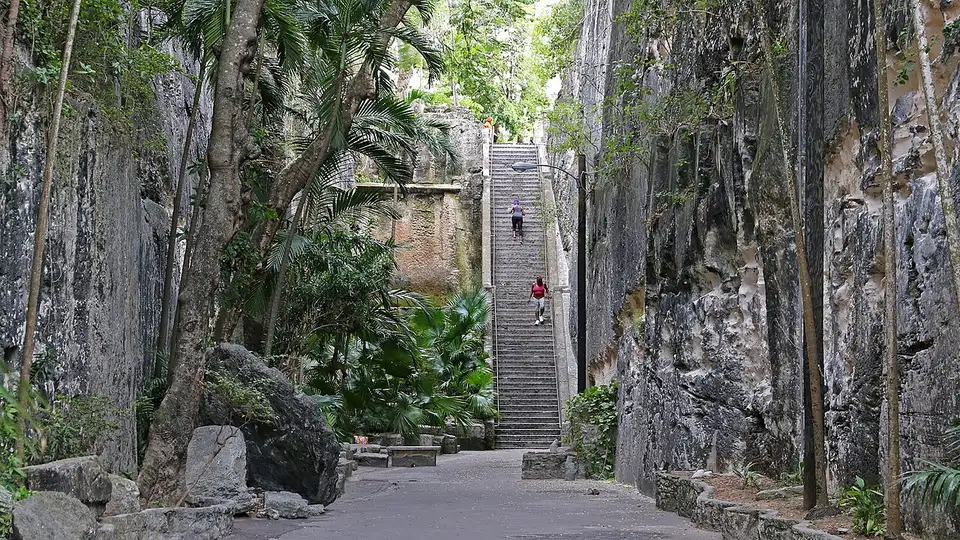
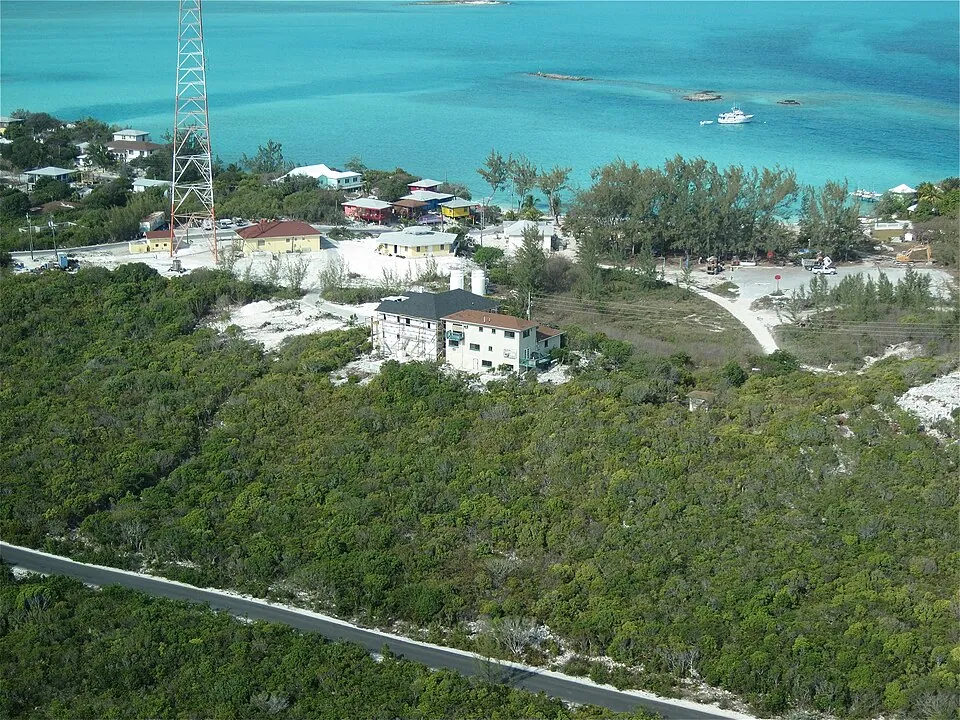
Where is the Bahamas?
The Bahamas is a chain of around 700 islands and cays in the Atlantic Ocean, starting just off Florida and stretching south-east towards Cuba and Hispaniola. Only about 30 are inhabited. The capital, Nassau, is on New Providence, a small island near the centre of the chain where most people live. Technically the Bahamas is in the Atlantic, not the Caribbean Sea, though it is always grouped with the Caribbean.
On a world map, find Florida and look east and south-east. The scatter of islands between Florida and Cuba is the Bahamas.
How to find the Bahamas on the map
- Start from Florida. The nearest Bahamian island, Bimini, is only about 80 km from Miami.
- Look for a scatter, not a single shape. Unlike Cuba or Jamaica, the Bahamas is a spray of small islands running diagonally from north-west to south-east.
- It's north of Cuba. The chain runs along the top of Cuba.
- Don't confuse it with the Turks and Caicos, a British territory at the south-eastern end of the same chain.
Flag
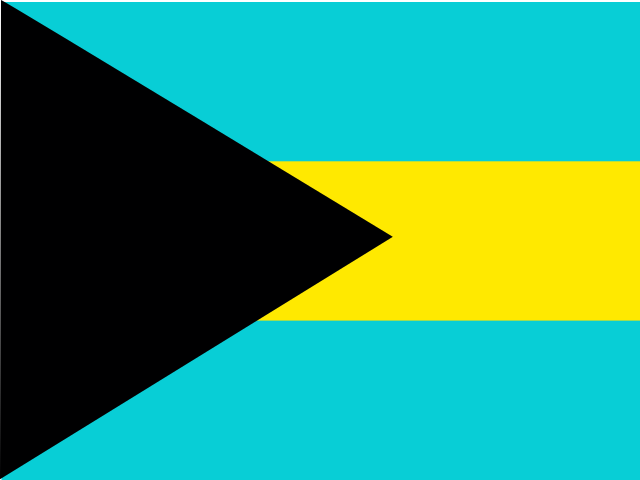
The flag has three horizontal bands – aquamarine, gold and aquamarine – with a black triangle at the hoist. Aquamarine stands for the sea, gold for sunshine and sand, and the black triangle for the strength and unity of the people. It was adopted at independence in 1973.
In the Flags quiz, a black triangle on blue-gold-blue is easy to recognise. St Lucia's flag also has a triangle, but it sits in the centre of a plain blue field.
A short history of the Bahamas
The first known inhabitants of the Bahamas were the Lucayans, a Taíno people who arrived from the Greater Antilles around the 8th century or later. They fished, grew cassava and paddled between the islands in dugout canoes. Within about thirty years of Spanish contact, almost all of them had been carried off as forced labour to Hispaniola and Cuba or had died from disease. The islands were left nearly empty, and the name probably comes from the Spanish baja mar, "shallow sea".
English settlers known as the Eleutheran Adventurers came from Bermuda in 1648, seeking religious freedom, and gave Eleuthera its name. Nassau, first called Charles Town, grew on New Providence. By the early 1700s it had become a pirate haven, home to men such as Blackbeard. Britain sent Governor Woodes Rogers, himself a former privateer, who cleared out the pirates in 1718, and the colony's motto became "Pirates expelled, commerce restored".
After the American Revolution, thousands of Loyalists moved to the Bahamas with the people they enslaved and tried to grow cotton. Poor soils made the plantations fail, and slavery ended across the British Empire in 1834. Ships carrying enslaved people that were wrecked or diverted here sometimes saw the captives freed on Bahamian soil.
The islands' closeness to the United States brought repeated booms. Blockade runners supplied the Confederacy during the American Civil War, and rum runners did a roaring trade during US Prohibition in the 1920s. Tourism took off after the Second World War, especially once the United States cut ties with Cuba. A small white elite, the "Bay Street Boys", long dominated politics until the Progressive Liberal Party under Lynden Pindling won power in 1967, giving the Black majority control of government for the first time.
Today the Bahamas has one of the highest incomes in the Caribbean. Because it lies so low, rising seas and stronger hurricanes are serious concerns.
Culture and daily life in the Bahamas
English is the official language, and most Bahamians also speak a local Creole full of West African influence. Life revolves around the church, with Baptists, Anglicans and Catholics the largest groups. Junkanoo, the street parade held on Boxing Day and New Year's Day with cowbells, drums and costumes made of crêpe paper, is the high point of the year. The best-known local music is goombay, played on goatskin drums, and the band The Baha Men had a worldwide hit with "Who Let the Dogs Out" in 2000.
The islands have a strong craft tradition. Straw work, plaiting palm leaves into hats, bags and baskets, has been passed down for generations and fills Nassau's famous straw market. On the Out Islands, the regattas of wooden sailing sloops are proud community events. Sidney Poitier, raised on Cat Island, became the first Black man to win the Oscar for best actor.
Bahamians excel at sprinting. Shaunae Miller-Uibo won two Olympic gold medals in the 400 metres, the women's 4 × 100 metres relay team, the "Golden Girls", took gold in Sydney in 2000, and the men's 4 × 400 metres team, the "Golden Knights", won in London in 2012. The pink sands of Harbour Island and the swimming pigs of the Exumas are favourite sights for visitors.
Five facts worth knowing
- The Bahamas became independent from the United Kingdom in 1973 and the British monarch remains head of state.
- Christopher Columbus's first landfall in the Americas in 1492 is traditionally placed on San Salvador in the Bahamas.
- Grand Bahama and Abaco were devastated by Hurricane Dorian in 2019, one of the strongest Atlantic hurricanes on record.
- Tourism and offshore finance dominate the economy.
- The pale turquoise shallows of the Bahama Banks are easily visible from space.
Culture and traditions in the Bahamas
- Saying hello
A friendly "Good morning" or "Good afternoon" is expected when entering a shop or starting a chat.
- Food and drink
Conch fritters and fresh conch salad, often with a side of peas and rice.
- Festivals and traditions
Junkanoo street parades on 26 December (Boxing Day) and 1 January, with costumes, cowbells and drums.
- Everyday life
Life follows a relaxed "island time" pace, and a 15% gratuity is often added to restaurant bills.
- Did you know?
In rake-and-scrape music, a carpenter's handsaw is played as an instrument by scraping it with a screwdriver.
Common mistakes
- Tapping Cuba, the big island just south of the chain.
- Tapping the Turks and Caicos Islands at the south-eastern end.
- Tapping only one island when the quiz expects the whole chain – aim for the middle of the scatter.
Practise with the Bahamas
- Caribbean quiz – the island chain running from Florida towards Cuba.
- North America quiz – the scatter of islands east of Florida.
- North America flags – blue, gold, blue with a black triangle.
- North America capitals quiz – Nassau.
- Mystery Country – a diagonal spray of islands rather than a solid outline.
Quick check: how well do you know the Bahamas?
3 questions, no sign-up. Tap an answer.
1. Which flag belongs to the Bahamas?
That's the flag of the Bahamas.
2. What is the capital of the Bahamas?
The capital of the Bahamas is Nassau.
3. Which is bigger by area?
Panama (75,417 km²) is bigger than the Bahamas (13,943 km²).
Keep going on the North America quiz – Bahamas is one of 23 countries there.
More ways to practise: find the Bahamas on the blank map with no borders (hard mode), or play today's Globe and the other daily puzzles.
Frequently asked questions about the Bahamas
What language is spoken in the Bahamas?
English is the official language. Many Bahamians speak Bahamian Creole, an English-based creole, in daily life, and Haitian Creole is widely spoken by the large community of Haitian origin.
What currency does the Bahamas use?
The Bahamas uses the Bahamian dollar (BSD), which is pegged one-to-one to the US dollar. US dollars are accepted almost everywhere alongside the local currency, and the Bahamas once issued a famous three-dollar note.
What time zone is the Bahamas in?
The Bahamas is on Eastern Standard Time, UTC−5, and moves to UTC−4 for daylight saving time in summer, following the same dates as the United States.
Which side of the road do they drive on in the Bahamas?
Bahamians drive on the left, a legacy of British rule. Because many cars are imported from the United States, a lot of them have the steering wheel on the left, which is unusual for a left-driving country.
What is the highest point in the Bahamas?
The highest point is Mount Alvernia, only about 63 metres, on Cat Island. It is topped by a small hermitage built by a priest-architect in the 1930s. The low limestone islands make the Bahamas one of the flattest countries in the world.
How many islands are in the Bahamas?
The Bahamas is made up of about 700 islands and more than 2,000 cays and rocks, stretching for hundreds of kilometres across the Atlantic. Only around 30 of the islands are inhabited, and most people live on New Providence.
Quizzes with the Bahamas
Guides that help with this
- The 25 hardest countries to find on a mapPacific islands, Caribbean islands and landlocked Africa – where they are.
- All 50 US states on the map, region by regionThe ordering tricks that make the states stick.
- Flags that look alike (and how to tell them apart)Chad or Romania? Australia or New Zealand? The flag pairs that cost quiz points.