Barbados
Capital: Bridgetown. Barbados is one of the 23 countries in the North America quiz.
Quick answers: What is the capital of Barbados? · Which countries border Barbados?
Facts about Barbados
- CapitalBridgetown
- Population282,623
- Area430 km²
- RegionsNorth America, The Caribbean
- LanguageEnglish
- CurrencyBarbadian dollar (BBD)
Barbados is the 17th most populous of the 23 countries in North America and the 20th largest by area. Worldwide it ranks 176th by population and 185th by area.
Where is Barbados?
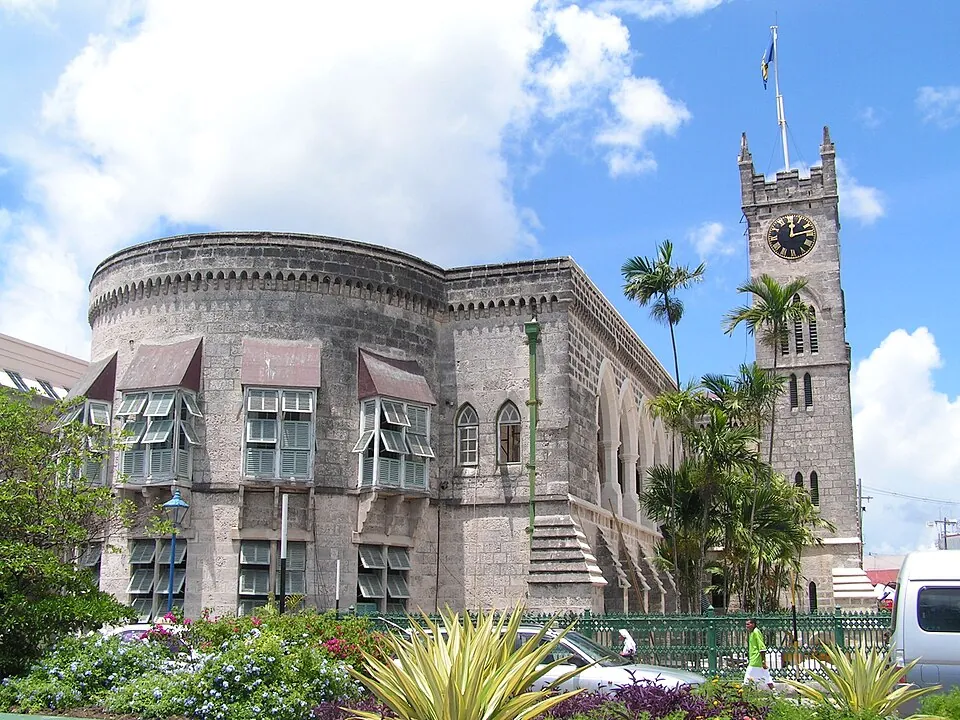
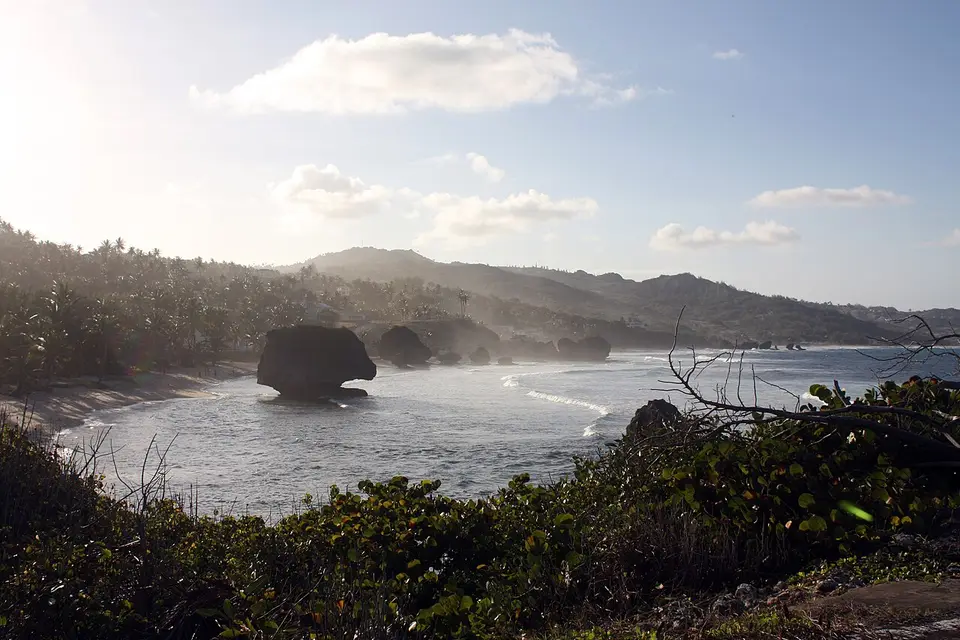
Barbados is a small island country at the eastern edge of the Caribbean. It sits apart from the main arc of islands, about 150 km east of St Vincent and the Grenadines, out in the Atlantic. It is roughly 34 km long and 23 km wide. The capital, Bridgetown, is on the sheltered south-west coast.
On a world map, follow the chain of islands from Puerto Rico down towards Trinidad. Barbados is the lone island to the right of that chain, further out in the Atlantic than any other Caribbean country.
How to find Barbados on the map
- Start from the Windward Islands. Find St Lucia and St Vincent, then look east – Barbados is the island off on its own.
- It's the easternmost. No Caribbean country is further east.
- Look north-east of Trinidad and Tobago.
- Don't confuse it with St Lucia or St Vincent, which are in the main volcanic arc; Barbados is the flatter island outside it.
Flag
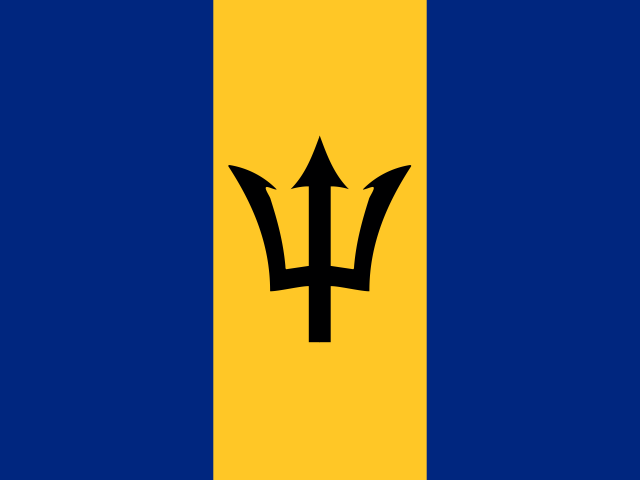
Barbados has a vertical tricolour of ultramarine blue, gold and ultramarine blue, with a black trident head in the centre of the gold band. The blue bands represent the sea and the sky, the gold the sand. The trident is broken off from its shaft to symbolise the break from colonial rule – the full trident appeared on the colonial badge.
In the Flags quiz, the black trident is the giveaway. No other national flag has one.
A short history of Barbados
Amerindian peoples lived on Barbados for many centuries, but by the time the English arrived the island appears to have been empty. Portuguese sailors had passed by and are thought to have named it Os Barbados, "the bearded ones", perhaps after the hanging roots of its fig trees. English settlers landed at Holetown on the west coast and began growing tobacco and cotton.
The great change came in the 1640s, when planters switched to sugar. Barbados became the first English colony built on large sugar plantations worked by enslaved Africans, and the model it created spread to Jamaica, the Carolinas and beyond. For a time it was the richest colony in English America. Bridgetown grew into a busy port, and its historic centre and the Garrison area are now a UNESCO World Heritage Site. Barbados also gained one of the oldest elected assemblies in the Americas, dating from 1639.
In 1816 enslaved people rose up in what became known as Bussa's Rebellion, the largest revolt in the island's history. It was crushed, but Bussa is now a National Hero. Slavery ended across the British Empire in 1834, though planters kept control of most of the land and power for another century.
In 1937 riots over poverty and low wages swept the island, as they did across the British Caribbean. Out of them grew trade unions and new political parties. Grantley Adams led the push for reform, and Errol Barrow became the first prime minister when Barbados gained independence on 30 November 1966. Barbados then built one of the most stable democracies in the region, with strong public schools and health care.
Today tourism, financial services and rum drive the economy. The island has become a strong voice on climate finance for small island states.
Culture and daily life in Barbados
English is the official language, and Bajan, the local Creole, is spoken in daily life. "Bajan" is also what people from Barbados call themselves. The island is strongly Christian, with the Anglican Church historically dominant and many Pentecostal and other churches, and it is often said to have more churches than almost anywhere of its size.
The island's music runs from calypso and soca to the older tuk band, a fife-and-drum band that parades with costumed characters such as the Shaggy Bear. Writer George Lamming described growing up in colonial Barbados in In the Castle of My Skin, and poet Kamau Brathwaite was another major literary voice.
Cricket has produced a stream of greats, including Garfield Sobers, often called the finest all-rounder ever, and the three Ws, Worrell, Weekes and Walcott. Fish cakes and the fried snacks sold at the Oistins Friday-night fish fry are local favourites. Chattel houses, small wooden homes that could be taken apart and moved, still dot the countryside.
Five facts worth knowing
- Barbados became a republic in November 2021, replacing the British monarch as head of state while staying in the Commonwealth.
- It is a coral island, not a volcanic one, which is why it lies outside the main arc and is much flatter than its neighbours.
- Rihanna was born in Barbados and was named a National Hero of the country in 2021.
- Barbados was a British colony continuously from 1627 until independence in 1966 and is sometimes nicknamed "Little England".
- Rum has been made on the island since the 17th century; Mount Gay claims to be the world's oldest commercial rum brand.
Culture and traditions in Barbados
- Saying hello
A warm "Good morning" is expected before any conversation.
- Food and drink
Cou-cou and flying fish, the national dish: cornmeal and okra with steamed fish.
- Festivals and traditions
Crop Over, a summer festival that ends with Grand Kadooment Day on the first Monday of August.
- Everyday life
Cricket is a passion, and local rum shops are social hubs in every village.
- Did you know?
Mount Gay, founded in Barbados, is considered the world's oldest surviving rum brand, with records from 1703.
Common mistakes
- Tapping St Vincent or St Lucia, the nearest islands in the main chain.
- Tapping Trinidad, the larger island to the south-west.
- Looking for Barbados inside the Caribbean arc instead of out to the east.
Practise with Barbados
- Caribbean quiz – the island sitting alone east of the Windward Islands.
- North America quiz – tiny at continental scale; find the eastern edge of the Caribbean.
- North America flags – blue, gold, blue with a black trident.
- North America capitals quiz – Bridgetown.
- Mystery Country – a small pear-shaped outline that's easier to recognise than you'd expect.
Quick check: how well do you know Barbados?
3 questions, no sign-up. Tap an answer.
1. Which flag belongs to Barbados?
That's the flag of Barbados.
2. What is the capital of Barbados?
The capital of Barbados is Bridgetown.
3. Which is bigger by area?
Canada (9,984,670 km²) is bigger than Barbados (430 km²).
Keep going on the North America quiz – Barbados is one of 23 countries there.
More ways to practise: find Barbados on the blank map with no borders (hard mode), or play today's Globe and the other daily puzzles.
Frequently asked questions about Barbados
What language is spoken in Barbados?
English is the official language, used in government, schools and the media. In everyday life most Barbadians also speak Bajan, an English-based creole with West African influences and its own distinctive vocabulary and rhythm.
What currency does Barbados use?
Barbados uses the Barbados dollar (BBD), pegged to the US dollar at two to one since 1975. US dollars are widely accepted in shops and hotels, and Barbadian notes show national heroes.
What time zone is Barbados in?
Barbados is on Atlantic Standard Time, UTC−4, all year round and does not use daylight saving time. In winter it is one hour ahead of New York, and in summer the two share the same time.
Which side of the road do they drive on in Barbados?
Barbadians drive on the left, a legacy of more than three centuries of British rule. The island has a dense network of roads, and its many roundabouts follow the British pattern.
What is the highest point in Barbados?
The highest point is Mount Hillaby, about 340 metres, in the parish of St Andrew. Barbados is a coral island rather than a volcanic one, so it is much lower than most of its Caribbean neighbours.
Why is Barbados called Barbados?
The name is usually traced to Portuguese sailors, who called the island Os Barbados, "the bearded ones". The beards are thought to have been the hanging aerial roots of the island's fig trees, though some suggest breaking waves or bearded inhabitants.
Quizzes with Barbados
Guides that help with this
- The 25 hardest countries to find on a mapPacific islands, Caribbean islands and landlocked Africa – where they are.
- All 50 US states on the map, region by regionThe ordering tricks that make the states stick.
- Flags that look alike (and how to tell them apart)Chad or Romania? Australia or New Zealand? The flag pairs that cost quiz points.