Costa Rica
Capital: San José. Costa Rica is one of the 23 countries in the North America quiz.
Quick answers: What is the capital of Costa Rica? · Which countries border Costa Rica?
Facts about Costa Rica
- CapitalSan José
- Population5.2 million
- Area51,100 km²
- RegionsNorth America, Central America
- LanguageSpanish
- CurrencyCosta Rican colón (CRC)
Costa Rica is the 11th most populous of the 23 countries in North America and the 9th largest by area. Worldwide it ranks 126th by population and 126th by area.
Where is Costa Rica?
Costa Rica is in Central America, on the narrow land bridge between North and South America. Nicaragua lies to the north and Panama to the south-east. It has two coastlines: the Caribbean Sea to the east and the Pacific Ocean to the west. The capital, San José, is in the Central Valley, roughly in the middle of the country.
On a world map, follow the isthmus down from Mexico. Costa Rica is the second-last country before South America, just before Panama's S-shaped curve.
How to find Costa Rica on the map
- Start from Panama. Costa Rica is the country directly north-west of Panama.
- Find Nicaragua's big lake. Lake Nicaragua sits just above the border; Costa Rica is immediately south of it.
- Count from the top. Going south from Guatemala and Belize, Costa Rica is the sixth of the seven Central American countries.
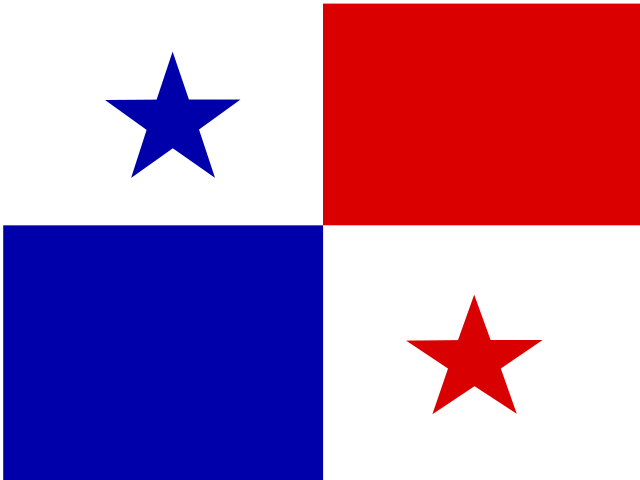
- Don't confuse it with Panama. Panama is the twisted strip that joins South America; Costa Rica is the chunkier country before it.
Flag
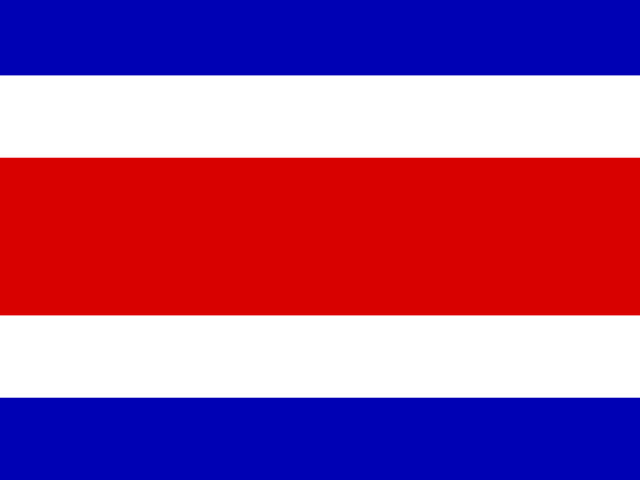
Costa Rica's flag has five horizontal stripes: blue, white, red, white, blue, with the central red stripe twice as wide as the others. The design was adopted in 1848 and was inspired by the colours of the French tricolour. The state version adds the coat of arms on the red stripe towards the hoist side.
In the Flags quiz, the flag to watch for is Thailand's, which has the same five-stripe pattern but with red on the outside and blue in the middle. Costa Rica is blue on the outside, red in the middle.
A short history of Costa Rica
Long before Europeans arrived, Costa Rica was a meeting point between the cultures of Mesoamerica to the north and the Chibcha-speaking peoples of the south. Groups such as the Huetar, Bribri and Chorotega farmed maize, worked gold and jade, and carved the mysterious stone spheres of the Diquís delta, some more than two metres across. The site of Guayabo, on the slopes of the Turrialba volcano, preserves roads, aqueducts and mounds from this era.
Christopher Columbus landed on the Caribbean coast in 1502, on his fourth voyage. Spanish settlement was slow, because there was little gold and few people to put to forced labour. The colonists who stayed moved up to the cooler Central Valley, founding Cartago in the 1560s, and lived mostly as small farmers. That pattern of modest landholdings, rather than huge estates, shaped the country's later politics.
Costa Rica became independent from Spain in 1821 along with the rest of Central America, briefly joining the Mexican Empire and then the Federal Republic of Central America before going its own way in the 1830s and 1840s. San José replaced Cartago as capital in 1823. In the 19th century coffee grown in the Central Valley became the main export, and a railway to the Caribbean port of Limón was built with the help of Jamaican workers. Bananas followed, and large plantations spread along both coasts.
In 1856 Costa Rican troops helped defeat the American adventurer William Walker, who had seized power in Nicaragua; the drummer boy Juan Santamaría became a national hero. The most important modern turning point came in 1948, when a short civil war followed a disputed election. The winners, led by José Figueres, wrote a new constitution, gave women the vote and nationalised the banks.
Since then Costa Rica has been one of the most stable democracies in Latin America. Its economy has moved from coffee and bananas towards tourism, medical devices and services, and it has built a reputation for conservation.
Culture and daily life in Costa Rica
Spanish is spoken almost everywhere, with a Costa Rican habit of using "usted" even among friends. On the Caribbean coast around Limón, many families descend from Jamaican railway workers, and an English-based creole, calypso music and rice and beans cooked in coconut milk set the region apart. Several Indigenous languages, including Bribri and Cabécar, survive in the southern mountains.
Most Costa Ricans are Roman Catholic, and the biggest religious event of the year is the pilgrimage to the Basilica of Our Lady of the Angels in Cartago, where hundreds of thousands walk through the night each August to honour the "Negrita", a small dark statue of the Virgin. Evangelical churches have grown fast in recent decades.
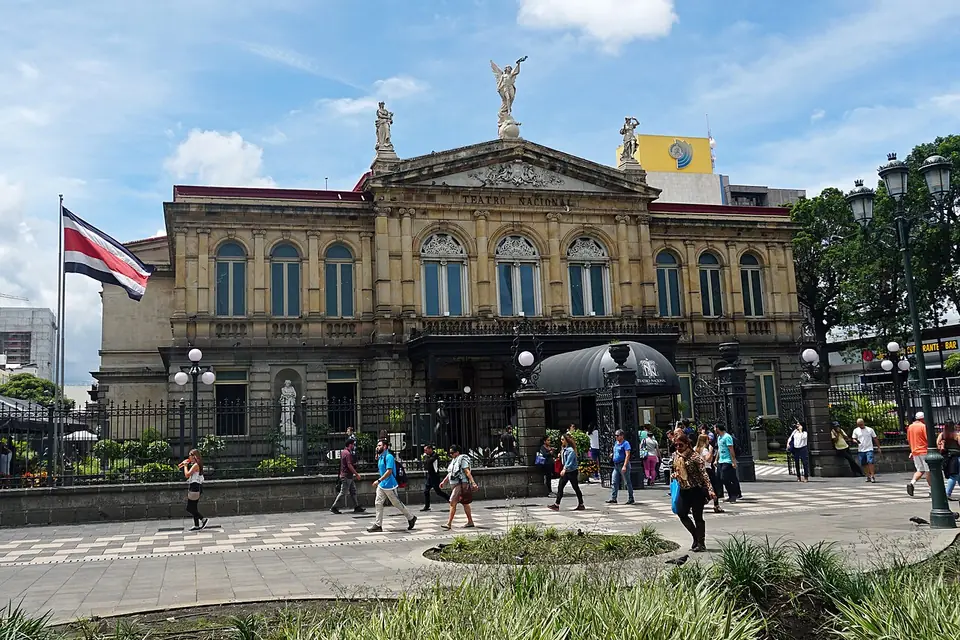
Football is the national sport, and the team's run to the quarter-finals of the 2014 World Cup, with goalkeeper Keylor Navas, is still remembered with pride. San José's National Theatre, opened in 1897 and paid for partly by a coffee tax, is its most celebrated building. The phrase "pura vida" serves as a greeting, a thank-you and a motto, and Costa Ricans call themselves "ticos" after their habit of adding the diminutive -tico to words.
Five facts worth knowing
- Costa Rica abolished its army in 1948 and has had no standing military since, spending the savings on education and health.
- It holds a large share of the world's biodiversity within a very small area, with around a quarter of the country protected as national parks and reserves.
- Almost all of its electricity comes from renewable sources, mainly hydro, geothermal and wind.
- Cocos Island, far out in the Pacific, belongs to Costa Rica and is a UNESCO World Heritage site known for hammerhead sharks.
- The name means "rich coast" in Spanish, a label given by early Spanish explorers.
Culture and traditions in Costa Rica
- Saying hello
"Pura vida" is used as a greeting, a goodbye and a way of life.
- Food and drink
Gallo pinto (rice and beans) for breakfast, and casado, a plate of rice, beans, meat and salad.
- Festivals and traditions
Independence Day on 15 September, with a lantern parade the evening before.
- Everyday life
Life is relaxed and friendly, and Costa Ricans call themselves "ticos".
- Did you know?
Costa Rica's painted oxcarts and oxherding traditions are on UNESCO's intangible heritage list.
Common mistakes
- Tapping Panama, the neighbour to the south-east.
- Tapping Nicaragua, the larger neighbour to the north.
- Choosing Thailand's flag in the Flags quiz.
Practise with Costa Rica
- North America quiz – Central America is included; find the isthmus and tap just before Panama.
- Central America quiz – only seven countries, so the map zooms right in.
- North America flags – learn the blue-white-red-white-blue stripes.
- North America capitals quiz – San José.
- Mystery Country – a compact outline with the Nicoya and Osa peninsulas sticking out on the Pacific side.
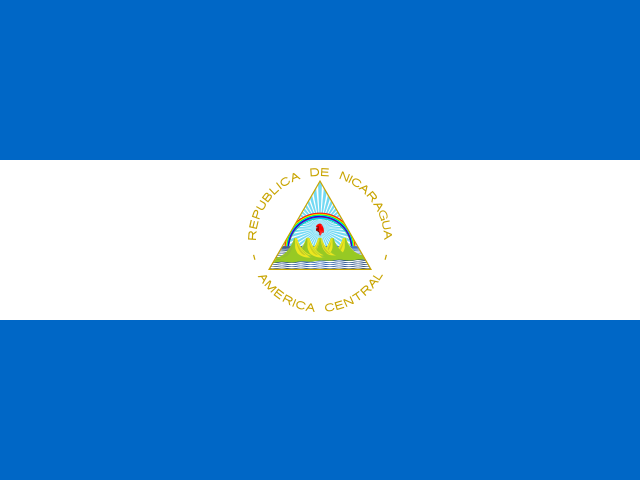
Nearby countries
Quick check: how well do you know Costa Rica?
3 questions, no sign-up. Tap an answer.
1. Which flag belongs to Costa Rica?
That's the flag of Costa Rica.
2. What is the capital of Costa Rica?
The capital of Costa Rica is San José.
3. Which of these countries borders Costa Rica?
Nicaragua and Panama border Costa Rica.
Keep going on the North America quiz – Costa Rica is one of 23 countries there.
More ways to practise: find Costa Rica on the blank map with no borders (hard mode), or play today's Globe and the other daily puzzles.
Frequently asked questions about Costa Rica
What language is spoken in Costa Rica?
Spanish is the official language and is spoken by almost everyone. On the Caribbean coast around Limón, many people of Jamaican descent also speak Limonese Creole, an English-based Creole, and Indigenous languages such as Bribri and Cabécar survive in the south.
What currency does Costa Rica use?
Costa Rica's currency is the colón (CRC), named after Christopher Columbus, whose name in Spanish is Cristóbal Colón. US dollars are also widely accepted in tourist areas, and many hotel prices are quoted in dollars.
What time zone is Costa Rica in?
Costa Rica uses Central Standard Time, UTC−6, all year. It does not observe daylight saving time, so sunrise and sunset stay close to 5.30 am and 5.30 pm throughout the year.
Which side of the road do they drive on in Costa Rica?
Costa Ricans drive on the right. Many rural roads are unpaved and cross rivers on narrow one-lane bridges, so a four-wheel-drive car is often recommended outside the Central Valley.
What is the highest point in Costa Rica?
Cerro Chirripó, in the Talamanca range, is Costa Rica's highest point at about 3,820 metres. On a clear day hikers at the summit can see both the Pacific Ocean and the Caribbean Sea.
Is Costa Rica in North or South America?
Costa Rica is in Central America, the narrow land bridge that is usually treated as the southern part of the North American continent. It lies between Nicaragua to the north and Panama to the south-east, with coasts on both the Pacific and the Caribbean.
Quizzes with Costa Rica
Guides that help with this
- The 25 hardest countries to find on a mapPacific islands, Caribbean islands and landlocked Africa – where they are.
- All 50 US states on the map, region by regionThe ordering tricks that make the states stick.
- Flags that look alike (and how to tell them apart)Chad or Romania? Australia or New Zealand? The flag pairs that cost quiz points.