Nicaragua
Capital: Managua. Nicaragua is one of the 23 countries in the North America quiz.
Quick answers: What is the capital of Nicaragua? · Which countries border Nicaragua?
Facts about Nicaragua
- CapitalManagua
- Population7 million
- Area130,373 km²
- RegionsNorth America, Central America
- LanguageSpanish
- CurrencyNicaraguan córdoba (NIO)
Nicaragua is the 9th most populous of the 23 countries in North America and the 4th largest by area. Worldwide it ranks 108th by population and 96th by area.
Where is Nicaragua?
Nicaragua is the largest country in Central America, in the middle of the isthmus that links North and South America. Honduras lies to the north and Costa Rica to the south. The Pacific Ocean is on the west coast and the Caribbean Sea on the east. Managua, the capital, is in the west near the Pacific, on the shore of Lake Managua. Just south of it is Lake Nicaragua, the largest lake in Central America.
On a world map, follow the narrowing strip of land south from Mexico. Nicaragua is the broad country roughly two-thirds of the way down, above Costa Rica and Panama.
How to find Nicaragua on the map
- Start from Costa Rica and Panama. Nicaragua is the country directly north of Costa Rica.
- Look for the big lake. Lake Nicaragua, in the south-west, is visible even at continental zoom.
- Count from the top. Going south from Mexico along the isthmus: Guatemala, Honduras, Nicaragua, Costa Rica, Panama. Belize and El Salvador are off to the sides.
- Don't confuse it with Honduras. Honduras is the neighbour to the north; Nicaragua is the one with the large lake and a wider Caribbean coast.
Flag
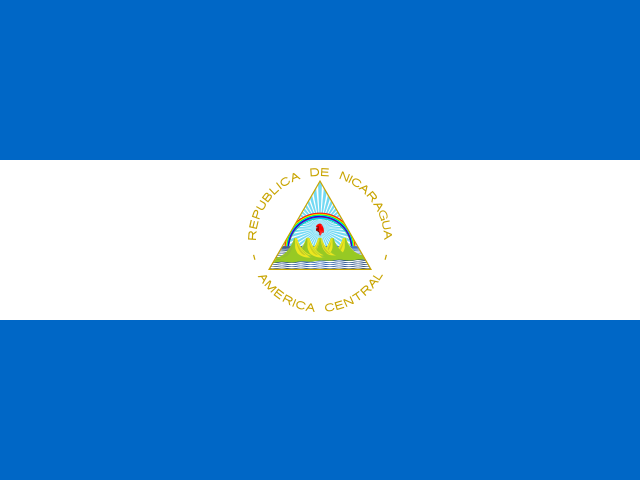
Nicaragua's flag has three horizontal bands – blue, white, blue – with the national coat of arms in the centre: a triangle containing five volcanoes, a rainbow and a red Phrygian cap, surrounded by the words República de Nicaragua – América Central.
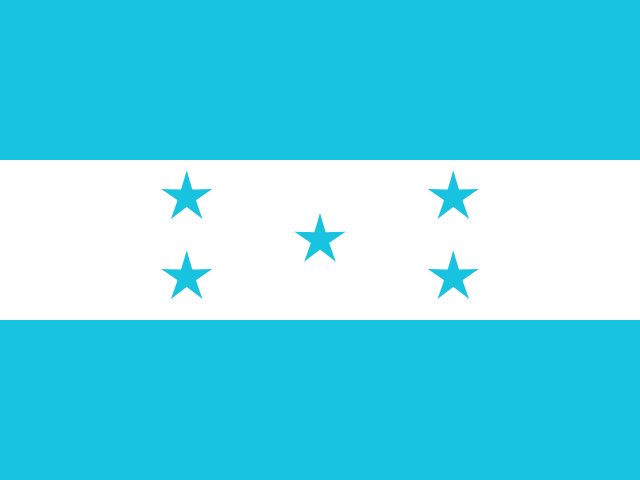
The same blue-white-blue layout is shared by El Salvador, Honduras and Guatemala (vertical), all descended from the flag of the old Federal Republic of Central America. The way to tell Nicaragua apart is the coat of arms: a triangle in a circle with the country's name written around it. El Salvador's emblem is similar but with a different inscription, and Honduras has five blue stars instead.
A short history of Nicaragua
Before Europeans arrived, the Pacific side of Nicaragua was home to peoples with ties to Mexico, such as the Nicarao, who spoke a language related to Nahuatl and gave the country its name. The Caribbean side was thinly settled by peoples linked to South America, including the ancestors of the Miskito, Mayangna and Rama. This split between the two coasts runs through the whole of Nicaragua's history.
Spanish conquistadors arrived in the 1520s, and Francisco Hernández de Córdoba founded both Granada and León in 1524. Many indigenous people died from disease or were shipped off as slaves to Peru. Spain never controlled the Caribbean coast, where Britain allied with the Miskito and set up a protectorate known as the Mosquito Coast.
Nicaragua won independence from Spain in 1821 as part of Central America, and became a separate republic in 1838. Liberal León and conservative Granada fought for decades. In the 1850s an American adventurer, William Walker, took control and declared himself president, until an alliance of Central American armies drove him out. The route across Lake Nicaragua and the San Juan River was used to carry gold-rush travellers to California, and for decades Nicaragua was a leading candidate for an inter-ocean canal. Britain gave up its claim to the Mosquito Coast, which was fully absorbed in 1894.
The United States occupied Nicaragua almost continuously from 1912 to 1933. The guerrilla leader Augusto César Sandino fought the US Marines and was murdered in 1934 on the orders of Anastasio Somoza García, whose family then ruled for over four decades. A devastating earthquake hit Managua in 1972, and anger over the misuse of aid fuelled opposition. In 1979 the Sandinista revolution overthrew the dictatorship. The US backed the Contra rebels against the new government, leading to a war that lasted through the 1980s. Peace and elections came in 1990, when the Sandinistas lost power, though they returned to government in 2007.
Today Nicaragua relies on farming, especially coffee, beef and sugar, along with gold and money sent home from abroad. The government has faced strong international criticism since a crackdown on protests in 2018.
Culture and daily life in Nicaragua
Nicaragua is known as a land of poets. Rubén Darío, born in 1867, founded the modernismo movement that transformed Spanish-language poetry, and he is the country's greatest national hero. Poetry festivals are still held in Granada, and later writers such as Ernesto Cardenal and Gioconda Belli continued the tradition.
Spanish is spoken by almost everyone, but on the Caribbean coast Miskito, English Creole and other languages are common, and the Garifuna people keep their own music and dances. Most Nicaraguans are Catholic, though evangelical churches have grown fast. El Güegüense, a satirical street theatre performed in masks and mixing Spanish and Nahuatl, is one of the oldest dramatic works of the Americas and is recognised by UNESCO.
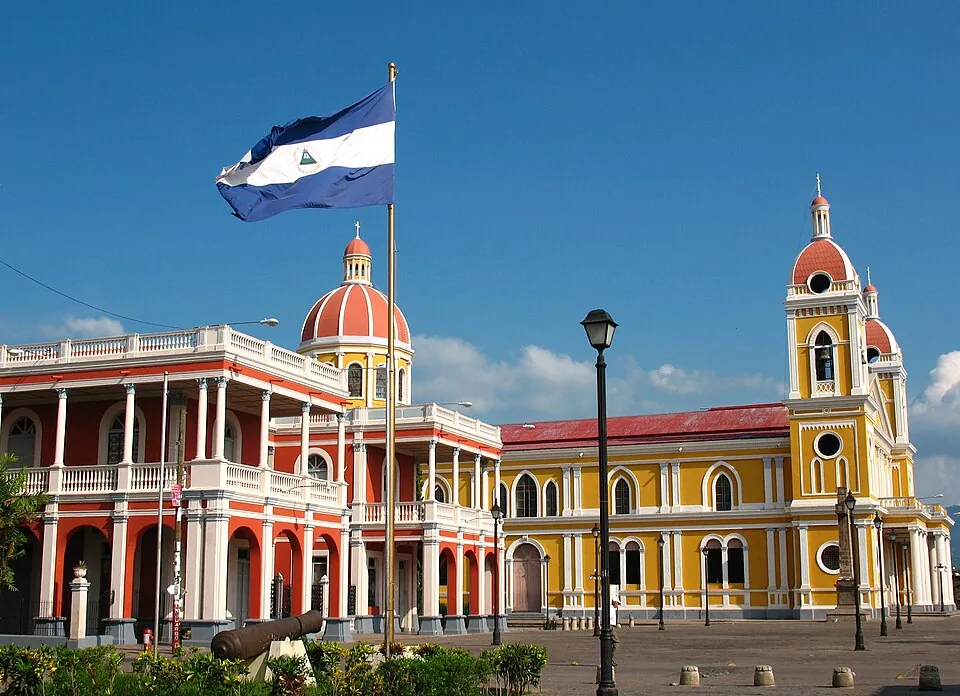
Unlike most of Central America, the national sport is baseball, a legacy of the US presence, and the country has produced Major League players such as Dennis Martínez, who pitched a perfect game. Boxing is also hugely popular, with Román "Chocolatito" González among its world champions. Masaya is known for its markets of hammocks, pottery and woodwork, and colonial Granada and León are full of brightly painted houses and churches.
Five facts worth knowing
- Lake Nicaragua is home to freshwater sharks – bull sharks swim up the San Juan River from the Caribbean into the lake.
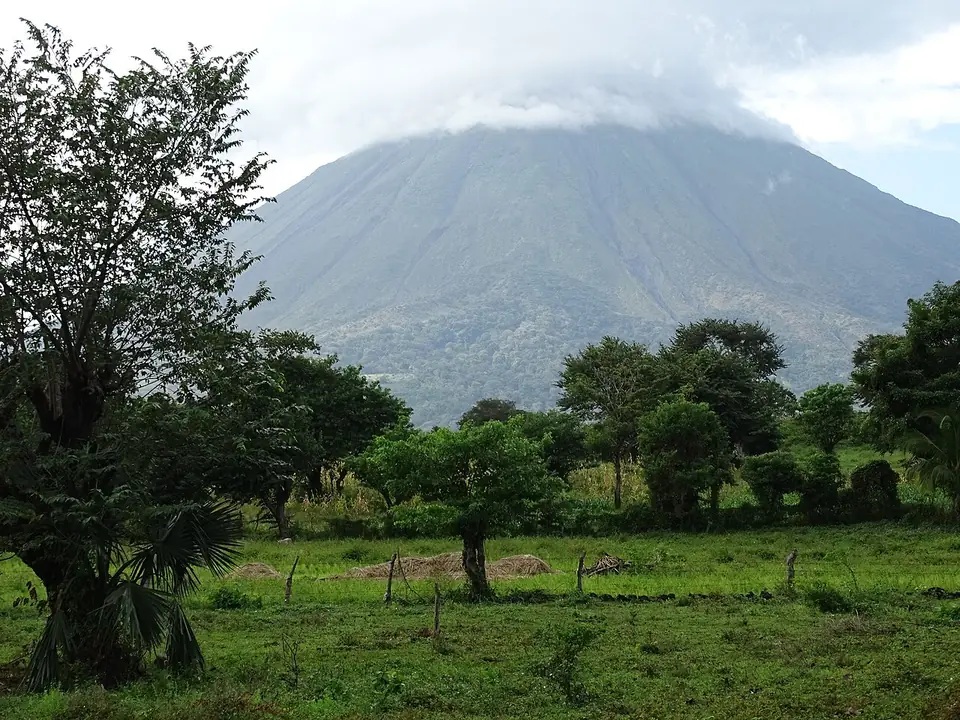
- Ometepe Island, in Lake Nicaragua, is formed by two volcanoes rising out of the water.
- Nicaragua has coasts on both the Pacific and the Caribbean, like all of Central America except Belize and El Salvador.
- The Caribbean side is known as the Mosquito Coast, historically autonomous and home to the Miskito people, with English and Creole widely spoken.
- Managua became the capital in 1852 as a compromise between the rival cities of León and Granada.
Culture and traditions in Nicaragua
- Saying hello
"Buenos días" with a handshake; friends often greet with a kiss on the cheek.
- Food and drink
Gallo pinto, rice and beans fried together, and nacatamal, a large tamale wrapped in banana leaves.
- Festivals and traditions
La Gritería on 7 December celebrates the Immaculate Conception; Masaya's Fiestas de San Jerónimo run in autumn.
- Everyday life
Rocking chairs on porches are a classic evening pastime. Directions are often given using landmarks instead of street names.
- Did you know?
Nicaragua's Lake Cocibolca is home to freshwater bull sharks, one of the few lakes in the world with sharks.
Common mistakes
- Tapping Honduras – the two countries are similar in size and sit next to each other.
- Picking El Salvador's flag, which is almost identical at a glance.
- Tapping Costa Rica, the smaller neighbour to the south.
Practise with Nicaragua
- North America quiz – Central America is part of this map; find Costa Rica and move north.
- Central America quiz – only seven countries, so Nicaragua's lake and width stand out.
- North America flags – learn to separate the blue-white-blue flags of Nicaragua, El Salvador and Honduras.
- North America capitals quiz – Managua.
- Mystery Country – a rough triangle with a notch in the south-west where the big lake sits.
Nearby countries
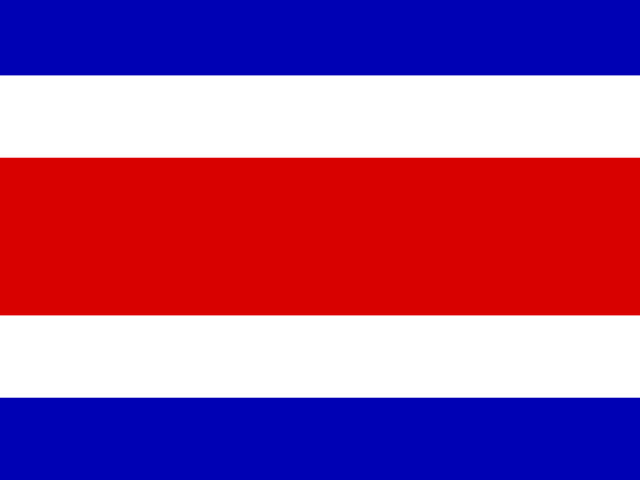 Costa RicaSan José
 HondurasTegucigalpa
Quick check: how well do you know Nicaragua?
3 questions, no sign-up. Tap an answer.
1. Which flag belongs to Nicaragua?
That's the flag of Nicaragua.
2. What is the capital of Nicaragua?
The capital of Nicaragua is Managua.
3. Which of these countries borders Nicaragua?
Costa Rica and Honduras border Nicaragua.
Keep going on the North America quiz – Nicaragua is one of 23 countries there.
More ways to practise: find Nicaragua on the blank map with no borders (hard mode), or play today's Globe and the other daily puzzles.
Frequently asked questions about Nicaragua
What language is spoken in Nicaragua?
Spanish is the official language and is spoken by almost everyone. On the Caribbean coast, Miskito, Mayangna and an English-based creole are widely spoken, and they have official status in the two autonomous regions there.
What currency does Nicaragua use?
Nicaragua uses the córdoba (NIO), named after Francisco Hernández de Córdoba, the Spanish founder of León and Granada. It is divided into 100 centavos, and US dollars are also widely accepted in tourist areas.
What time zone is Nicaragua in?
Nicaragua is on UTC−6, Central Standard Time, all year round. It does not currently use daylight saving time, so its clocks match those of Honduras and Costa Rica.
Which side of the road do they drive on in Nicaragua?
Nicaragua drives on the right. The Pan-American Highway crosses the Pacific side of the country, but there is very little road access to the Caribbean coast, where travel is often by boat or plane.
What is the highest point in Nicaragua?
Mogotón, in the Cordillera de Dipilto on the border with Honduras, is Nicaragua's highest point at about 2,107 metres. The range is covered in pine forest and is one of the coolest parts of the country.
Does Nicaragua have active volcanoes?
Yes – a chain of volcanoes runs along the Pacific side of the country. Masaya, near the capital, often has a glowing lava lake that visitors can see from the crater rim, and Cerro Negro, near León, is famous for volcano boarding down its black ash slopes.
Quizzes with Nicaragua
Often confused with
Guides that help with this
- The 25 hardest countries to find on a mapPacific islands, Caribbean islands and landlocked Africa – where they are.
- All 50 US states on the map, region by regionThe ordering tricks that make the states stick.
- Flags that look alike (and how to tell them apart)Chad or Romania? Australia or New Zealand? The flag pairs that cost quiz points.