Cuba
Capital: Havana. Cuba is one of the 23 countries in the North America quiz.
Quick answers: What is the capital of Cuba? · Which countries border Cuba?
Facts about Cuba
- CapitalHavana
- Population10.9 million
- Area109,884 km²
- RegionsNorth America, The Caribbean
- LanguageSpanish
- CurrencyCuban peso (CUP)
Cuba is the 8th most populous of the 23 countries in North America and the 6th largest by area. Worldwide it ranks 88th by population and 104th by area.
Where is Cuba?
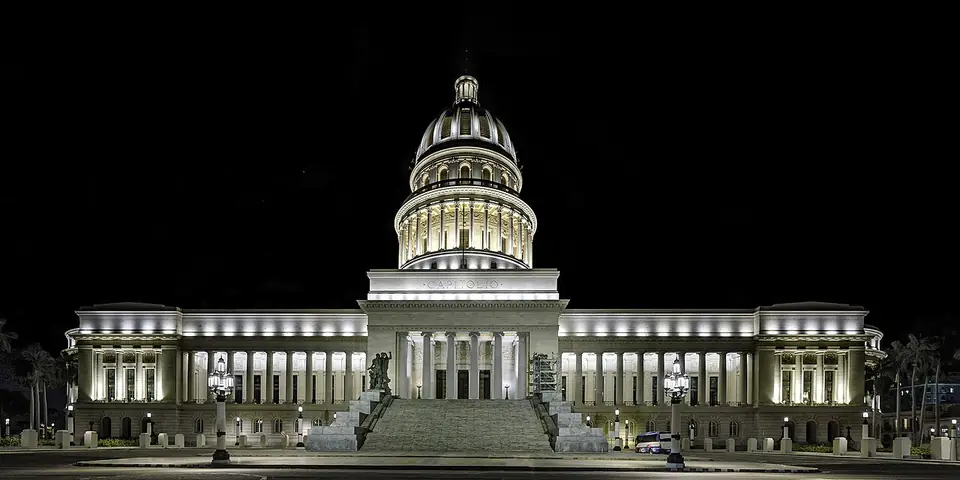
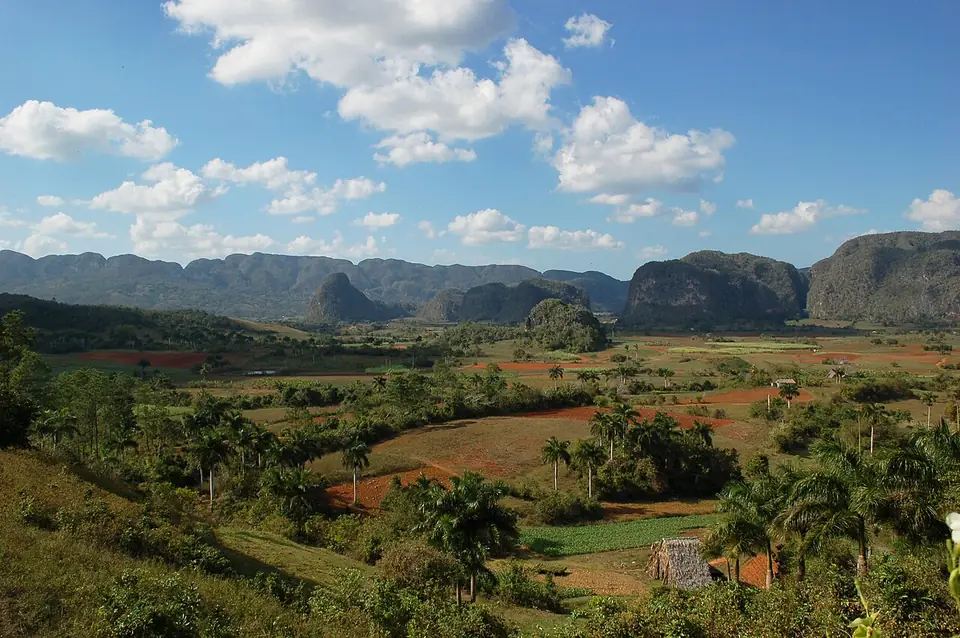
Cuba is the largest island in the Caribbean, lying at the entrance to the Gulf of Mexico. It stretches roughly 1,200 km from west to east, a long, thin crescent that sits just south of Florida and east of Mexico's Yucatán peninsula. Haiti and the Dominican Republic, on the island of Hispaniola, are to the east across the Windward Passage; Jamaica is to the south; the Bahamas are to the north-east. Havana, the capital, is on the north-west coast facing Florida.
On a world map, find the southern tip of Florida. The long island just below it, running across the mouth of the Gulf of Mexico, is Cuba.
How to find Cuba on the map
- Start from Florida. Cuba is the big island directly south, across the Straits of Florida.
- Look for the crescent. Cuba is much longer than it is wide and curves gently like a fish or a crocodile.
- Don't confuse it with Hispaniola. Hispaniola, next door to the east, is more compact and is split between two countries. Cuba is the long one.
- It's not Jamaica. Jamaica is a much smaller island to the south of Cuba's eastern half.
Flag
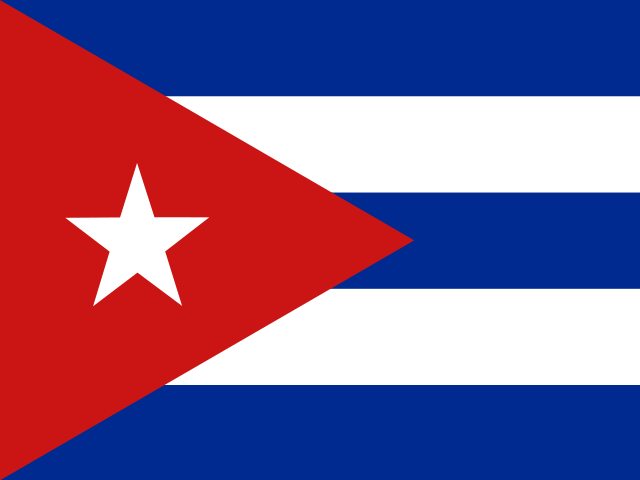
Cuba's flag has five horizontal stripes – three blue and two white, with blue at the top and bottom – and a red triangle at the hoist containing a single white five-pointed star.
The flag of Puerto Rico is its mirror image in colour: red stripes with a blue triangle. The two were designed by related independence movements in the 19th century, which is why they match so closely. In the Flags quiz, blue stripes and a red triangle is Cuba; red stripes and a blue triangle is Puerto Rico.
A short history of Cuba
Before 1492 Cuba was home to the Taíno and older groups such as the Ciboney, who fished, farmed cassava and lived in villages of thatched houses. Columbus reached the island on his first voyage, and Spanish conquest began in earnest in 1511 under Diego Velázquez. The Taíno chief Hatuey resisted and was burned at the stake. Within a few decades, war, forced labour and European diseases had devastated the Indigenous population.
Havana grew into Spain's most important port in the Caribbean, the place where treasure fleets gathered before crossing the Atlantic, and it was heavily fortified. From the late 1700s sugar transformed the island. Hundreds of thousands of enslaved Africans were brought to work the plantations, and slavery was not abolished in Cuba until 1886, among the last places in the Americas.
While most of Spain's American colonies broke away in the 1810s and 1820s, Cuba stayed Spanish much longer. The Ten Years' War began in 1868, and the poet and writer José Martí organised a new rising in 1895, dying in one of its first battles. In 1898 the United States entered the conflict after the battleship Maine exploded in Havana harbour. Spain lost, and Cuba became formally independent in 1902, but under strong US influence.
The first half of the 20th century brought coups and dictatorship, ending with Fulgencio Batista. A guerrilla movement led by Fidel Castro and Che Guevara took power on 1 January 1959. The new government nationalised land and businesses, allied with the Soviet Union and became a one-party communist state. A US-backed invasion failed at the Bay of Pigs in 1961, and the Cuban Missile Crisis of 1962 brought the world close to nuclear war.
The Soviet collapse in 1991 caused severe shortages, known as the Special Period. Cuba still has a state-run economy, now relying on tourism, money sent from relatives abroad, nickel, tobacco and medical services provided to other countries.
Culture and daily life in Cuba
Cuban culture grew from the mixing of Spanish and West African traditions, and it shows everywhere. Spanish is the only official language, but Yoruba words survive in Santería, a religion that links West African orishas with Catholic saints. Many Cubans practise both, while others are not religious at all after decades of an officially atheist state.
Music is the country's great export. The son, born in the east, fed into salsa, and the danzón, mambo and cha-cha-chá all came from Cuba. The Buena Vista Social Club album of 1997 introduced older musicians like Compay Segundo to a world audience, and Celia Cruz became the Queen of Salsa. In literature, Alejo Carpentier and the poet Nicolás Guillén are major names.
Baseball is the favourite sport, followed closely by boxing, where Cuba has won many Olympic medals. Cigars from the Vuelta Abajo region in the west are prized. Thanks to free state education, literacy is almost universal, and dominoes games on the street are a daily ritual.
Five facts worth knowing
- Cuba is about 150 km from Key West, Florida, which makes the United States its nearest non-Caribbean neighbour.
- Guantánamo Bay, on the south-east coast, has housed a United States naval base since the early 20th century, even though Cuba and the US have had no normal relations for decades.
- Isla de la Juventud, off the south-west coast, is Cuba's second-largest island and is included in the country's outline.
- Havana's old town is a UNESCO World Heritage Site, known for its colonial architecture and the classic American cars still driving its streets.
- Cuba is the largest Caribbean island both by area and by population.
Culture and traditions in Cuba
- Saying hello
A kiss on the cheek among friends and acquaintances.
- Food and drink
Ropa vieja (shredded beef) and moros y cristianos (black beans and rice); the mojito to drink.
- Festivals and traditions
The Santiago de Cuba Carnival in July, one of the oldest in the Caribbean.
- Everyday life
Classic 1950s American cars still fill the streets, and live music is heard everywhere.
- Did you know?
Cuban rumba is on UNESCO's intangible heritage list.
Common mistakes
- Tapping Hispaniola (Haiti or the Dominican Republic) instead of Cuba.
- Picking the Puerto Rican flag in the Flags quiz – check whether the stripes are blue or red.
- Tapping the Bahamas, whose islands are scattered just north-east of Cuba.
Practise with Cuba
- Caribbean quiz – Cuba is the biggest island, so it's the natural anchor for finding Jamaica, Haiti and the Dominican Republic.
- North America quiz – the Caribbean is counted with North America here; Cuba is the long island under Florida.
- North America flags – learn the Cuba–Puerto Rico pair.
- North America capitals quiz – Havana.
- Mystery Country – the long crescent shape with the small island hanging below is distinctive.
Quick check: how well do you know Cuba?
3 questions, no sign-up. Tap an answer.
1. Which flag belongs to Cuba?
That's the flag of Cuba.
2. What is the capital of Cuba?
The capital of Cuba is Havana.
3. Which is bigger by area?
Cuba (109,884 km²) is bigger than Panama (75,417 km²).
Keep going on the North America quiz – Cuba is one of 23 countries there.
More ways to practise: find Cuba on the blank map with no borders (hard mode), or play today's Globe and the other daily puzzles.
Frequently asked questions about Cuba
What language is spoken in Cuba?
Spanish is the official language and is spoken by virtually everyone. Cuban Spanish is famous for its fast rhythm and dropped 's' sounds. Haitian Creole is spoken by some descendants of Haitian migrants in the east of the island.
What currency does Cuba use?
Cuba's official currency is the Cuban peso (CUP). Until 2021 the country also had a second currency, the convertible peso (CUC), which was abolished in a monetary reform; in practice, foreign currencies such as the US dollar and euro are still widely used.
What time zone is Cuba in?
Cuba uses UTC−5 as standard time, the same as the US East Coast in winter, and moves to UTC−4 for daylight saving time in summer.
Which side of the road do they drive on in Cuba?
Cubans drive on the right. The Autopista Nacional, a motorway begun in the 1970s, runs east from Havana but was never finished, and horse-drawn carts still share many rural roads with cars and lorries.
What is the highest point in Cuba?
Pico Turquino, in the Sierra Maestra in the south-east, is Cuba's highest point at about 1,970 metres. A bronze bust of the independence hero José Martí stands on its summit.
What is Cuba famous for?
Cuba is known for hand-rolled cigars, rum and sugar, and for music styles such as son, mambo and cha-cha-chá that shaped salsa. Baseball is the national sport, and the island has produced many Olympic boxing champions.
Quizzes with Cuba
Guides that help with this
- The 25 hardest countries to find on a mapPacific islands, Caribbean islands and landlocked Africa – where they are.
- All 50 US states on the map, region by regionThe ordering tricks that make the states stick.
- Flags that look alike (and how to tell them apart)Chad or Romania? Australia or New Zealand? The flag pairs that cost quiz points.