Cyprus
Capital: Nicosia. Cyprus is one of the 46 countries in the Europe quiz.
Quick answers: What is the capital of Cyprus? · Which countries border Cyprus?
Facts about Cyprus
- CapitalNicosia
- Population1.4 million
- Area9,251 km²
- RegionsEurope, Middle East
- LanguagesGreek, Turkish
- CurrencyEuro (EUR)
Cyprus is the 36th most populous of the 46 countries in Europe and the 39th largest by area. Worldwide it ranks 154th by population and 164th by area.
Where is Cyprus?
Cyprus is an island in the eastern Mediterranean, south of Turkey and west of Syria and Lebanon. Geographically it lies closer to Asia than to Europe, but politically it is a member of the European Union and is usually counted as a European country, which is why it appears in the Europe quiz here. The capital, Nicosia, is near the centre of the island. Since 1974 the northern third has been under Turkish Cypriot control, and Nicosia is the last divided capital in Europe.
On a world map, find the far eastern end of the Mediterranean, where the sea meets Turkey, Syria and Lebanon. Cyprus is the island in that corner.
How to find Cyprus on the map
- Start from Turkey. Cyprus is the island just off Turkey's southern coast.
- Look for the corner of the Mediterranean. It is the easternmost large island in the sea.
- Spot the panhandle. The island has a long thin peninsula pointing north-east, which makes its shape easy to recognise.
- Don't confuse it with Crete. Crete is Greek and lies further west, south of mainland Greece; Cyprus is closer to Turkey and Syria.
Flag
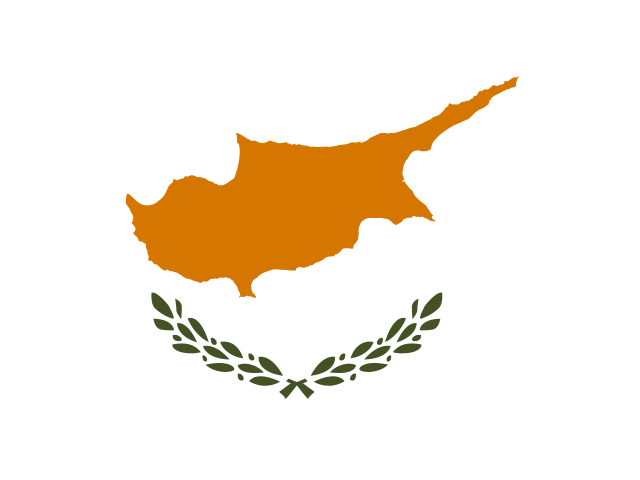
The flag of Cyprus is a white field with a copper-coloured silhouette of the island in the centre, above two crossed green olive branches. The copper colour refers to the metal that gave the island its name; the olive branches stand for peace between the Greek and Turkish communities. It was deliberately designed to avoid the colours of either Greece or Turkey.
In the Flags quiz, Cyprus is one of only two national flags that show a map of the country, the other being Kosovo. Kosovo's is blue with a yellow map and six stars; Cyprus is white with an orange map and branches.
A short history of Cyprus
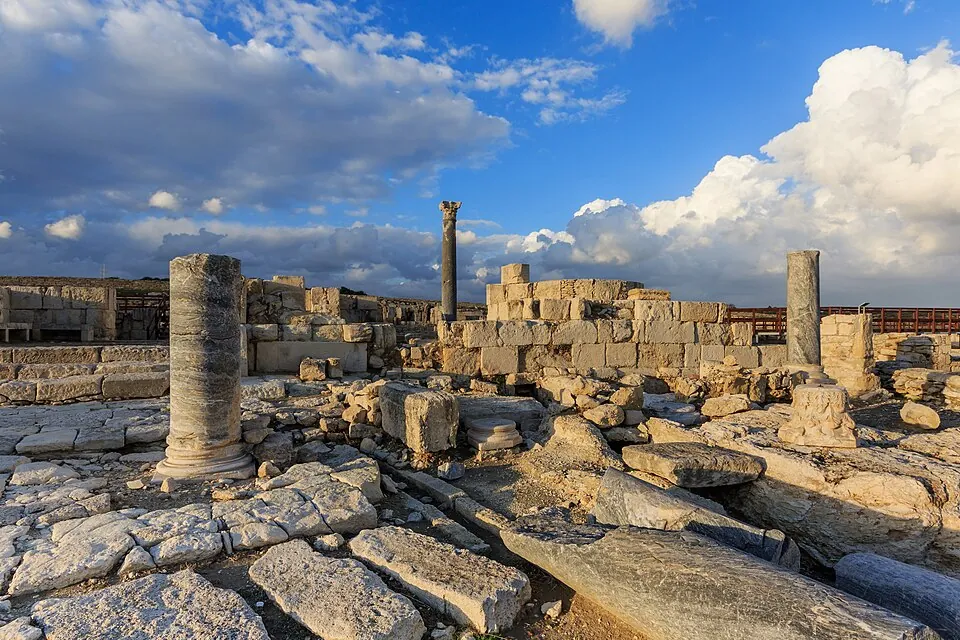
People have lived on Cyprus for at least ten thousand years. The Neolithic village of Choirokoitia, with its round stone houses, is one of the best-preserved prehistoric sites in the Mediterranean. In the Bronze Age the island grew rich from its copper, and from around 1200 BC Greek-speaking settlers arrived, founding city-kingdoms such as Salamis and Kourion. Phoenicians also built towns, notably Kition, today's Larnaca.
Sitting at a crossroads, Cyprus was ruled in turn by Assyrians, Egyptians, Persians, Alexander the Great's successors and Rome. The apostles Paul and Barnabas preached here, and the island became part of the Byzantine Empire. In 1191 Richard the Lionheart captured it during the Third Crusade and soon sold it. The French Lusignan family then ruled for three centuries, building Gothic cathedrals in Nicosia and Famagusta, before Venice took over in 1489.
The Ottoman Empire conquered Cyprus in 1570–71. Turkish settlers arrived, and the island gained the two communities, Greek Cypriot and Turkish Cypriot, that shape it today. Britain took over its administration in 1878 and made it a colony in 1925. In the 1950s Greek Cypriot fighters of EOKA campaigned for union with Greece, known as enosis, while many Turkish Cypriots wanted partition.
Cyprus became independent in 1960, with a power-sharing constitution. It broke down within a few years amid intercommunal violence, and UN peacekeepers arrived in 1964. In 1974 a coup backed by the military government in Greece sought union with Greece, and Turkey responded by sending troops, who took the north. Large numbers of people on both sides were displaced. In 1983 the north declared itself the Turkish Republic of Northern Cyprus. Only Turkey recognises it; the Republic of Cyprus and most of the world regard the north as occupied, while Turkish Cypriots see the Turkish presence as protection. Reunification talks have repeatedly failed, including a UN plan rejected in 2004.
Today the Republic of Cyprus is a service economy built on tourism, shipping and finance.
Culture and daily life in Cyprus
Most people in the south speak Greek, with a distinct Cypriot dialect that mainland Greeks can find hard to follow, and the large majority are Greek Orthodox. In the north, Turkish is spoken and Sunni Islam is the main faith. English is widely understood across the island, a legacy of British rule, and Cypriots drive on the left.
The painted churches of the Troodos mountains, decorated with Byzantine frescoes and roofed with steep wooden eaves against the snow, are on UNESCO's list, as are the mosaics of Paphos, which show scenes from Greek myth in tiny coloured stones. Lefkara, a village in the hills, is famous for its lace and silverwork, a craft said to have impressed Leonardo da Vinci. Commandaria, a sweet dessert wine, has been made on the island since medieval times.
Easter is the high point of the Greek Cypriot year, with midnight church services and bonfires. Football is the most followed sport, and families tend to stay close, often building homes near their parents.
Five facts worth knowing
- Cyprus is the third-largest island in the Mediterranean, after Sicily and Sardinia.
- It has been divided since 1974, with a UN buffer zone known as the Green Line running through the island and through Nicosia.
- The United Kingdom keeps two sovereign military bases on the island, Akrotiri and Dhekelia, which remain British territory.
- Cyprus joined the European Union in 2004 and adopted the euro in 2008.
- The island's name is linked to copper; the Latin word for the metal, cuprum, derives from Cyprus, which was a major source in ancient times.
Culture and traditions in Cyprus
- Saying hello
"Yia sou" in Greek or "Merhaba" in Turkish, with a handshake.
- Food and drink
Halloumi, the grilled squeaky cheese, and meze, a long spread of small dishes.
- Festivals and traditions
Kataklysmos, the Flood Festival at Pentecost, and the Limassol Wine Festival in late summer.
- Everyday life
Afternoons are quiet in the heat of summer, and coffee is a slow, social affair.
- Did you know?
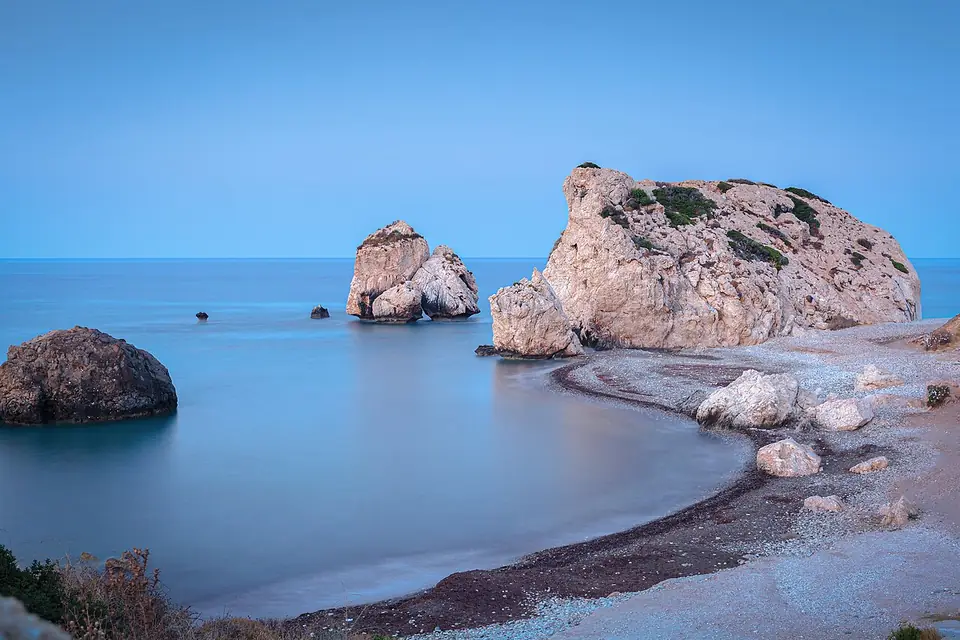
Petra tou Romiou on the south coast is said to be the birthplace of the goddess Aphrodite.
Common mistakes
- Tapping Crete, the other large island in the eastern Mediterranean.
- Looking for Cyprus in the Asia quiz; here it is counted in Europe.
- Picking the Kosovo flag because both show a map.
Practise with Cyprus
- Europe quiz – the island in the far south-east corner of the map, below Turkey.
- Europe flags – the only white flag with a copper map.
- Europe capitals quiz – Nicosia.
- Mystery Country – the long north-eastern panhandle gives it away.
- Mistake Bank – Cyprus and Crete are a frequent pair here.
Quick check: how well do you know Cyprus?
3 questions, no sign-up. Tap an answer.
1. Which flag belongs to Cyprus?
That's the flag of Cyprus.
2. What is the capital of Cyprus?
The capital of Cyprus is Nicosia.
3. Which is bigger by area?
Albania (28,748 km²) is bigger than Cyprus (9,251 km²).
Keep going on the Europe quiz – Cyprus is one of 46 countries there.
More ways to practise: find Cyprus on the blank map with no borders (hard mode), or play today's Globe and the other daily puzzles.
Frequently asked questions about Cyprus
What language is spoken in Cyprus?
Greek and Turkish are the two official languages of the Republic of Cyprus. Greek is spoken in the south and Turkish in the north, and Armenian is a recognised minority language. Cypriot Greek has its own distinctive dialect, and English is widely spoken.
What currency does Cyprus use?
The Republic of Cyprus uses the euro (EUR), which replaced the Cypriot pound in 2008. In the north, which is outside the government's control, the Turkish lira is used instead.
What time zone is Cyprus in?
Cyprus uses Eastern European Time, UTC+2, and moves to UTC+3 for summer time from late March to late October. It is one hour ahead of most of the European mainland.
Which side of the road do they drive on in Cyprus?
Cypriots drive on the left, a legacy of British rule from 1878 to 1960. Cyprus is one of only a few EU countries that drive on the left, alongside Ireland and Malta.
What is the highest point in Cyprus?
Mount Olympus, also called Chionistra, in the Troodos Mountains, is the island's highest point at about 1,950 metres. It often has enough snow in winter for skiing, unusual for a Mediterranean island.
What is Cyprus famous for?
Cyprus is famous for halloumi, a firm cheese that can be grilled without melting, and for the legend that Aphrodite was born from the sea at Petra tou Romiou. The painted Byzantine churches of the Troodos Mountains are a UNESCO World Heritage site.
Quizzes with Cyprus
Guides that help with this
- All 46 European capitals, with a memory trick for eachCapitals grouped by region, with hooks for the ones people forget.
- Flags that look alike (and how to tell them apart)Chad or Romania? Australia or New Zealand? The flag pairs that cost quiz points.
- The 25 hardest countries to find on a mapPacific islands, Caribbean islands and landlocked Africa – where they are.