Dominica
Capital: Roseau. Dominica is one of the 23 countries in the North America quiz.
Quick answers: What is the capital of Dominica? · Which countries border Dominica?
Facts about Dominica
- CapitalRoseau
- Population65,871
- Area751 km²
- RegionsNorth America, The Caribbean
- LanguageEnglish
- CurrencyEast Caribbean dollar (XCD)
Dominica is the 22nd most populous of the 23 countries in North America and the 17th largest by area. Worldwide it ranks 188th by population and 176th by area.
Where is Dominica?
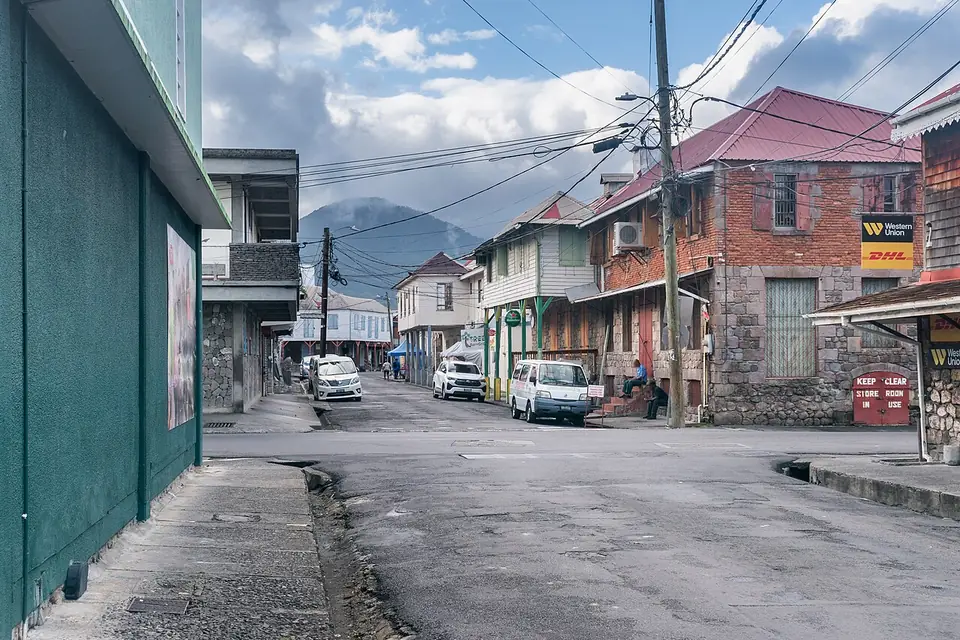
Dominica is a small island nation in the eastern Caribbean, part of the Lesser Antilles chain. It sits between the two French islands of Guadeloupe, to the north, and Martinique, to the south. It is not the Dominican Republic, which is a much larger country far to the north-west on the island of Hispaniola. The capital, Roseau, is on the south-western coast.
On a world map, find the curved line of islands that runs from Puerto Rico down towards Venezuela. Dominica is roughly in the middle of that arc, one of the islands in the Windward group.
How to find Dominica on the map
- Start from Guadeloupe and Martinique. Dominica is the island sandwiched between them.
- Follow the island arc. Counting south from Antigua, it comes after Guadeloupe.
- Look for the rugged oval. Dominica is tall, narrow and mountainous, without the long peninsulas of some neighbours.
- Don't confuse it with the Dominican Republic. That country shares an island with Haiti and is many times larger.
Flag
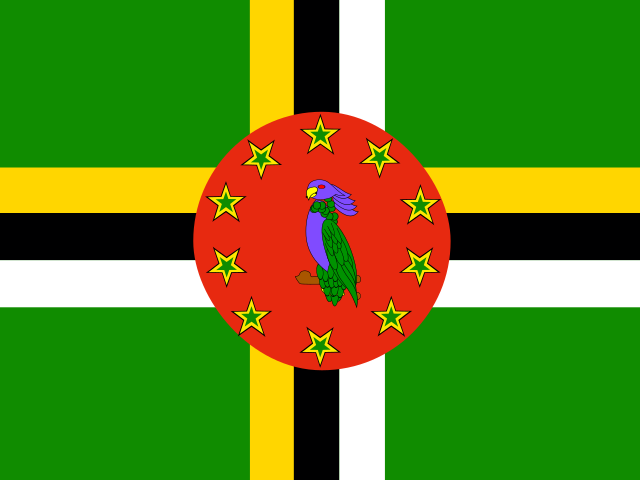
Dominica's flag is green with a cross of three thin stripes – yellow, black and white – running both vertically and horizontally. In the centre is a red disc containing a Sisserou parrot, the national bird, surrounded by ten green five-pointed stars for the ten parishes.
In the Flags quiz, Dominica is one of the very few national flags that include the colour purple, found on the parrot's plumage. No other flag has a parrot, so once seen it is easy to remember.
A short history of Dominica
The first people to reach Dominica came by canoe from South America, followed by Arawak-speaking groups. By the time Europeans arrived, the island was home to the Kalinago, who called it Waitukubuli, often translated as "tall is her body". Columbus sighted it on a Sunday in November 1493 on his second voyage and named it after the Latin word for that day.
Unlike most Caribbean islands, Dominica was not quickly colonised. Its steep mountains and thick forest, and the fierce resistance of the Kalinago, kept Europeans at bay for more than two centuries. In 1660 Britain and France agreed to leave it to the Kalinago, but French settlers and missionaries moved in anyway, starting coffee estates worked by enslaved Africans. Some enslaved people escaped into the interior, forming maroon communities that fought the planters for years.
Britain won Dominica in 1763 at the end of the Seven Years' War. France captured it back in 1778 and returned it in 1783, and a French attack in 1805 burned much of Roseau. These changes of ownership left a lasting mark: many place names are French, and the everyday language of many people is a French-based Creole, even though English became official. Slavery was abolished across the British Empire in the 1830s, and Dominica was one of the few places in the region where people of African descent soon formed a majority in the local assembly.
In the 20th century Dominica was part of the short-lived West Indies Federation and then became an associated state of Britain in 1967. It became fully independent on 3 November 1978 as a republic within the Commonwealth. The new country was struck by Hurricane David the following year, and repeated storms have shaped its development ever since.
Today Dominica relies on agriculture, especially bananas, eco-tourism built on its rainforest and diving, and a citizenship-by-investment programme.
Culture and daily life in Dominica
English is the official language, but many Dominicans also speak Kwéyòl, a French-based Creole close to those of Martinique and St Lucia, a reminder of the island's French colonial years. Most people are Roman Catholic, another French legacy, with Protestant churches also strong.
Music is central to island identity. Cadence-lypso, developed in the 1970s by bands such as Exile One, blended Haitian cadence with calypso, and the later bouyon style is a fast, energetic sound born on the island. The novelist Jean Rhys, author of Wide Sargasso Sea, was born in Roseau, as was the writer Phyllis Shand Allfrey.
Life is rural and close to nature. Hiking the Waitukubuli National Trail, which runs the length of the island, and diving at Champagne Reef, where volcanic bubbles rise from the seabed, are favourites with visitors. Cricket is the most popular sport, and Dominica has produced players for the West Indies team. Each October Roseau hosts the World Creole Music Festival, and the national dress, the wob dwiyet, is worn for independence celebrations.
Five facts worth knowing
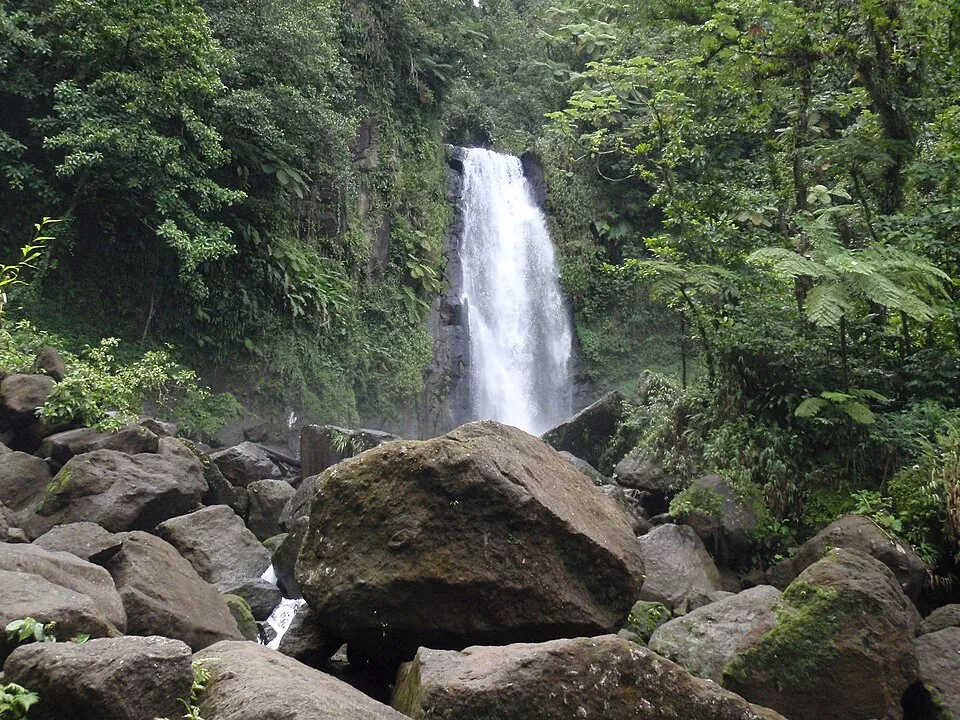
- Dominica is known as the Nature Island for its rainforest, waterfalls and hot springs; much of the interior is protected.
- Boiling Lake, in Morne Trois Pitons National Park, is one of the largest hot lakes in the world and the park is a UNESCO World Heritage site.
- The island was badly hit by Hurricane Maria in 2017, which damaged or destroyed most buildings on the island.
- Dominica has an indigenous Kalinago community, one of the few remaining in the Caribbean, living in a territory on the east coast.
- The name is pronounced dom-in-EE-ka, with the stress on the third syllable, unlike the Dominican Republic.
Culture and traditions in Dominica
- Saying hello
"Good morning" in English, or a greeting in Kweyol (Creole).
- Food and drink
Callaloo soup and provisions; the mountain chicken frog was once the national dish.
- Festivals and traditions
The World Creole Music Festival in October, and Independence Day on 3 November.
- Everyday life
Creole Day sees people wearing traditional madras clothing, and village life is tight-knit.
- Did you know?
Dominica's Kalinago Territory is home to the Kalinago, the Caribbean's Indigenous people.
Common mistakes
- Tapping the Dominican Republic on Hispaniola, the most common error by far.
- Tapping Guadeloupe or Martinique, the French islands on either side.
- Tapping St Lucia, the next island south of Martinique.
Practise with Dominica
- North America quiz – the Caribbean is included; zoom in on the Lesser Antilles.
- Caribbean quiz – the best place to learn the island chain in order.
- North America flags – the green flag with the parrot.
- North America capitals quiz – Roseau.
- Mystery Country – a single tall oval island, with no outlying islets.
Quick check: how well do you know Dominica?
3 questions, no sign-up. Tap an answer.
1. Which flag belongs to Dominica?
That's the flag of Dominica.
2. What is the capital of Dominica?
The capital of Dominica is Roseau.
3. Which is bigger by area?
Dominica (751 km²) is bigger than Barbados (430 km²).
Keep going on the North America quiz – Dominica is one of 23 countries there.
More ways to practise: find Dominica on the blank map with no borders (hard mode), or play today's Globe and the other daily puzzles.
Frequently asked questions about Dominica
What language is spoken in Dominica?
English is the official language. Many Dominicans also speak Kwéyòl, a French-based Creole close to those of Martinique and Guadeloupe, a legacy of French settlement. In the north-east, some people speak Kokoy, an English-based Creole brought by migrants from other British Caribbean islands.
What currency does Dominica use?
Dominica uses the East Caribbean dollar (XCD), shared with seven other members of the Eastern Caribbean Central Bank. It has been pegged to the US dollar at 2.70 since 1976, and US dollars are widely accepted.
What time zone is Dominica in?
Dominica uses Atlantic Standard Time, UTC−4, all year. It does not observe daylight saving time. That puts it in the same time as its neighbours Guadeloupe and Martinique, and one hour ahead of New York in winter.
Which side of the road do they drive on in Dominica?
Dominicans drive on the left, a legacy of British rule. Roads wind through steep, mountainous country with many hairpin bends, and visitors need a local driving permit.
What is the highest point in Dominica?
Morne Diablotins, a dormant volcano in the north of the island, is the highest point at about 1,450 metres. Its forested slopes are home to the sisserou parrot, the national bird shown on the flag.
What is the difference between Dominica and the Dominican Republic?
They are separate countries, with capitals roughly 1,000 kilometres apart. Dominica is a small English-speaking island in the Lesser Antilles with around 66,000 people. The Dominican Republic is a Spanish-speaking country on Hispaniola with over 11 million people.
Quizzes with Dominica
Often confused with
Guides that help with this
- The 25 hardest countries to find on a mapPacific islands, Caribbean islands and landlocked Africa – where they are.
- All 50 US states on the map, region by regionThe ordering tricks that make the states stick.
- Flags that look alike (and how to tell them apart)Chad or Romania? Australia or New Zealand? The flag pairs that cost quiz points.