Fiji
Capital: Suva. Fiji is one of the 14 countries in the Oceania quiz.
Quick answers: What is the capital of Fiji? · Which countries border Fiji?
Facts about Fiji
- CapitalSuva
- Population933,154
- Area18,272 km²
- RegionOceania
- LanguagesEnglish, Fijian, Fiji Hindi
- CurrencyFijian dollar (FJD)
Fiji is the 4th most populous of the 14 countries in Oceania and the 5th largest by area. Worldwide it ranks 160th by population and 152nd by area.
Where is Fiji?
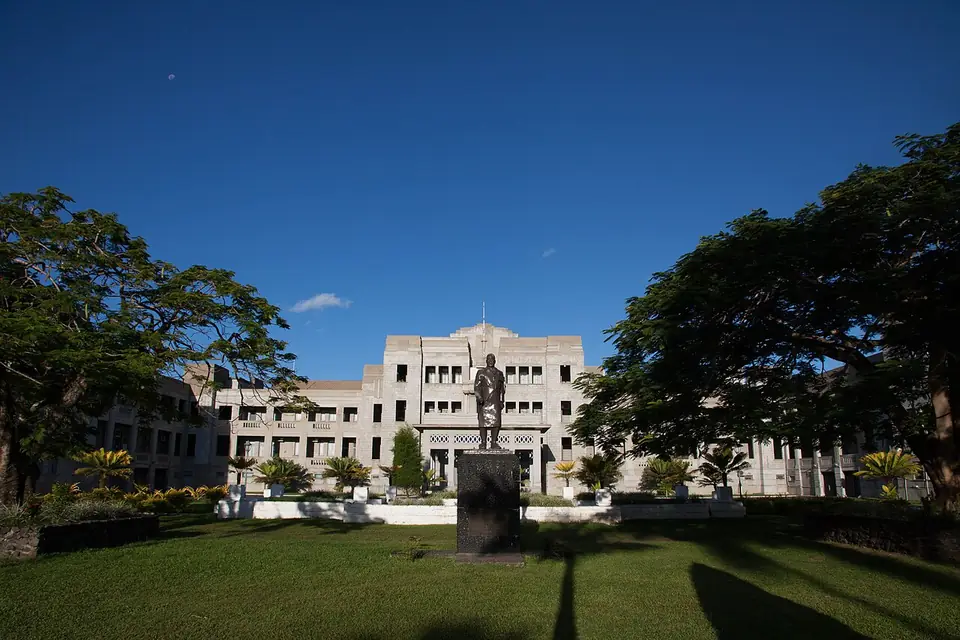
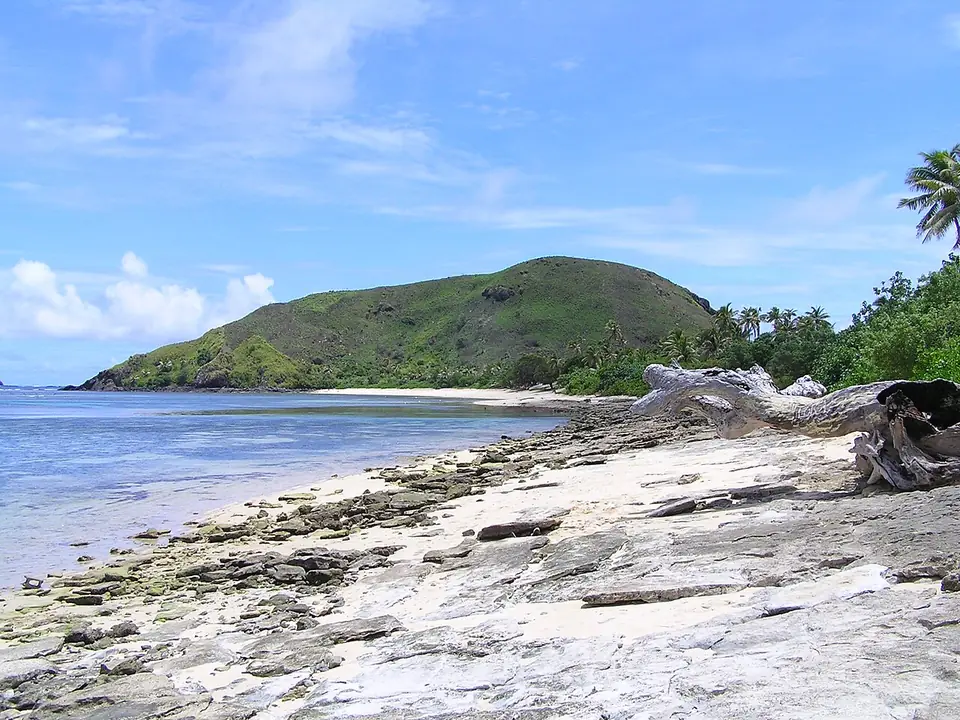
Fiji is an island nation in the South Pacific, roughly 2,000 kilometres north of New Zealand and east of Australia. It is made up of more than 300 islands, of which around a third are inhabited. Two large islands dominate: Viti Levu, where the capital Suva and the main airport at Nadi are found, and Vanua Levu to the north-east. The rest are smaller volcanic islands and coral atolls spread across a wide stretch of ocean.
Vanuatu lies to the west, Tonga to the south-east and Tuvalu to the north.
How to find Fiji on the map
- Start from New Zealand. Go north, roughly the same distance as the length of New Zealand itself, and you reach Fiji.
- Look east of Vanuatu. Vanuatu is the chain of islands east of Australia; Fiji is the next group further east.
- Pick the larger pair. Viti Levu and Vanua Levu are noticeably bigger than most Pacific islands at normal zoom, which helps separate Fiji from Tonga and Samoa.
- Remember the 180th meridian. It passes through the Fijian island of Taveuni, so Fiji sits almost exactly opposite Greenwich.
Flag
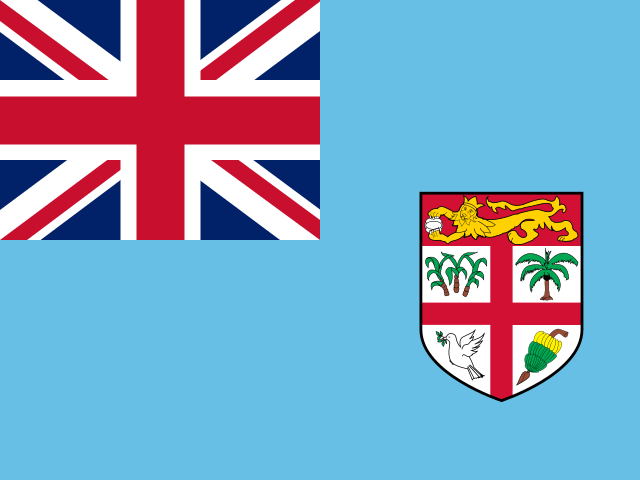
Fiji's flag is light blue with the Union Jack in the top-left corner and the shield from the national coat of arms on the fly side. The shield shows a red cross and a lion holding a cocoa pod, with sugar cane, a coconut palm, a dove and bananas in the quarters.
Several Pacific and Commonwealth flags carry the Union Jack, so the colour of the field matters. Australia and New Zealand use dark blue with stars; Tuvalu uses light blue with stars; Fiji uses light blue with a shield. If you see a shield rather than stars, it's Fiji.
A short history of Fiji
The first settlers reached Fiji around 3,000 years ago, part of the great seafaring migration of the Lapita people, known for their finely stamped pottery. Over the centuries Fiji became a meeting place of Melanesian and Polynesian cultures, with strong ties to Tonga and Samoa through trade, marriage and warfare. Society was organised into chiefdoms that frequently fought one another, and fortified hill villages were common.
The Dutch navigator Abel Tasman sighted some of the islands in 1643, and James Cook passed through in the 1770s, but the reefs gave Fiji a dangerous reputation and few Europeans stayed at first. In the early 1800s traders came for sandalwood and sea cucumbers, followed by Christian missionaries and settlers. The powerful chief Ratu Seru Cakobau of Bau, a tiny island off Viti Levu, gained influence over much of Fiji and in 1871 was proclaimed king.
Struggling with debts, unrest and pressure from settlers, Cakobau and other chiefs ceded Fiji to Britain in 1874. The first governor, Sir Arthur Gordon, protected Fijian land ownership, so that most land is still held communally by Fijian clans. To work the new sugar plantations instead, Britain brought in labourers from India under an indenture system from 1879 to 1916. Levuka, on Ovalau, was the colonial capital until it moved to Suva in the 1880s.
Fiji became independent in 1970. Tension between Indigenous Fijians and Indo-Fijians shaped politics, and a series of coups followed: two in 1987, another in 2000 and a military takeover in 2006. Many Indo-Fijians emigrated as a result. A new constitution was adopted in 2013, and elections resumed the following year.
Fiji is one of the larger economies among the Pacific islands, earning money from tourism, sugar, bottled water and remittances, and it hosts regional bodies such as the University of the South Pacific.
Culture and daily life in Fiji
Three main languages are spoken: English, iTaukei (Fijian) and Fiji Hindi. The mix reflects Fiji's history – Fijian with its regional dialects, the Hindi spoken by descendants of indentured labourers, and the English of the colonial era. Most Indigenous Fijians are Methodist Christians, a legacy of 19th-century missionaries, and Sunday is a quiet day of church and family. Most Indo-Fijians are Hindu, with Muslim and Sikh minorities, so temples and mosques stand alongside churches.
The meke, a dance that tells stories through song and movement, is performed at festivals and for visitors. Masi, or tapa cloth, made from mulberry bark and printed with bold brown and black patterns, is used in ceremonies and given as a gift. Tabua, polished whale teeth, are highly valued in traditional exchanges.
Beyond rugby sevens, Fiji produces players for top rugby union and league teams worldwide, and golfer Vijay Singh became world number one. Visitors to a village traditionally present a sevusevu, a gift of kava root, to the chief, and the kava bowl is shared at most gatherings.
Five facts worth knowing
- Fiji won the first Olympic gold medal in rugby sevens at Rio 2016, then defended it in Tokyo. Rugby is the national passion.
- Suva, on Viti Levu's south-east coast, is the capital, but most visitors arrive at Nadi on the drier western side.
- Fiji became independent from Britain in 1970 and is a republic, though the Union Jack stays on the flag.
- A large share of the population is Indo-Fijian, descended from labourers brought from India in the 19th century to work on sugar plantations.
- Fiji is among the first places to see each new day, thanks to its position on the 180th meridian.
Culture and traditions in Fiji
- Saying hello
A big, friendly "Bula!" is used for hello, welcome and good wishes.
- Food and drink
Kokoda, raw fish marinated in lime and coconut milk; lovo, food slow-cooked in an earth oven; kava (yaqona) drink.
- Festivals and traditions
Fiji Day on 10 October; Diwali is also widely celebrated across the islands.
- Everyday life
In villages, visitors remove hats, cover shoulders and knees, and present kava root to the chief in a sevusevu ceremony. Island time is relaxed.
- Did you know?
Firewalking on hot stones is a traditional ceremony of the Sawau people on Beqa island.
Common mistakes
- Tapping Vanuatu – the islands immediately to the west.
- Tapping Tonga or Samoa, which are smaller and further east.
- Confusing the flag with Tuvalu's, which has the same light blue field but stars instead of a shield.
Practise with Fiji
- Oceania quiz – the map zooms in on the Pacific so the island groups are actually visible.
- Oceania flags – sort out the Union Jack flags: Fiji, Tuvalu, Australia and New Zealand.
- Whole World quiz – a hard find at full zoom; aim for the islands north of New Zealand.
- Oceania capitals quiz – Suva.
- Mystery Country – two large islands with a scatter of small ones is a distinctive Pacific shape.
Quick check: how well do you know Fiji?
3 questions, no sign-up. Tap an answer.
1. Which flag belongs to Fiji?
That's the flag of Fiji.
2. What is the capital of Fiji?
The capital of Fiji is Suva.
3. Which is bigger by area?
Solomon Islands (28,896 km²) is bigger than Fiji (18,272 km²).
Keep going on the Oceania quiz – Fiji is one of 14 countries there.
More ways to practise: find Fiji on the blank map with no borders (hard mode), or play today's Globe and the other daily puzzles.
Frequently asked questions about Fiji
What language is spoken in Fiji?
Fiji's constitution names three official languages: English, iTaukei (Fijian) and Fiji Hindi. English is used in government and schools, iTaukei is spoken by Indigenous Fijians, and Fiji Hindi by most Indo-Fijians. Urdu is also spoken by some Muslim Indo-Fijians.
What currency does Fiji use?
Fiji uses the Fijian dollar (FJD). Its value is set against a basket of the currencies of Fiji's main trading partners, including the Australian, New Zealand and US dollars.
What time zone is Fiji in?
Fiji uses UTC+12 all year. It has used daylight saving time at times in the past, but suspended it in recent years. The 180th meridian crosses the country, but the International Date Line bends east so that all of Fiji shares one date.
Which side of the road do they drive on in Fiji?
Fijians drive on the left, a legacy of British rule. The Queens Road and Kings Road together circle Viti Levu, linking Suva and Nadi along the south and north coasts.
What is the highest point in Fiji?
Mount Tomanivi, also called Mount Victoria, in the centre of Viti Levu, is the highest point at about 1,320 metres. Three of Fiji's major rivers rise on its slopes.
What does 'bula' mean in Fiji?
Bula is the Fijian greeting, used like 'hello' and literally meaning 'life'. Visitors hear it everywhere. A 'bula shirt', a brightly patterned shirt, is acceptable formal wear, and 'vinaka' means 'thank you'.
Quizzes with Fiji
Guides that help with this
- The 25 hardest countries to find on a mapPacific islands, Caribbean islands and landlocked Africa – where they are.
- Flags that look alike (and how to tell them apart)Chad or Romania? Australia or New Zealand? The flag pairs that cost quiz points.
- Learn all 197 countries in 30 daysA day-by-day plan: one region at a time, spaced repetition for review.