Grenada
Capital: St. George's. Grenada is one of the 23 countries in the North America quiz.
Quick answers: What is the capital of Grenada? · Which countries border Grenada?
Facts about Grenada
- CapitalSt. George's
- Population117,303
- Area344 km²
- RegionsNorth America, The Caribbean
- LanguageEnglish
- CurrencyEast Caribbean dollar (XCD)
Grenada is the 19th most populous of the 23 countries in North America and the 22nd largest by area. Worldwide it ranks 182nd by population and 187th by area.
Where is Grenada?
Grenada is a small island nation at the southern end of the Lesser Antilles in the Caribbean, roughly 150 kilometres north of Venezuela's coast. It is the last island in the Windward chain before Trinidad and Tobago. The country consists of the main island of Grenada plus two smaller inhabited islands to the north, Carriacou and Petite Martinique, which belong to the Grenadines chain shared with St Vincent. The capital, St George's, is a horseshoe-shaped harbour town on the south-west coast.
Grenada is known as the Spice Isle for its nutmeg, mace, cinnamon and cloves.
How to find Grenada on the map
- Start from Trinidad. Trinidad is the large island just off Venezuela. Grenada is the next island going north.
- Follow the Windward Islands. From north to south they run Dominica, Martinique, St Lucia, St Vincent, Grenada. Grenada is the bottom of the chain.
- It's below St Vincent and the Grenadines. The scatter of tiny Grenadine islands between the two countries belongs partly to each.
- Zoom in. On a world map, Grenada is a pinprick. Use the Caribbean quiz to see it properly.
Flag
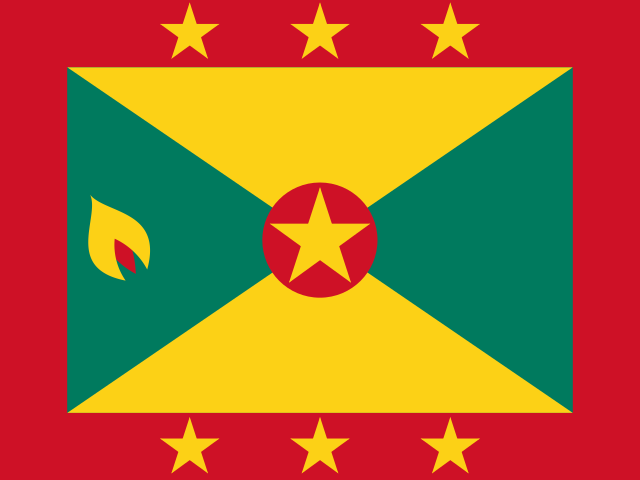
Grenada's flag is one of the busiest in the Caribbean. A red border carries six gold stars – three along the top and three along the bottom. Inside, the field is split diagonally into yellow and green triangles, with a red disc and a seventh gold star in the centre. On the hoist side, in the green triangle, is a nutmeg pod.
Each of the seven stars represents one of Grenada's parishes. The nutmeg is the giveaway: no other national flag shows one.
A short history of Grenada
The first settlers came by canoe from South America, and by the time Europeans arrived the island was held by the Kalinago, sometimes called Island Caribs. Christopher Columbus sighted it in 1498 but did not land, and fierce Kalinago resistance kept Europeans away for more than a century.
The French settled in 1650, coming from Martinique. Fighting with the Kalinago ended in 1651 when, according to tradition, the last defenders leapt from a cliff in the north rather than surrender. The town there is still called Sauteurs, French for "leapers". The French turned the island into a sugar colony worked by enslaved Africans, and many place names, such as Grand Anse and Grand Étang, date from this time.
Britain took Grenada in the 1760s and, apart from a few years of French recapture, held it from 1783. In 1795 the planter Julien Fédon led a rebellion inspired by the French Revolution that controlled most of the island for over a year before it was crushed. Slavery ended in the 1830s, and in the 1840s nutmeg was introduced, eventually earning the island its "Spice Isle" name. Grenada governs the smaller islands of Carriacou and Petite Martinique to the north, which is why the country's map stretches into the Grenadines.
After independence, politics took a dramatic turn. In 1979 the left-wing New Jewel Movement seized power and Maurice Bishop led a revolutionary government with ties to Cuba. A split within the party in 1983 ended with Bishop's killing, which was followed by the US-led invasion. Parliamentary democracy was restored soon after.
In 2004 Hurricane Ivan damaged or destroyed most of the island's homes and flattened many nutmeg trees, a blow that took years to recover from. Today Grenada lives mainly from tourism, spices, cocoa and St George's University, a large medical school that draws students from North America.
Culture and daily life in Grenada
English is the official language and Grenadian Creole English is spoken every day. A French-based patois survives among some older people, another trace of the island's French past. Most Grenadians are Christian, with Roman Catholics the largest group.
Music is the soundtrack of daily life, especially calypso and soca. On Carriacou, the Big Drum dance preserves rhythms and songs linked to the African nations from which enslaved people were taken, and the island's carnival includes Shakespeare Mas, where costumed men compete by reciting speeches from Julius Caesar. Boatbuilders in the village of Windward still build wooden sloops by hand.
Cricket is a passion, but the island's greatest sporting moment came in 2012, when Kirani James won the Olympic 400 metres, Grenada's first Olympic medal. Local cocoa farmers also produce fine dark chocolate, and Grand Anse Beach, a long arc of white sand, is the island's pride. Fishermen in Gouyave hold a weekly Friday-night fish festival, where locals and visitors share grilled catch and music in the street.
Five facts worth knowing
- Grenada is one of the world's leading producers of nutmeg, which is why the spice appears on the flag.
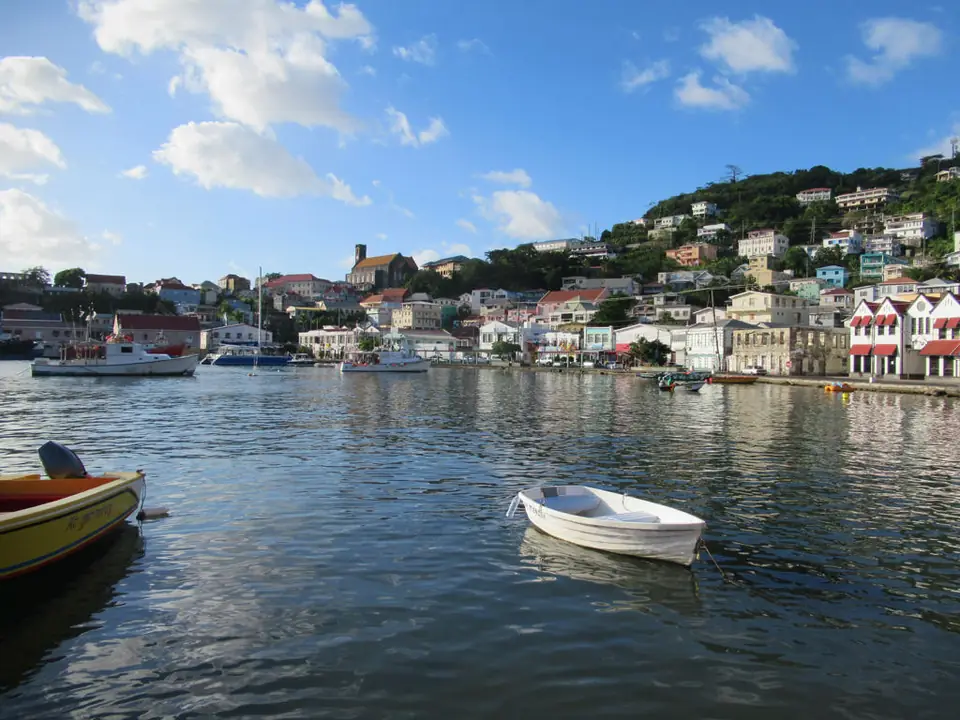
- St George's is the capital, built around the Carenage, one of the most photographed harbours in the Caribbean.
- Grenada became independent from Britain in 1974 and remains a Commonwealth realm.
- The United States invaded in 1983 after a coup, a short conflict still remembered on the island.
- The Molinere Underwater Sculpture Park, off the west coast, was the world's first underwater sculpture park, with life-size figures resting on the seabed.
Culture and traditions in Grenada
- Saying hello
A polite "Good morning" or "Good afternoon" is expected before any conversation.
- Food and drink
Oil down, the national dish of breadfruit, salted meat, callaloo and dumplings cooked in coconut milk; nutmeg in many treats.
- Festivals and traditions
Spicemas carnival in August; Independence Day on 7 February.
- Everyday life
Greeting everyone when you enter a shop or bus is good manners. Life moves at a relaxed island pace.
- Did you know?
Known as the "Spice Isle", Grenada features a nutmeg on its national flag.
Common mistakes
- Tapping St Vincent and the Grenadines, the next country north.
- Tapping Barbados, which lies off to the east on its own.
- Confusing Grenada with Granada, the city in southern Spain.
Practise with Grenada
- Caribbean quiz – the zoomed-in map is the only fair way to find an island this small.
- North America flags – the nutmeg and seven stars make Grenada's flag unmistakable.
- North America quiz – the Caribbean counts here, so Grenada is a tough target at the bottom of the island chain.
- North America capitals quiz – St George's.
- Mistake Bank – ideal for learning the order of the Windward Islands.
Quick check: how well do you know Grenada?
3 questions, no sign-up. Tap an answer.
1. Which flag belongs to Grenada?
That's the flag of Grenada.
2. What is the capital of Grenada?
The capital of Grenada is St. George's.
3. Which is bigger by area?
Honduras (112,492 km²) is bigger than Grenada (344 km²).
Keep going on the North America quiz – Grenada is one of 23 countries there.
More ways to practise: find Grenada on the blank map with no borders (hard mode), or play today's Globe and the other daily puzzles.
Frequently asked questions about Grenada
What language is spoken in Grenada?
English is the official language. Many Grenadians also speak Grenadian Creole English in daily life, and a few older people in rural areas still speak a French-based Creole, a legacy of French rule.
What currency does Grenada use?
Grenada uses the East Caribbean dollar (XCD), shared with seven other Eastern Caribbean states. It has been pegged to the US dollar at 2.70 since 1976.
What time zone is Grenada in?
Grenada uses Atlantic Standard Time, UTC−4, all year. It does not use daylight saving time. It shares its clock with the other Windward Islands, which is one hour ahead of New York in winter and the same in summer.
Which side of the road do they drive on in Grenada?
Grenadians drive on the left, a legacy of British rule. Visitors need a local driving permit, and many roads are narrow, steep and winding. Minibuses are the main public transport.
What is the highest point in Grenada?
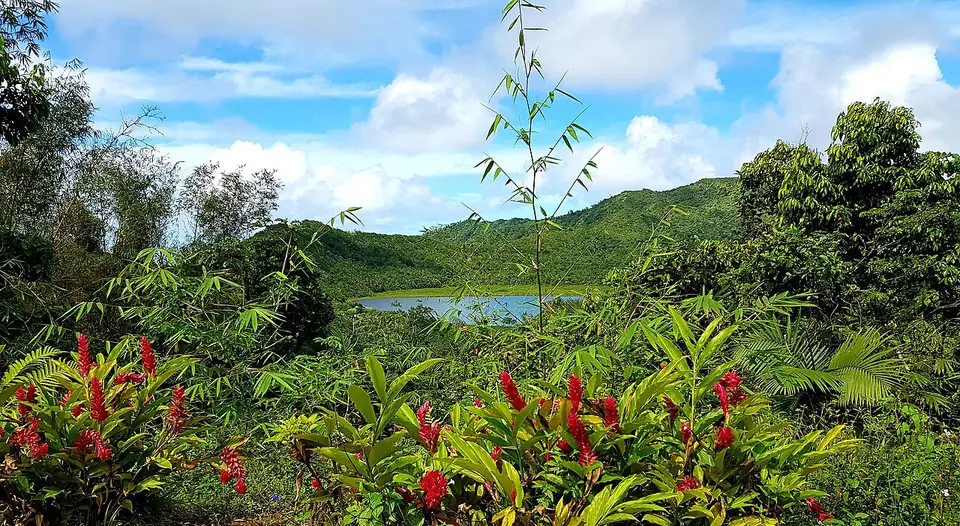
Mount St. Catherine, an extinct volcano in the north of the main island, is the highest point at about 840 metres. The mountainous interior also holds the crater lake of Grand Etang.
Which islands belong to Grenada?
The country is made up of the main island of Grenada and the smaller islands of Carriacou and Petite Martinique to the north-east. They are the southernmost of the Grenadines; the rest of the chain belongs to Saint Vincent and the Grenadines.
Quizzes with Grenada
Guides that help with this
- The 25 hardest countries to find on a mapPacific islands, Caribbean islands and landlocked Africa – where they are.
- All 50 US states on the map, region by regionThe ordering tricks that make the states stick.
- Flags that look alike (and how to tell them apart)Chad or Romania? Australia or New Zealand? The flag pairs that cost quiz points.