Iceland
Capital: Reykjavik. Iceland is one of the 46 countries in the Europe quiz.
Quick answers: What is the capital of Iceland? · Which countries border Iceland?
Facts about Iceland
- CapitalReykjavik
- Population392,404
- Area103,000 km²
- RegionsEurope, The Nordics
- LanguageIcelandic
- CurrencyIcelandic króna (ISK)
Iceland is the 41st most populous of the 46 countries in Europe and the 16th largest by area. Worldwide it ranks 174th by population and 106th by area.
Where is Iceland?
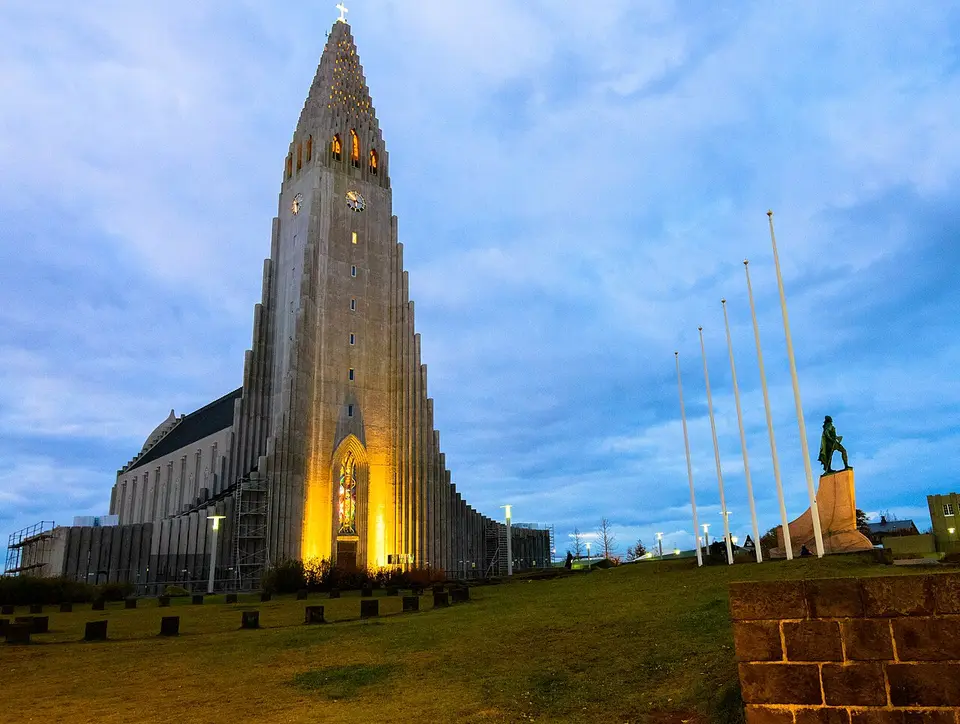
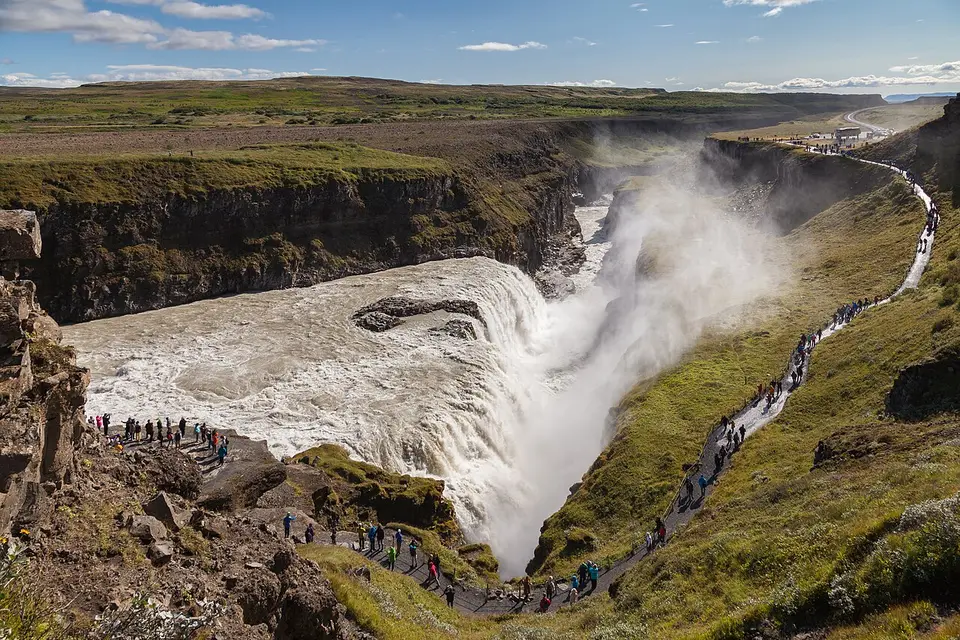
Iceland is an island in the North Atlantic, alone between Greenland and Norway, just south of the Arctic Circle. Its nearest neighbours are Greenland to the north-west, across the Denmark Strait, and the Faroe Islands to the south-east. Scotland is about 800 km away to the south-east, and Norway lies further east across the Norwegian Sea. Reykjavík, the capital and by far the largest town, is on the south-west coast on Faxaflói bay – the northernmost capital of a sovereign state.
On a world map, find the big white blob of Greenland and look to its right. The island about a third of the way to Norway is Iceland.
How to find Iceland on the map
- Start from Greenland. Iceland is the island just off Greenland's south-eastern coast.
- Look for the lonely island. Iceland is the only large landmass in the North Atlantic between Greenland and mainland Europe.
- Check the latitude. It sits at around 64–66° north, level with northern Norway and Alaska, so it is well up the map.
- Don't confuse it with Ireland. The names look alike in English, but Ireland is next to Britain, far to the south-east. Iceland has nothing beside it.
Flag
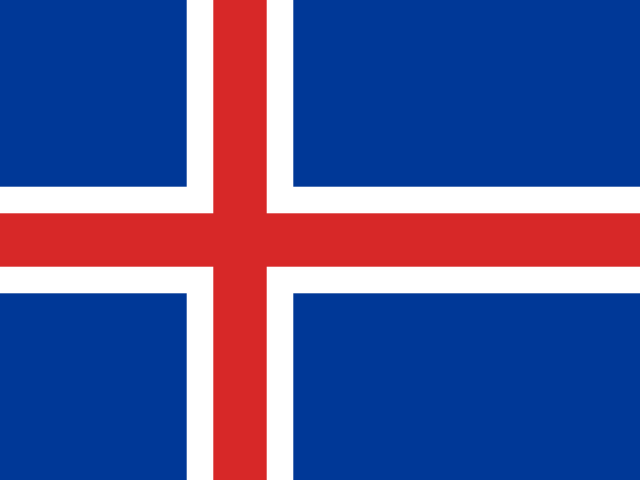
A blue field with a red Nordic cross outlined in white, the cross shifted towards the hoist. Blue is the sea and sky, white the snow and ice, and red the volcanic fire. The flag was adopted in 1915 and became the national flag at independence from Denmark in 1944.
The Nordic cross family is the trap. Norway's flag has the same three colours but reversed – red field with a blue cross outlined in white. A blue background with a red cross is Iceland; a red background with a blue cross is Norway.
A short history of Iceland
Iceland was one of the last places in Europe to be settled. Irish monks may have visited first, but permanent settlement began around 874, when, according to the sagas, the Norwegian chieftain Ingólfur Arnarson made his home at Reykjavík. Within sixty years the habitable coast was claimed, mostly by Norse families, many bringing Irish and Scottish people with them as wives or slaves. Around the year 1000 the assembly decided that the country would become Christian.
The early centuries, known as the Commonwealth, had no king. Chieftains settled disputes at assemblies, and this age produced the sagas, written down in the 1200s. Feuds between powerful families eventually tore the system apart, and in 1262–64 Icelanders accepted the rule of the Norwegian king. When Norway joined a union with Denmark, Iceland came under Danish rule for more than five centuries.
These were hard times. The Reformation imposed Lutheranism in 1550, a Danish trade monopoly from 1602 to 1787 kept the island poor, and the Laki eruption of 1783–84 poisoned livestock and caused a famine that killed about a fifth of the population. In the 1800s a national movement led by Jón Sigurðsson pushed for self-rule. Iceland won home rule in 1904 and became a sovereign kingdom sharing Denmark's king in 1918, before declaring a republic in 1944 while Denmark was occupied.
British troops landed in 1940, followed by American forces, and Iceland became a founding member of NATO in 1949. In the Cod Wars of the 1950s to 1970s, Iceland's coastguard clashed with the Royal Navy as it extended its fishing limits to 200 nautical miles – and won. In 2008 its three main banks collapsed, triggering a deep crisis from which the country recovered surprisingly fast.
Today fishing, tourism and aluminium smelting, powered by cheap renewable energy, are the pillars of the economy.
Culture and daily life in Iceland
Icelandic has changed so little since Viking times that schoolchildren can read the medieval sagas with modest effort. Rather than borrowing foreign words, Icelanders coin their own: a computer is a tölva, from words for "number" and "prophetess". Most people belong to the Lutheran Church of Iceland, though many are not religious in practice.
Literature is a national passion. Njáls saga is the most famous of the sagas, and Halldór Laxness won the Nobel Prize in Literature in 1955. Every Christmas brings the Jólabókaflóð, the "Christmas book flood", when new books are given as presents and read on Christmas Eve. Music punches far above the population, from Björk to Sigur Rós and Of Monsters and Men.
Folklore is still alive: road projects have been rerouted out of respect for rocks said to house elves, and children await thirteen mischievous Yule Lads in December. In 2016 the men's football team reached the European Championship quarter-finals, beating England along the way, and the "Viking clap" of their fans became famous.
Five facts worth knowing
- Iceland sits on the Mid-Atlantic Ridge, where the North American and Eurasian tectonic plates pull apart. That is why it has around 30 active volcanic systems and so many geysers and hot springs.
- Almost all of Iceland's electricity comes from renewable sources – hydropower and geothermal – and geothermal water heats most homes.
- Vatnajökull is the largest glacier in Europe by volume, covering around 8 per cent of the country.
- Iceland has no standing army and is one of the least densely populated countries in Europe, with under 400,000 people.
- The Althing, Iceland's parliament, was founded in 930 at Þingvellir and is often cited as one of the oldest parliaments in the world.
Culture and traditions in Iceland
- Saying hello
A simple "Hæ" or "Góðan dag" with a handshake; people use first names, even with officials.
- Food and drink
Lamb soup (kjötsúpa); skyr, a thick cultured dairy product; fermented shark (hákarl) for the brave.
- Festivals and traditions
Þorrablót midwinter feasts in January-February; National Day on 17 June.
- Everyday life
Showering without a swimsuit before entering pools is required. Tipping is not expected.
- Did you know?
Most Icelanders have patronymic surnames, so a person's last name is their father's or mother's first name plus -son or -dóttir.
Common mistakes
- Tapping Ireland because of the similar name.
- Tapping the Faroe Islands, the small cluster between Iceland and Norway, or Svalbard, the archipelago far to the north-east.
- Picking Norway's flag in the Flags quiz – remember Iceland is blue with red, Norway is red with blue.
Practise with Iceland
- Europe quiz – the island in the top-left corner of the map, east of Greenland.
- Nordics quiz – only five countries, so Iceland is the one off on its own in the Atlantic.
- Europe flags – sort out the five Nordic crosses, with Iceland and Norway as the pair to drill.
- Europe capitals quiz – Reykjavík.
- Mystery Country – the rounded island with the deeply fjorded Westfjords peninsula in the north-west.
Quick check: how well do you know Iceland?
3 questions, no sign-up. Tap an answer.
1. Which flag belongs to Iceland?
That's the flag of Iceland.
2. What is the capital of Iceland?
The capital of Iceland is Reykjavik.
3. Which is bigger by area?
Iceland (103,000 km²) is bigger than Luxembourg (2,586 km²).
Keep going on the Europe quiz – Iceland is one of 46 countries there.
More ways to practise: find Iceland on the blank map with no borders (hard mode), or play today's Globe and the other daily puzzles.
Frequently asked questions about Iceland
What language is spoken in Iceland?
The national language is Icelandic, a North Germanic language that has changed so little that Icelanders can still read the medieval sagas. A committee creates new Icelandic words for modern things rather than borrowing them. English is widely spoken, and Danish is taught in schools.
What currency does Iceland use?
Iceland uses the Icelandic króna (ISK), one of the smallest independent currencies in the world. Its value floats and fell sharply in the 2008 banking crisis. Card payments are so common that many Icelanders rarely handle cash.
What time zone is Iceland in?
Iceland is on UTC+0, Greenwich Mean Time, all year and does not use daylight saving time. Because it lies far to the west of Greenwich, its clocks run well ahead of the sun, so it stays light until late in the evening.
Which side of the road do they drive on in Iceland?
Iceland drives on the right. It switched from the left on 26 May 1968, a day known in Icelandic as H-dagurinn, "H-day", following Sweden's switch the year before. The Ring Road circles the whole island.
What is the highest point in Iceland?
The highest point is Hvannadalshnúkur, about 2,110 metres, on the rim of the ice-covered Öræfajökull volcano at the southern edge of the Vatnajökull ice cap. Climbers usually reach it in a long single day on the glacier.
Is Iceland in the EU?
No. Iceland is not a member of the European Union, but it belongs to the European Economic Area, which gives it access to the EU single market, and to the Schengen area. It applied to join the EU in 2009 but later dropped the bid.
Quizzes with Iceland
Often confused with
Guides that help with this
- All 46 European capitals, with a memory trick for eachCapitals grouped by region, with hooks for the ones people forget.
- Flags that look alike (and how to tell them apart)Chad or Romania? Australia or New Zealand? The flag pairs that cost quiz points.
- The 25 hardest countries to find on a mapPacific islands, Caribbean islands and landlocked Africa – where they are.