Malta
Capital: Valletta. Malta is one of the 46 countries in the Europe quiz.
Quick answers: What is the capital of Malta? · Which countries border Malta?
Facts about Malta
- CapitalValletta
- Population579,704
- Area316 km²
- RegionEurope
- LanguagesMaltese, English
- CurrencyEuro (EUR)
Malta is the 40th most populous of the 46 countries in Europe and the 42nd largest by area. Worldwide it ranks 168th by population and 188th by area.
Where is Malta?
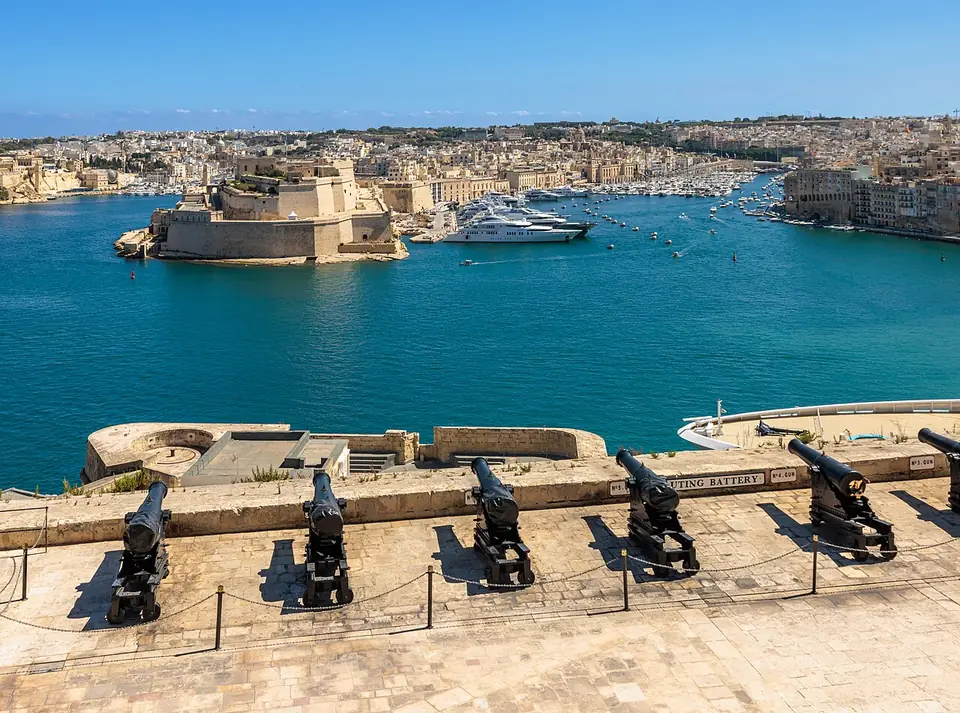
Malta is a small island country in the central Mediterranean, about 90 km south of Sicily and roughly 300 km north of Libya. It consists of three inhabited islands – Malta, Gozo and Comino – plus a few islets. The capital, Valletta, is on the main island's north-east coast, overlooking one of the finest natural harbours in Europe. The whole country is only about 316 square kilometres.
On a world map, find the toe of Italy and the island of Sicily below it. Malta is the speck just south of Sicily, roughly in the middle of the Mediterranean between Europe and Africa.
How to find Malta on the map
- Start from Sicily. Malta is directly south of it, a short way across the sea.
- Find the middle of the Mediterranean. Malta sits about halfway between Gibraltar and Lebanon, and between Sicily and Libya.
- Zoom in. At continent zoom it is a dot. Aim just below Sicily and let the map magnify.
- Don't confuse it with Cyprus. Cyprus is a far larger island at the eastern end of the Mediterranean, near Turkey.
Flag
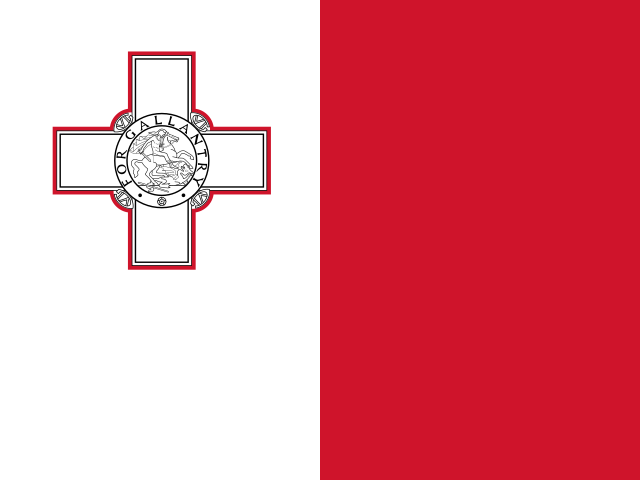
Malta's flag is two vertical bands, white at the hoist and red at the fly, with the George Cross outlined in red in the top-left corner of the white band. The George Cross was awarded to the whole island by King George VI in 1942 for its resistance during wartime bombing, and it was added to the flag at independence in 1964.
The nearest lookalikes are Poland and Indonesia, which are red and white but horizontal, and Monaco. Vertical white and red with a small grey cross in the corner is Malta.
A short history of Malta
Farmers from Sicily reached Malta nearly 8,000 years ago, and their descendants later built temples and carving the Ħal Saflieni Hypogeum, an underground burial complex cut into solid rock. Later came the Phoenicians, who used the deep harbours as a trading stop, followed by Carthage and then Rome, which took the islands in 218 BC. Tradition holds that Saint Paul was shipwrecked here around AD 60 and brought Christianity with him.
Arab rule began in 870 and lasted about two centuries. It left a lasting mark, because the Maltese language grew out of the Arabic spoken in this period. The Normans of Sicily arrived in 1091, and for the next four centuries Malta was passed between European rulers along with Sicily.
In 1530 the Holy Roman Emperor Charles V granted the islands to the Knights of St John, a religious military order that had been driven out of Rhodes. The Knights fortified the harbours, built Valletta and ruled for over 250 years. Their rule ended in 1798, when Napoleon seized Malta on his way to Egypt. The Maltese rose against the French and asked Britain for help, and British troops took control in 1800.
Under the British, Malta became a major naval base, the "fortress" guarding the route between Gibraltar and the Suez Canal. During the Second World War it was one of the most heavily bombed places on Earth, as Axis forces tried to cut British supply lines to North Africa. After independence, Malta became a republic in 1974, and the last British forces left on 31 March 1979, a date still marked as Freedom Day.
Malta joined the European Union in 2004 and adopted the euro in 2008. Its small economy now rests on tourism, financial services, shipping and online gaming, and its central position in the Mediterranean still shapes its politics and trade.
Culture and daily life in Malta
The Maltese language tells the islands' story in a single sentence. Its grammar and everyday words come from Arabic, but a large share of its vocabulary is borrowed from Sicilian and Italian, and more recent words from English. Most Maltese switch easily between Maltese and English, and many also understand Italian from years of watching Italian television.
The Catholic Church remains at the centre of community life, and the islands have hundreds of churches for a population smaller than many European cities. The Rotunda of Mosta has one of the largest church domes in Europe. St John's Co-Cathedral in Valletta holds Caravaggio's Beheading of Saint John the Baptist, the only painting he ever signed. Inland, the walled hilltop town of Mdina, once the capital, is nicknamed the "Silent City".
Along the shore, brightly painted fishing boats called luzzu carry a pair of eyes on the bow, a custom often traced back to the Phoenicians. Traditional folk singing, known as għana, is improvised in rhyming verse. Football is followed passionately, with many fans supporting English or Italian clubs. Malta's old forts and streets have also become a favourite set for films and television, from Gladiator to Game of Thrones.
Five facts worth knowing
- Malta is the smallest member state of the European Union by area, and one of the most densely populated countries in the world.
- Valletta was built by the Knights of St John after the Great Siege of 1565, and the whole city is a UNESCO World Heritage site.
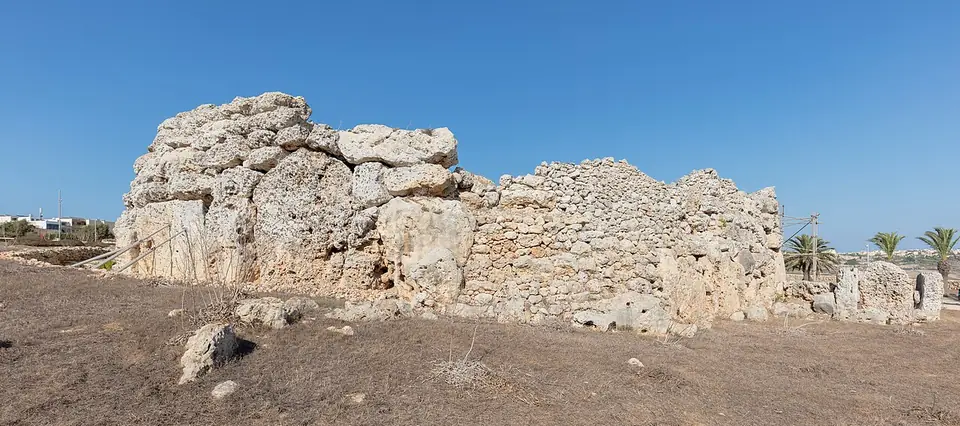
- The megalithic temples of Malta, such as Ġgantija on Gozo, are older than Stonehenge and the Egyptian pyramids.
- Maltese is the only Semitic language written in the Latin alphabet and the only one that is an official EU language. English is co-official.
- Malta was a British colony from 1814 to 1964, which is why cars drive on the left and English is so widely spoken.
Culture and traditions in Malta
- Saying hello
"Bonġu" (good morning) in Maltese, or simply "hello" in English, which is also an official language.
- Food and drink
Pastizzi, flaky pastries filled with ricotta or mushy peas, and stuffat tal-fenek, a slow-cooked rabbit stew.
- Festivals and traditions
Village festi in summer honour patron saints with fireworks and brass bands; Carnival takes place in February.
- Everyday life
Family Sunday lunches are a big tradition. Traffic drives on the left, a legacy of British rule.
- Did you know?
Maltese is the only Semitic language that is an official language of the EU and is written in the Latin alphabet.
Common mistakes
- Tapping Sicily, which is part of Italy, instead of the small island below it.
- Confusing Malta with Cyprus at the other end of the sea.
- Picking Poland's or Monaco's flag in the Flags quiz.
Practise with Malta
- Europe quiz – a tiny target south of Sicily. Zoom in before you tap.
- Europe flags – white and red, vertical, with the George Cross.
- Europe capitals quiz – Valletta.
- Mystery Country – a cluster of three small islands, the largest shaped like a fish pointing south-east.
- Italian Regions – Sicily, Malta's nearest neighbour, is one of the 20 regions.
Quick check: how well do you know Malta?
3 questions, no sign-up. Tap an answer.
1. Which flag belongs to Malta?
That's the flag of Malta.
2. What is the capital of Malta?
The capital of Malta is Valletta.
3. Which is bigger by area?
Kosovo (10,908 km²) is bigger than Malta (316 km²).
Keep going on the Europe quiz – Malta is one of 46 countries there.
More ways to practise: find Malta on the blank map with no borders (hard mode), or play today's Globe and the other daily puzzles.
Frequently asked questions about Malta
What language is spoken in Malta?
Malta has two official languages, Maltese and English. Maltese is the national language and the one most people speak at home, while English is used widely in business, education and tourism. Italian is also understood by many Maltese, thanks to decades of Italian television.
What currency does Malta use?
Malta uses the euro (EUR), which replaced the Maltese lira on 1 January 2008. Maltese euro coins carry national designs, including the Maltese cross, the island's coat of arms and the Mnajdra temple on the smallest coins.
What time zone is Malta in?
Malta follows Central European Time, UTC+1, in winter. Like other EU countries it switches to Central European Summer Time, UTC+2, from the last Sunday in March to the last Sunday in October.
Which side of the road do they drive on in Malta?
Malta drives on the left, a legacy of British rule, and is one of only a handful of EU countries to do so, along with Ireland and Cyprus. Car hire is popular for reaching the quieter coasts of Malta and Gozo.
What is the highest point in Malta?
Ta' Dmejrek, on the Dingli Cliffs in the south-west of the main island, is Malta's highest point at about 253 metres. The cliffs drop steeply to the sea, giving views across to the islet of Filfla.
What are the Megalithic Temples of Malta?
They are a group of prehistoric stone temples built between about 3600 and 2500 BC. The Ġgantija temples on Gozo are older than Stonehenge and the Egyptian pyramids, making them among the oldest free-standing structures on Earth. They are a UNESCO World Heritage site.
Quizzes with Malta
Guides that help with this
- All 46 European capitals, with a memory trick for eachCapitals grouped by region, with hooks for the ones people forget.
- Flags that look alike (and how to tell them apart)Chad or Romania? Australia or New Zealand? The flag pairs that cost quiz points.
- The 25 hardest countries to find on a mapPacific islands, Caribbean islands and landlocked Africa – where they are.