Marshall Islands
Capital: Majuro. The Marshall Islands is one of the 14 countries in the Oceania quiz.
Quick answers: What is the capital of the Marshall Islands? · Which countries border the Marshall Islands?
Facts about the Marshall Islands
- CapitalMajuro
- Population36,282
- Area181 km²
- RegionOceania
- LanguagesEnglish, Marshallese
- CurrencyUS dollar (USD)
The Marshall Islands is the 11th most populous of the 14 countries in Oceania and the 12th largest by area. Worldwide it ranks 192nd by population and 191st by area.
Where is the Marshall Islands?
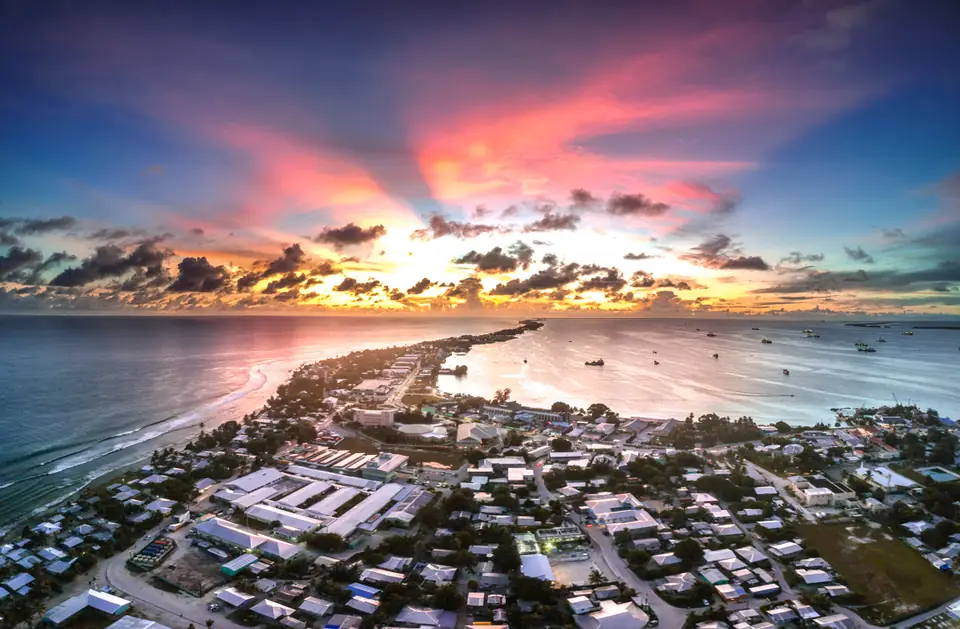
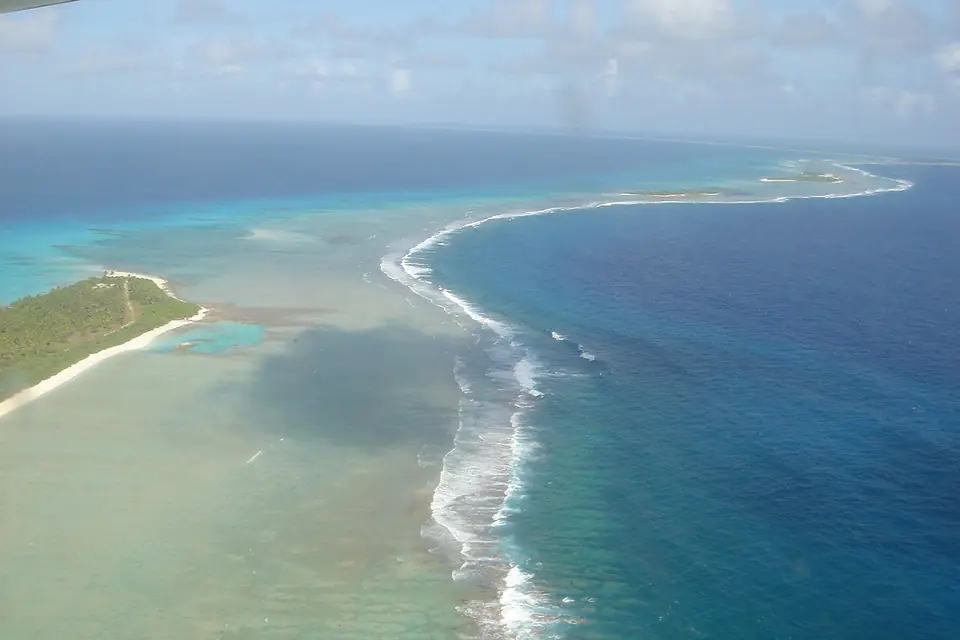
The Marshall Islands is a country of low coral atolls in the central Pacific, roughly halfway between Hawaii and Australia and north of the equator. The islands form two parallel chains running north-west to south-east: the Ratak ("sunrise") chain in the east and the Ralik ("sunset") chain in the west. Its nearest neighbours are the Federated States of Micronesia to the west, Kiribati to the south-east and Nauru to the south-west. The capital, Majuro, is an atoll in the southern Ratak chain.
On a world map, find the empty stretch of Pacific between Papua New Guinea and Hawaii. The Marshall Islands are the scatter of dots in the north-eastern part of that region, above the equator and east of Micronesia.
How to find the Marshall Islands on the map
- Start from Micronesia. The Marshalls lie to its east, with Kiribati's Gilbert Islands to the south-east.
- Stay north of the equator. The whole country sits between about 4° and 15° north.
- Look for two lines of dots. The Ratak and Ralik chains run side by side.
- Don't confuse them with Kiribati. Kiribati straddles the equator and spreads far to the east; the Marshalls are a compact group above it.
Flag
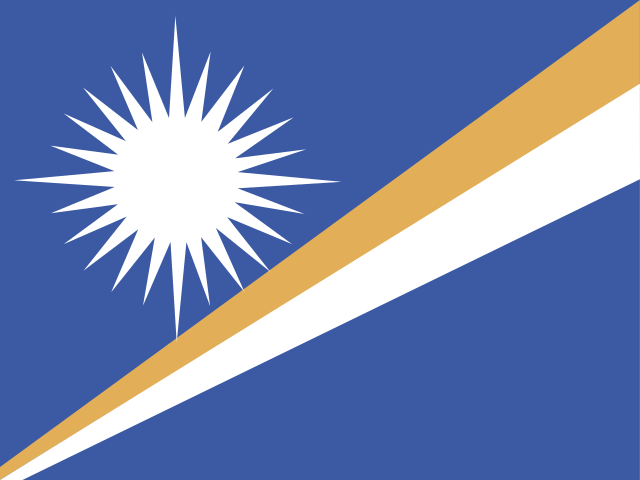
The flag is dark blue with two diagonal stripes, orange and white, rising from the bottom-left corner to the top-right, and a large white 24-pointed star in the upper-left. The blue is the Pacific, the two stripes are the two island chains, and the star's 24 points stand for the country's electoral districts. Four longer points form a cross for the Christian faith. It was adopted in 1979.
No other flag has that pair of widening diagonal stripes with a many-pointed star.
A short history of the Marshall Islands
The first Marshallese arrived by canoe at least two thousand years ago, part of the great Austronesian migrations across the Pacific. Living on atolls with little soil and no fresh rivers, they became expert navigators and farmers of breadfruit, pandanus and coconut. Society was organised around powerful chiefs, called iroij, who controlled land and the right to its harvest.
Spanish sailors sighted some of the atolls in the 1500s, but Europeans showed little interest for centuries. The islands take their English name from John Marshall, a British captain who sailed through in 1788. In the 1800s whalers, traders and American Protestant missionaries arrived, and the copra trade – dried coconut sold for its oil – drew the islands into the world economy.
Germany declared a protectorate over the Marshalls in 1885. At the start of the First World War, Japan seized them and later ran them under a League of Nations mandate, building bases on several atolls. In early 1944 American forces captured Kwajalein and Enewetak in some of the fiercest fighting of the Pacific war.
After the war the islands became part of the Trust Territory of the Pacific Islands, administered by the United States for the United Nations. This period brought the nuclear test programme and the forced relocation of the people of Bikini and Enewetak, whose descendants still seek compensation. As the trust territory broke up, the Marshalls chose to go their own way rather than join the Federated States of Micronesia, which is why two separate countries now sit side by side on the map. Self-government began in 1979, the Compact of Free Association with the United States took effect in 1986, and the country joined the UN in 1991.
Today the economy depends heavily on US funding, fishing licences and the ship registry. The Marshall Islands has become one of the loudest voices in global climate talks, arguing that rising seas threaten its very survival.
Culture and daily life in the Marshall Islands
Marshallese, a Micronesian language, is spoken in almost every home, with English used in government and schools. Society is matrilineal: land and clan membership pass down through the mother's line, and owning a share of land on one's home atoll is a key part of identity. Chiefs still hold a respected place alongside the elected parliament, which includes a council of traditional leaders.
Christianity, brought by American missionaries in the 1850s, is now part of daily life, and church choirs and Sunday services draw whole communities. A child's first birthday, known as kemem, is one of the biggest celebrations a family will hold, with feasts, singing and guests from across the atoll.
Weaving is a prized skill. Women make fine mats, fans and baskets from pandanus leaves and coconut fibre, and handicrafts made by the displaced people of Bikini, now living on Kili, are known across the region. Outrigger canoe building has been revived by training programmes for young people. Basketball and volleyball are the most popular sports. A large Marshallese community has also grown up in the United States, especially in Springdale, Arkansas.
Five facts worth knowing
- Bikini and Enewetak atolls were used by the United States for nuclear weapons tests between 1946 and 1958, including the largest US test ever, Castle Bravo in 1954. Bikini remains uninhabited.
- The country is in free association with the United States, which handles its defence, and Marshallese citizens can live and work in the US.
- Kwajalein Atoll hosts a US missile-testing range and one of the largest lagoons in the world.
- The average height of the land is about two metres above sea level, so sea-level rise threatens the whole nation.
- The Marshall Islands has one of the world's largest ship registries, with thousands of vessels flying its flag.
Culture and traditions in the Marshall Islands
- Saying hello
People greet with "Iakwe", which also means love and is used for goodbye too.
- Food and drink
Breadfruit, pandanus and fresh reef fish, often cooked in an underground oven; coconut is used in many dishes.
- Festivals and traditions
Manit Day (Culture Day) in late September celebrates Marshallese traditions; Constitution Day is 1 May.
- Everyday life
Community and extended family are central, and sharing food is expected. Modest dress is appreciated, especially for women.
- Did you know?
Marshallese navigators traditionally used stick charts, made from palm ribs and shells, to map ocean swells.
Common mistakes
- Tapping Micronesia or Kiribati, the island neighbours on either side.
- Missing the target because the atolls are tiny at full-ocean zoom.
- Looking south of the equator; the Marshalls are in the northern hemisphere.
Practise with the Marshall Islands
- Oceania quiz – the dots north-east of Micronesia, above the equator.
- Oceania flags – the orange and white diagonal with the 24-point star.
- Oceania capitals quiz – Majuro.
- Mystery Country – two faint parallel lines of specks.
- Mistake Bank – the Pacific micro-states are worth drilling together.
Quick check: how well do you know the Marshall Islands?
3 questions, no sign-up. Tap an answer.
1. Which flag belongs to the Marshall Islands?
That's the flag of the Marshall Islands.
2. What is the capital of the Marshall Islands?
The capital of the Marshall Islands is Majuro.
3. Which is bigger by area?
Australia (7,692,024 km²) is bigger than the Marshall Islands (181 km²).
Keep going on the Oceania quiz – Marshall Islands is one of 14 countries there.
More ways to practise: find the Marshall Islands on the blank map with no borders (hard mode), or play today's Globe and the other daily puzzles.
Frequently asked questions about the Marshall Islands
What language is spoken in the Marshall Islands?
Marshallese and English are both official. Marshallese, an Austronesian language, is spoken by almost everyone at home and in church, and each of the two island chains has its own dialect. English is used in government, business and higher education.
What currency does the Marshall Islands use?
The Marshall Islands has no currency of its own and uses the US dollar (USD). This reflects its close ties with the United States under the Compact of Free Association, which also provides much of the government's budget.
What time zone is the Marshall Islands in?
The Marshall Islands is on UTC+12 across the whole country and does not use daylight saving time. Being just west of the International Date Line, it is among the first places in the world to start each new day.
Which side of the road do they drive on in the Marshall Islands?
Vehicles drive on the right, following American practice. Most atolls have few roads or none at all; the main one runs along the length of Majuro, and boats and small planes connect the outer islands.
What is the highest point in the Marshall Islands?
The country's highest point is an unnamed spot on Likiep Atoll, only about 10 metres above sea level. That makes the Marshall Islands one of the lowest-lying nations on Earth, with no hills anywhere on its atolls.
How many atolls does the Marshall Islands have?
The country is made up of 29 coral atolls and 5 single islands, together containing over 1,000 islets. Kwajalein, in the Ralik chain, has one of the largest lagoons of any atoll in the world and hosts a US missile-testing range.
Quizzes with the Marshall Islands
Guides that help with this
- The 25 hardest countries to find on a mapPacific islands, Caribbean islands and landlocked Africa – where they are.
- Flags that look alike (and how to tell them apart)Chad or Romania? Australia or New Zealand? The flag pairs that cost quiz points.
- Learn all 197 countries in 30 daysA day-by-day plan: one region at a time, spaced repetition for review.