New Zealand
Capital: Wellington. New Zealand is one of the 14 countries in the Oceania quiz.
Quick answers: What is the capital of New Zealand? · Which countries border New Zealand?
Facts about New Zealand
- CapitalWellington
- Population5.3 million
- Area270,467 km²
- RegionOceania
- LanguagesEnglish, Māori
- CurrencyNew Zealand dollar (NZD)
New Zealand is the 3rd most populous of the 14 countries in Oceania and the 3rd largest by area. Worldwide it ranks 124th by population and 75th by area.
Where is New Zealand?
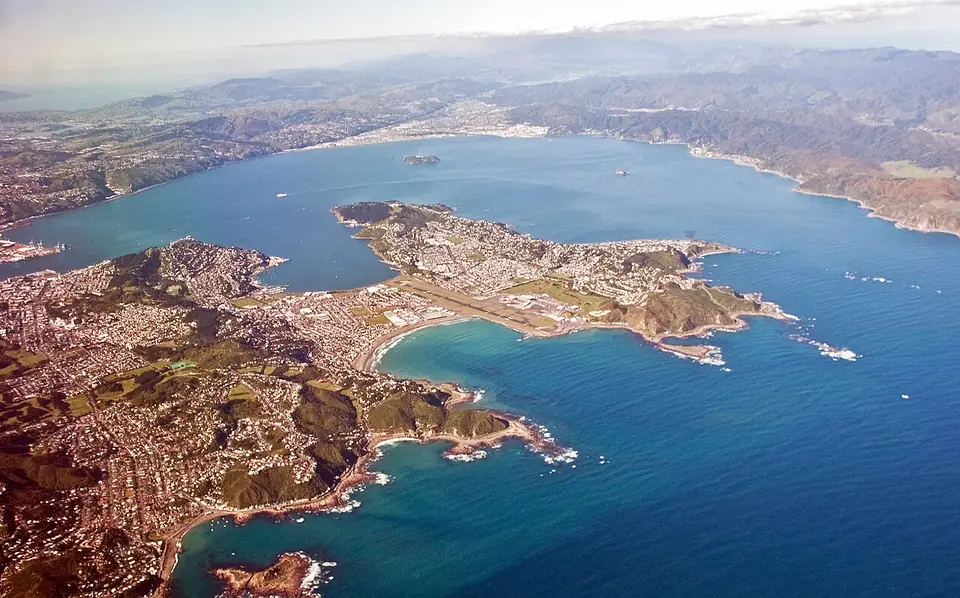
New Zealand sits alone in the south-western Pacific Ocean, about 2,000 km south-east of Australia across the Tasman Sea. It has no land borders at all. The country is made of two large islands – the North Island and the South Island – separated by the narrow Cook Strait, plus the smaller Stewart Island at the bottom. Wellington, the capital, sits at the southern tip of the North Island, right on Cook Strait. Auckland, the largest city, is further north.
On a world map, go to the bottom-right corner. Below and to the right of Australia, on the far side of the Tasman Sea, you'll see two long islands running diagonally from north-east to south-west. That's New Zealand.
How to find New Zealand on the map
- Start from Australia. New Zealand is the pair of islands to its south-east, with open sea between them.
- Look for the diagonal. The two islands together form a tilted shape, leaning the same way as a forward slash.
- Don't confuse it with Tasmania. Tasmania is a single, roughly triangular island tucked right under Australia's south-east corner. New Zealand is much further out and in two pieces.
- It's not Papua New Guinea. Despite the similar name, Papua New Guinea is north of Australia, near the equator. New Zealand is far to the south.
Flag
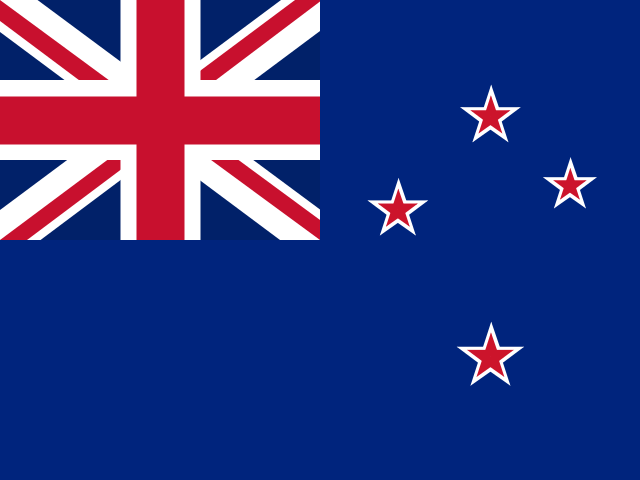
The New Zealand flag is a dark blue field with the Union Jack in the canton and four red, white-bordered five-pointed stars on the fly side, arranged as the Southern Cross constellation.
The obvious trap is Australia. Both flags are blue ensigns with the Union Jack and the Southern Cross, but Australia's stars are white and there are six of them, including the large Commonwealth Star under the Union Jack. New Zealand's version is simpler: four red stars, nothing else. Red stars means New Zealand; white stars and a big extra star means Australia.
A short history of New Zealand
New Zealand was one of the last major land masses on Earth to be settled by humans. Polynesian voyagers arrived by canoe from eastern Polynesia around the late 1200s, and their descendants became the Māori. They adapted to a much cooler climate than their tropical homeland, hunted the giant moa to extinction, and organised themselves into iwi, or tribes, often building fortified hilltop villages called pā.
The Dutch explorer Abel Tasman reached the coast in 1642, and the country's name comes from the Dutch province of Zeeland. More than a century later, James Cook sailed around both islands in 1769–70 and mapped them in detail. Whalers, sealers, traders and missionaries followed. The arrival of muskets fuelled the destructive Musket Wars between Māori tribes in the early 1800s.
In 1840 British officials and many Māori chiefs signed the Treaty of Waitangi, which made New Zealand a British colony. The English and Māori versions differ in important ways, especially over whether chiefs gave up sovereignty or only governance, and this remains central to the country's politics. As settlers poured in, disputes over land led to the New Zealand Wars of the 1840s to 1870s, and vast areas of Māori land were confiscated or sold. The capital moved from Auckland to Wellington in 1865, partly because of its central position between the two main islands.
Refrigerated shipping, from 1882, allowed meat and butter to be sent to Britain, which built the farming economy. New Zealand became a dominion in 1907 and fought alongside Britain in both world wars; the losses at Gallipoli in 1915 helped shape its national identity. A welfare state was created in the 1930s. When Britain joined the European Community in 1973, New Zealand lost its main market and had to find new ones. In the 1980s it declared itself nuclear-free, and from the 1970s the Waitangi Tribunal began addressing Māori land claims.
Today New Zealand is a prosperous, export-driven economy built on dairy, meat, wine, tourism and film, with close ties across the Pacific and Asia.
Culture and daily life in New Zealand
Te reo Māori was once discouraged in schools, but a revival since the 1970s has brought it back through Māori-language preschools, radio and television, and many place names now appear in both languages. Most people speak English with a distinctive accent. Christianity was historically dominant, but around half the population now says it has no religion.
Rugby is close to a national religion, and the All Blacks perform the haka, a Māori challenge dance, before every match. Sailing, netball and cricket are also hugely popular. Edmund Hillary, one of the first two climbers to reach the summit of Everest, appears on the five-dollar note.
New Zealand's landscapes reached global audiences through Peter Jackson's The Lord of the Rings films. In literature, Katherine Mansfield is one of the masters of the short story, and Keri Hulme won the Booker Prize for The Bone People. The singer Lorde became an international star. Māori carving and tā moko, traditional tattooing of the face and body, have seen a strong revival, and the marae, a tribal meeting ground, remains central to Māori life.
Five facts worth knowing
- Wellington is the southernmost capital city of any sovereign country in the world.
- New Zealand was the first country to give women the vote, in 1893.
- The Māori name for the country is Aotearoa, often translated as "land of the long white cloud". Māori and English are both official languages, alongside New Zealand Sign Language.
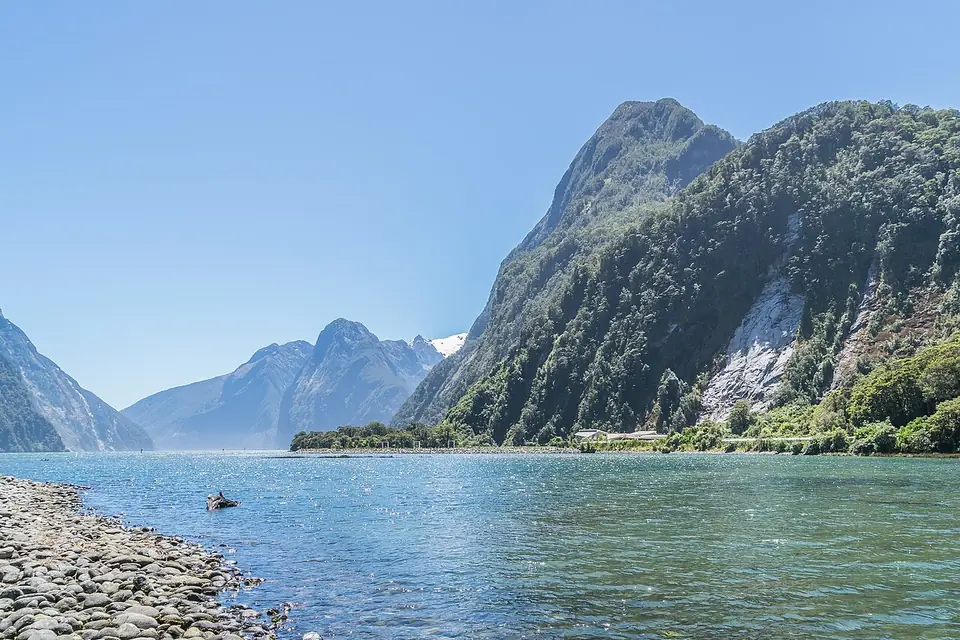
- The highest peak is Aoraki / Mount Cook, at 3,724 metres, in the Southern Alps that run down the spine of the South Island.
- The kiwi is a flightless bird found nowhere else, and "Kiwi" is also what New Zealanders call themselves.
Culture and traditions in New Zealand
- Saying hello
"Kia ora" is a common Māori greeting; the hongi, pressing noses, is used at formal Māori welcomes.
- Food and drink
Hāngī, food slow-cooked in an earth oven, and pavlova, a meringue dessert; flat whites are a café staple.
- Festivals and traditions
Waitangi Day on 6 February; Matariki, the Māori New Year, is a public holiday in June or July.
- Everyday life
Life is casual and outdoorsy; walking barefoot in shops is not unusual. Tipping is not expected.
- Did you know?
In 1893, New Zealand became the first self-governing country to give all women the right to vote.
Common mistakes
- Tapping Tasmania instead of New Zealand.
- Mixing up the Australian and New Zealand flags – count the stars and check their colour.
- Forgetting that Stewart Island, at the bottom of the South Island, is part of the outline.
Practise with New Zealand
- Oceania quiz – the big two-island shape to the right of Australia; one of the easiest countries in the region to find.
- Oceania flags – learn to split New Zealand from Australia and from the other Southern Cross flags of the Pacific.
- Oceania capitals quiz – Wellington, not Auckland.
- Mystery Country – two long diagonal islands with a narrow strait between them is a giveaway once you've seen it.
Quick check: how well do you know New Zealand?
3 questions, no sign-up. Tap an answer.
1. Which flag belongs to New Zealand?
That's the flag of New Zealand.
2. What is the capital of New Zealand?
The capital of New Zealand is Wellington.
3. Which is bigger by area?
Papua New Guinea (462,840 km²) is bigger than New Zealand (270,467 km²).
Keep going on the Oceania quiz – New Zealand is one of 14 countries there.
More ways to practise: find New Zealand on the blank map with no borders (hard mode), or play today's Globe and the other daily puzzles.
Frequently asked questions about New Zealand
What language is spoken in New Zealand?
English is spoken by almost everyone and is the main language of daily life. Te reo Māori became an official language in 1987 and New Zealand Sign Language in 2006. Māori words such as kia ora and whānau are widely used in everyday English.
What currency does New Zealand use?
New Zealand uses the New Zealand dollar (NZD), introduced in 1967 to replace the pound. It is also the currency of the Cook Islands, Niue, Tokelau and the Pitcairn Islands, and is nicknamed the "kiwi" on currency markets.
What time zone is New Zealand in?
New Zealand uses UTC+12 in winter and UTC+13 during daylight saving, from the last Sunday in September to the first Sunday in April. The Chatham Islands are 45 minutes ahead of the mainland.
Which side of the road do they drive on in New Zealand?
New Zealand drives on the left. Many roads are winding two-lane highways through hills and mountains, and some still have one-lane bridges where drivers must give way.
What is the highest point in New Zealand?
Aoraki / Mount Cook, in the Southern Alps, is the highest point at 3,724 metres. It used to be taller: a huge rock avalanche in 1991 knocked about 10 metres off its summit, and erosion has lowered it further since.
Why are New Zealanders called Kiwis?
The name comes from the kiwi, a flightless, nocturnal bird found only in New Zealand and used as a national emblem since the 1800s. New Zealand soldiers were called Kiwis during the First World War, and the nickname spread to everyone.
Quizzes with New Zealand
Often confused with
Guides that help with this
- The 25 hardest countries to find on a mapPacific islands, Caribbean islands and landlocked Africa – where they are.
- Flags that look alike (and how to tell them apart)Chad or Romania? Australia or New Zealand? The flag pairs that cost quiz points.
- Learn all 197 countries in 30 daysA day-by-day plan: one region at a time, spaced repetition for review.