Palau
Capital: Ngerulmud. Palau is one of the 14 countries in the Oceania quiz.
Quick answers: What is the capital of Palau? · Which countries border Palau?
Facts about Palau
- CapitalNgerulmud
- Population17,663
- Area459 km²
- RegionOceania
- LanguagesPalauan, English
- CurrencyUS dollar (USD)
Palau is the 12th most populous of the 14 countries in Oceania and the 11th largest by area. Worldwide it ranks 194th by population and 182nd by area.
Where is Palau?
Palau is a small island country in the western Pacific Ocean, in the region of Micronesia. It lies about 800 km east of the Philippines and around 900 km north of Indonesia's West Papua, at the western end of the Caroline Islands chain. The Federated States of Micronesia are to the east. Palau's capital is Ngerulmud on the large island of Babeldaob, although most people live in Koror, the former capital, just to the south.
On a world map, find the Philippines, then move east into the open Pacific. The first small cluster of islands you reach, before the longer spread of Micronesia, is Palau.
How to find Palau on the map
- Start from the Philippines. Palau is the nearest island country to the east of Mindanao.
- Find Micronesia. Palau sits at the far western end of the long Caroline Islands line, just before the Federated States of Micronesia.
- Look for a tight cluster. Palau's main islands are grouped close together, unlike the widely scattered atolls further east.
- Don't confuse it with Guam. Guam is a US territory to the north-east and is not on the quiz; Palau is further south-west.
Flag
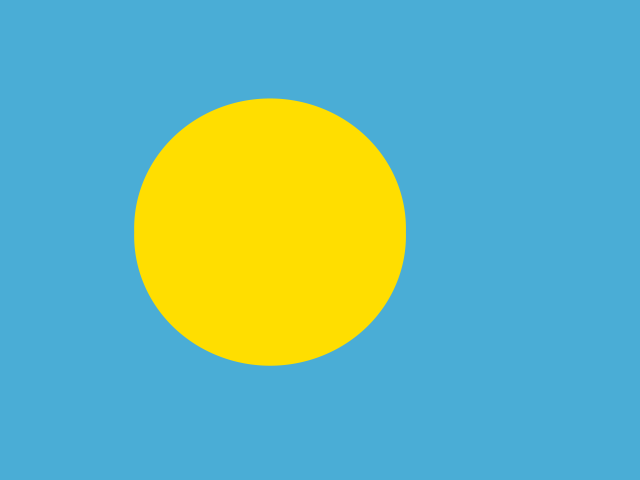
Palau's flag is a light blue field with a yellow disc placed slightly towards the hoist. The blue stands for the ocean and the yellow disc for the full moon, which is important in Palauan culture for timing fishing and planting.
It looks a little like Japan's flag with the colours swapped – blue field, yellow circle, off-centre. Bangladesh has a red disc on green, also off-centre. If the field is light blue and the circle is yellow, it's Palau.
A short history of Palau
People reached Palau by canoe around 3,000 years ago or more, probably from the islands of South-east Asia. They built a society of villages organised around clans, with chiefs whose titles passed through the mother's line. On Babeldaob, they shaped whole hillsides into great earthwork terraces whose purpose is still debated, and at Badrulchau, at the northern tip of the island, rows of carved stone monoliths still stand.
Palau also had an unusual role in Pacific trade. Its own people used pieces of glass and ceramic as valuable money, but the famous giant stone discs of Yap, to the east, were quarried and carved in Palau by visiting Yapese and carried home by canoe across hundreds of kilometres of open sea. Europeans only made lasting contact in 1783, when a British ship, the Antelope, was wrecked on the reef and its crew were helped by the high chief of Koror.
Spain claimed the islands in the late 1800s but did little with them, and in 1899 sold them to Germany, which started phosphate mining on Angaur. Japan took Palau in 1914 and ruled it under a League of Nations mandate. Koror became the administrative capital of Japan's whole Pacific island territory, and by the late 1930s Japanese settlers greatly outnumbered Palauans. In 1944, during the Second World War, American forces landed on Peleliu, and the battle there was one of the bloodiest of the Pacific war.
After the war, Palau became part of the US-run Trust Territory of the Pacific Islands. In 1978 Palauans voted not to join the Federated States of Micronesia, then wrote their own constitution, which took effect in 1981. A long dispute followed over a clause banning nuclear material, which clashed with US defence plans, and it took many referendums before the Compact of Free Association was approved.
Today Palau's economy rests on tourism, especially diving, along with aid linked to its compact with the United States. It is known worldwide for protecting its seas.
Culture and daily life in Palau
Palauan and English are both official languages, and Japanese loanwords in Palauan, along with Japanese family names, are a reminder of the colonial era. Most people are Christian, mainly Roman Catholic or Protestant, while Modekngei, a local faith that blends Christian and traditional beliefs, also has followers.
The most famous building is the bai, the traditional men's meeting house, with a tall, steep roof and gables painted with stories from legend and history. These painted beams inspired Palau's best-known craft, the storyboard, a wooden plank carved with scenes from myths. Women hold great authority in clan affairs, choosing and advising chiefs, and family events such as a first-child ceremony involve large exchanges of food and money between clans. Basketball and baseball, legacies of the American and Japanese periods, are both very popular. Traditional navigation and canoe building are being revived, and outrigger canoe racing is part of community events. Betel nut chewing is a common social habit, shared among friends and family. Much of daily life still centres on the sea, from fishing to the reefs that draw divers from around the world.
Five facts worth knowing
- Palau became independent in 1994, one of the newest countries in the world, after being a UN trust territory administered by the United States.
- It is in free association with the United States, which handles its defence, and Palauans use the US dollar.
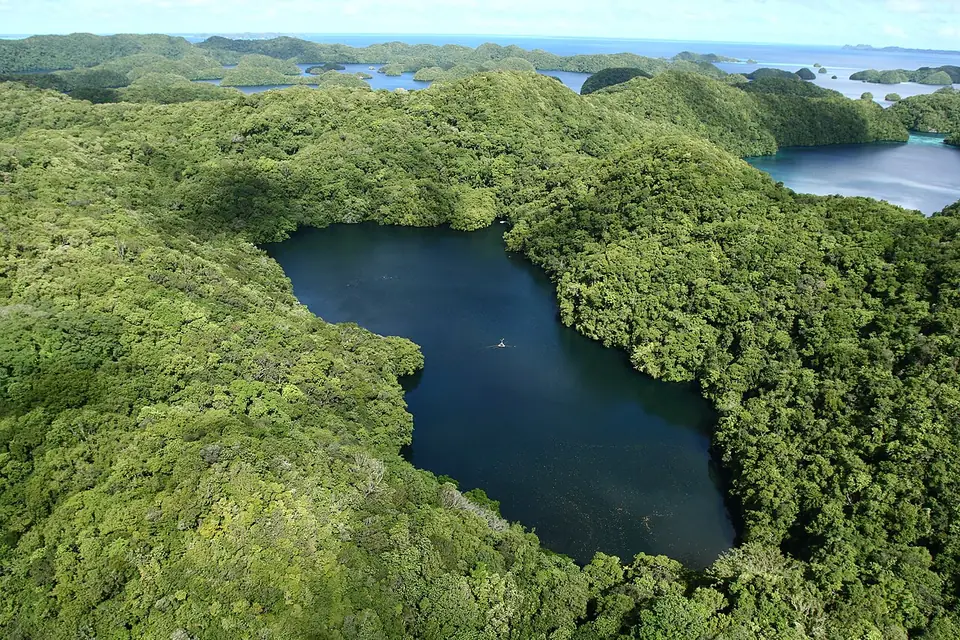
- Jellyfish Lake on Eil Malk island is famous for millions of golden jellyfish that have lost most of their sting and can be swum among.
- Palau created one of the world's first shark sanctuaries in 2009, banning commercial shark fishing in all of its waters.
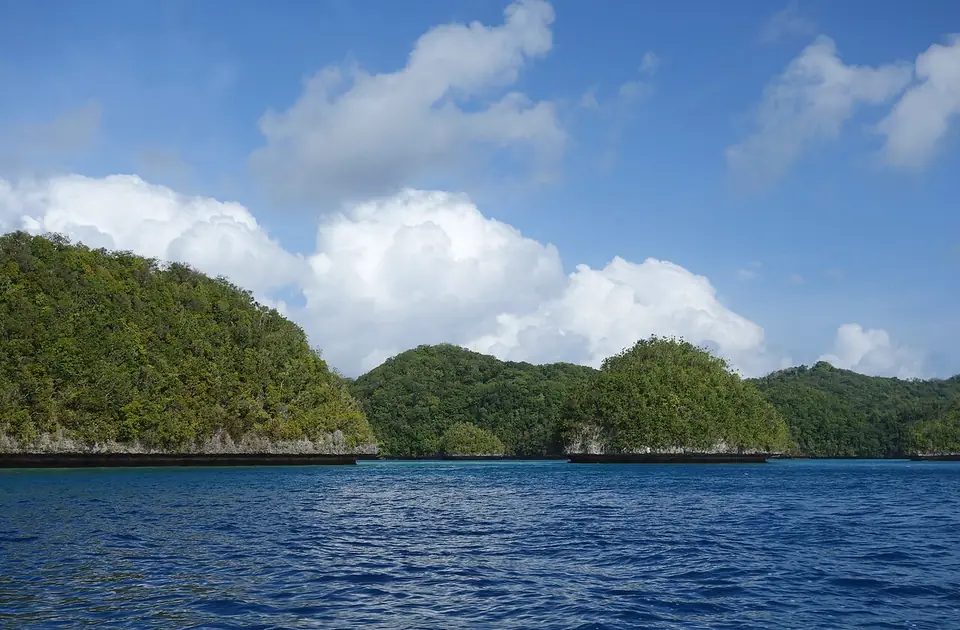
- The Rock Islands, a group of hundreds of mushroom-shaped limestone islets south of Koror, are a UNESCO World Heritage site.
Culture and traditions in Palau
- Saying hello
"Alii" is the common greeting in Palauan; English is widely spoken.
- Food and drink
Fresh reef fish, taro and tapioca; coconut crab is a local delicacy.
- Festivals and traditions
Independence Day on 1 October; the Belau Arts Festival celebrates local culture.
- Everyday life
Respect for elders and clan traditions is strong. Visitors sign the Palau Pledge to protect the environment.
- Did you know?
Palau created one of the world's first shark sanctuaries in 2009 and requires visitors to sign an eco-pledge in their passport.
Common mistakes
- Tapping the Federated States of Micronesia, Palau's much more spread-out neighbour to the east.
- Tapping the southern Philippines, which is the nearest large landmass.
- Looking too far east – Palau is at the western edge of Micronesia, not the middle.
Practise with Palau
- Oceania quiz – zoom in east of the Philippines; Palau is the first cluster you hit.
- Whole World quiz – a tiny target at world scale, so learn its spot relative to the Philippines.
- Oceania flags – light blue with an off-centre yellow moon.
- Oceania capitals quiz – Ngerulmud, one of the least-known capitals in the world.
- Mystery Country – a cluster of small islands with one larger one (Babeldaob) in the middle.
Quick check: how well do you know Palau?
3 questions, no sign-up. Tap an answer.
1. Which flag belongs to Palau?
That's the flag of Palau.
2. What is the capital of Palau?
The capital of Palau is Ngerulmud.
3. Which is bigger by area?
Kiribati (811 km²) is bigger than Palau (459 km²).
Keep going on the Oceania quiz – Palau is one of 14 countries there.
More ways to practise: find Palau on the blank map with no borders (hard mode), or play today's Globe and the other daily puzzles.
Frequently asked questions about Palau
What language is spoken in Palau?
English is used across government and education, and Palauan is the language of daily life on most islands. In the remote south-western islands, Sonsorolese and Tobian are official in their own states, and some older people still remember Japanese from the colonial era.
What currency does Palau use?
Palau uses the US dollar (USD) and has never had its own currency. This reflects its Compact of Free Association with the United States, which also provides financial support and handles Palau's defence.
What time zone is Palau in?
Palau is on UTC+9 all year round, the same as Japan and South Korea, and does not use daylight saving time. It is one hour behind Guam and the western states of neighbouring Micronesia.
Which side of the road do they drive on in Palau?
Palau drives on the right, following American practice, although many cars are right-hand-drive imports from Japan. A paved ring road around Babeldaob connects Koror with the capital at Melekeok.
What is the highest point in Palau?
Mount Ngerchelchuus, on the large island of Babeldaob, is Palau's highest point at about 242 metres. Babeldaob is a volcanic island, much higher and larger than the limestone and coral islands to its south.
What is the Palau Pledge?
Since 2017, every visitor to Palau must sign a pledge in their passport promising to protect the islands' nature and culture. Palau also created the world's first national shark sanctuary in 2009, banning commercial shark fishing in its waters.
Quizzes with Palau
Guides that help with this
- The 25 hardest countries to find on a mapPacific islands, Caribbean islands and landlocked Africa – where they are.
- Flags that look alike (and how to tell them apart)Chad or Romania? Australia or New Zealand? The flag pairs that cost quiz points.
- Learn all 197 countries in 30 daysA day-by-day plan: one region at a time, spaced repetition for review.