Samoa
Capital: Apia. Samoa is one of the 14 countries in the Oceania quiz.
Quick answers: What is the capital of Samoa? · Which countries border Samoa?
Facts about Samoa
- CapitalApia
- Population219,306
- Area2,842 km²
- RegionOceania
- LanguagesSamoan, English
- CurrencySamoan tālā (WST)
Samoa is the 7th most populous of the 14 countries in Oceania and the 7th largest by area. Worldwide it ranks 178th by population and 169th by area.
Where is Samoa?
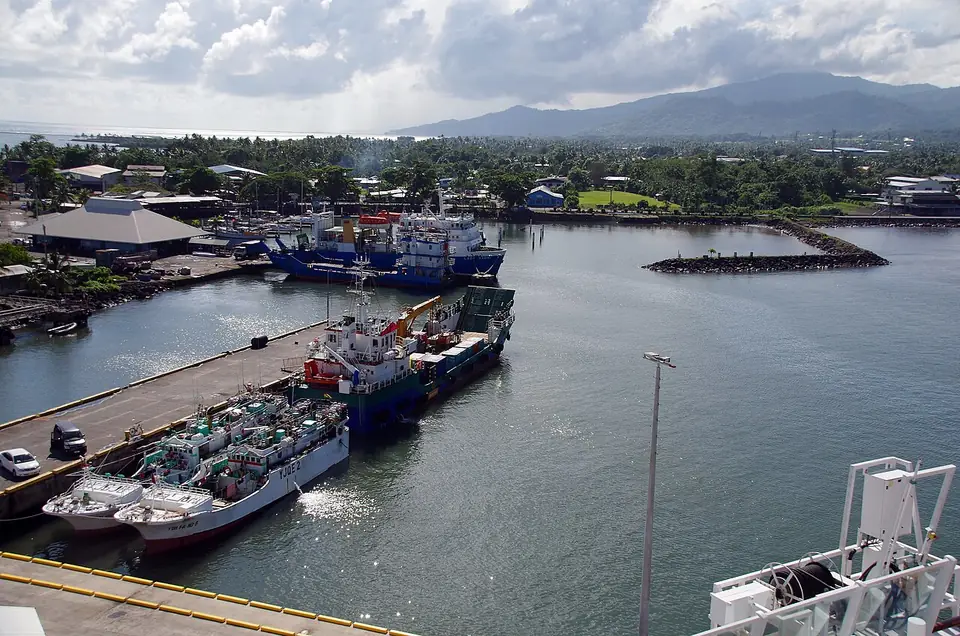
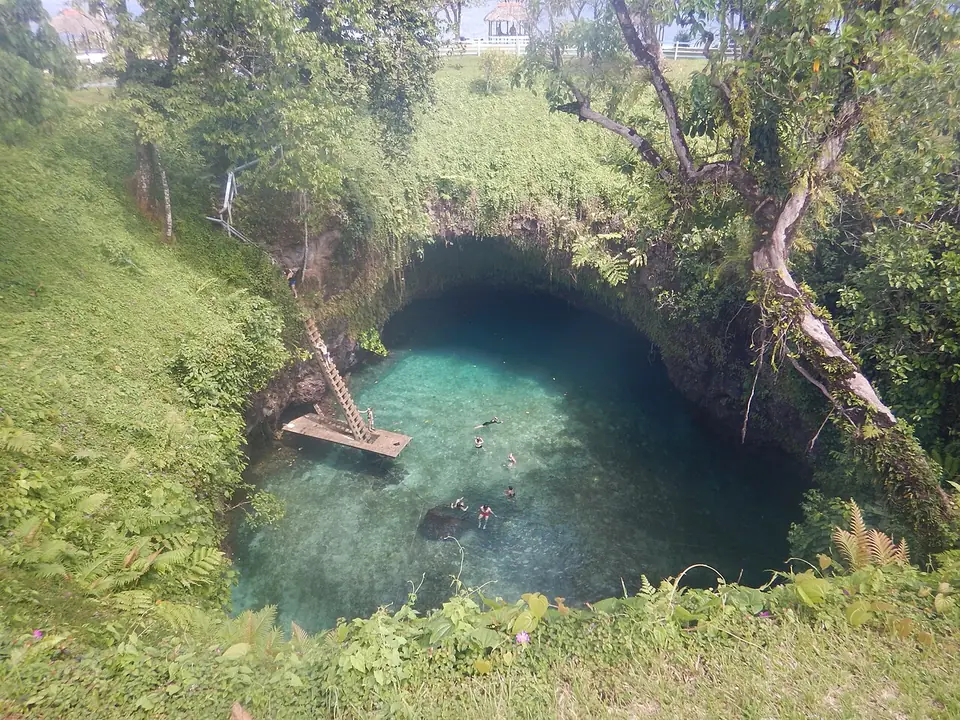
Samoa is an island country in the South Pacific, in Polynesia, roughly halfway between Hawaii and New Zealand. It consists of two main islands, Upolu and Savai'i, plus several smaller ones. Apia, the capital, is on the north coast of Upolu. Its nearest neighbours are American Samoa, a US territory, just to the east; Tonga to the south; Fiji to the west; and Tokelau and Tuvalu to the north.
On a world map, find Fiji and go east. The pair of islands next along, just west of the International Date Line, is Samoa.
How to find Samoa on the map
- Start from Fiji. Samoa is the next island group to the north-east of Fiji.
- Find Tonga. Tonga is the chain running north-south below Samoa; Samoa is above its northern end.
- Look for two islands side by side. Savai'i (west) and Upolu (east) sit close together in an east-west line.
- Don't confuse it with American Samoa. The smaller islands immediately east belong to the United States and are not on the quiz.
Flag
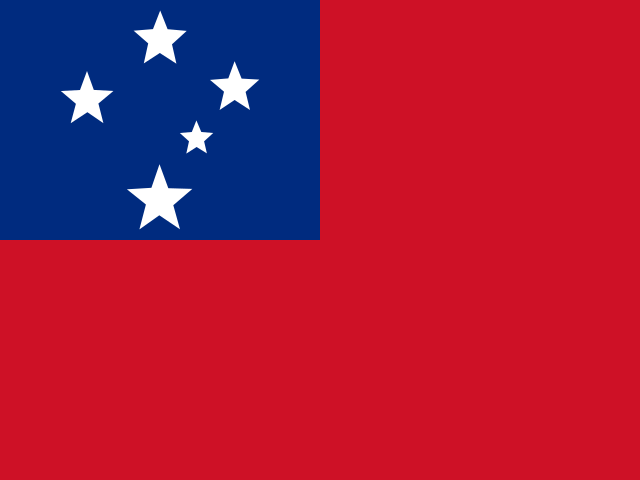
Samoa's flag is red with a dark blue rectangle in the top-left corner (the canton). Inside the blue canton are five white stars forming the Southern Cross – four larger stars and one smaller one.
Several Pacific flags carry the Southern Cross. Australia and New Zealand use it on a blue field with the Union Jack; Papua New Guinea puts it on a black triangle. Samoa is the only one with a red field and a plain blue canton. If the flag is mostly red with stars in a blue corner, it's Samoa.
A short history of Samoa
Samoa was settled around 3,000 years ago by the seafaring Lapita people, whose distinctive pottery has been found at Mulifanua on Upolu. Samoa and Tonga are often seen as the cradle of Polynesian culture, and from this area voyagers later sailed east to settle the rest of Polynesia. On Savai'i, the Pulemelei Mound, a large stone platform, is the biggest ancient structure in Polynesia.
Samoan society was built on extended families led by chiefs called matai, and on village councils. Ties with Tonga and Fiji were close, sometimes through marriage and sometimes through war. Tonga dominated Samoa for a period, until Samoans drove them out, an event remembered in oral history.
The Dutch explorer Jacob Roggeveen sighted the islands in 1722. In the 1830s, missionaries from the London Missionary Society arrived and Christianity spread quickly. Apia grew into a trading port, and Britain, Germany and the United States competed for influence, backing rival chiefs. In 1889 their warships faced each other in Apia harbour when a cyclone sank most of them. In 1899 the islands were divided: the western islands became German Samoa, and the eastern ones became American Samoa, which is why the two are still separate.
New Zealand seized German Samoa at the start of the First World War and governed it under a League of Nations mandate. Its rule was harsh. In 1918 a ship from Auckland brought influenza that killed about a fifth of the population. Resistance grew through the Mau movement, and in 1929 New Zealand police fired on a peaceful march in Apia, killing the high chief Tupua Tamasese Lealofi III and others on what became known as Black Saturday. New Zealand formally apologised in 2002.
After independence, Samoa built a stable parliamentary system that blends chiefly traditions with democracy. Today it depends on farming, fishing, tourism and money sent home by the many Samoans living in New Zealand, Australia and the United States.
Culture and daily life in Samoa
Samoan is spoken by almost everyone, and English is widely used in schools and business. Christianity, brought by 19th-century missionaries, is at the centre of village life, and churches are often the grandest buildings in a village.
Traditional houses called fale have no walls, just a domed roof on wooden posts, so the breeze can flow through. The pe'a, a male tattoo covering the body from waist to knees, is an important rite of passage, and the English word "tattoo" comes from the Polynesian word tatau. The ava ceremony, sharing a drink made from kava root, marks important meetings. Fine mats called ie toga are treasured gifts exchanged at weddings and funerals.
Rugby union is the national sport, and the national team, Manu Samoa, performs the Siva Tau war dance before matches. Many Samoans have also become stars in rugby league and American football abroad. Sunday lunch, cooked in an umu, an above-ground stone oven, brings families together after church.
Five facts worth knowing
- Samoa skipped a day in 2011 – it moved west of the International Date Line, jumping straight from 29 to 31 December, to align its working week with Australia and New Zealand.
- Samoa became independent from New Zealand in 1962, the first Pacific island state to gain independence in the twentieth century.
- Until 1997 the country was officially called Western Samoa, to distinguish it from American Samoa next door.
- Robert Louis Stevenson, author of Treasure Island, spent his final years in Samoa and is buried on a hill above Apia.
- Savai'i is one of the largest islands in Polynesia outside Hawaii and New Zealand, and is dominated by the shield volcano Mount Silisili.
Culture and traditions in Samoa
- Saying hello
"Talofa" is the common greeting, with a handshake.
- Food and drink
Palusami, taro leaves baked in coconut cream, and oka, raw fish marinated in coconut and lime.
- Festivals and traditions
The Teuila Festival (September) celebrates Samoan culture; Independence Day on 1 June.
- Everyday life
Sunday is for church and rest, and evening prayer time (sa) is respected. Fa'a Samoa, the Samoan way, values family and respect.
- Did you know?
In 2011, Samoa moved to the other side of the International Date Line, skipping 30 December entirely.
Common mistakes
- Tapping American Samoa, the neighbouring islands just to the east.
- Tapping Tonga or Fiji, the nearest other island countries.
- Picking Papua New Guinea's or New Zealand's flag because of the shared Southern Cross.
Practise with Samoa
- Oceania quiz – find Fiji, then move east to the two-island pair.
- Whole World quiz – small at world scale; use Fiji and the date line as anchors.
- Oceania flags – red with the Southern Cross on a blue canton.
- Oceania capitals quiz – Apia.
- Mystery Country – two chunky islands side by side, the western one slightly larger.
Quick check: how well do you know Samoa?
3 questions, no sign-up. Tap an answer.
1. Which flag belongs to Samoa?
That's the flag of Samoa.
2. What is the capital of Samoa?
The capital of Samoa is Apia.
3. Which is bigger by area?
Samoa (2,842 km²) is bigger than Kiribati (811 km²).
Keep going on the Oceania quiz – Samoa is one of 14 countries there.
More ways to practise: find Samoa on the blank map with no borders (hard mode), or play today's Globe and the other daily puzzles.
Frequently asked questions about Samoa
What language is spoken in Samoa?
Samoan and English are the official languages. Samoan, a Polynesian language closely related to Tongan and Tokelauan, is the first language of nearly everyone and is used in church, village life and parliament. English is common in business and schools.
What currency does Samoa use?
Samoa uses the tala, code WST, divided into 100 sene. The names are the Samoan forms of "dollar" and "cent". The currency is managed against a basket of the currencies of Samoa's main trading partners.
What time zone is Samoa in?
Samoa is on UTC+13. At the end of 2011 it moved to the western side of the International Date Line, skipping 30 December entirely. It stopped using daylight saving time in 2021.
Which side of the road do they drive on in Samoa?
Samoa drives on the left. It switched from the right in September 2009, partly so that residents could import cheaper right-hand-drive cars from Australia, New Zealand and Japan. It was one of the few countries in recent decades to change sides.
What is the highest point in Samoa?
Mount Silisili, on the island of Savai'i, is the highest point at about 1,858 metres. Savai'i is a large shield volcano, and its interior is covered in rainforest and young lava fields from eruptions in the early 1900s.
What is a Samoan tatau?
Tatau is Samoa's traditional tattooing art, and the English word tattoo comes from Polynesian words like it. The men's pe'a covers the body from waist to knees and is applied by hand with bone combs; the women's version is called the malu.
Quizzes with Samoa
Guides that help with this
- The 25 hardest countries to find on a mapPacific islands, Caribbean islands and landlocked Africa – where they are.
- Flags that look alike (and how to tell them apart)Chad or Romania? Australia or New Zealand? The flag pairs that cost quiz points.
- Learn all 197 countries in 30 daysA day-by-day plan: one region at a time, spaced repetition for review.