Solomon Islands
Capital: Honiara. The Solomon Islands is one of the 14 countries in the Oceania quiz.
Quick answers: What is the capital of the Solomon Islands? · Which countries border the Solomon Islands?
Facts about the Solomon Islands
- CapitalHoniara
- Population838,645
- Area28,896 km²
- RegionOceania
- LanguageEnglish
- CurrencySolomon Islands dollar (SBD)
The Solomon Islands is the 5th most populous of the 14 countries in Oceania and the 4th largest by area. Worldwide it ranks 162nd by population and 140th by area.
Where is the Solomon Islands?
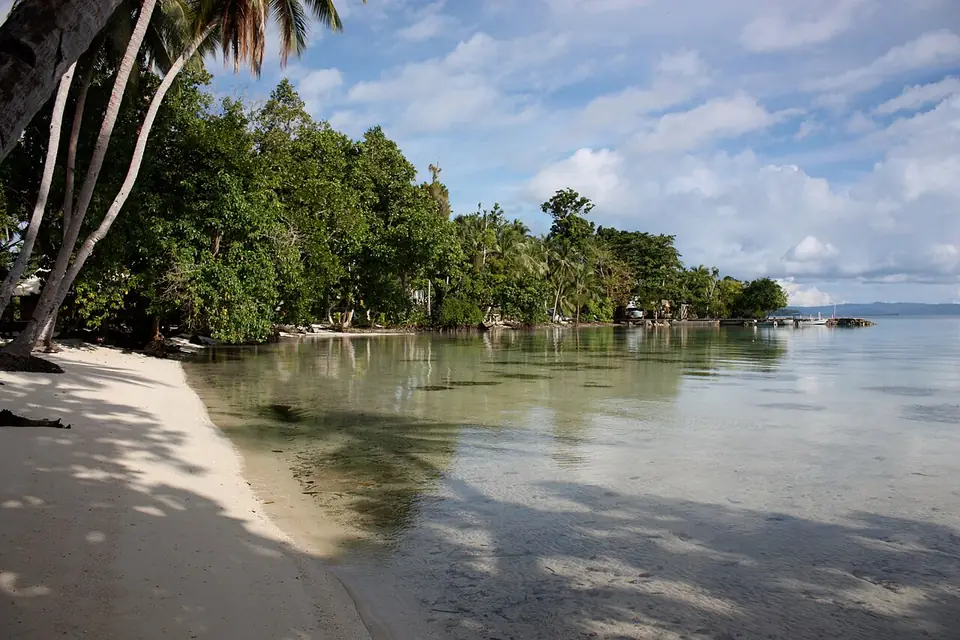
Solomon Islands is an archipelago in the south-western Pacific, east of Papua New Guinea and north-east of Australia. The country stretches across roughly 1,500 kilometres of ocean in two parallel chains of islands running north-west to south-east. The main islands include Guadalcanal, Malaita, New Georgia, Choiseul, Santa Isabel and Makira.
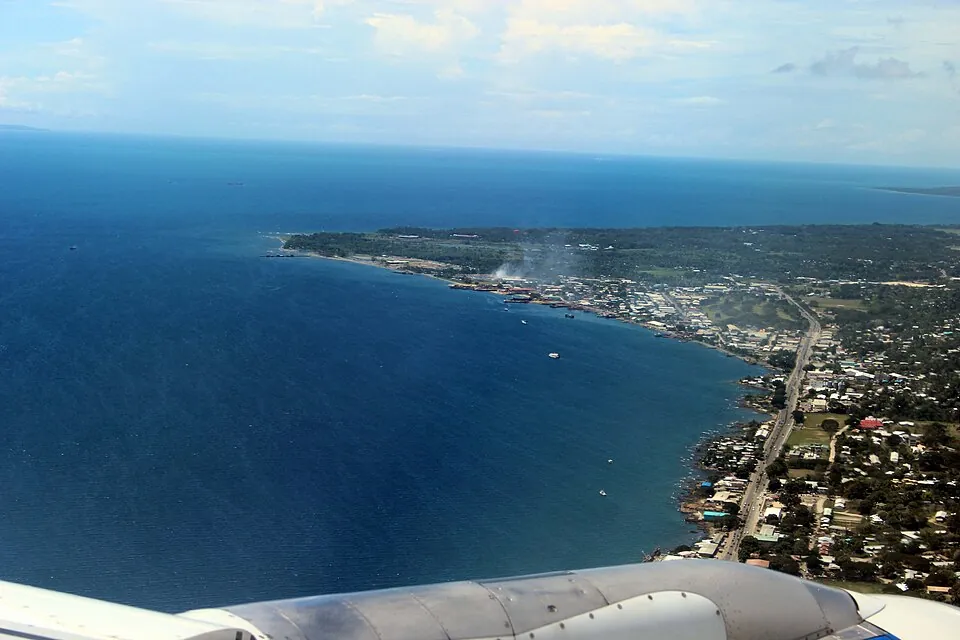
The capital, Honiara, is on the north coast of Guadalcanal. Most of the islands are mountainous, forested and volcanic, and the population is spread across hundreds of islands and villages.
How to find the Solomon Islands on the map
- Start from Papua New Guinea. Solomon Islands is the scatter of islands just east of PNG's Bougainville island, continuing south-east.
- Look for a double chain. The islands line up in two rows, like a necklace pulled apart, pointing towards Vanuatu.
- Trace the line from PNG to Vanuatu to Fiji. These Melanesian countries form a south-eastward arc off Australia's north-east coast; Solomon Islands is the second link.
- Don't confuse it with Vanuatu, which is further south-east and forms a single Y-shaped chain, or with Micronesia, which is far to the north across the equator.
Flag
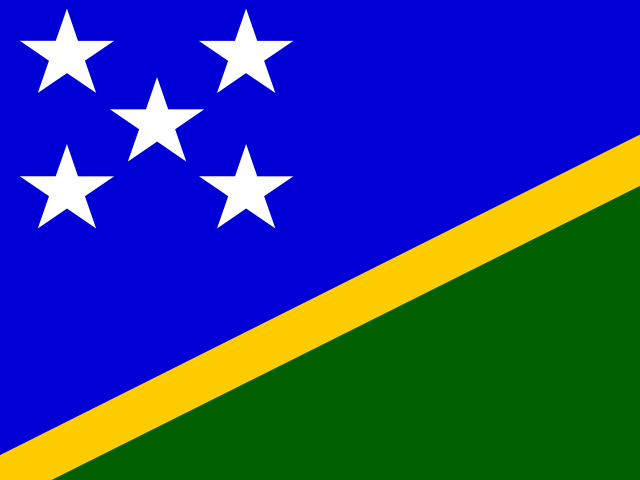
The Solomon Islands flag is divided diagonally by a thin yellow stripe running from the bottom-left corner to the top-right. The upper-left triangle is blue with five white five-pointed stars arranged in an X; the lower-right triangle is green. Blue stands for the ocean, green for the land, yellow for the sun, and the five stars for the five original districts.
The diagonal split is distinctive. The only flags likely to compete are Papua New Guinea's (also diagonal, but red and black with a bird) and Vanuatu's (a Y-shape in red, green and black). If it's blue and green split by a yellow line, it's Solomon Islands.
A short history of the Solomon Islands
People reached the north-western Solomons at least 30,000 years ago, moving out from New Guinea when sea levels were lower. Much later, around 3,000 years ago, seafarers of the Lapita culture, known for their finely stamped pottery, passed through the eastern islands on their way into the open Pacific. Polynesian communities settled a few outer islands, such as Rennell, Bellona and Tikopia, which is why Polynesian languages are still spoken there today.
The first European to arrive was the Spanish navigator Álvaro de Mendaña in 1568. Hoping he had found the source of King Solomon's gold, he named the islands after the biblical king. No gold was found, and Europeans did not return in numbers for two centuries. In the 1800s whalers, traders and missionaries came, followed by "blackbirders" who recruited – and often kidnapped – islanders to work on plantations in Queensland and Fiji. Violence on both sides led Britain to declare a protectorate over the southern islands in 1893. Germany controlled the northern islands, and when the two powers divided the region in 1899–1900, Bougainville and Buka stayed with German New Guinea. That is why those islands belong to Papua New Guinea today.
Under British rule, coconut plantations spread and Christianity became almost universal. The Second World War brought the conflict right to Guadalcanal, and the fighting changed the islands. Local scouts and coastwatchers helped the Allies; one scout, Jacob Vouza, became a war hero. After the war, a movement called Maasina Rule on Malaita pushed for self-government and fairer treatment, an early sign of nationalism. Honiara grew from the wartime American base to replace Tulagi as the capital.
Independence came peacefully in 1978. From 1998 to 2003 tension between people from Guadalcanal and Malaita turned into violent conflict, known locally as "the Tensions", and the government nearly collapsed. An Australian-led regional mission, RAMSI, restored order and stayed until 2017.
Today the country relies on logging, fishing, mining and foreign aid, and it has drawn attention as a point of competition between China and Western powers in the Pacific.
Culture and daily life in the Solomon Islands
Daily life is rooted in the village, in garden plots and in the sea. Most people are Christian – Anglican, Catholic, the South Seas Evangelical Church, the United Church and Seventh-day Adventists are all strong – but beliefs in ancestral spirits and kastom, the customary ways of each community, still shape land rights, marriages and the settling of disputes.
The islands have a remarkable tradition of carving and craftwork. Canoe prows on New Georgia once carried carved figureheads called nguzunguzu, and these figures are now a national symbol, seen on stamps and souvenirs.
Music is famous for its panpipe ensembles, especially from the 'Are'are people of Malaita, whose layered bamboo music has been recorded and studied around the world. Football and above all futsal are hugely popular, and the national futsal team, the Kurukuru, has played at several FIFA Futsal World Cups. Betelnut chewing, which turns mouths red, is a common social habit, despite efforts to limit it in public places in Honiara.
Five facts worth knowing
- Guadalcanal was the site of one of the key campaigns of the Second World War in the Pacific, fought between Allied and Japanese forces in 1942–43.
- The country became independent from Britain in 1978 and remains a Commonwealth realm.
- Marovo Lagoon in the New Georgia group is one of the largest saltwater lagoons in the world.
- More than 70 languages are spoken across the islands; Solomon Islands Pijin is the common language, with English official.
- The official name has no "the" – it is simply "Solomon Islands", which is why the headings on this page are written that way.
Culture and traditions in the Solomon Islands
- Saying hello
A smile and a handshake with "Halo" or "Gud morning" in the Solomon Islands Pijin.
- Food and drink
Fresh fish, taro, sweet potato and cassava, often cooked with coconut milk or in a stone oven called a motu.
- Festivals and traditions
Independence Day on 7 July is celebrated with parades, music and traditional dancing.
- Everyday life
The "wantok" system, meaning people who share a language, links families in strong mutual support. Most land is owned by customary groups.
- Did you know?
Traditional shell money, strings of tiny polished shell discs, is still made on Malaita and used for bride price and ceremonies.
Common mistakes
- Tapping Vanuatu, the next island nation to the south-east.
- Tapping Bougainville, which looks like part of the same chain but belongs to Papua New Guinea.
- Mixing up the flag with Papua New Guinea's because both are split diagonally.
Practise with the Solomon Islands
- Oceania quiz – the double chain of islands east of Papua New Guinea.
- Oceania flags – learn the three diagonal and Y-shaped Melanesian flags: Solomon Islands, Papua New Guinea, Vanuatu.
- Whole World quiz – harder, because the islands are tiny at world zoom; aim just east of PNG.
- Oceania capitals quiz – Honiara.
- Mystery Country – the two parallel rows of islands are a recognisable pattern once you know to look for them.
Quick check: how well do you know the Solomon Islands?
3 questions, no sign-up. Tap an answer.
1. Which flag belongs to the Solomon Islands?
That's the flag of the Solomon Islands.
2. What is the capital of the Solomon Islands?
The capital of the Solomon Islands is Honiara.
3. Which is bigger by area?
Solomon Islands (28,896 km²) is bigger than Samoa (2,842 km²).
Keep going on the Oceania quiz – Solomon Islands is one of 14 countries there.
More ways to practise: find the Solomon Islands on the blank map with no borders (hard mode), or play today's Globe and the other daily puzzles.
Frequently asked questions about the Solomon Islands
What language is spoken in the Solomon Islands?
English is the official language, used in government and schools, but only a small share of people speak it fluently. Solomon Islands Pijin, an English-based creole, is the common everyday language, and around 70 local languages are spoken across the islands.
What currency does Solomon Islands use?
Solomon Islands uses the Solomon Islands dollar, code SBD, divided into 100 cents. It replaced the Australian dollar in 1977. Traditional shell money is still used for ceremonies such as bride price on Malaita.
What time zone is the Solomon Islands in?
Solomon Islands is on UTC+11 all year, the same as Vanuatu and New Caledonia and an hour ahead of Papua New Guinea. It does not use daylight saving time.
Which side of the road do they drive on in the Solomon Islands?
Solomon Islands drives on the left, like Australia and New Zealand. There are few roads outside Honiara and the main towns, and most travel between islands is by boat or small plane.
What is the highest point in the Solomon Islands?
Mount Popomanaseu, on Guadalcanal, is the highest point at about 2,335 metres. It lies in the rugged and rarely climbed interior of the island, in a mountain chain that runs along Guadalcanal's southern side.
What is Rennell Island known for?
East Rennell, on the southern island of Rennell, is a UNESCO World Heritage Site. It contains Lake Tegano, the largest lake in the insular Pacific, a former lagoon of a raised coral atoll that now holds brackish water and many endemic species.
Quizzes with the Solomon Islands
Guides that help with this
- The 25 hardest countries to find on a mapPacific islands, Caribbean islands and landlocked Africa – where they are.
- Flags that look alike (and how to tell them apart)Chad or Romania? Australia or New Zealand? The flag pairs that cost quiz points.
- Learn all 197 countries in 30 daysA day-by-day plan: one region at a time, spaced repetition for review.