St Lucia
Capital: Castries. St Lucia is one of the 23 countries in the North America quiz.
Quick answers: What is the capital of St Lucia? · Which countries border St Lucia?
Facts about St Lucia
- CapitalCastries
- Population180,149
- Area616 km²
- RegionsNorth America, The Caribbean
- LanguageEnglish
- CurrencyEast Caribbean dollar (XCD)
St Lucia is the 18th most populous of the 23 countries in North America and the 18th largest by area. Worldwide it ranks 179th by population and 180th by area.
Where is St Lucia?
St Lucia is a single-island country in the eastern Caribbean, part of the Windward Islands in the southern Lesser Antilles. It lies between Martinique (a French overseas department) to the north and St Vincent and the Grenadines to the south, with Barbados further out to the south-east. The island is about 43 kilometres long and 23 wide, mountainous and volcanic, covered in rainforest.
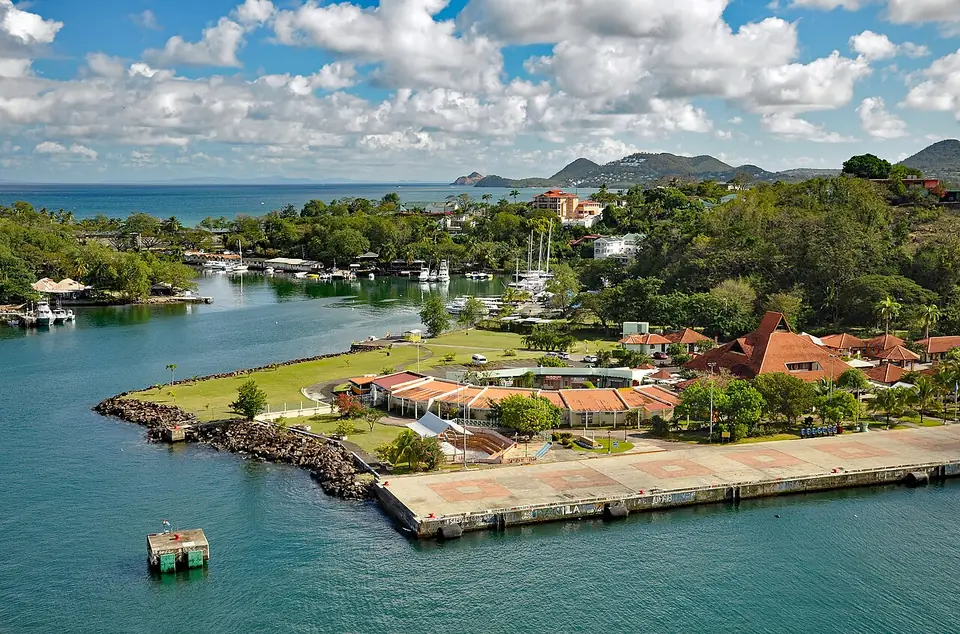
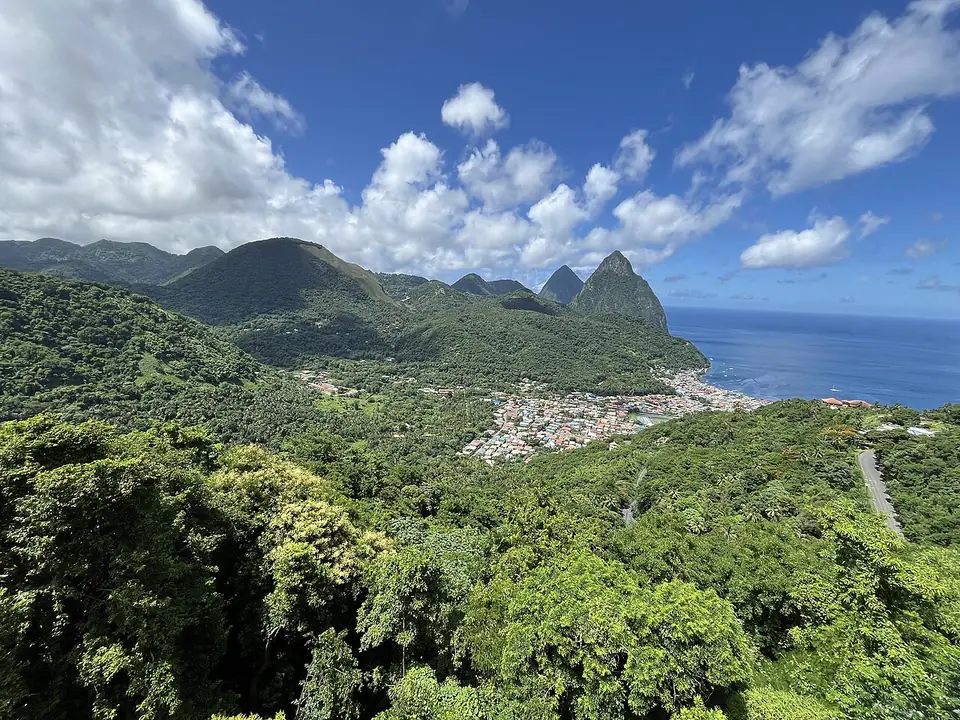
The capital, Castries, is a harbour town on the north-west coast. The island's most famous landmark is the pair of volcanic spires called the Pitons, near the town of Soufrière on the south-west coast.
How to find St Lucia on the map
- Start from the bottom of the Lesser Antilles. The chain of islands runs south from Puerto Rico and bends towards Venezuela. St Lucia is in the lower part of that chain.
- Count down from Martinique. Guadeloupe, Dominica, Martinique, St Lucia, St Vincent, Grenada – St Lucia is fourth in that sequence heading south.
- Look for the teardrop. St Lucia is slightly wider at the bottom than the top, like a drop of water.
- Don't confuse it with St Vincent (the next island south, with the Grenadines trailing below it) or St Kitts (far to the north in the Leeward Islands).
Flag
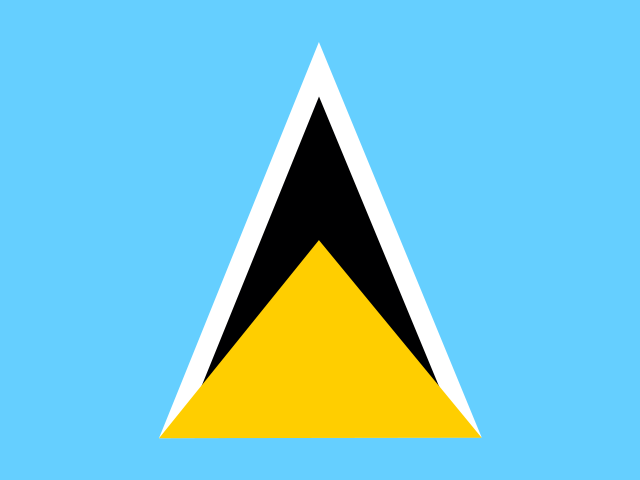
St Lucia's flag is a light blue field with a design in the centre: a white-edged black isosceles triangle with a smaller gold triangle overlapping its base. The blue represents the sea and sky, the black and white the two main ethnic groups living in harmony, and the gold the sunshine. The triangles together represent the Pitons rising from the sea.
Nothing else in the Flags quiz looks like it. A blue field with a pointed black-and-gold shape in the middle is St Lucia.
A short history of St Lucia
The first people to settle St Lucia were Arawak-speaking farmers who arrived from South America. They were later replaced by the Kalinago, who knew the island as Iyanola or Hewanorra – a name now carried by its international airport. The island's European name honours St Lucy of Syracuse, and her feast day, 13 December, is St Lucia's National Day.
Early English attempts at settlement in the 1600s ended in failure, largely because of Kalinago resistance. The French had more success and signed a treaty with the Kalinago in 1660. From then on, Britain and France fought over the island again and again, drawn by its sheltered harbours. Pigeon Island in the north was fortified, and in 1782 the British admiral Rodney sailed from nearby to win the Battle of the Saintes against the French fleet.
During the French Revolution, enslaved people were briefly freed and many joined guerrilla bands, known as the "Brigands", who fought the British in the forests until the late 1790s. Once Britain took final control, slavery was restored until abolition in the 1830s. Castries later became an important coaling station for steamships crossing the Atlantic, and the town was rebuilt several times after great fires, the worst in 1948.
In the 20th century, universal suffrage came in 1951. St Lucia joined the short-lived West Indies Federation, became an associated state with control over its own affairs in 1967 and gained full independence in 1979. Bananas replaced sugar as the main export in the mid-1900s, and for decades "green gold" shipped to Britain sustained rural families. When guaranteed European markets ended around the turn of the century, the industry shrank sharply.
Tourism now drives the economy, built on the island's beaches, rainforest and volcanic scenery, with farming, fishing and offshore services alongside it.
Culture and daily life in St Lucia
St Lucia's two languages tell its story. English, the official language, comes from British rule, while Kwéyòl is a French-based creole shared with Dominica, Martinique and Guadeloupe. It is spoken in homes and markets and is widely heard on radio and television. The French past also shows in religion: most St Lucians are Roman Catholic, and village churches stand at the heart of community life.
One unusual tradition is the rivalry between two flower societies, La Rose and La Marguerite. Each has its own queen, songs and feast day – 30 August and 17 October – and members parade in their colours. Older dances such as the kwadril, a Creole version of the European quadrille, are still performed with violin, banjo and the chak-chak shaker. On the modern side, St Lucia gave Caribbean music "Dennery Segment", a fast, drum-heavy style of soca named after an east-coast village.
Sport brings real pride. Daren Sammy captained the West Indies to two T20 World Cup titles, and the national cricket ground at Gros Islet now bears his name. In 2024 Julien Alfred won the women's 100 metres at the Paris Olympics, the country's first Olympic medal. Street snacks include accra, crisp saltfish fritters, and bouyon, a hearty one-pot soup.
Five facts worth knowing
- The Pitons, Gros Piton and Petit Piton, are a UNESCO World Heritage Site – two volcanic plugs rising straight out of the sea.
- St Lucia changed hands between Britain and France 14 times before Britain finally kept it in 1814, which is why many place names are French.
- The island has produced two Nobel laureates: economist Sir Arthur Lewis and poet Derek Walcott – a remarkable number for a population under 200,000.
- Sulphur Springs near Soufrière is often marketed as a drive-in volcano, with bubbling mud pools and steam vents.
- St Lucia became independent from Britain in 1979 and remains a Commonwealth realm.
Culture and traditions in St Lucia
- Saying hello
"Good morning" in English or "Bonjou" in Kwéyòl, the island's French-based Creole.
- Food and drink
Green fig and saltfish, the national dish, made with green bananas and salted cod.
- Festivals and traditions
Jounen Kwéyòl (Creole Day) in October, Saint Lucia Carnival in July and the Saint Lucia Jazz Festival in May.
- Everyday life
The Friday night "jump-up" street party in Gros Islet is a local favourite. Greeting people before talking business is expected.
- Did you know?
This small island has produced two Nobel Prize winners: Arthur Lewis (Economics, 1979) and Derek Walcott (Literature, 1992).
Common mistakes
- Tapping St Vincent, the next island down the chain.
- Tapping Martinique, which is French, not independent.
- Looking for St Lucia up near St Kitts in the Leeward Islands; it is well to the south.
Practise with St Lucia
- Caribbean quiz – the zoomed map lines up the Windward Islands so you can count down to St Lucia.
- North America quiz – the Caribbean belongs to North America here; aim for the lower part of the island arc.
- North America flags – the blue field with the Pitons triangle is a quick win.
- North America capitals quiz – Castries.
- Mistake Bank – review the three "Saint" countries side by side until you can place each one.
Quick check: how well do you know St Lucia?
3 questions, no sign-up. Tap an answer.
1. Which flag belongs to St Lucia?
That's the flag of St Lucia.
2. What is the capital of St Lucia?
The capital of St Lucia is Castries.
3. Which is bigger by area?
Haiti (27,750 km²) is bigger than St Lucia (616 km²).
Keep going on the North America quiz – St Lucia is one of 23 countries there.
More ways to practise: find St Lucia on the blank map with no borders (hard mode), or play today's Globe and the other daily puzzles.
Frequently asked questions about St Lucia
What language is spoken in St Lucia?
English is the official language, used in government and schools. Most people also speak St Lucian Creole, a French-based creole often called Kwéyòl, which reflects the long periods of French rule. Its use is celebrated each October on Jounen Kwéyòl.
What currency does St Lucia use?
St Lucia uses the Eastern Caribbean dollar, code XCD, shared with its neighbours in the Eastern Caribbean Currency Union. It is pegged to the US dollar at 2.70 EC dollars per US dollar.
What time zone is St Lucia in?
St Lucia uses Atlantic Standard Time, UTC−4, all year round, like the rest of the Eastern Caribbean. With no daylight saving time, it is level with New York in summer and an hour ahead in winter.
Which side of the road do they drive on in St Lucia?
St Lucia drives on the left, a legacy of British rule. Roads are steep and winding, and the drive from Hewanorra airport in the south to Castries in the north takes well over an hour.
What is the highest point in St Lucia?
Mount Gimie, in the island's rainforest interior, is the highest point at about 950 metres. The more famous Gros Piton, on the south-west coast, is lower at around 770 metres.
Why is St Lucia named after a woman?
St Lucia is named after Saint Lucy of Syracuse, a Christian martyr. It is often said to be the only country named after a woman, and her feast day, 13 December, is the national day.
Quizzes with St Lucia
Guides that help with this
- The 25 hardest countries to find on a mapPacific islands, Caribbean islands and landlocked Africa – where they are.
- All 50 US states on the map, region by regionThe ordering tricks that make the states stick.
- Flags that look alike (and how to tell them apart)Chad or Romania? Australia or New Zealand? The flag pairs that cost quiz points.