Tonga
Capital: Nuku'alofa. Tonga is one of the 14 countries in the Oceania quiz.
Quick answers: What is the capital of Tonga? · Which countries border Tonga?
Facts about Tonga
- CapitalNuku'alofa
- Population103,742
- Area747 km²
- RegionOceania
- LanguagesEnglish, Tongan
- CurrencyTongan paʻanga (TOP)
Tonga is the 10th most populous of the 14 countries in Oceania and the 9th largest by area. Worldwide it ranks 184th by population and 177th by area.
Where is Tonga?
Tonga is a kingdom of around 170 islands in the South Pacific, roughly 2,000 km north-east of New Zealand. Fiji lies to the north-west and Samoa to the north-east. The islands are arranged in a rough north–south line stretching about 800 km, grouped into three main clusters: Tongatapu in the south, Ha'apai in the middle and Vava'u in the north. The capital, Nuku'alofa, is on Tongatapu, the largest and most populous island.
On a world map, Tonga is a scatter of dots just west of the International Date Line, in the open ocean between Fiji and the Cook Islands.
How to find Tonga on the map
- Start from Fiji. Tonga is the island group south-east of Fiji, slightly further from the equator.
- Look for the Date Line. Tonga sits just on the western side of the 180° meridian, which is why it is one of the first countries to see each new day.
- Find the Tonga Trench. On a physical map, the deep ocean trench running north–south just east of the islands marks their position.
- Don't confuse it with Samoa. Samoa is a pair of larger islands further north; Tonga is a longer chain of smaller ones.
Flag
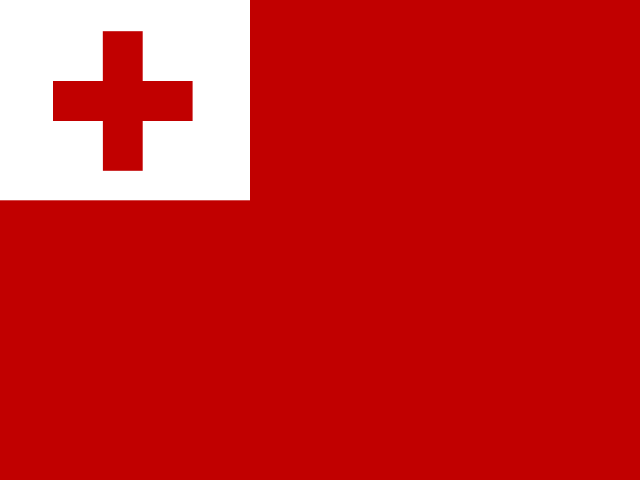
Tonga's flag is red with a white rectangle in the upper hoist corner containing a red cross. The design has been in use since 1875 and is protected in the country's constitution, which states that it must never be changed. The cross reflects the country's deep Christian identity.
In the Flags quiz, a plain red field with a red cross on white in the corner is Tonga. The Swiss flag is a white cross on red – the opposite colour arrangement – and the Red Cross emblem is a red cross on white but never as a national flag canton.
A short history of Tonga
The first people reached Tonga around 3,000 years ago. They belonged to the Lapita culture, seafarers known for their decorated pottery, and their descendants became the Polynesians. Tonga and Samoa are where Polynesian culture first took shape before voyagers spread east across the Pacific.
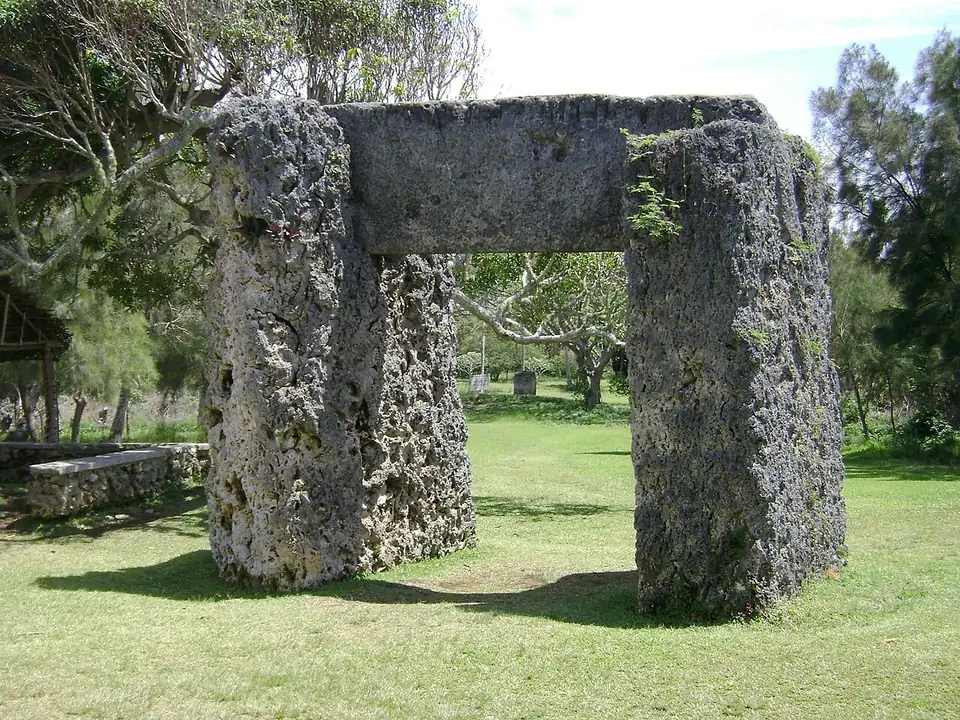
From around the 10th century, Tonga was ruled by a line of sacred kings, the Tu'i Tonga. At their height their influence reached across the sea to Samoa, Fiji, 'Uvea (Wallis) and beyond, a network sometimes called the Tongan maritime empire. Huge stone tombs called langi survive at Lapaha on Tongatapu, and the Ha'amonga 'a Maui, a stone gateway built around 1200, is one of the most striking monuments in Polynesia. Over time, real political power passed to other royal lines.
The Dutch navigator Abel Tasman visited in 1643, and James Cook came in the 1770s, naming the group the "Friendly Islands" after a warm welcome. Methodist missionaries arrived in the 1820s, and Christianity spread during a period of civil wars. A chief named Tāufa'āhau united the islands and became King George Tupou I in 1845. He freed commoners from forced service to chiefs and gave Tonga a written constitution, which also promised every adult man a plot of land – a rule that shaped Tongan land ownership ever since.
In 1900 Tonga accepted British protection over its foreign affairs but kept its monarchy. Queen Sālote Tupou III, who reigned from 1918 to 1965, won affection worldwide when she rode in an open carriage through heavy rain at Queen Elizabeth II's coronation in 1953. Tonga regained full control of its affairs in 1970. Riots in Nuku'alofa in 2006 led to reforms, and since 2010 most members of parliament have been elected by the people.
Today Tonga's economy depends heavily on money sent home by the large Tongan communities in New Zealand, Australia and the United States, along with farming and fishing.
Culture and daily life in Tonga
The Tongan language is Polynesian, closely related to Samoan and Māori, and English is widely used in government and schools. Christianity dominates daily life, and the Free Wesleyan Church, founded from the early Methodist missions, is the largest denomination. Church choirs are famous for their powerful singing.
Tongan society has a clear structure of king, nobles and commoners, and family rank matters. In a custom called fahu, a father's sister holds special status and is honoured at weddings and funerals. Respect for elders and the church shapes how people speak and dress.
Dance is central to celebrations. The lakalaka, a group dance combining poetry, song and movement, is recognised by UNESCO, while the tau'olunga is a graceful solo dance often performed by a young woman. Women make tapa cloth, called ngatu, by beating the bark of the paper mulberry tree and painting it with bold patterns; huge pieces are given at important events. Kava, a drink made from a pepper root, is shared at ceremonies and evening gatherings. Taekwondo athlete Pita Taufatofua became world-famous carrying Tonga's flag at the 2016 Olympics.
Five facts worth knowing
- Tonga is the only monarchy in the Pacific islands that was never formally colonised; it was a British protected state but kept its own king.
- The 2022 eruption of Hunga Tonga–Hunga Ha'apai, an undersea volcano, was one of the most powerful recorded in modern times and sent a tsunami across the Pacific.
- Tonga's time zone is UTC+13, putting it a full day ahead of nearby American Samoa even though the two are only a few hundred kilometres apart.
- The Tonga Trench reaches depths of more than 10,000 metres, making it one of the deepest places in any ocean.
- Rugby union is the national passion, and Tongan players are found in top teams around the world.
Culture and traditions in Tonga
- Saying hello
"Mālō e lelei" (hello) with a warm smile and handshake.
- Food and drink
'Ota 'ika, raw fish in coconut milk and lime; lu pulu, corned beef wrapped in taro leaves, cooked in an umu earth oven.
- Festivals and traditions
The Heilala Festival in July, named after the national flower, with dancing, pageants and music.
- Everyday life
Sunday is a day of rest by law, so most shops close. Many people wear a ta'ovala, a woven mat around the waist, on formal occasions.
- Did you know?
Tonga is the only Pacific island nation that was never formally colonised, and it remains a kingdom today.
Common mistakes
- Tapping Fiji or Samoa, Tonga's larger and better-known neighbours.
- Choosing the Swiss flag in the Flags quiz because of the red-and-white cross.
- Forgetting that the country is a long chain, so the quiz target is a line of islands, not a single blob.
Practise with Tonga
- Oceania quiz – the dotted line south-east of Fiji.
- Oceania flags – the red cross in a white canton on red.
- Whole World quiz – a tough one at world zoom; use Fiji and New Zealand as anchors.
- Oceania capitals quiz – Nuku'alofa.
- Mystery Country – a vertical string of tiny islands with Tongatapu at the bottom.
Quick check: how well do you know Tonga?
3 questions, no sign-up. Tap an answer.
1. Which flag belongs to Tonga?
That's the flag of Tonga.
2. What is the capital of Tonga?
The capital of Tonga is Nuku'alofa.
3. Which is bigger by area?
Tonga (747 km²) is bigger than Nauru (21 km²).
Keep going on the Oceania quiz – Tonga is one of 14 countries there.
More ways to practise: find Tonga on the blank map with no borders (hard mode), or play today's Globe and the other daily puzzles.
Frequently asked questions about Tonga
What language is spoken in Tonga?
Tongan and English are both official languages. Tongan, a Polynesian language related to Samoan, is spoken by almost everyone, while English is used in schools, government and business.
What currency does Tonga use?
Tonga uses the pa'anga (TOP), divided into 100 seniti. It was introduced in 1967, replacing the Tongan pound, and its value is managed against a basket of currencies, mainly the Australian, New Zealand and US dollars.
What time zone is Tonga in?
Tonga is on UTC+13, among the first countries in the world to start each new day. It has used daylight saving time only occasionally, most recently in the 2016–17 summer, and does not use it now.
Which side of the road do they drive on in Tonga?
Tonga drives on the left, like New Zealand, Australia and Fiji. The speed limit is low, and on Sundays traffic is very quiet because the constitution keeps the Sabbath as a day of rest.
What is the highest point in Tonga?
The highest point is Kao, an extinct volcanic cone rising to just over 1,000 metres out of the sea in the Ha'apai group. Most of Tonga's other islands are low coral islands.
Is Tonga a monarchy?
Yes. Tonga is the only kingdom among the Pacific island nations and was never formally colonised; it was a British protected state from 1900 to 1970. The king still has significant powers, though a 2010 reform gave voters a larger role in parliament.
Quizzes with Tonga
Guides that help with this
- The 25 hardest countries to find on a mapPacific islands, Caribbean islands and landlocked Africa – where they are.
- Flags that look alike (and how to tell them apart)Chad or Romania? Australia or New Zealand? The flag pairs that cost quiz points.
- Learn all 197 countries in 30 daysA day-by-day plan: one region at a time, spaced repetition for review.