Trinidad and Tobago
Capital: Port of Spain. Trinidad and Tobago is one of the 23 countries in the North America quiz.
Quick answers: What is the capital of Trinidad and Tobago? · Which countries border Trinidad and Tobago?
Facts about Trinidad and Tobago
- CapitalPort of Spain
- Population1.4 million
- Area5,130 km²
- RegionsNorth America, The Caribbean
- LanguageEnglish
- CurrencyTrinidad and Tobago dollar (TTD)
Trinidad and Tobago is the 14th most populous of the 23 countries in North America and the 16th largest by area. Worldwide it ranks 155th by population and 167th by area.
Where is Trinidad and Tobago?
Trinidad and Tobago is a two-island country at the very bottom of the Caribbean island chain, just off the north-east coast of Venezuela. Trinidad, the larger island, lies only about 11 km from the South American mainland across the Gulf of Paria. Tobago is a smaller island about 30 km to the north-east. The capital, Port of Spain, is on the west coast of Trinidad, facing Venezuela.
On a world map, find where South America's north coast turns the corner towards the Caribbean. Trinidad is the island tucked into that corner, closer to the continent than to any other island nation.
How to find Trinidad and Tobago on the map
- Start from Venezuela. Trinidad is the island sitting right off Venezuela's north-east tip, in the mouth of the Orinoco delta region.
- Follow the Lesser Antilles down. The arc of small islands running south from Puerto Rico ends with Grenada, and the next landfall is Trinidad.
- Look for the pair. Trinidad is roughly rectangular; Tobago is a small cigar shape to its north-east.
- Don't confuse it with Barbados. Barbados is a lone island further out in the Atlantic; Trinidad is the one hugging the mainland.
Flag
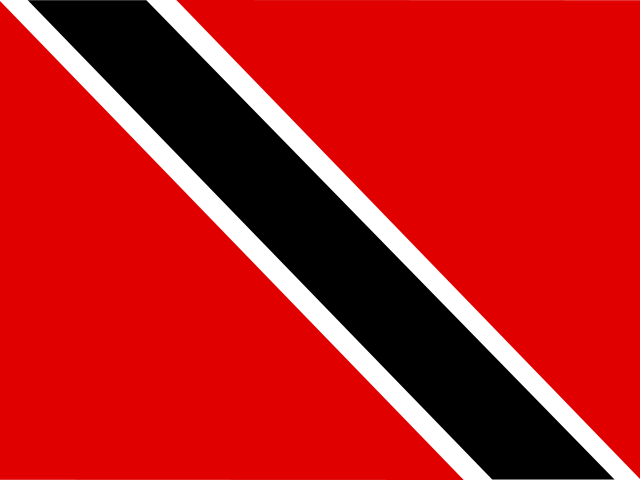
The flag is red with a black diagonal band, edged in white, running from the upper hoist corner to the lower fly corner. Red stands for the sun and the people's vitality, white for the sea and black for strength and unity. It was adopted at independence in 1962.
In the Flags quiz, this is one of the few diagonal designs in the Americas. Tanzania's flag also has a black diagonal band, but it runs the other way, is edged in yellow and splits green from blue. If the field is plain red and the stripe is black on white, it's Trinidad and Tobago.
A short history of Trinidad and Tobago
Amerindian peoples from the South American mainland lived on Trinidad for thousands of years; the island's old name is often given as Iere, "land of the hummingbird". Columbus arrived in 1498 on his third voyage and named the island after the Holy Trinity, reportedly because of three hills he saw from the sea.
Spain claimed Trinidad but did little with it for almost 300 years. In 1783 a Spanish decree, the Cedula of Population, invited Catholic settlers to the island, and French planters from other Caribbean islands arrived with enslaved Africans. They gave Trinidad its French Creole flavour, from place names to the roots of Carnival. A British fleet captured the island in 1797. Tobago, meanwhile, changed hands between European powers more often than almost any other island in the Caribbean, before being joined to Trinidad as a single British colony in 1889.
After slavery ended in the 1830s, Britain brought in indentured labourers to work the plantations, mostly from India. Between 1845 and 1917, about 140,000 Indians arrived, and their descendants now make up a large share of the population. Chinese, Portuguese and Syrian-Lebanese migrants added to the mix. Oil production began in the early 1900s and soon became the island's lifeblood. Riots in the oilfields in 1937 led by Tubal Uriah "Buzz" Butler launched the labour movement.
Eric Williams, a historian, founded the People's National Movement in 1956 and led the country to independence on 31 August 1962. It became a republic in 1976. The 1970s brought a Black Power protest movement and then an oil boom. In 1990 an armed group stormed parliament and held the prime minister hostage for six days before surrendering.
Today Trinidad and Tobago is a major exporter of natural gas, along with products made from it such as ammonia and methanol, while Tobago relies more on tourism.
Culture and daily life in Trinidad and Tobago
English is the official language, but everyday speech is Trinidadian Creole, full of words from French Creole, Hindi, Spanish and African languages. A few older people still speak French Patois. Religion is just as varied: Catholics, Hindus, Muslims, Anglicans, Pentecostals and Spiritual Baptists all have public holidays or major festivals. Spiritual Baptists were banned by the colonial government from 1917 to 1951, and their liberation is now marked by a holiday on 30 March.
Calypso legends such as the Mighty Sparrow and Lord Kitchener told stories of island life in song, while chutney music blends Indian folk songs with soca rhythms. At Christmas, parang groups sing in Spanish with guitars and cuatros, a tradition brought from nearby Venezuela.
Writers include V. S. Naipaul, winner of the 2001 Nobel Prize in Literature, whose A House for Mr Biswas is set in Trinidad, and Sam Selvon. Cricket great Brian Lara set the record for the highest individual Test innings, 400 not out, in 2004. Hasely Crawford won Olympic 100 metres gold in 1976, and rapper Nicki Minaj was born in Trinidad.
Five facts worth knowing
- Trinidad is geologically part of South America, not the Caribbean island arc; it broke away from the Venezuelan coast and shares its wildlife and oil-bearing rocks.
- It is the birthplace of the steelpan, invented in Trinidad in the 1930s from oil drums, and of calypso and soca music.
- Pitch Lake, in south-west Trinidad, is the largest natural deposit of asphalt in the world and has been mined for road surfaces for more than a century.
- Oil and gas make it one of the wealthiest economies in the Caribbean, unlike most of its tourism-based neighbours.
- Trinidad's Carnival, held on the Monday and Tuesday before Ash Wednesday, is among the largest in the world.
Culture and traditions in Trinidad and Tobago
- Saying hello
A friendly "Good morning" or a casual "Wha' going on?"
- Food and drink
Doubles, curried chickpeas in soft fried bread; bake and shark from Maracas Bay; roti with curry.
- Festivals and traditions
Carnival on the Monday and Tuesday before Ash Wednesday; Divali, the festival of lights, is a public holiday.
- Everyday life
"Liming", relaxing and hanging out with friends, is a much-loved national pastime.
- Did you know?
The steelpan, made from oil drums, was invented in Trinidad and is the national instrument.
Common mistakes
- Tapping Barbados or Grenada, the nearest other island nations.
- Tapping the Venezuelan coast, since Trinidad is so close to it.
- Mixing up the flag with Tanzania's in the Flags quiz.
Practise with Trinidad and Tobago
- North America quiz – the southernmost Caribbean country, almost touching South America.
- Caribbean quiz – a zoomed map where the two islands are easy to pick out.
- North America flags – the red flag with a black diagonal band.
- North America capitals quiz – Port of Spain.
- Mystery Country – a boxy island with a smaller one off its north-east corner.
Quick check: how well do you know Trinidad and Tobago?
3 questions, no sign-up. Tap an answer.
1. Which flag belongs to Trinidad and Tobago?
That's the flag of Trinidad and Tobago.
2. What is the capital of Trinidad and Tobago?
The capital of Trinidad and Tobago is Port of Spain.
3. Which is bigger by area?
Haiti (27,750 km²) is bigger than Trinidad and Tobago (5,130 km²).
Keep going on the North America quiz – Trinidad and Tobago is one of 23 countries there.
More ways to practise: find Trinidad and Tobago on the blank map with no borders (hard mode), or play today's Globe and the other daily puzzles.
Frequently asked questions about Trinidad and Tobago
What language is spoken in Trinidad and Tobago?
English is the official language. Most people speak Trinidadian or Tobagonian Creole in daily life, and older generations and place names keep traces of French Creole, Hindi-based Bhojpuri and Spanish from the islands' past.
What currency does Trinidad and Tobago use?
The country uses the Trinidad and Tobago dollar (TTD), introduced in 1964. It is managed against the US dollar at a closely controlled rate of roughly 6.8 TT dollars to one US dollar.
What time zone is Trinidad and Tobago in?
Trinidad and Tobago is on Atlantic Standard Time, UTC−4, all year. It does not use daylight saving time. That puts it one hour ahead of New York in winter and level with it in summer, when the US moves its clocks forward.
Which side of the road do they drive on in Trinidad and Tobago?
Trinidad and Tobago drives on the left, a legacy of British rule, as do most former British islands in the Caribbean. Neighbouring Venezuela, just across the Gulf of Paria, drives on the right.
What is the highest point in Trinidad and Tobago?
The highest point is El Cerro del Aripo, at about 940 metres, in Trinidad's Northern Range. The range is a continuation of Venezuela's coastal mountains, showing that Trinidad was once joined to South America.
What is Trinidad and Tobago famous for?
Trinidad and Tobago is famous for Carnival, calypso and soca music, and for the steelpan, often called the only acoustic instrument invented in the 20th century. It also has the Pitch Lake, the world's largest natural deposit of asphalt.
Quizzes with Trinidad and Tobago
Often confused with
Guides that help with this
- The 25 hardest countries to find on a mapPacific islands, Caribbean islands and landlocked Africa – where they are.
- All 50 US states on the map, region by regionThe ordering tricks that make the states stick.
- Flags that look alike (and how to tell them apart)Chad or Romania? Australia or New Zealand? The flag pairs that cost quiz points.