Tuvalu
Capital: Funafuti. Tuvalu is one of the 14 countries in the Oceania quiz.
Quick answers: What is the capital of Tuvalu? · Which countries border Tuvalu?
Facts about Tuvalu
- CapitalFunafuti
- Population9,492
- Area26 km²
- RegionOceania
- LanguagesTuvaluan, English
- CurrencyAustralian dollar (AUD)
Tuvalu is the 14th most populous of the 14 countries in Oceania and the 13th largest by area. Worldwide it ranks 196th by population and 194th by area.
Where is Tuvalu?
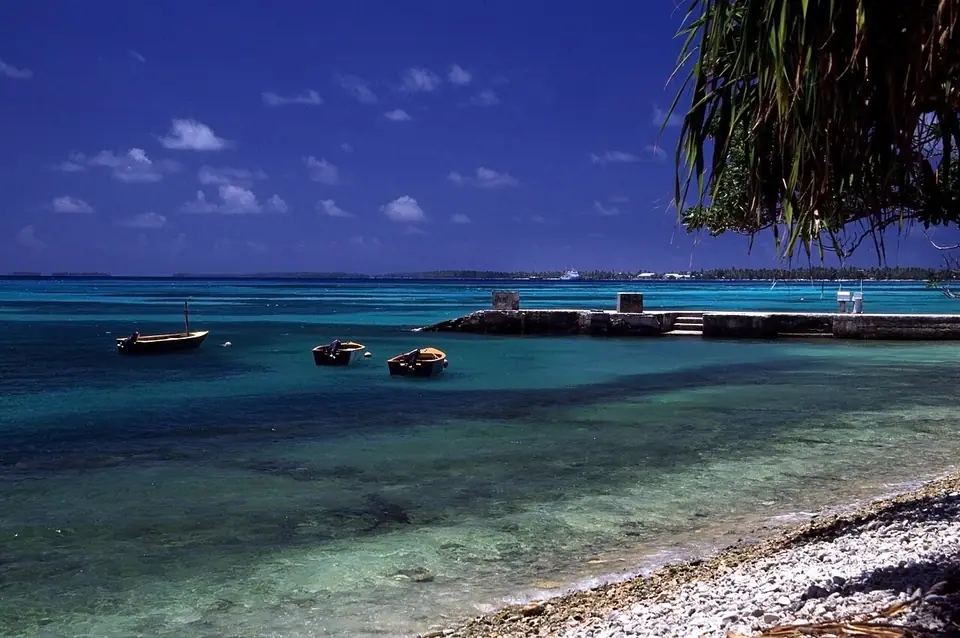
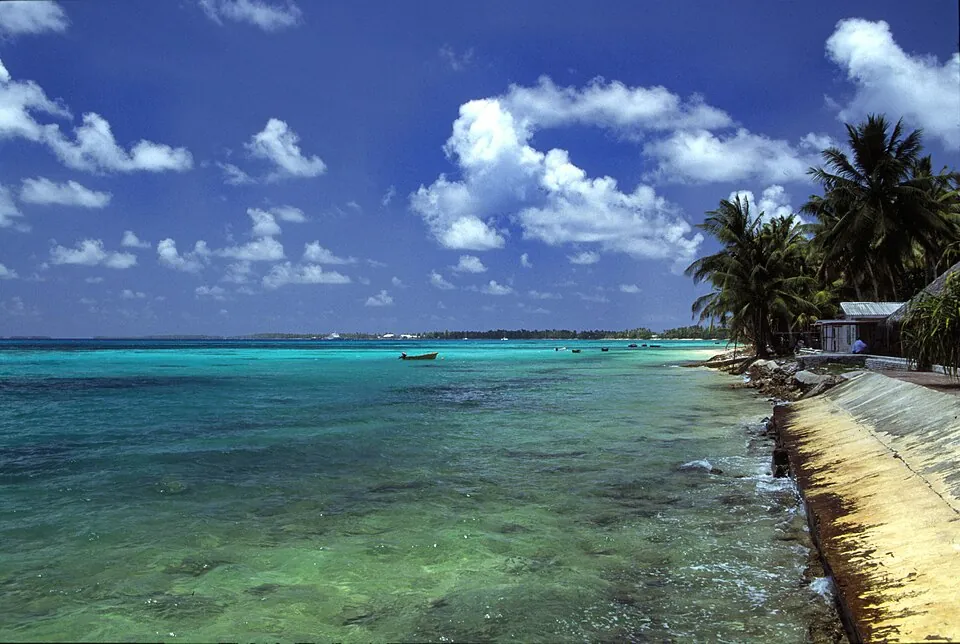
Tuvalu is a tiny island nation in the central Pacific, roughly midway between Hawaii and Australia. It consists of nine low-lying coral atolls and reef islands scattered over about 600 km of ocean, just south of the equator and west of the International Date Line. Kiribati lies to the north and east, Fiji to the south and Samoa to the south-east. The capital is Funafuti, an atoll whose main islet holds the airport, the government and most of the population.
On a world map, Tuvalu is one of the hardest countries to see. The land totals only about 26 km², so the quiz target is really the patch of ocean the atolls sit in.
How to find Tuvalu on the map
- Start from Fiji. Go north about 1,000 km and you reach Tuvalu's southern atolls.
- Look for the gap between Kiribati and Fiji. Tuvalu fills the empty-looking stretch of ocean between those two island groups.
- Find the equator and the Date Line. Tuvalu is just below the equator and just west of 180°.
- Don't confuse it with Kiribati. Kiribati is spread over a far larger area and straddles the equator; Tuvalu is a compact chain entirely south of it.
Flag
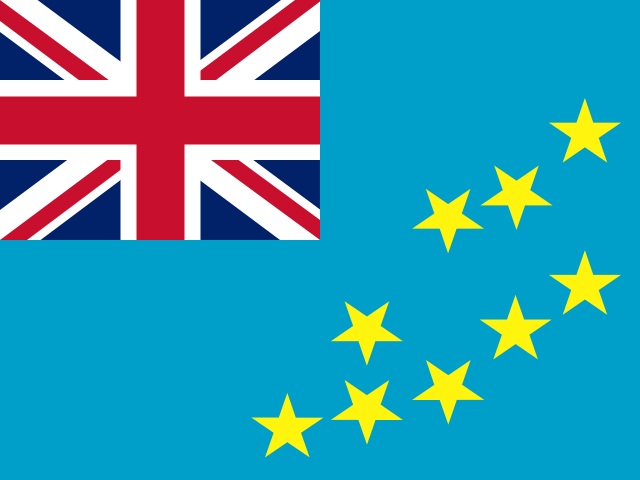
Tuvalu's flag is light blue with the British Union Jack in the upper hoist corner and nine yellow five-pointed stars on the fly side, arranged to show the position of the nine islands as seen on a map. It was adopted at independence in 1978.
In the Flags quiz, several Pacific flags carry a Union Jack – Australia, New Zealand and Fiji among them. Fiji's is also light blue, but it has a shield; Tuvalu has only the scattered yellow stars. Australia and New Zealand use dark blue.
A short history of Tuvalu
Polynesian voyagers settled these atolls many centuries ago, and island traditions point to Samoa and Tonga as the homelands of the first families. On the island of Nui, settlers from the Gilbert Islands to the north arrived too, and people there still speak a language close to that of Kiribati. Life depended on fishing, coconuts and carefully tended taro pits, with each island run by its chiefs and elders.
The first European to sight the islands was probably the Spanish explorer Álvaro de Mendaña, who passed Nui in 1568. Regular contact came only in the 1800s, when whaling ships and traders called for supplies. In the 1860s Peruvian slave raiders, known as blackbirders, carried off hundreds of people from Funafuti and Nukulaelae to work in South America, and very few ever returned. Around the same time the London Missionary Society sent Samoan pastors, who converted most islanders to Christianity within a generation.
Britain declared a protectorate in 1892 and later ran the islands as one colony with the Gilberts. During the Second World War, the United States forces built an airstrip on Funafuti in 1943 and used it as a base for attacks on Japanese-held Tarawa. The runway is still the country's only airport, and the pits dug for building material scarred the atoll for decades until a land reclamation project filled many of them in the 2010s.
Polynesian Tuvaluans and Micronesian Gilbertese felt little in common, and in a 1974 vote Tuvaluans chose to separate. Full independence followed in 1978, with the British monarch remaining head of state. Tuvalu joined the United Nations in 2000.
Today the country lives on fishing licences sold to foreign fleets, aid, money sent home by sailors and workers abroad, and the Tuvalu Trust Fund, set up in 1987. A 2023 treaty with Australia offers Tuvaluans a path to live there, reflecting worries about the islands' long-term future.
Culture and daily life in Tuvalu
Tuvaluan is a Polynesian language closely related to Samoan, which was long the language of church and school because of those early Samoan pastors. Most people belong to the Church of Tuvalu, and Sunday is kept as a day of worship and rest, with church singing at the heart of island life.
Each island keeps a strong identity. Traditional assemblies of elders, called the falekaupule, still guide local decisions, and when people from different islands live on Funafuti they often stay grouped by home island. Sharing is expected: a good catch of fish is divided among relatives and neighbours rather than kept.
Women are known for fine handicrafts, weaving mats, fans and baskets from pandanus leaves and decorating them with shells. Men traditionally build small outrigger canoes for fishing inside the lagoon. A local ball game called te ano is played between two teams, and football is popular on the runway when no plane is due. Tuvalu first competed at the Olympic Games in 2008, in Beijing.
Five facts worth knowing
- It is the fourth-smallest country in the world by area, after Vatican City, Monaco and Nauru, and one of the least populated.
- The highest point is only about 4.6 metres above sea level, which makes Tuvalu one of the countries most threatened by rising seas.
- Its internet domain, .tv, is a major source of national income, licensed to television and streaming companies around the world.
- The name means "eight standing together" in Tuvaluan, referring to the eight islands that were traditionally inhabited; the ninth, Niulakita, was settled later.
- It was formerly the Ellice Islands, part of a British colony with the Gilbert Islands, which became Kiribati when the two separated in the 1970s.
Culture and traditions in Tuvalu
- Saying hello
"Talofa" (hello) with a warm smile.
- Food and drink
Pulaka, a swamp taro grown in pits; fresh fish and coconut in many forms.
- Festivals and traditions
Independence Day on 1 October, with feasting and fatele, the traditional group dance and song.
- Everyday life
Each island community gathers in a maneapa, a large open meeting hall, for feasts, dances and decisions.
- Did you know?
Tuvalu earns a significant share of its income from licensing its internet domain name, ".tv".
Common mistakes
- Tapping Kiribati, which surrounds Tuvalu on two sides.
- Tapping Fiji or Samoa, the larger neighbours to the south.
- Picking the Fijian flag in the Flags quiz, since both are light blue with a Union Jack.
Practise with Tuvalu
- Oceania quiz – the dots between Kiribati and Fiji; use both as anchors.
- Oceania flags – light blue, Union Jack, nine yellow stars.
- Whole World quiz – one of the toughest targets on the whole map.
- Oceania capitals quiz – Funafuti.
- Mystery Country – a diagonal sprinkle of atolls with almost no land to see.
Quick check: how well do you know Tuvalu?
3 questions, no sign-up. Tap an answer.
1. Which flag belongs to Tuvalu?
That's the flag of Tuvalu.
2. What is the capital of Tuvalu?
The capital of Tuvalu is Funafuti.
3. Which is bigger by area?
Vanuatu (12,189 km²) is bigger than Tuvalu (26 km²).
Keep going on the Oceania quiz – Tuvalu is one of 14 countries there.
More ways to practise: find Tuvalu on the blank map with no borders (hard mode), or play today's Globe and the other daily puzzles.
Frequently asked questions about Tuvalu
What language is spoken in Tuvalu?
English and Tuvaluan are the main languages, and English is used in government and law. Almost everyone speaks Tuvaluan, a Polynesian language, while on the island of Nui many people speak a language derived from Gilbertese (Kiribati).
What currency does Tuvalu use?
Tuvalu uses the Australian dollar (AUD). It also issues its own Tuvaluan coins, which are equal in value to Australian ones and circulate alongside them, but there are no Tuvaluan banknotes.
What time zone is Tuvalu in?
Tuvalu is on UTC+12 all year, the same as Fiji's standard time and New Zealand's standard time. It does not use daylight saving time. It lies just west of the International Date Line, so it is among the first places to start each new day.
Which side of the road do they drive on in Tuvalu?
Tuvalu drives on the left, like Australia, New Zealand and Fiji. There are only a few kilometres of road, mainly on Fongafale, and most people get around by motor scooter.
What is the highest point in Tuvalu?
Tuvalu's highest point is only about 4.6 metres above sea level, on Niulakita, making it one of the lowest-lying countries in the world. Most land is less than 3 metres above the sea.
How is Tuvalu responding to rising seas?
Tuvalu is reclaiming land on Funafuti to build higher ground. In 2023 it signed a treaty with Australia giving Tuvaluans a pathway to migrate there, and it is creating a digital copy of the nation so its culture and records survive whatever happens.
Quizzes with Tuvalu
Guides that help with this
- The 25 hardest countries to find on a mapPacific islands, Caribbean islands and landlocked Africa – where they are.
- Flags that look alike (and how to tell them apart)Chad or Romania? Australia or New Zealand? The flag pairs that cost quiz points.
- Learn all 197 countries in 30 daysA day-by-day plan: one region at a time, spaced repetition for review.