Vanuatu
Capital: Port Vila. Vanuatu is one of the 14 countries in the Oceania quiz.
Quick answers: What is the capital of Vanuatu? · Which countries border Vanuatu?
Facts about Vanuatu
- CapitalPort Vila
- Population335,169
- Area12,189 km²
- RegionOceania
- LanguagesBislama, English, French
- CurrencyVanuatu vatu (VUV)
Vanuatu is the 6th most populous of the 14 countries in Oceania and the 6th largest by area. Worldwide it ranks 175th by population and 158th by area.
Where is Vanuatu?
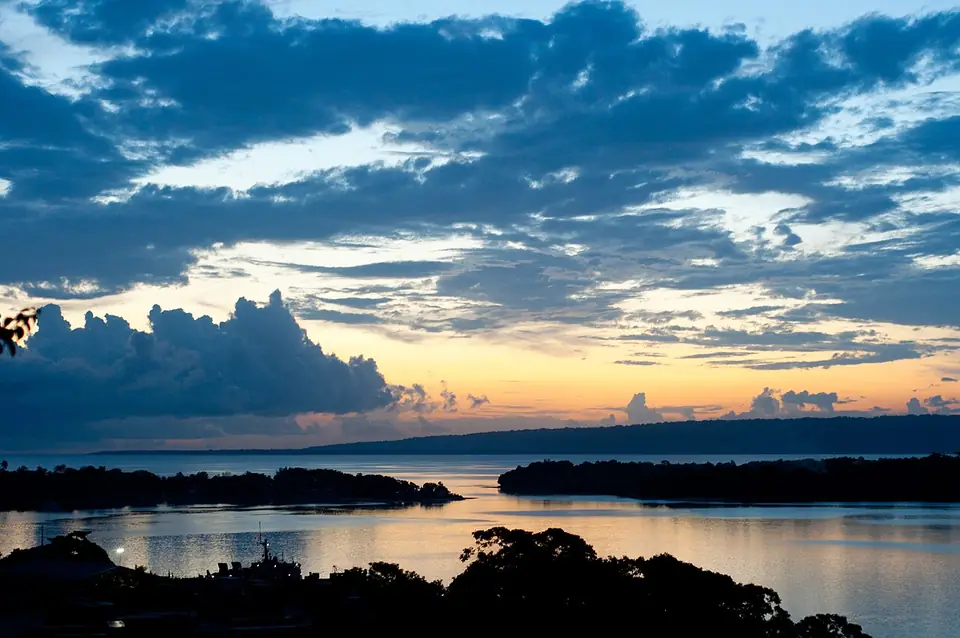
Vanuatu is a chain of around 80 islands in the south-west Pacific, forming a rough Y shape that runs north–south for about 1,300 km. It lies east of Australia's Queensland coast, north-east of New Caledonia, west of Fiji and south-east of the Solomon Islands. The capital, Port Vila, is on the island of Efate, in the middle of the chain. The largest island, Espiritu Santo, is in the north.
On a world map, Vanuatu is the cluster of islands between New Caledonia and the Solomon Islands, in the stretch of ocean north-east of Australia.
How to find Vanuatu on the map
- Start from New Caledonia. Vanuatu is the island chain just to its north-east.
- Look between the Solomons and Fiji. Vanuatu sits roughly halfway between those two larger island groups.
- Find the Y. On a zoomed map the islands form a shape like a forked stick, with two arms in the north.
- Don't confuse it with Fiji. Fiji is further east, past the Date Line, and its two main islands are much bigger than any in Vanuatu.
Flag
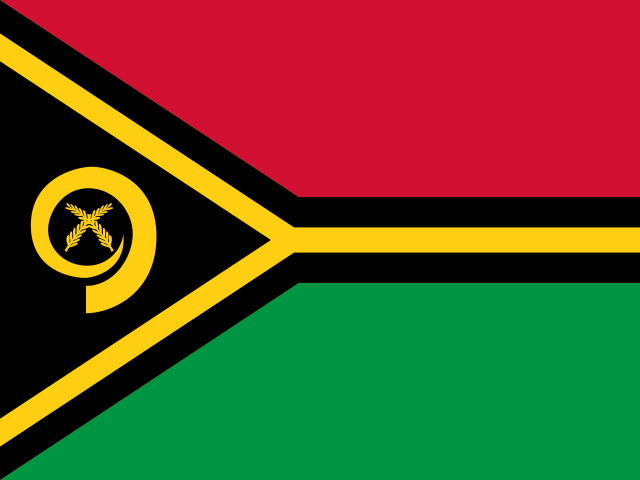
Vanuatu's flag has a black triangle at the hoist, with red and green horizontal bands on the fly side separated by a yellow Y shape edged in black that follows the triangle's outline. Inside the triangle is a yellow boar's tusk encircling two crossed namele fern leaves. The Y represents the shape of the island chain; the tusk and fern are traditional symbols of prosperity and peace.
In the Flags quiz, Timor-Leste also has a black triangle at the hoist, but with a yellow triangle behind it and a white star. If the triangle contains a curved tusk and there's a yellow Y, it's Vanuatu.
A short history of Vanuatu
The first people reached these islands around 3,000 years ago. They belonged to the Lapita culture, seafarers known for their finely decorated pottery, who spread across the Pacific from the islands near New Guinea. One of the oldest Lapita cemeteries in the Pacific was found at Teouma on Efate. Over the centuries, small communities on each island developed their own languages, customs and systems of rank, which explains the country's extraordinary variety today.
The Portuguese navigator Pedro Fernández de Quirós, sailing for Spain, landed on the largest island in 1606, believing he had found the great southern continent; he named it Espiritu Santo. James Cook charted the islands in 1774 and named them the New Hebrides, after the islands off Scotland. In the 1800s traders arrived to cut sandalwood, missionaries came to convert islanders, and recruiters took thousands of men to work on plantations in Queensland and Fiji, sometimes by trickery or force – a practice known as blackbirding.
British and French settlers competed for land, and rather than fight, the two powers agreed in 1906 to rule together. The condominium meant two of everything: two police forces, two school systems, two currencies and two sets of laws. During the Second World War, the United States built a huge base on Espiritu Santo, and the American writer James Michener drew on his time there for Tales of the South Pacific.
In the 1970s the Vanua'aku Pati led the push for independence. Just before independence in 1980, a secession movement on Espiritu Santo, led by Jimmy Stevens, tried to break away, but it was put down with help from Papua New Guinean troops. The new country took the name Vanuatu, meaning roughly "land that stands up".
Today most people live by subsistence farming and fishing, and tourism, cruise ships and seasonal work in Australia and New Zealand are major sources of income.
Culture and daily life in Vanuatu
The colonial split still shapes daily life: children attend either English-speaking or French-speaking schools, and the country is a member of both the Commonwealth and the Francophonie. Most people are Christian, belonging to Presbyterian, Anglican, Catholic and other churches. On Tanna, the John Frum movement, a cargo cult that arose in the 1930s, still holds ceremonies.
Custom, or kastom, remains strong. Village chiefs settle disputes, land is held by families under custom law, and on some islands men rise through ranked societies by holding pig-killing ceremonies; curved pig tusks are prized as signs of wealth. Sand drawing, in which an artist traces a continuous pattern with one finger to tell a story or pass on knowledge, is recognised by UNESCO.
On Ambrym, carvers make tall slit drums from hollowed tree trunks. On Gaua, women perform water music, slapping the surface of the sea to make rhythms. The string band, played with guitars and a homemade bass, is the sound of every celebration.
Five facts worth knowing
- The country was called the New Hebrides until independence in 1980, and was jointly ruled by Britain and France in a rare arrangement known as a condominium.
- Bislama, an English-based creole, is the national language, alongside English and French. More than 100 local languages are also spoken.
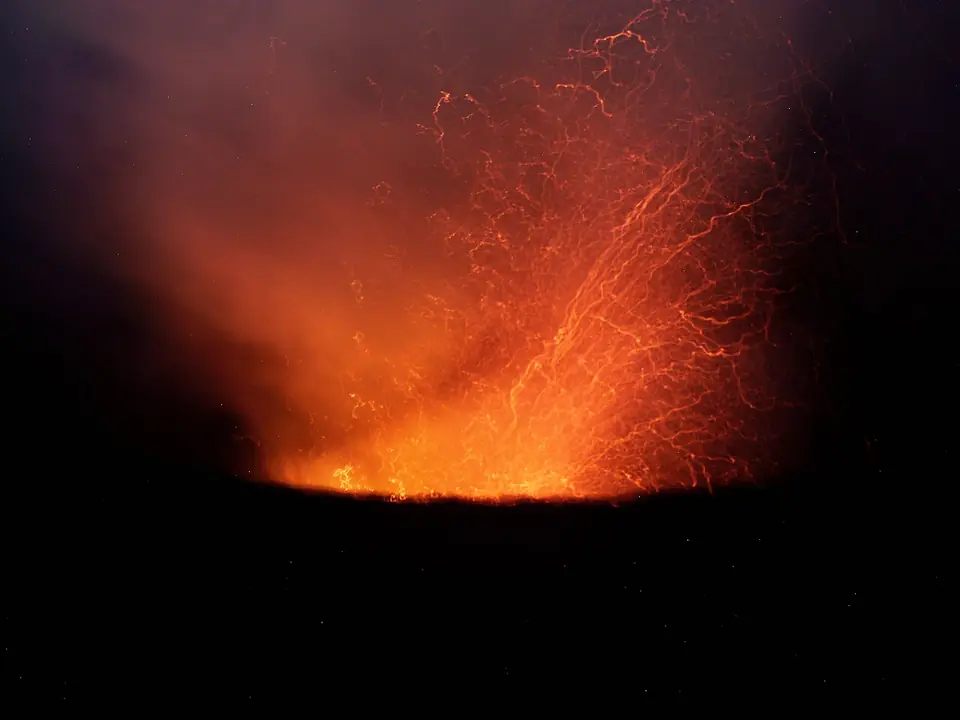
- Vanuatu is one of the most active volcanic areas in the world, and Mount Yasur on the island of Tanna has been erupting almost continuously for centuries.
- Land diving on Pentecost Island, where men jump from wooden towers with vines tied to their ankles, is the ancestor of modern bungee jumping.
- Vanuatu regularly tops the World Risk Index as the country most exposed to natural disasters, including cyclones, earthquakes and volcanic eruptions.
Culture and traditions in Vanuatu
- Saying hello
"Halo" in Bislama, with a smile and handshake.
- Food and drink
Lap lap, the national dish of grated root vegetables baked with coconut cream in an earth oven; kava, a calming root drink.
- Festivals and traditions
Nagol land diving on Pentecost Island (April–June), where men dive from wooden towers with vines tied to their ankles.
- Everyday life
Kava is drunk in the evening at a nakamal (meeting place), where things are kept quiet. Life runs on relaxed "island time".
- Did you know?
Vanuatu has over 100 languages, giving it one of the highest numbers of languages per person in the world.
Common mistakes
- Tapping New Caledonia, the larger French island just to the south-west.
- Tapping the Solomon Islands or Fiji, the neighbouring chains.
- Picking the Timor-Leste flag because of the shared black triangle.
Practise with Vanuatu
- Oceania quiz – the Y-shaped chain between New Caledonia and the Solomons.
- Oceania flags – black triangle, yellow Y, boar's tusk.
- Whole World quiz – a tough target at world zoom; use Australia's east coast as the anchor.
- Oceania capitals quiz – Port Vila.
- Mystery Country – a scattered string of islands forking at the top.
Quick check: how well do you know Vanuatu?
3 questions, no sign-up. Tap an answer.
1. Which flag belongs to Vanuatu?
That's the flag of Vanuatu.
2. What is the capital of Vanuatu?
The capital of Vanuatu is Port Vila.
3. Which is bigger by area?
Papua New Guinea (462,840 km²) is bigger than Vanuatu (12,189 km²).
Keep going on the Oceania quiz – Vanuatu is one of 14 countries there.
More ways to practise: find Vanuatu on the blank map with no borders (hard mode), or play today's Globe and the other daily puzzles.
Frequently asked questions about Vanuatu
What language is spoken in Vanuatu?
Vanuatu has three official languages: Bislama, English and French. Bislama, an English-based creole, is the common language between islands, while schools teach in English or French. More than 100 local languages are also spoken.
What currency does Vanuatu use?
Vanuatu uses the vatu (VUV), introduced in 1981. Unusually, it has no subunits, so there are no cents. Its value is managed against a basket of the currencies of Vanuatu's main trading partners.
What time zone is Vanuatu in?
Vanuatu is on UTC+11 all year, the same as New Caledonia and the Solomon Islands. It does not use daylight saving time. That is one hour ahead of Sydney's standard time and one hour behind Fiji's.
Which side of the road do they drive on in Vanuatu?
Vanuatu drives on the right, unlike most of its Pacific neighbours. The rule dates from the Anglo-French Condominium, when the French side's practice was adopted.
What is the highest point in Vanuatu?
The highest point is Mount Tabwemasana, at about 1,880 metres, on Espiritu Santo, the largest island. It lies in a remote, rugged interior with few tracks.
What is Vanuatu famous for?
Vanuatu is famous for land diving on Pentecost Island, where men leap from tall wooden towers with vines tied to their ankles – a forerunner of bungee jumping. Mount Yasur on Tanna is one of the world's most accessible active volcanoes.
Quizzes with Vanuatu
Guides that help with this
- The 25 hardest countries to find on a mapPacific islands, Caribbean islands and landlocked Africa – where they are.
- Flags that look alike (and how to tell them apart)Chad or Romania? Australia or New Zealand? The flag pairs that cost quiz points.
- Learn all 197 countries in 30 daysA day-by-day plan: one region at a time, spaced repetition for review.