All 54 African Capitals – With a Memory Trick for Each One
On this page
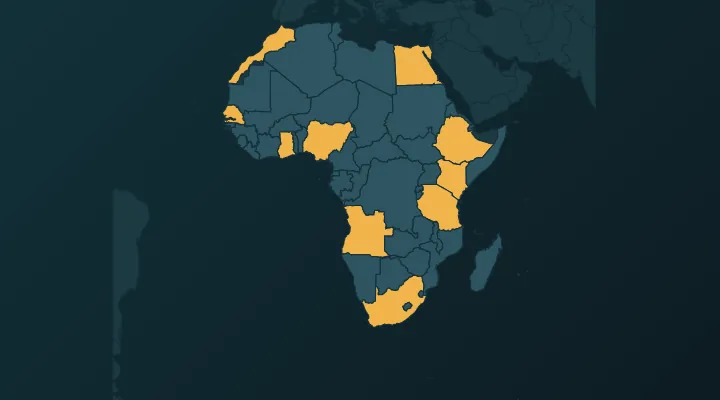
Africa has 54 countries – more than any other continent – and it is often the hardest part of a world-capitals quiz. Several countries have moved their capital in the last 50 years, and in many of them the biggest, best-known city is not the capital at all. This guide goes through every African capital in the same regions as the site's quizzes, with a hook for the tricky ones and the mix-ups to watch for.
The traps: famous city, wrong answer
Learn these first. They cover most of the wrong answers people give.
- Nigeria – Abuja, not Lagos. Abuja was built in the middle of the country and took over in 1991, partly so the capital would not belong to any one of the big ethnic regions.
- Ivory Coast – Yamoussoukro, not Abidjan. It became the official capital in 1983 because it was the home town of the first president, Félix Houphouët-Boigny. Abidjan is still where most government business actually happens.
- Tanzania – Dodoma, not Dar es Salaam. Chosen in 1973; ministries were slow to follow and only moved in large numbers under President Magufuli (2015–21).
- Morocco – Rabat, not Casablanca or Marrakesh.
- Cameroon – Yaoundé, not Douala.
- Benin – Porto-Novo is the official capital, but the government sits in Cotonou, the largest city.
- Burundi – Gitega, not Bujumbura. The change was made in 2019, so older maps and quizzes are wrong.
- Malawi – Lilongwe, which replaced Zomba in 1975.
- South Africa – three capitals: Pretoria (government), Cape Town (parliament) and Bloemfontein (courts). Quizzes, including this one, use Pretoria.
- Eswatini – Mbabane is the administrative capital; Lobamba, about 18 km away, has the parliament and the royal residence. The quiz uses Mbabane.
Hook: Abuja, Dodoma, Yamoussoukro, Gitega, Lilongwe – inland capitals that took over from bigger cities.
North Africa (5)
- Egypt – Cairo, on the Nile just above the delta.
- Libya – Tripoli, on the Mediterranean coast in the west of the country.
- Tunisia – Tunis.
- Algeria – Algiers.
- Morocco – Rabat, on the Atlantic coast.
Hook: chop the end off the country and you have the capital – Tunisia → Tunis, Algeria → Algiers. In Arabic the match is exact: each country and its capital share one name.
West Africa (16)
Go along the coast from north-west to south-east, then do the three Sahel countries.
- Mauritania – Nouakchott, a planned city built from almost nothing around independence in 1960.
- Senegal – Dakar, on the Cap-Vert peninsula – the westernmost point of mainland Africa.
- Gambia – Banjul, on an island at the mouth of the Gambia River.
- Cabo Verde – Praia, Portuguese for "beach", on the island of Santiago.
- Guinea-Bissau – Bissau. The country's second word is the capital.
- Guinea – Conakry, on a peninsula reaching into the Atlantic. Hook: Guinea-Bissau gives its capital away; plain Guinea doesn't.
- Sierra Leone – Freetown, founded in 1792 as a settlement for freed slaves.
- Liberia – Monrovia, founded in 1822 and named after US president James Monroe.
- Ivory Coast – Yamoussoukro.
- Ghana – Accra.
- Togo – Lomé, right on the border with Ghana.
- Benin – Porto-Novo, "new port" in Portuguese.
- Nigeria – Abuja.
- Mali – Bamako, on the Niger River.
- Niger – Niamey, also on the Niger, downstream.
- Burkina Faso – Ouagadougou. Say it "wah-gah-DOO-goo" and it stops being scary. Locals shorten it to "Ouaga".
Hook: the Niger River links two capitals – Bamako upstream in Mali, Niamey downstream in Niger. Niger and Niamey share their first letter.
Central Africa (8)
- Chad – N'Djamena, on the border with Cameroon. It was called Fort-Lamy until 1973.
- Central African Republic – Bangui, on the Ubangi River, opposite DR Congo.
- Cameroon – Yaoundé.
- Equatorial Guinea – Malabo, on Bioko island. In January 2026 a presidential decree named Ciudad de la Paz, a new city on the mainland, as the capital, with ministries given a year to move. The site's quiz still uses Malabo while the move is under way.
- Gabon – Libreville, French for "free town", founded in 1849 for people freed from a slave ship.
- São Tomé and Príncipe – São Tomé, on the larger of the two islands.
- Congo – Brazzaville, named after the explorer Pierre Savorgnan de Brazza.
- DR Congo – Kinshasa, called Léopoldville in colonial times.
Hook: Brazzaville and Kinshasa face each other across the Congo River – the two closest capitals in the world apart from Rome and Vatican City. The smaller Congo gets the "-ville".
East Africa (11)
- Sudan – Khartoum, where the Blue Nile and White Nile meet. The government ran the country from Port Sudan during the war and announced its return to Khartoum in January 2026.
- South Sudan – Juba, on the White Nile. South Sudan became independent in 2011, the newest country in Africa.
- Eritrea – Asmara, on the highlands, famous for its 1930s Italian modernist buildings.
- Ethiopia – Addis Ababa, "new flower" in Amharic. It is also where the African Union is headquartered.
- Djibouti – Djibouti. Same name as the country.
- Somalia – Mogadishu, on the Indian Ocean coast.
- Kenya – Nairobi.
- Uganda – Kampala, just north of Lake Victoria.
- Rwanda – Kigali, in the middle of the country.
- Burundi – Gitega.
- Tanzania – Dodoma.
Hook: Rwanda and Burundi are the small twins, and both capitals have a hard "g": Kigali, Gitega.
Southern Africa and the islands (14)
- Angola – Luanda.
- Zambia – Lusaka.
- Malawi – Lilongwe.
- Zimbabwe – Harare, called Salisbury until 1982.
- Mozambique – Maputo, formerly Lourenço Marques, in the far south of the country, close to Eswatini and South Africa.
- Namibia – Windhoek, on the central highlands, roughly in the middle of the country.
- Botswana – Gaborone, only about 15 km from the border with South Africa.
- South Africa – Pretoria.
- Lesotho – Maseru, on the border river with South Africa.
- Eswatini – Mbabane.
- Madagascar – Antananarivo, which locals shorten to "Tana".
- Mauritius – Port Louis.
- Seychelles – Victoria, one of the smallest capitals in the world.
- Comoros – Moroni. Hook: Comoros and Moroni – both are full of O's.
Hook: Luanda, Lusaka, Lilongwe – three L capitals in a row from west to east: Angola, Zambia, Malawi.
Pairs that get confused
- Freetown / Libreville – Sierra Leone / Gabon. Same meaning, different language. Freetown is English and in West Africa; Libreville is French and on the equator in Central Africa.
- Brazzaville / Kinshasa – Congo / DR Congo. The smaller country gets the "-ville".
- Bamako / Niamey – Mali / Niger. Both on the Niger River; N goes with N.
- Lusaka / Lilongwe – Zambia / Malawi. Neighbours; Malawi is the long, thin one beside Lake Malawi.
- Guinea / Guinea-Bissau – Conakry / Bissau. The hyphenated one names its capital.
Practise it
- Play Africa – capitals once without studying to get a baseline.
- Drill the hardest regions on their own: West Africa – capitals, East Africa – capitals and Southern Africa – capitals.
- Then try Whole World – capitals. Africa is more than a quarter of it, so you are already well on the way.
Tip: do one region a day, and replay it the next morning before starting a new one. The capitals you miss go into your Mistake Bank, and the flashcards bring them back at growing intervals until they stick.
FAQ
How many countries and capitals are there in Africa?
There are 54 countries in Africa that are UN members, and that is the list the site's Africa quiz uses. South Africa has three capitals, and a few others split their capital between two cities, so you may see slightly different lists of capitals.
What is the capital of Nigeria?
Abuja. It replaced Lagos as the capital in 1991. Lagos is still Nigeria's largest city and its business centre.
Does South Africa have three capitals?
Yes. Pretoria is the seat of government, Cape Town is home to parliament, and Bloemfontein to the Supreme Court of Appeal. Quizzes usually expect Pretoria.
What is the capital of Equatorial Guinea now?
A presidential decree in January 2026 named Ciudad de la Paz, on the mainland, as the new capital in place of Malabo on Bioko island. Government offices are moving over, so you will still see Malabo in many lists and quizzes.
Sources
More guides
 All 48 Asian Capitals – With a Memory Trick for Each One
All 48 Asian capitals grouped by region, with a memory trick for the ones that never stick.
 All 46 European Capitals – With Memory Tricks for the Hard Ones
All 46 European capitals grouped by region, with a memory trick for the ones people forget.
 All 45 Landlocked Countries – Where They Are and How to Remember Them
All 45 countries with no coastline, continent by continent – plus the two that are doubly landlocked.