All 45 Landlocked Countries – Where They Are and How to Remember Them
On this page
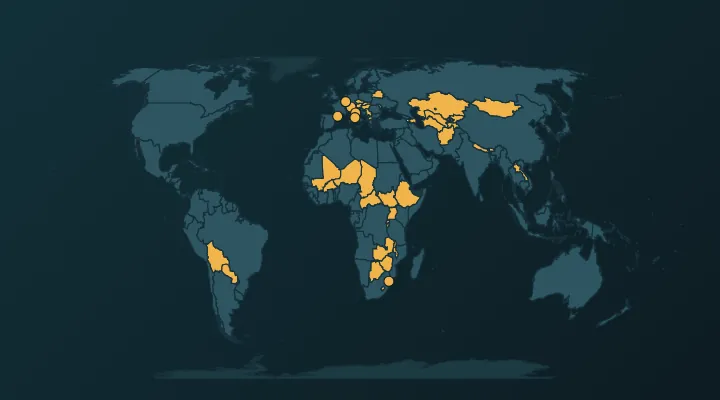
A landlocked country has no coastline on the open ocean. It sounds easy to spot on a map, but in a quiz it is a classic trap: people put Bolivia on the Pacific, give Ethiopia a Red Sea coast it lost in 1993, or forget that Hungary and Austria have no sea at all. This guide goes through every landlocked country, continent by continent, so you can name all 45, find them on the map and know why each one ended up without a coast.
Why 45 and not 44?
Most lists say 44, because they count only UN members plus Vatican City. Quiz the Map counts 45 because we include Kosovo, which is landlocked and is on our world map.
The other point that changes the count is the Caspian Sea. It has no natural link to the ocean, so it is treated as a lake for this purpose. That keeps Kazakhstan, Turkmenistan and Azerbaijan on the list even though they have long Caspian shores. (If you treated the Caspian as a sea, those three would drop off.)
North America and Oceania have no landlocked countries at all. Everything happens in four continents:
| Continent | Landlocked countries |
|---|---|
| Africa | 16 |
| Europe | 15 (with Kosovo) |
| Asia | 12 |
| South America | 2 |
| Total | 45 |
Together they hold about 10% of the world's land and roughly 6% of its people.
Europe: 15 landlocked countries
Europe's landlocked countries fall into four easy clusters.
The Alps and the Rhine (4): Switzerland, Austria, Liechtenstein and Luxembourg. Switzerland and Austria form a band across the Alps; Liechtenstein is the thin strip between them on the upper Rhine. Luxembourg sits further north-west, wedged between Belgium, France and Germany – not in the Alps, but an easy add-on to this group.
Central Europe (3): Czechia, Slovakia and Hungary – the old Habsburg heartland. Hungary was not always landlocked: until the end of the First World War it controlled the port of Fiume (today Rijeka in Croatia). The Treaty of Trianon in 1920 took the coast away.
The Balkans and the east (5): Serbia, Kosovo, North Macedonia, Moldova and Belarus. Serbia lost its only coast when Montenegro became independent in 2006. Moldova got about 600 metres of Danube riverbank in a 2005 land swap with Ukraine and built the river port of Giurgiulești there, but it has no Black Sea coast. Belarus is the largest landlocked country in Europe.
The micro-states (3): Andorra in the Pyrenees between France and Spain, and San Marino and Vatican City inside Italy. San Marino and the Vatican are enclaves – entirely surrounded by one other country.
Hook: Alps four, Central three, Balkans and east five, micro-states three.
Africa: 16 landlocked countries
Africa has the most landlocked countries of any continent, a legacy of colonial borders that cut the interior into separate territories. They sit in three groups.
The Sahel belt, west to east (7): Mali, Burkina Faso, Niger, Chad, the Central African Republic, South Sudan and Ethiopia. Trace them in a rough line from the southern edge of the Sahara to the Horn of Africa. Ethiopia is the most populous landlocked country in the world, with well over 100 million people; it lost its coast when Eritrea became independent in 1993. South Sudan is the newest, landlocked from the day of independence in 2011.
The Great Lakes (3): Uganda, Rwanda and Burundi. Uganda sits on the north shore of Lake Victoria; Rwanda and Burundi are the two small countries stacked below it to the south-west, between DR Congo and Tanzania. Rwanda is the upper one, on Lake Kivu; Burundi is below it, on the north tip of Lake Tanganyika.
Southern Africa (6): Zambia, Malawi, Zimbabwe, Botswana, Eswatini and Lesotho. Lesotho is completely surrounded by South Africa and is the only independent country that lies entirely above 1,000 metres – its lowest point is about 1,400 metres. Eswatini is almost surrounded by South Africa too, with a short border with Mozambique on the east. Malawi is the long thin one along Lake Malawi.
Hook: seven across the Sahel, three in the Great Lakes, six in the south.
Asia: 12 landlocked countries
Central Asia (6): Kazakhstan, Uzbekistan, Turkmenistan, Kyrgyzstan and Tajikistan – all five Central Asian "-stans" – plus Afghanistan below them. Kazakhstan is the largest landlocked country in the world (about 2.7 million km², ninth-largest country of any kind). Kyrgyzstan is the country furthest from any ocean.
The Himalayas (2): Nepal and Bhutan, both squeezed between India and China. Bhutan is the smaller one to the east, separated from Nepal by the Indian state of Sikkim.
East and Southeast Asia (2): Mongolia, between Russia and China, and Laos, the only landlocked country in Southeast Asia.
The Caucasus (2): Armenia and Azerbaijan. Azerbaijan has a long shore on the Caspian, but because the Caspian is closed off from the ocean, it still counts as landlocked. Georgia, their neighbour, has a Black Sea coast and is not on the list.
Hook: the five "-stans" plus Afghanistan, two in the Himalayas, two between giants (Mongolia, Laos), two in the Caucasus.
South America: 2 landlocked countries
Bolivia and Paraguay sit side by side in the middle of the continent. They are the only landlocked countries in the Western Hemisphere.
Bolivia had a Pacific coast until the War of the Pacific (1879–1884), when it lost its coastal province around Antofagasta to Chile. It still keeps a navy, which patrols Lake Titicaca and the country's rivers, and every 23 March marks the Día del Mar (Day of the Sea) to remember the lost coast.
Paraguay reaches the Atlantic by river, down the Paraguay and Paraná to the Río de la Plata, and has the largest river barge fleet in Latin America – a landlocked country that is a serious shipping nation.
The two doubly landlocked countries
A doubly landlocked country is surrounded only by other landlocked countries, so you must cross at least two borders to reach the sea. There are two:
- Liechtenstein – bordered only by Switzerland and Austria.
- Uzbekistan – bordered only by Kazakhstan, Kyrgyzstan, Tajikistan, Afghanistan and Turkmenistan.
Uzbekistan's status depends on the Caspian rule above: if the Caspian were a sea, Kazakhstan and Turkmenistan would have coasts and Uzbekistan would only be "singly" landlocked. A handy pairing for memory: one of the smallest countries on the list and the most populous country in Central Asia.
Common mistakes
- Giving Bolivia a coast. Old atlases and the Chile–Peru border make it look as if Bolivia should touch the Pacific. It hasn't since the 1880s.
- Forgetting Ethiopia. It looks as if it should reach the Red Sea, but Eritrea and Djibouti are in the way.
- Adding Georgia, Croatia or Montenegro. All three have coasts. Serbia, Kosovo and North Macedonia are the landlocked ones in the Balkans.
- Forgetting the Caspian three. Kazakhstan, Turkmenistan and Azerbaijan touch water, but not the ocean.
- Missing the micro-states. Vatican City, San Marino, Liechtenstein and Andorra all count and are easy to leave out.
Why it matters
Being landlocked shapes a country's history and economy. Trade has to cross a neighbour's territory, so landlocked countries depend on transit deals: Ethiopia ships most of its trade through the port of Djibouti, and Bolivia uses ports in Chile and Peru. Several countries – Hungary, Bolivia, Ethiopia, Serbia – became landlocked through war or a neighbour's independence, which is why some borders seem to stop just short of the coast.
Practise it
- Landlocked countries – all 45 on the world map.
- Central & South Asia and Southern Africa – regional maps where the landlocked countries are easier to see as shapes.
- Smallest countries in the world – more on the micro-states.
Tip: play the landlocked quiz once by continent in your head – Europe first, then Africa, Asia, South America – and note which cluster you lose points in. Replay just that cluster on the regional quiz the next day.
FAQ
How many landlocked countries are there in the world?
Usually 44 – or 45 if you include Kosovo, as Quiz the Map does. The count assumes the Caspian Sea is a lake.
What is the largest landlocked country?
Kazakhstan, at about 2.7 million km². Ethiopia is the most populous landlocked country.
Which countries are doubly landlocked?
Liechtenstein and Uzbekistan. Both are surrounded only by other landlocked countries.
Does Bolivia have a navy?
Yes. Bolivia's navy operates on Lake Titicaca and the country's rivers, a reminder of the coast it lost to Chile in the War of the Pacific (1879–1884).
Sources
More guides
 The 15 Smallest Countries in the World – and Where to Find Them on the Map
The 15 smallest countries in the world by area – how big they really are and where to find them on the map.
 Countries That Changed Their Names (and Why)
Swaziland, Burma, Ceylon, Zaire… the countries that got new names, when it happened and why.
 The 25 Hardest Countries to Find on a Map
25 countries that are hard to find on a world map – Pacific and Caribbean islands, small African states – and exactly where each one is.