Name all 39 lakes
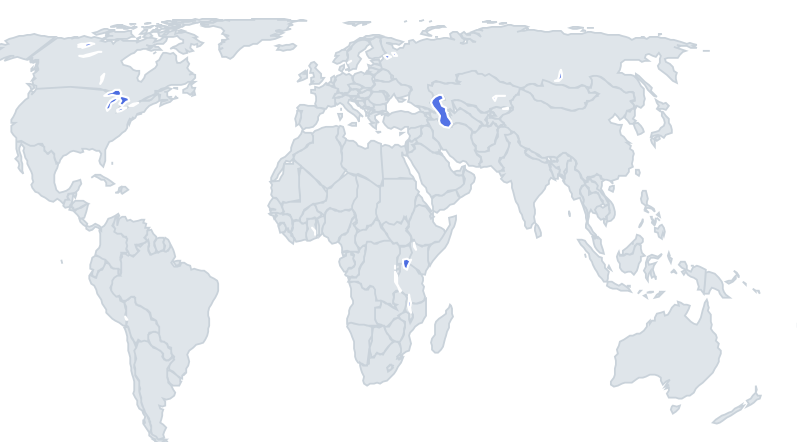
No map hints and no multiple choice: just type every one you can remember. Each correct answer lights up on the map, and the clock keeps running until you give up or get all 39.
Top scores
- The five fastest 100% rounds on this quiz.
Finish with 100% and post your time to get on the board – here or in full screen. All leaderboards
Your next quiz
 Mountain ranges quiz36 mountain ranges
 Deserts quiz18 deserts
What's on this map
Thirty-nine lakes, typed from memory. Two of them are called seas – the Caspian Sea and the Aral Sea – and one more, the Dead Sea, is a salt lake more than 400 metres below sea level, the lowest point on land. All three count as lakes because they have no outlet to the ocean. The Caspian is the largest lake on Earth by area, bigger than Germany.
Names come in two forms, and you need both. Most take "Lake" first (Lake Victoria, Lake Baikal), but some are always written without it: Vänern, Vättern, Issyk-Kul, Great Salt Lake, Great Bear Lake, Great Slave Lake.
Several names carry history. Lake Victoria was named by the British explorer John Hanning Speke in 1858 after the queen; Lake Albert was named by Samuel Baker in 1864 after her late husband. Lake Titicaca, on the Peru–Bolivia border, is often called the highest navigable lake in the world. Lake Eyre in Australia is usually dry and only fills completely a few times a century. Lake Baikal in Siberia is the deepest lake on Earth, at over 1,600 metres.
The places people miss
- Lake Peipus – on the border between Estonia and Russia, where Alexander Nevsky defeated the Teutonic Knights on the ice in 1242.
- Lake Urmia and Lake Van – the two salt lakes of Iran and Turkey, close together and easy to forget.
- Lake Kivu and Lake Albert – the smaller Rift Valley lakes on the DR Congo border.
- Lake Tana – in Ethiopia, the source of the Blue Nile.
- Lake Taupo – New Zealand's largest lake, filling a volcanic crater on the North Island.
- Lake Constance – also Bodensee; shared by Germany, Austria and Switzerland.
How to learn it
- Type the five Great Lakes first, then the three "Greats" of North America (Bear, Slave, Salt) and Winnipeg.
- Then sweep the African Rift from Turkana down to Malawi, and add Chad, Volta, Kariba and Tana.
- Then Europe west to east, then Asia, then the southern hemisphere.
- When the clock stops, check which continent your misses come from.
- Done means 36 or more of 39.
Guides that help with this
- Oceans, seas, rivers and mountainsThe physical map: seas around each continent, the big rivers and ranges.
- Why you forget countries – and how spaced repetition fixes itThe forgetting curve, and how the Mistake Bank and flashcards use it.
- Flags that look alike (and how to tell them apart)Chad or Romania? Australia or New Zealand? The flag pairs that cost quiz points.
How it works
Type a name and press enter. Spelling is forgiving: accents, capital letters and common alternative names are all accepted. When you stop, the ones you missed are shown on the map so you know which to practise next time.
Most people get well under half on the first try. Play the map quiz a few times first, then come back and see how many you can name.
Answer list (39 lakes)
Show all 39 answers (spoilers)
- Aral Sea
- Caspian Sea
- Dead Sea
- Great Bear Lake
- Great Salt Lake
- Great Slave Lake
- Issyk-Kul
- Lake Albert
- Lake Baikal
- Lake Balaton
- Lake Balkhash
- Lake Chad
- Lake Constance
- Lake Erie
- Lake Eyre
- Lake Geneva
- Lake Huron
- Lake Kariba
- Lake Kivu
- Lake Ladoga
- Lake Malawi
- Lake Michigan
- Lake Nicaragua
- Lake Onega
- Lake Ontario
- Lake Peipus
- Lake Superior
- Lake Tana
- Lake Tanganyika
- Lake Taupo
- Lake Titicaca
- Lake Turkana
- Lake Urmia
- Lake Van
- Lake Victoria
- Lake Volta
- Lake Winnipeg
- Vänern
- Vättern