Name all 26 Swiss Cantons
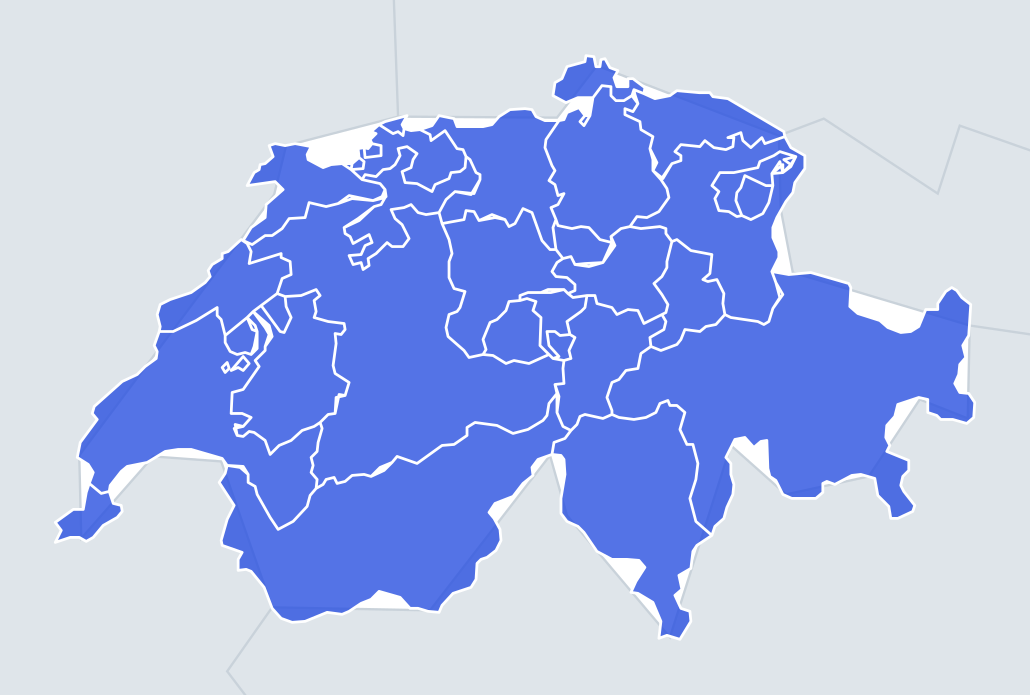
No map hints and no multiple choice: just type every one you can remember. Each correct answer lights up on the map, and the clock keeps running until you give up or get all 26.
Top scores
- The five fastest 100% rounds on this quiz.
Finish with 100% and post your time to get on the board – here or in full screen. All leaderboards
Your next quiz
 Swedish Counties quiz21 counties
 Finnish Regions quiz18 regions
What's on this map
All 26 Swiss cantons. Six of them – Obwalden, Nidwalden, Basel-Stadt, Basel-Landschaft, Appenzell Ausserrhoden and Appenzell Innerrhoden – were traditionally called half-cantons because each pair came from splitting one historical canton. Since the 1999 constitution they are simply cantons, but they still have only one seat each in the Council of States instead of two.
The cantons joined the Swiss Confederation over more than six centuries, from Uri, Schwyz and Unterwalden in 1291 to Jura in 1979. Four languages are used: German in most cantons, French in the west, Italian in Ticino and part of Grisons, and Romansh in Grisons. Fribourg, Bern and Valais are officially bilingual in French and German, and Grisons trilingual.
The places people miss
- The two Appenzells – type both full names: Ausserrhoden ("outer") and Innerrhoden ("inner"). They split in 1597 after the Reformation, Ausserrhoden becoming Protestant and Innerrhoden staying Catholic.
- Obwalden and Nidwalden – the two halves of old Unterwalden. "Ob" means above, "Nid" below.
- Basel-Stadt and Basel-Landschaft – split in 1833 after a conflict between the city and the countryside.
- Grisons – the English and French name. In German it is Graubünden, after the Grey League, one of three medieval alliances in the area.
- Thurgau, Aargau and Glarus – the quiet cantons that are forgotten when the clock is running. Thurgau is on Lake Constance; Aargau is between Zürich and Basel.
How to learn it
- Sweep the map in four parts: the west (Geneva, Vaud, Neuchâtel, Jura, Fribourg, Valais), the north (the two Basels, Solothurn, Aargau, Zürich, Schaffhausen, Thurgau, St. Gallen, the two Appenzells), the centre (Bern, Lucerne, Zug, Schwyz, Uri, Obwalden, Nidwalden, Glarus) and the south-east (Grisons, Ticino).
- Count as you go: 6, 10, 8, 2.
- Always type the pairs together: both Basels, both Appenzells, Obwalden and Nidwalden.
- Done is all 26 without stopping in the central cluster.
Guides that help with this
- Oceans, seas, rivers and mountainsThe physical map: seas around each continent, the big rivers and ranges.
- Why you forget countries – and how spaced repetition fixes itThe forgetting curve, and how the Mistake Bank and flashcards use it.
- Flags that look alike (and how to tell them apart)Chad or Romania? Australia or New Zealand? The flag pairs that cost quiz points.
How it works
Type a name and press enter. Spelling is forgiving: accents, capital letters and common alternative names are all accepted. When you stop, the ones you missed are shown on the map so you know which to practise next time.
Most people get well under half on the first try. Play the map quiz a few times first, then come back and see how many you can name.
Answer list (26 cantons)
Show all 26 answers (spoilers)
- Aargau
- Appenzell Ausserrhoden
- Appenzell Innerrhoden
- Basel-Landschaft
- Basel-Stadt
- Bern
- Fribourg
- Geneva
- Glarus
- Grisons
- Jura
- Lucerne
- Neuchâtel
- Nidwalden
- Obwalden
- Schaffhausen
- Schwyz
- Solothurn
- St. Gallen
- Thurgau
- Ticino
- Uri
- Valais
- Vaud
- Zug
- Zürich