Bangladesh
Capital: Dhaka. Bangladesh is one of the 48 countries in the Asia quiz.
Quick answers: What is the capital of Bangladesh? · Which countries border Bangladesh?
Facts about Bangladesh
- CapitalDhaka
- Population175.7 million
- Area147,570 km²
- RegionsAsia, Central & South Asia
- LanguageBengali
- CurrencyBangladeshi taka (BDT)
Bangladesh is the 5th most populous of the 48 countries in Asia and the 26th largest by area. Worldwide it ranks 8th by population and 92nd by area.
Where is Bangladesh?
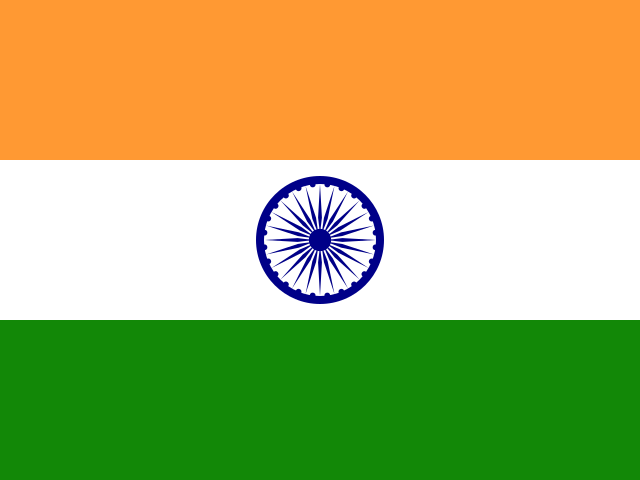
Bangladesh is in South Asia, tucked into the eastern side of India where the Ganges and Brahmaputra rivers reach the sea. India surrounds it on the west, north and east; the only other land border is a short one with Myanmar in the far south-east. The southern edge is the coast of the Bay of Bengal. Dhaka, the capital, is in the centre of the country, on the Buriganga River.
Almost all of Bangladesh is a river delta – the largest in the world – which is why the country is so flat, so fertile and so prone to flooding.
How to find Bangladesh on the map
- Start from India. Look at the top of the Bay of Bengal, where India's coast curves round towards Myanmar. The notch there is Bangladesh.
- It's nearly enclosed by India. Only the sea in the south and a short stretch of Myanmar in the south-east aren't Indian border.
- Don't confuse it with Bhutan or Nepal. Both are landlocked and sit in the Himalayas to the north; Bangladesh is on the coast.
- Don't confuse it with Myanmar. Myanmar is the much larger country to the east, running down to the Andaman Sea.
Flag
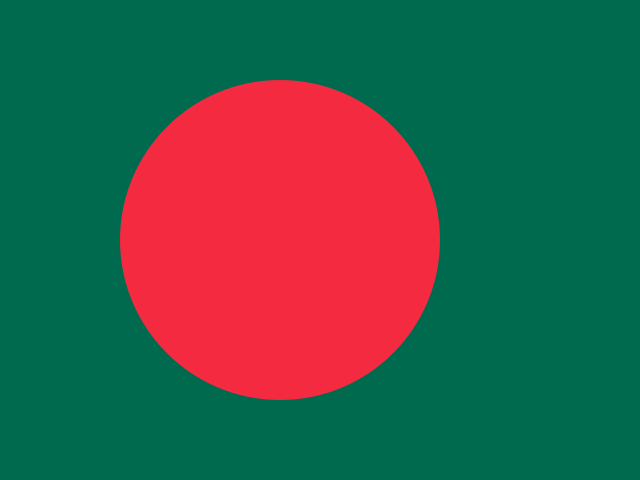
The Bangladeshi flag is a dark green field with a red disc slightly off-centre towards the hoist. The green stands for the land and the red disc for the sun rising over Bengal and the blood of those who died in the 1971 independence war. It was adopted in 1972.
Japan is the obvious lookalike: a red disc on a white field, with the disc in the exact centre. Palau has a yellow disc on blue, also off-centre. If the field is green and the disc is red, it's Bangladesh.
A short history of Bangladesh
The great river delta of Bengal has supported rice farming and busy towns for thousands of years. One of the oldest sites is Mahasthangarh, a fortified city whose remains go back more than 2,000 years. Under the Pala dynasty, from the 8th to the 12th centuries, Bengal was a centre of Buddhist learning, and the ruined monastery at Paharpur was one of the largest south of the Himalayas.
Muslim rulers arrived around 1200, and over the following centuries Islam spread widely in the east of Bengal, partly as farmers cleared the forests of the delta. Bengal later became one of the richest provinces of the Mughal Empire, and Dhaka, its capital for a time, was famous for muslin, a cloth so fine it was prized across the world.
In 1757 the British East India Company defeated the Nawab of Bengal at the Battle of Plassey, beginning British rule in India. Bengal's weavers suffered as British factory cloth replaced theirs. Britain split Bengal in 1905, but protests forced it to reunite the province in 1911. When British India was partitioned in 1947, the mainly Muslim east of Bengal became East Pakistan, separated from West Pakistan by about 1,600 kilometres of India. That is why Bangladesh is almost entirely surrounded by India today.
Tension grew as power sat in the west. After the Awami League, led by Sheikh Mujibur Rahman, won the 1970 election but was kept from office, the Pakistani army launched a crackdown in March 1971. In the war that followed, huge numbers of civilians were killed and some ten million fled to India. Indian forces entered the war in December, and Pakistan surrendered on 16 December, now Victory Day. The new country faced famine in 1974, a series of coups, and long periods of military rule before democracy returned in 1991. In 2024 student-led protests brought down a long-serving government.
Bangladesh has since become one of the world's largest exporters of ready-made clothing and has made big gains in health and education. Floods and cyclones, made worse by climate change, remain a serious threat.
Culture and daily life in Bangladesh
Bengali, or Bangla, is spoken by nearly everyone and is one of the most widely spoken languages in the world. Most people are Muslim, with a sizeable Hindu minority and smaller Buddhist and Christian groups, including the hill peoples of the Chittagong Hill Tracts.
The towering literary figure is Rabindranath Tagore, who won the Nobel Prize in Literature in 1913 and wrote the words of the national anthem, "Amar Shonar Bangla". Kazi Nazrul Islam, the "rebel poet", is the national poet. Rural singers called Bauls wander with a one-stringed ektara, singing mystical songs, a tradition UNESCO has recognised. The economist Muhammad Yunus won the Nobel Peace Prize for pioneering small loans to the poor through the Grameen Bank.
Colourful hand-painted rickshaw art and jamdani, a finely woven muslin with patterns added on the loom, are well-known crafts. Cox's Bazar has one of the longest natural sea beaches in the world. Cricket is the most loved sport, and all-rounder Shakib Al Hasan became one of the game's best players.
Five facts worth knowing
- Bangladesh is one of the most densely populated large countries in the world, with about 176 million people in an area only a little larger than Greece.
- The Ganges, Brahmaputra and Meghna rivers all meet here before emptying into the Bay of Bengal.
- The Sundarbans, in the south-west, is the largest mangrove forest on Earth and home to Bengal tigers.
- Bangladesh was East Pakistan until 1971, when it won independence after a nine-month war. The name means "land of Bengal".
- Bengali is the official language, and the 1952 Language Movement protests are the origin of UNESCO's International Mother Language Day.
Culture and traditions in Bangladesh
- Saying hello
"Assalamu alaikum" or "Nomoskar", depending on the person.
- Food and drink
Hilsa (ilish) fish cooked in mustard sauce with rice, and biryani on special occasions.
- Festivals and traditions
Pohela Boishakh, the Bengali New Year, on 14 April, with colourful processions.
- Everyday life
Food is often eaten with the right hand, and cycle rickshaws are everywhere in the cities.
- Did you know?
International Mother Language Day on 21 February honours students who died for the Bengali language in 1952.
Common mistakes
- Tapping the Indian state of West Bengal, which lies just to the west and shares the same delta and language.
- Tapping Myanmar – the border in the south-east is easy to misjudge.
- Picking Japan's flag in the Flags quiz; check the background colour.
Practise with Bangladesh
- Asia quiz – the notch at the top of the Bay of Bengal, almost swallowed by India.
- Central & South Asia quiz – zooms in so Bangladesh is a clear target rather than a sliver.
- Asia flags – green with a red disc; Japan is the trap.
- Asia capitals quiz – Dhaka.
- Mystery Country – a compact shape with a ragged southern coast of river mouths and a tail running south-east along Myanmar.
Nearby countries
Quick check: how well do you know Bangladesh?
3 questions, no sign-up. Tap an answer.
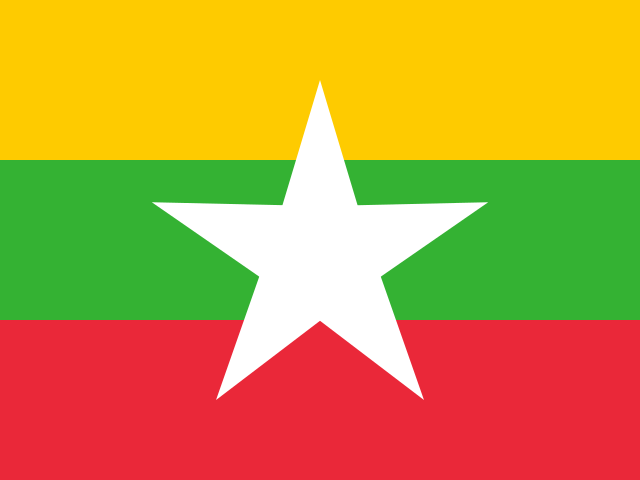
1. Which flag belongs to Bangladesh?
That's the flag of Bangladesh.
2. What is the capital of Bangladesh?
The capital of Bangladesh is Dhaka.
3. Which of these countries borders Bangladesh?
India and Myanmar border Bangladesh.
Keep going on the Asia quiz – Bangladesh is one of 48 countries there.
More ways to practise: find Bangladesh on the blank map with no borders (hard mode), or play today's Globe and the other daily puzzles.
Frequently asked questions about Bangladesh
What language is spoken in Bangladesh?
Bengali, also called Bangla, is the official language and the mother tongue of almost all Bangladeshis. English is used in higher education, law and business, and the hill peoples of the south-east speak their own languages, such as Chakma and Marma.
What currency does Bangladesh use?
Bangladesh uses the taka (BDT). The word taka comes from an old Sanskrit word for a coin, and in Bengali the same word is used for money in general. The taka replaced the Pakistani rupee after independence in 1972.
What time zone is Bangladesh in?
Bangladesh is on UTC+6 all year round. It tried daylight saving time once, in 2009, but abandoned it after one season. Its clocks run half an hour ahead of India's.
Which side of the road do they drive on in Bangladesh?
Bangladeshis drive on the left, like India and Pakistan, a legacy of British rule. Roads are shared by buses, cars, auto-rickshaws and vast numbers of cycle rickshaws.
What is the highest point in Bangladesh?
The highest point is usually given as Saka Haphong, about 1,050 metres, in the Chittagong Hill Tracts near the border with Myanmar. Keokradong, around 986 metres, was long listed as the highest, and measurements in this remote area still differ.
Why is Bangladesh called Bangladesh?
The name means "country of Bengal" in Bengali. Bangla refers to the Bengal region and its language, and desh means country. The name was adopted when East Pakistan became independent in 1971.
Quizzes with Bangladesh
Often confused with
Guides that help with this
- Oceans, seas, rivers and mountainsThe physical map: seas around each continent, the big rivers and ranges.
- Flags that look alike (and how to tell them apart)Chad or Romania? Australia or New Zealand? The flag pairs that cost quiz points.
- The 25 hardest countries to find on a mapPacific islands, Caribbean islands and landlocked Africa – where they are.