Bhutan
Capital: Thimphu. Bhutan is one of the 48 countries in the Asia quiz.
Quick answers: What is the capital of Bhutan? · Which countries border Bhutan?
Facts about Bhutan
- CapitalThimphu
- Population796,682
- Area38,394 km²
- RegionsAsia, Central & South Asia
- LanguageDzongkha
- CurrenciesBhutanese ngultrum (BTN), Indian rupee (INR)
Bhutan is the 46th most populous of the 48 countries in Asia and the 36th largest by area. Worldwide it ranks 164th by population and 133rd by area.
Where is Bhutan?
Bhutan is a small landlocked kingdom in the eastern Himalayas, sandwiched between China (Tibet) to the north and India on every other side. It is roughly the size of Switzerland and almost entirely mountainous, rising from subtropical foothills to peaks over 7,000 metres. The capital, Thimphu, is in the west.
On a world map, find the long border between India and China along the Himalayas. Two small countries sit on that line: Nepal, the longer one on the left, and Bhutan, the smaller one to the right, just above Bangladesh.
How to find Bhutan on the map
- Start from Nepal. Bhutan is the next small country east of Nepal, separated from it by a narrow strip of India.
- Look above Bangladesh. Bhutan sits just north of Bangladesh's northern tip, with only a sliver of India in between.
- It touches only India and China – no sea, no other neighbours.
- Don't confuse it with Nepal. Nepal is about three times bigger and further west.
Flag
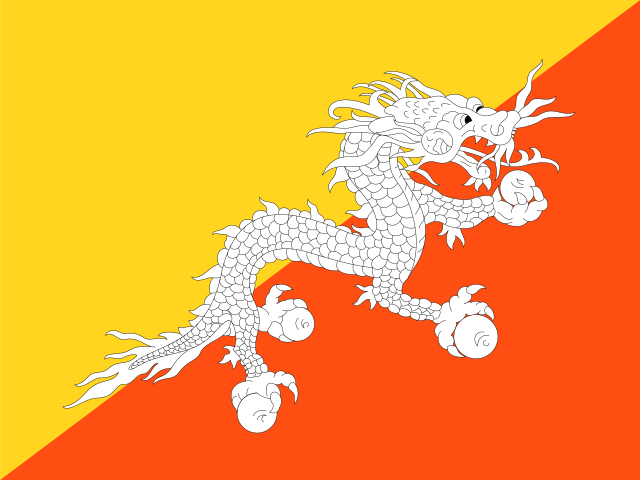
Bhutan's flag is split diagonally: yellow in the top-left triangle and orange in the bottom-right, with a white dragon holding jewels across the middle. Yellow represents the king's secular authority, orange the Buddhist tradition, and the dragon is the Druk, the thunder dragon that gives Bhutan its local name, Druk Yul.
In the Flags quiz, the dragon makes it unmistakable – no other sovereign flag has one.
A short history of Bhutan
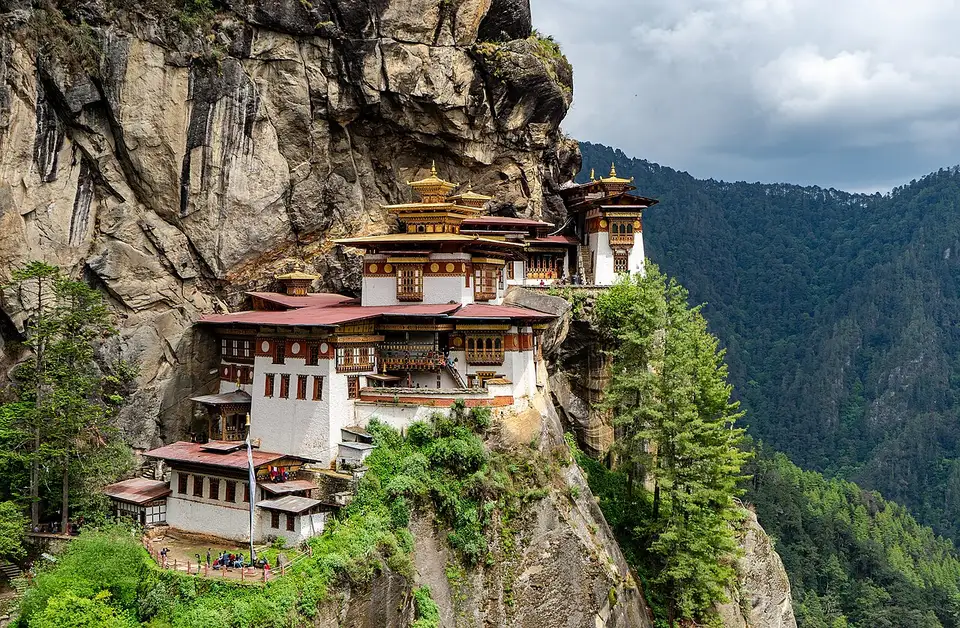
Little is known about Bhutan's earliest inhabitants, but Buddhism had reached the valleys by the 7th century, when the Tibetan king Songtsen Gampo is said to have founded Kyichu Lhakhang in Paro and Jambay Lhakhang in Bumthang. In the 8th century the teacher Padmasambhava, known locally as Guru Rinpoche, brought tantric Buddhism to the region. According to legend he flew to the Tiger's Nest on the back of a tigress.
For centuries Bhutan was a patchwork of valleys ruled by local lords and religious schools. That changed in 1616, when the Tibetan lama Zhabdrung Ngawang Namgyal fled to Bhutan after a dispute in Tibet. He unified the country, beat off several Tibetan invasions and built a chain of dzongs, huge fortress-monasteries that served as centres of both government and religion. He also set up a dual system, with a religious leader alongside a civil ruler.
After his death, regional governors competed for power for about two centuries. Clashes with British India in the 1860s ended with the loss of the southern plains, known as the Duars, which is why Bhutan begins abruptly at the foot of the mountains. In 1907 local leaders chose Ugyen Wangchuck as the first hereditary king, founding the Wangchuck dynasty that still reigns. Britain handled Bhutan's foreign relations, a role India took over after 1947.
Bhutan kept itself apart for a long time and only opened its first roads and modern schools in the 1960s. It joined the United Nations in 1971. In the early 1990s, tensions over citizenship and identity led to the departure of a large number of Lhotshampa, Bhutanese of Nepali origin, many of whom spent years in refugee camps in Nepal. In 2008 the king guided the country to constitutional monarchy, and Bhutan held its first parliamentary elections.
Hydroelectric power sold to India is now the largest source of income. Tourism is deliberately kept small and high-value through a daily fee charged to most visitors.
Culture and daily life in Bhutan
The national language is Dzongkha, related to Tibetan and written in the same script, but Sharchop is widely spoken in the east and Nepali in the south. English is taught in schools. Most people follow the Drukpa Kagyu school of Vajrayana Buddhism, and the Nepali-speaking south is largely Hindu.
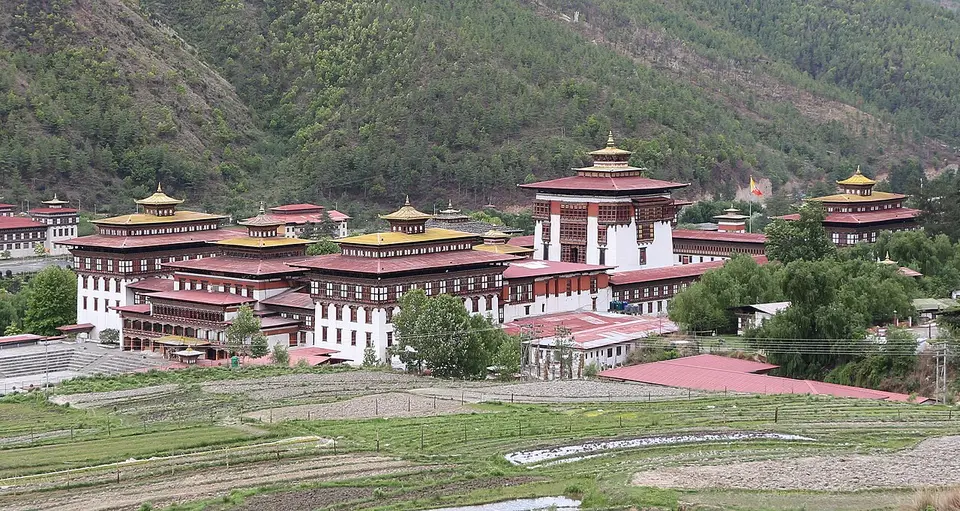
Religion is visible everywhere. Strings of prayer flags flutter across passes, prayer wheels turn in streams and phallus symbols painted on houses ward off evil, a custom linked to the 15th-century saint Drukpa Kunley, "the Divine Madman". Punakha Dzong, at the meeting of two rivers, is one of the most beautiful buildings in the Himalayas. Huge painted scrolls called thongdrel are unrolled at dawn on the last day of some festivals.
Bhutan protects its traditional arts through a school in Thimphu teaching thirteen crafts, including painting, wood carving and weaving. In 2004 Bhutan became the first country to ban the sale of tobacco, and Thimphu famously has no traffic lights, with a police officer directing cars by hand instead.
Five facts worth knowing
- Bhutan measures Gross National Happiness alongside economic output, a concept introduced by its fourth king in the 1970s.
- Television and the internet were only allowed in 1999, among the last countries in the world to get them.
- Gangkhar Puensum, at over 7,500 metres, is the highest unclimbed mountain in the world – climbing it is forbidden.
- Bhutan is carbon negative, absorbing more carbon dioxide than it emits thanks to forests the constitution requires to cover at least 60 per cent of the country.
- The Tiger's Nest monastery (Paro Taktsang) clings to a cliff about 900 metres above the Paro valley and is the country's most famous landmark.
Culture and traditions in Bhutan
- Saying hello
"Kuzuzangpo la", often with a slight bow.
- Food and drink
Ema datshi, the national dish of chilli peppers in cheese sauce, eaten with red rice.
- Festivals and traditions
Tsechu festivals with masked dances, including Paro Tsechu in spring.
- Everyday life
National dress (gho for men, kira for women) is worn in offices and schools, and people walk clockwise around temples.
- Did you know?
Bhutan measures progress by Gross National Happiness, and archery is the national sport.
Common mistakes
- Tapping Nepal, the other Himalayan kingdom-sized country to the west.
- Tapping Sikkim or Arunachal Pradesh, the Indian states on either side of Bhutan.
- Tapping Bangladesh, which lies just to the south.
Practise with Bhutan
- Central & South Asia quiz – a close-up where the Nepal–India–Bhutan arrangement is clear.
- Asia quiz – small on the continental map; find Bangladesh and look up.
- Asia flags – the white dragon on yellow and orange.
- Asia capitals quiz – Thimphu.
- Mystery Country – a small, rounded outline that's tricky without the neighbours for context.
Nearby countries
Quick check: how well do you know Bhutan?
3 questions, no sign-up. Tap an answer.
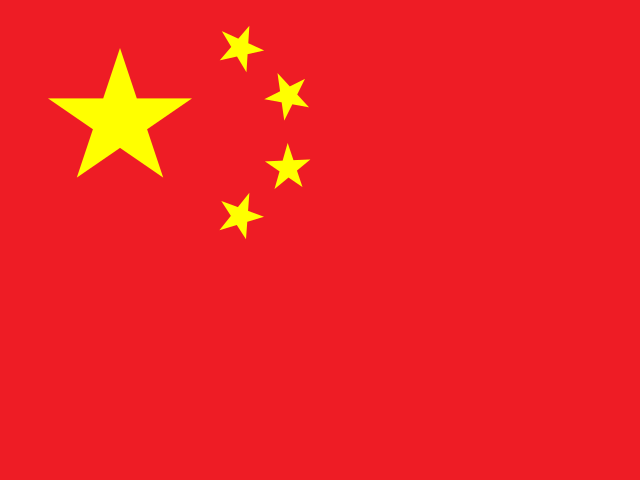
1. Which flag belongs to Bhutan?
That's the flag of Bhutan.
2. What is the capital of Bhutan?
The capital of Bhutan is Thimphu.
3. Which of these countries borders Bhutan?
China and India border Bhutan.
Keep going on the Asia quiz – Bhutan is one of 48 countries there.
More ways to practise: find Bhutan on the blank map with no borders (hard mode), or play today's Globe and the other daily puzzles.
Frequently asked questions about Bhutan
What language is spoken in Bhutan?
Dzongkha is the national language, related to Tibetan and written in a similar script. English is the language of instruction in schools and is widely used. Many people speak other languages at home, especially Tshangla (Sharchop) in the east and Nepali in the south.
What currency does Bhutan use?
Bhutan uses the ngultrum (BTN), which is pegged one-to-one to the Indian rupee (INR). Indian rupees are also legal tender and circulate freely, reflecting Bhutan's close economic ties with India.
What time zone is Bhutan in?
Bhutan is on UTC+6 all year round, with no daylight saving time. It is half an hour ahead of India and 15 minutes ahead of Nepal.
Which side of the road do they drive on in Bhutan?
Bhutanese drive on the left, like India. Roads are narrow and winding through the mountains, and Bhutan has no railway, so road and air are the only ways to travel.
What is the highest point in Bhutan?
The highest point is Gangkhar Puensum, about 7,570 metres, on the border with China. Since 1994 Bhutan has banned climbing peaks above 6,000 metres out of respect for local beliefs, so it remains unclimbed.
What do Bhutanese call their country?
Bhutanese call their country Druk Yul, "land of the Thunder Dragon", after the Drukpa school of Buddhism. The thunder dragon, Druk, appears on the national flag, and the king is called the Druk Gyalpo, "Dragon King".
Quizzes with Bhutan
Often confused with
Guides that help with this
- Oceans, seas, rivers and mountainsThe physical map: seas around each continent, the big rivers and ranges.
- Flags that look alike (and how to tell them apart)Chad or Romania? Australia or New Zealand? The flag pairs that cost quiz points.
- The 25 hardest countries to find on a mapPacific islands, Caribbean islands and landlocked Africa – where they are.