Djibouti
Capital: Djibouti. Djibouti is one of the 54 countries in the Africa quiz.
Quick answers: What is the capital of Djibouti? · Which countries border Djibouti?
Facts about Djibouti
- CapitalDjibouti
- Population1.2 million
- Area23,200 km²
- RegionsAfrica, East Africa
- LanguagesFrench, Arabic
- CurrencyDjiboutian franc (DJF)
Djibouti is the 50th most populous of the 54 countries in Africa and the 47th largest by area. Worldwide it ranks 159th by population and 147th by area.
Where is Djibouti?
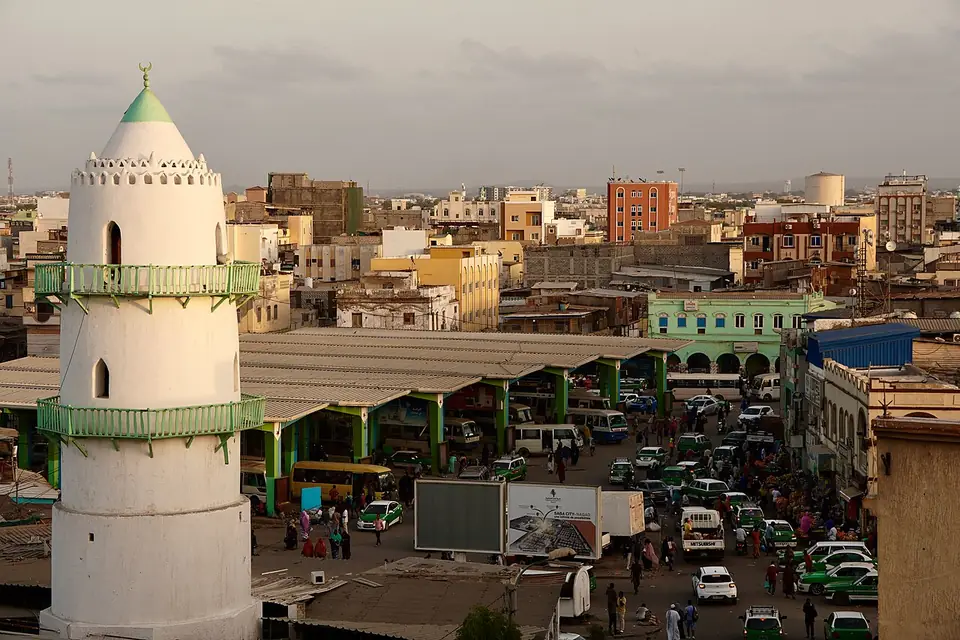
Djibouti is a small country on the Horn of Africa, at the southern entrance to the Red Sea. It sits on the Bab-el-Mandeb strait, the narrow passage between the Red Sea and the Gulf of Aden, directly across from Yemen. Eritrea lies to the north, Ethiopia to the west and south, and Somalia to the south-east. The capital, Djibouti City, is on the coast and shares its name with the country.
On a world map, find the point where the Red Sea narrows and opens into the Indian Ocean. Djibouti is the small wedge of land on the African side of that pinch point.
How to find Djibouti on the map
- Start from the Red Sea. Djibouti is at its southern end, on the African shore.
- Look across from Yemen. The two countries face each other across the strait.
- Find the Gulf of Tadjoura. This inlet cuts deep into the country and is the key feature of its outline.
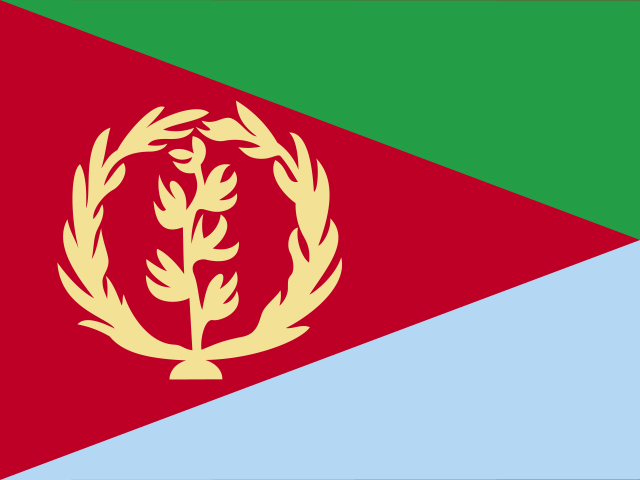
- Don't confuse it with Eritrea. Eritrea is the longer country running up the Red Sea coast to the north; Djibouti is the small one at the bottom.
Flag
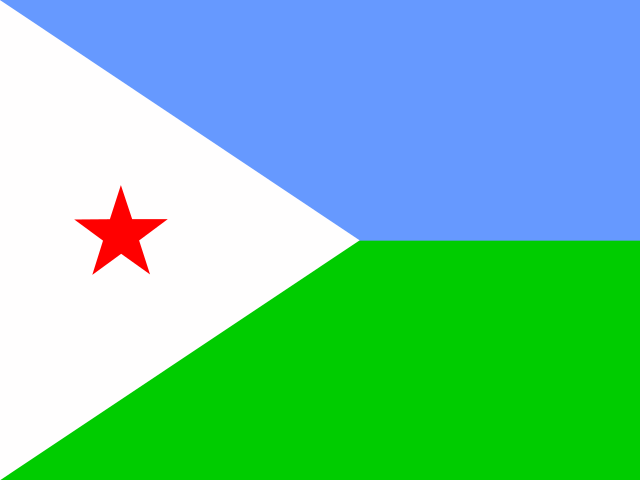
Djibouti's flag has two horizontal bands, light blue above green, with a white triangle at the hoist containing a red five-pointed star. Blue stands for the sea and sky and for the Issa people, green for the land and the Afar people, white for peace and the star for unity.
In the Flags quiz, the light blue and green combination with a white triangle is unusual enough to be recognised quickly. The flag most likely to be confused with it is that of Sudan, which also has a triangle at the hoist, but Sudan's is green with red, white and black stripes.
A short history of Djibouti
The lands around the Gulf of Tadjoura have been home to nomadic herders for thousands of years. Two peoples dominate the story: the Afar, who live mainly in the north and west, and the Somali Issa, who live mainly in the south. Rock art in the interior shows cattle and wild animals from a time when the climate was wetter. The coast was part of ancient Red Sea trade, and many historians think it lay within the region the ancient Egyptians called the Land of Punt.
Islam reached the area early, carried across the narrow strait from Arabia. In the Middle Ages the coast was linked to Muslim sultanates such as Adal, which competed with the Christian Ethiopian highlands for control of trade routes. Small Afar sultanates, including Tadjoura and Obock, controlled local ports for centuries.
France arrived in the 1860s, buying the anchorage at Obock to secure a coaling station on the route to its colonies in Asia, which became especially valuable after the Suez Canal opened. In the 1880s and 1890s France expanded the territory and moved its capital to Djibouti City, which had a better harbour. The colony was named French Somaliland. Its borders were drawn in agreements with Britain, Italy and Ethiopia, which is why the country wraps around the Gulf of Tadjoura in a compact block. The railway to Addis Ababa, finished in 1917, made the port Ethiopia's gateway to the sea.
In 1967 the colony was renamed the French Territory of the Afars and the Issas. Referendums in 1958 and 1967 kept it French, but pressure for independence grew, and Djibouti became independent in 1977. Tension between Afar and Issa groups led to a civil war in the 1990s, ended by peace agreements around 2000.
Djibouti's economy rests almost entirely on its location: its ports, the rail link, free trade zones and rent from foreign military bases. The capital is home to most of the population.
Culture and daily life in Djibouti
Somali and Afar are the languages most people speak at home, while French and Arabic are used in government, schools and religion. Almost everyone is Sunni Muslim, and the call to prayer and the rhythm of Ramadan shape daily life. Many families keep ties to nomadic relatives in the interior, where herding goats and camels remains the traditional way of life.
Oral poetry is highly respected in both Somali and Afar culture, and songs often carry news, praise or gentle criticism. Traditional dances, with rhythmic clapping and call-and-response singing, are performed at weddings and national celebrations. Women often wear colourful dirac dresses, while men may wear the macawiis, a wrap-around cloth.
Afternoons in many households centre on chewing khat, a mildly stimulant leaf flown in daily from Ethiopia. The landscape draws visitors too: the salt flats and hot springs of Lake Abbe, with its chimney-like limestone towers, and whale sharks that gather in the Gulf of Tadjoura in winter.
Five facts worth knowing
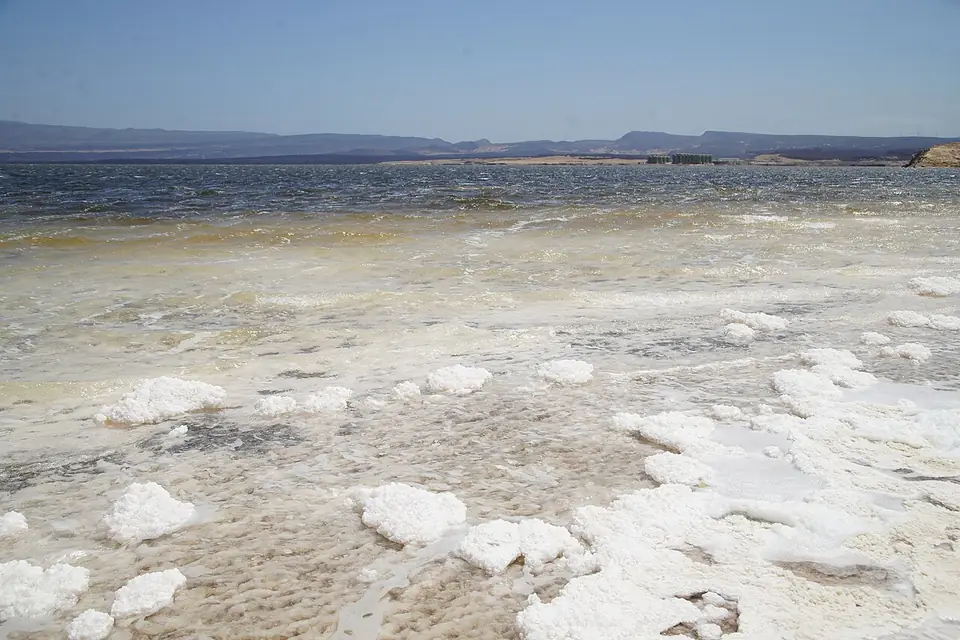
- Lake Assal is the lowest point in Africa, at around 155 metres below sea level, and one of the saltiest bodies of water in the world.
- Djibouti hosts military bases from several countries, including France, the United States, Japan and China, because of its strategic position on the shipping lane to the Suez Canal.
- Most of Ethiopia's foreign trade passes through the port of Djibouti, since Ethiopia has been landlocked since 1993.
- A railway links Djibouti City to Addis Ababa, a modern electric line opened in 2016 that replaced the historic French-built line.
- The country gained independence from France in 1977, and French and Arabic are the official languages.
Culture and traditions in Djibouti
- Saying hello
"Salam alaykum", with greetings in Somali, Afar, Arabic or French.
- Food and drink
Skoudehkaris (spiced rice with lamb) and lahoh, a spongy flatbread.
- Festivals and traditions
Independence Day on 27 June, with parades and celebrations.
- Everyday life
Many shops and offices close in the hot midday hours and reopen in the late afternoon.
- Did you know?
Afar salt caravans have carried salt from Lake Assal, Africa's lowest point, for centuries.
Common mistakes
- Tapping Eritrea, the neighbour to the north along the Red Sea.
- Tapping the northern tip of Somalia.
- Confusing the country with its capital in the Capitals quiz; both are called Djibouti.
Practise with Djibouti
- Africa quiz – a small target at the mouth of the Red Sea, so zoom in on the Horn.
- East Africa quiz – Djibouti, Eritrea, Ethiopia and Somalia appear together.
- Africa flags – the blue and green with a white triangle.
- Africa capitals quiz – Djibouti, the city.
- Mystery Country – a small triangular outline with a deep gulf cutting in from the east.
Nearby countries
Quick check: how well do you know Djibouti?
3 questions, no sign-up. Tap an answer.
1. Which flag belongs to Djibouti?
That's the flag of Djibouti.
2. What is the capital of Djibouti?
The capital of Djibouti is Djibouti.
3. Which of these countries borders Djibouti?
Eritrea, Ethiopia and Somalia border Djibouti.
Keep going on the Africa quiz – Djibouti is one of 54 countries there.
More ways to practise: find Djibouti on the blank map with no borders (hard mode), or play today's Globe and the other daily puzzles.
Frequently asked questions about Djibouti
What language is spoken in Djibouti?
French and Arabic are the official languages. Most people speak Somali, the language of the Issa and other Somali clans, or Afar, spoken in the north and west, as their first language.
What currency does Djibouti use?
Djibouti uses the Djiboutian franc (DJF). It has been pegged to the US dollar since 1949, at a rate of about 178 francs to the dollar, and the peg is fully backed by the central bank's dollar reserves.
What time zone is Djibouti in?
Djibouti uses East Africa Time, UTC+3, the same as Ethiopia and Somalia. It does not use daylight saving time. Lying close to the equator, Djibouti has little seasonal change in day length, so clock changes would bring little benefit.
Which side of the road do they drive on in Djibouti?
Traffic drives on the right in Djibouti. The busiest road is the corridor from the port of Djibouti to Ethiopia, used by long lines of lorries carrying goods to and from the Ethiopian border.
What is the highest point in Djibouti?
Mousa Ali, a volcanic mountain where the borders of Djibouti, Eritrea and Ethiopia meet, is the highest point at just over 2,000 metres. Much of the rest of the country is low, hot desert.
Is Djibouti in the Arab League?
Yes. Djibouti joined the Arab League in 1977, the year of its independence, even though most of its people are Somali or Afar rather than Arab. Arabic is an official language, and Islam is the religion of the great majority.
Quizzes with Djibouti
Often confused with
Guides that help with this
- Learn all 54 African countries in a weekLearn the coastline in order, region by region.
- Flags that look alike (and how to tell them apart)Chad or Romania? Australia or New Zealand? The flag pairs that cost quiz points.
- The 25 hardest countries to find on a mapPacific islands, Caribbean islands and landlocked Africa – where they are.