Dominican Republic
Capital: Santo Domingo. The Dominican Republic is one of the 23 countries in the North America quiz.
Quick answers: What is the capital of the Dominican Republic? · Which countries border the Dominican Republic?
Facts about the Dominican Republic
- CapitalSanto Domingo
- Population11.5 million
- Area48,671 km²
- RegionsNorth America, The Caribbean
- LanguageSpanish
- CurrencyDominican peso (DOP)
The Dominican Republic is the 6th most populous of the 23 countries in North America and the 10th largest by area. Worldwide it ranks 85th by population and 128th by area.
Where is the Dominican Republic?
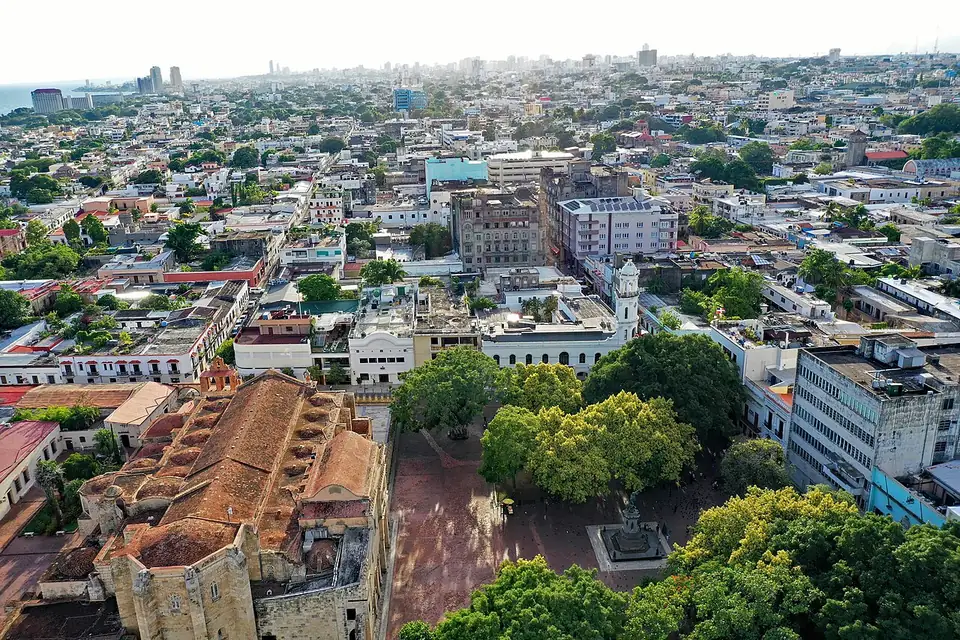
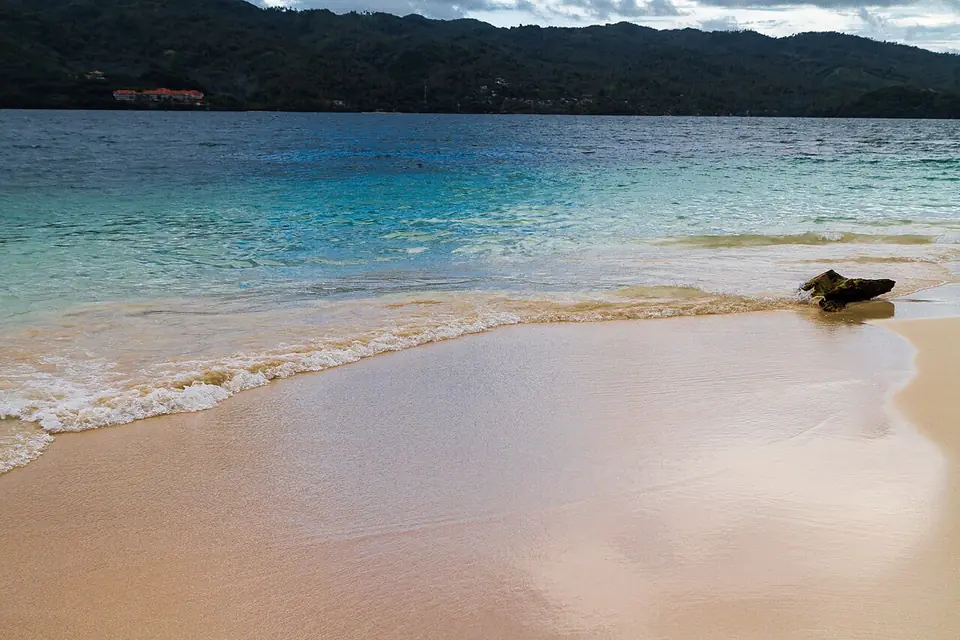
The Dominican Republic occupies the eastern two-thirds of Hispaniola, the second-largest island in the Caribbean, which it shares with Haiti. It lies between Cuba and Jamaica to the west and Puerto Rico to the east, with the Atlantic Ocean to the north and the Caribbean Sea to the south. The capital, Santo Domingo, is on the southern coast.
On a world map, find Cuba, the long island below Florida. Move east past its tail and you reach Hispaniola. The Dominican Republic is the larger, eastern part of that island.
How to find the Dominican Republic on the map
- Start from Cuba. Hispaniola is the next big island to the east.
- Split the island. Haiti is the western third, the Dominican Republic the eastern two-thirds.
- Find Puerto Rico. It is the next island east of the Dominican Republic, across the Mona Passage.
- Don't confuse it with Dominica. Dominica is a tiny island far to the south-east in the Lesser Antilles.
Flag
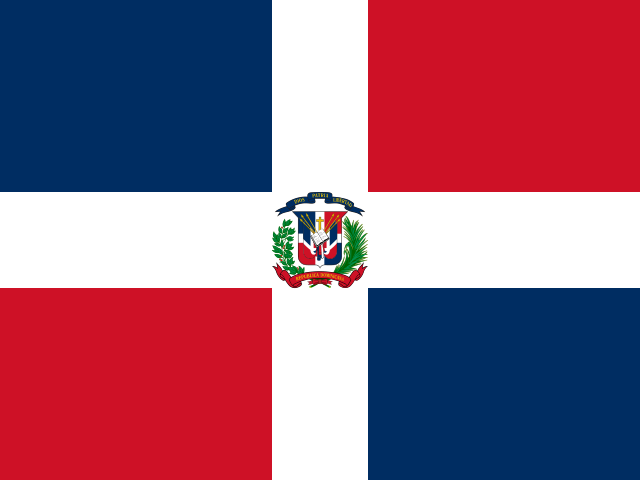
The flag is divided into four rectangles by a white cross: blue in the upper hoist and lower fly, red in the upper fly and lower hoist. The national coat of arms sits at the centre of the cross and includes an open Bible, making it the only national flag to feature one.
In the Flags quiz, the white cross with alternating blue and red quarters is distinctive. Panama's flag also has four quarters in red, white and blue, but Panama uses no cross and adds stars.
A short history of the Dominican Republic
Hispaniola was home to the Taíno, who called the island Ayiti or Quisqueya and lived in chiefdoms ruled by caciques. Columbus landed in December 1492, and the island became the base for Spain's first colony in the Americas. Forced labour and disease destroyed the Taíno within a few decades. Santo Domingo gained the first cathedral and university in the Americas, and the conquests of Mexico and Peru were partly launched from here.
As Spain's attention moved to the mainland, the colony declined into cattle ranching. France settled the western third of the island, and in 1697 Spain formally ceded it. That western part became Saint-Domingue, a huge sugar colony that later became Haiti, which is why the island is split between a French-Creole-speaking west and a Spanish-speaking east.
The 1800s were turbulent. France held the whole island for a time, Spain returned, and in 1821 the colonists declared a brief independence. Haiti then ruled the entire island from 1822 to 1844. Dominican independence came in 1844, led by the secret society La Trinitaria and its founder Juan Pablo Duarte. Spain was invited back in 1861, but a war of restoration ended Spanish rule again in 1865.
The United States occupied the country from 1916 to 1924. In 1930 Rafael Trujillo seized power and ruled as a brutal dictator for three decades, renaming the capital after himself. In 1937 his forces massacred thousands of Haitians living along the border. Trujillo was assassinated in 1961. A civil war in 1965 brought another US intervention, followed by the long rule of Joaquín Balaguer. Elections since the 1990s have become steadily more competitive.
Today the Dominican Republic has one of the fastest-growing economies in Latin America, driven by tourism, free trade zone manufacturing, mining and remittances from Dominicans living in the United States.
Culture and daily life in the Dominican Republic
Spanish is spoken everywhere, in a fast Caribbean style that often drops final consonants. The population is largely of mixed European and African ancestry, and Taíno words such as hamaca (hammock), huracán and barbacoa survive in everyday speech and have passed into English. Most people are Roman Catholic, and the Basilica of Higüey, a striking modern concrete arch, draws huge pilgrimages each January.
Beyond merengue and bachata, Dominican music includes dembow, a newer urban sound, and stars like Juan Luis Guerra have won fans across Latin America. Writers include Julia Álvarez, whose novel In the Time of the Butterflies tells of the Mirabal sisters, murdered under Trujillo, and Junot Díaz, a Pulitzer winner born in Santo Domingo.
Baseball is played on every patch of open ground, and players like Pedro Martínez and David Ortiz are national heroes. Dominoes, loud and competitive, is the classic evening pastime. Amber from the northern mountains and larimar, a blue stone found only here, are used in local jewellery.
Five facts worth knowing
- Santo Domingo is the oldest continuously inhabited European city in the Americas, founded in the 1490s, and its colonial centre is a UNESCO World Heritage site.
- Pico Duarte is the highest mountain in the Caribbean, rising to just over 3,000 metres in the Cordillera Central.
- The Dominican Republic is the most visited country in the Caribbean, with Punta Cana on the eastern tip as its main resort area.
- Baseball is the national passion, and the country produces more Major League players than any nation outside the United States.
- Independence Day, 27 February, marks separation from Haiti in 1844, not from Spain, which is unusual among Latin American countries.
Culture and traditions in the Dominican Republic
- Saying hello
A kiss on the cheek among friends, or a warm handshake.
- Food and drink
La bandera (rice, red beans and meat) and mangu, mashed green plantains.
- Festivals and traditions
Carnival throughout February, peaking around Independence Day on 27 February.
- Everyday life
Merengue music is everywhere and baseball is a national passion.
- Did you know?
Both merengue and bachata, born in the Dominican Republic, are on UNESCO's heritage list.
Common mistakes
- Tapping Haiti, the western part of the same island.
- Tapping Dominica, the small island in the Lesser Antilles.
- Tapping Puerto Rico, the next island to the east.
Practise with the Dominican Republic
- North America quiz – find Hispaniola east of Cuba and tap the larger eastern half.
- Caribbean quiz – a zoomed map where the Haiti border is clear.
- North America flags – the white cross with blue and red quarters.
- North America capitals quiz – Santo Domingo.
- Mystery Country – the eastern part of Hispaniola with the Samaná Peninsula jutting out in the north-east.
Nearby countries
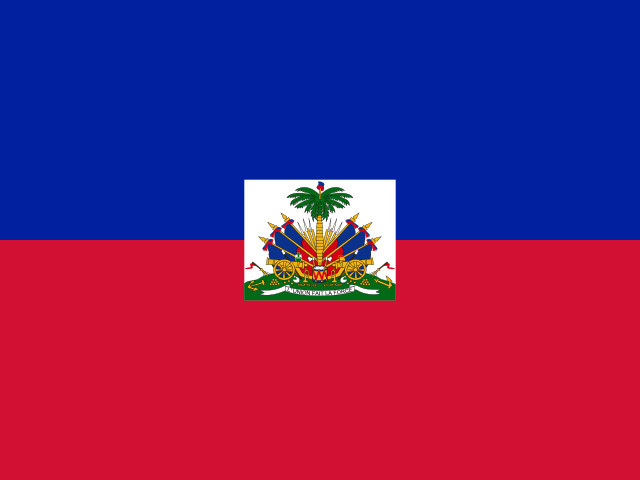 HaitiPort-au-Prince
Quick check: how well do you know the Dominican Republic?
3 questions, no sign-up. Tap an answer.
1. Which flag belongs to the Dominican Republic?
That's the flag of the Dominican Republic.
2. What is the capital of the Dominican Republic?
The capital of the Dominican Republic is Santo Domingo.
3. Which of these countries borders the Dominican Republic?
Haiti borders the Dominican Republic.
Keep going on the North America quiz – Dominican Republic is one of 23 countries there.
More ways to practise: find the Dominican Republic on the blank map with no borders (hard mode), or play today's Globe and the other daily puzzles.
Frequently asked questions about the Dominican Republic
What language is spoken in the Dominican Republic?
Spanish is the official language and is spoken by nearly everyone. Haitian Creole is spoken by many Haitian migrants and their descendants, and in Samaná some descendants of 19th-century African American settlers still speak English.
What currency does the Dominican Republic use?
The Dominican Republic uses the Dominican peso (DOP), written RD$. It floats against other currencies, though US dollars are widely accepted in resort areas such as Punta Cana.
What time zone is the Dominican Republic in?
The Dominican Republic uses Atlantic Standard Time, UTC−4, all year. It does not use daylight saving time, so in summer it shares the time of New York, and in winter it is one hour ahead.
Which side of the road do they drive on in the Dominican Republic?
Dominicans drive on the right. Motorcycle taxis called motoconchos are common, and shared cars and minibuses known as carros públicos and guaguas fill the streets of Santo Domingo.
What is the highest point in the Dominican Republic?
Pico Duarte, in the Cordillera Central, is the highest point at about 3,100 metres, the highest peak in the Caribbean. Hikers usually reach it on a trek of two or three days, often with mules carrying supplies.
What is the Dominican Republic famous for?
The Dominican Republic is the home of merengue and bachata, two dance music styles both added to UNESCO's intangible heritage list. It also produces many Major League Baseball players and is the world's only source of larimar, a blue gemstone.
Quizzes with the Dominican Republic
Often confused with
Guides that help with this
- The 25 hardest countries to find on a mapPacific islands, Caribbean islands and landlocked Africa – where they are.
- All 50 US states on the map, region by regionThe ordering tricks that make the states stick.
- Flags that look alike (and how to tell them apart)Chad or Romania? Australia or New Zealand? The flag pairs that cost quiz points.