Ghana
Capital: Accra. Ghana is one of the 54 countries in the Africa quiz.
Quick answers: What is the capital of Ghana? · Which countries border Ghana?
Facts about Ghana
- CapitalAccra
- Population35.1 million
- Area238,533 km²
- RegionsAfrica, West Africa
- LanguageEnglish
- CurrencyGhanaian cedi (GHS)
Ghana is the 14th most populous of the 54 countries in Africa and the 33rd largest by area. Worldwide it ranks 47th by population and 80th by area.
Where is Ghana?
Ghana is in West Africa, on the Gulf of Guinea, the big bay on the underside of the continent's western bulge. Ivory Coast lies to the west, Burkina Faso to the north and Togo to the east. The country is roughly rectangular, running from the Atlantic coast in the south to the dry savanna in the north. Accra, the capital, is on the coast in the south-east.
On a world map, look at the bottom edge of the West African bulge, where the coastline runs east to west. Ghana is one of the row of countries along that coast, sitting between Ivory Coast and the narrow strip of Togo.
How to find Ghana on the map
- Start from Nigeria. Nigeria is the big country at the corner of the Gulf of Guinea. Go west past Benin and Togo, two thin countries, and the next one is Ghana.
- Look for the rectangle. Ghana is taller than it is wide and fairly straight-sided compared with its neighbours.
- Don't confuse it with Ivory Coast. Ivory Coast is next door to the west, larger and squarer.
- Don't confuse it with Guinea. Despite the similar names, Guinea is further north-west on the Atlantic coast, nowhere near Ghana.
Flag
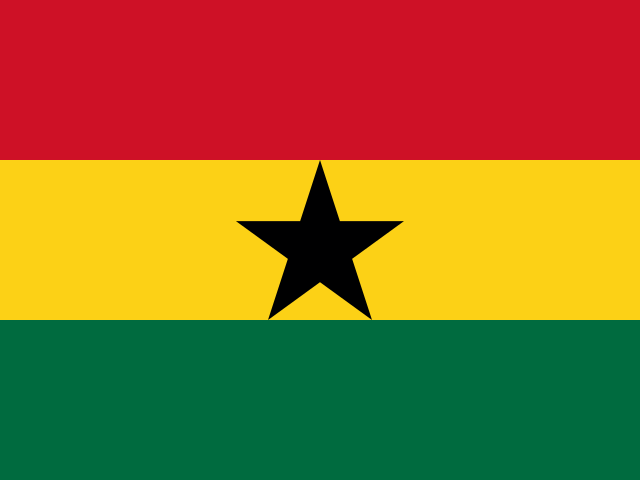
Ghana's flag has three horizontal bands – red, yellow and green – with a black five-pointed star in the centre of the yellow band. It was adopted at independence in 1957 and was the second African flag, after Ethiopia's, to use the pan-African colours. The black star stands for African freedom and gives Ghana's national football team its nickname, the Black Stars.
Several West African neighbours use the same colours. Guinea has them vertically, Mali has green-yellow-red vertically, and Senegal has a green star on a vertical tricolour. Horizontal bands with a black star in the middle is Ghana.
A short history of Ghana
The forests and savannahs of modern Ghana were home to many kingdoms long before Europeans arrived. Akan-speaking peoples grew rich from gold, which they mined and traded north across the Sahara. In the late 1600s the Asante united several Akan states under Osei Tutu, and the Asante Empire, ruled from Kumasi, became one of the most powerful states in West Africa. Its symbol of unity was the Golden Stool, believed to hold the soul of the nation.
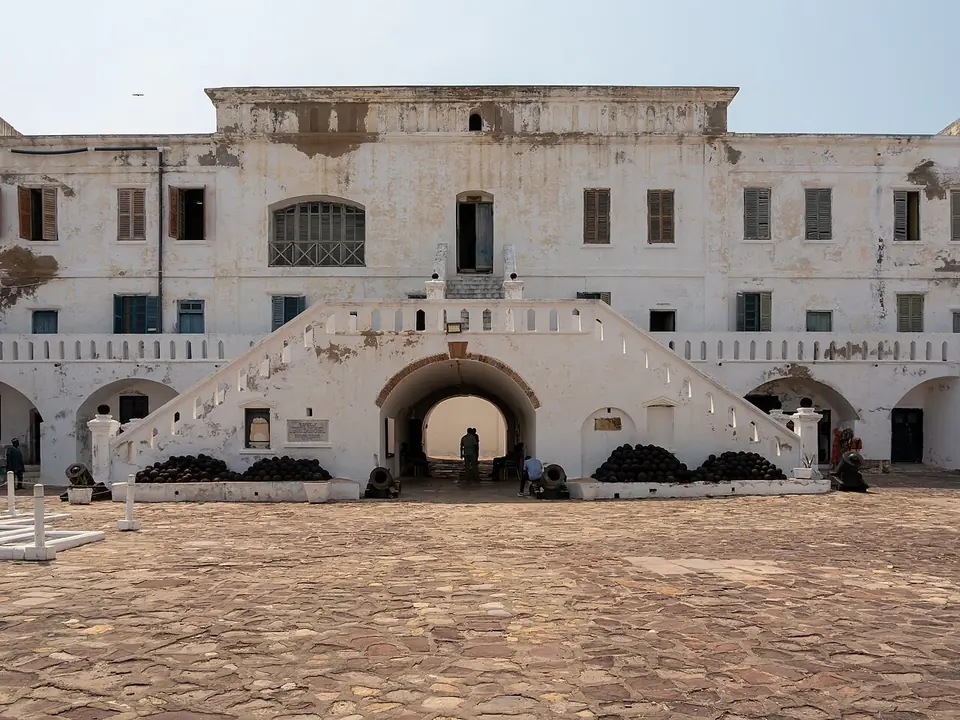
The Portuguese reached the coast in 1471 and built Elmina Castle in 1482. They called the region the Gold Coast. The Dutch, British, Danes, Swedes and others followed, building more than thirty forts and castles along the shore. Over time the trade shifted from gold to enslaved people, and Cape Coast and Elmina became departure points for countless Africans shipped to the Americas.
Britain gradually took over the coast and declared the Gold Coast colony in 1874. It fought a series of wars with the Asante, and in 1900 the queen mother Yaa Asantewaa led a final uprising after a British governor demanded the Golden Stool. The British won, but the stool was never handed over. After the First World War, Britain also took over the western part of the German colony of Togoland, which voted to join the Gold Coast in 1956 – the reason Ghana's eastern Volta Region reaches up beside Togo.
After independence, Ghana became a republic in 1960, but its first leader was overthrown in a coup in 1966. Coups and military rule followed until 1992, when a new constitution created the Fourth Republic. Since then Ghana has held regular elections and several peaceful handovers of power, earning a reputation as one of Africa's steadier democracies.
Today its economy rests on gold, cocoa and, since the 2010s, offshore oil, and Accra has become a busy regional hub for business and tech.
Culture and daily life in Ghana
English is the official language, but most Ghanaians speak at least one local language. Twi, an Akan language, is the most widely spoken, alongside Ewe, Ga, Fante and Dagbani. Most people in the south are Christian, while Islam is strongest in the north, and churches, mosques and roadside shrines all play a part in daily life.
Kente cloth, woven in narrow strips by Asante and Ewe weavers, uses colours and patterns that each carry meaning, and Adinkra symbols stamped on cloth express proverbs and ideas. Ga carpenters in Teshie are famous for fantasy coffins shaped like fish, cars or cocoa pods, showing the life of the person being buried.
Highlife music, which mixes local rhythms with brass and guitars, grew from the bands of E.T. Mensah in the 1950s and later inspired hiplife and Afrobeats. Ayi Kwei Armah's novel The Beautyful Ones Are Not Yet Born is a classic of African literature, and Kofi Annan, from Kumasi, became Secretary-General of the United Nations.
Five facts worth knowing
- Ghana was the first sub-Saharan African colony to win independence, from Britain in 1957, under Kwame Nkrumah.
- Lake Volta, in the east of the country, is one of the largest artificial lakes in the world by surface area, created by the Akosombo Dam in the 1960s.
- The Greenwich meridian passes through Ghana, near the port of Tema just east of Accra.
- Ghana is one of the world's two biggest cocoa producers, alongside Ivory Coast next door.
- The country took its name from the medieval Ghana Empire, which was actually located further north-west, in what is now Mali and Mauritania.
Culture and traditions in Ghana
- Saying hello
Handshakes are common, and when greeting a group people often go around from right to left. "Akwaaba" means welcome.
- Food and drink
Jollof rice; fufu, pounded cassava and plantain, with light soup; kelewele, spicy fried plantain.
- Festivals and traditions
Homowo, a Ga harvest festival in August-September; Independence Day on 6 March.
- Everyday life
Use the right hand for eating, giving and receiving. Taking time to greet properly is important.
- Did you know?
Many Ghanaians have a day name for the weekday they were born on, such as Kofi for a boy born on Friday.
Common mistakes
- Tapping Ivory Coast or Togo on either side.
- Tapping Guinea because of the name.
- Picking another red-yellow-green flag in the Flags quiz; look for the black star.
Practise with Ghana
- West Africa quiz – the region zooms in, which makes the row of coastal countries along the Gulf of Guinea much easier to sort out.
- Africa quiz – the rectangle on the underside of the western bulge.
- Africa flags – the black star on red, yellow and green.
- Africa capitals quiz – Accra.
- Mystery Country – a tall, straight-sided shape with a flat coast at the bottom; look for the big lake inside.
Nearby countries
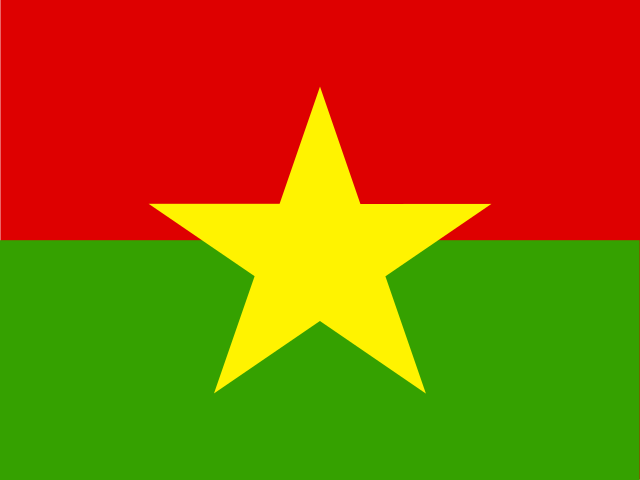 Burkina FasoOuagadougou
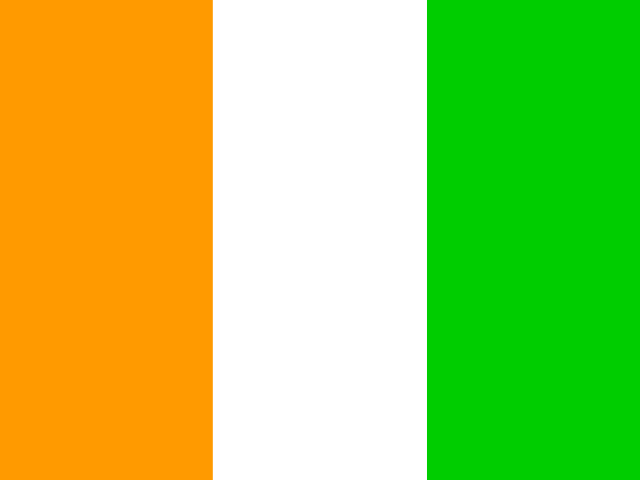 Ivory CoastYamoussoukro
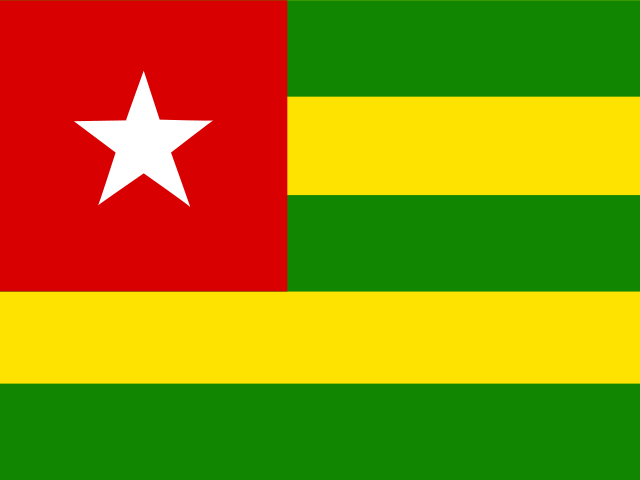 TogoLomé
Quick check: how well do you know Ghana?
3 questions, no sign-up. Tap an answer.
1. Which flag belongs to Ghana?
That's the flag of Ghana.
2. What is the capital of Ghana?
The capital of Ghana is Accra.
3. Which of these countries borders Ghana?
Burkina Faso, Ivory Coast and Togo border Ghana.
Keep going on the Africa quiz – Ghana is one of 54 countries there.
More ways to practise: find Ghana on the blank map with no borders (hard mode), or play today's Globe and the other daily puzzles.
Frequently asked questions about Ghana
What language is spoken in Ghana?
English is the official language. Around 80 languages are spoken in Ghana; the Akan languages, especially Twi and Fante, are the most widely spoken, followed by Ewe, Ga, Dagbani and Dagaare.
What currency does Ghana use?
Ghana uses the cedi (GHS), divided into 100 pesewas. The name comes from an Akan word for cowrie shells, once used as money. The current cedi was introduced in 2007, when four zeros were removed from the old one.
What time zone is Ghana in?
Ghana uses Greenwich Mean Time, UTC+0, all year, with no daylight saving. The Greenwich meridian itself passes through the country near Tema. Ghana shares its clock with London in winter.
Which side of the road do they drive on in Ghana?
Ghanaians drive on the right. Ghana switched from the left in 1974. Shared minibuses called tro-tros are the main form of public transport. The switch to the right was made to match its French-speaking neighbours.
What is the highest point in Ghana?
Mount Afadja (Afadjato), in the Volta Region near the border with Togo, is often listed as the highest point at about 885 metres. The Volta Region hills also hold Wli Falls.
What is Ghana famous for?
Ghana is famous for kente, a brightly woven cloth of interlocking strips from the Asante and Ewe traditions, and for cocoa. It is also known for jollof rice, highlife music and a long record of peaceful changes of government since 1992.
Quizzes with Ghana
Often confused with
Guides that help with this
- Learn all 54 African countries in a weekLearn the coastline in order, region by region.
- Flags that look alike (and how to tell them apart)Chad or Romania? Australia or New Zealand? The flag pairs that cost quiz points.
- The 25 hardest countries to find on a mapPacific islands, Caribbean islands and landlocked Africa – where they are.