Guinea-Bissau
Capital: Bissau. Guinea-Bissau is one of the 54 countries in the Africa quiz.
Quick answers: What is the capital of Guinea-Bissau? · Which countries border Guinea-Bissau?
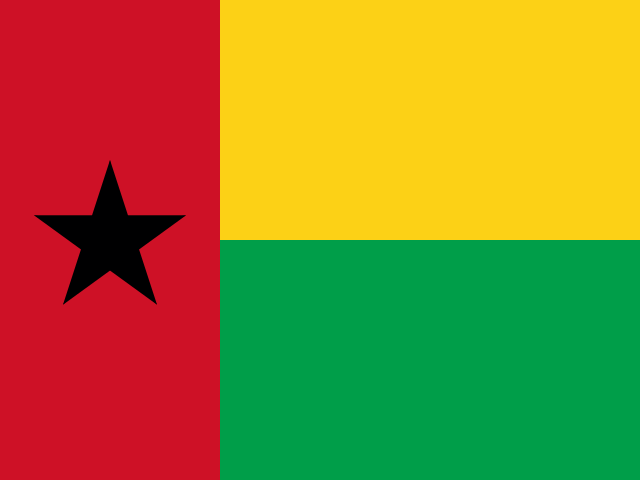
Facts about Guinea-Bissau
- CapitalBissau
- Population2.2 million
- Area36,125 km²
- RegionsAfrica, West Africa
- LanguagePortuguese
- CurrencyWest African CFA franc (XOF)
Guinea-Bissau is the 46th most populous of the 54 countries in Africa and the 42nd largest by area. Worldwide it ranks 146th by population and 135th by area.
Where is Guinea-Bissau?
Guinea-Bissau is a small country on the Atlantic coast of West Africa, wedged between Senegal to the north and Guinea to the south and east. Its coastline is a maze of estuaries, mangroves and islands, including the Bijagós Archipelago, a group of more than 80 islands scattered off the shore. The capital, Bissau, sits on the Geba River estuary. The country covers around 36,000 square kilometres and has a population of about two million.
Guinea-Bissau was a Portuguese colony, which is why its official language is Portuguese while its neighbours speak French.
How to find Guinea-Bissau on the map
- Start from Senegal. Guinea-Bissau is the small country directly below Senegal on the coast.
- Look for the ragged edge. No other West African coast is as broken up by inlets and islands at this scale.
- Guinea is the big neighbour. Guinea-Bissau is tucked into the north-western corner of Guinea's crescent.
- Don't go too far north. The Gambia is the thin strip inside Senegal; Guinea-Bissau is the next country south of Senegal, not inside it.
Flag
Guinea-Bissau's flag has a vertical red band at the hoist with a black five-pointed star in its centre, and two horizontal bands on the fly side – yellow above green. The colours are pan-African and the black star is a symbol of African unity, taken from the design used by the independence movement.
Ghana's flag uses the same colours and black star but with horizontal red, yellow and green bands and the star in the middle. If the red is a vertical bar on the left, it's Guinea-Bissau.
A short history of Guinea-Bissau
For several centuries much of this land belonged to Kaabu, a Mandinka kingdom that began as a western province of the Mali Empire and later became powerful in its own right. Kaabu grew rich partly through trading captives with Europeans, and it lasted until the Fula defeated it in the 1860s.
Portuguese sailors reached these rivers in the mid-1400s. Cacheu, founded in 1588, became one of the main slave-trading posts on the coast, and Bissau was established in the 1600s. For a long time Portugal only controlled a few river ports, often relying on Cape Verdean traders as go-betweens. The borders were fixed by a convention with France in 1886, when Portugal gave up the Casamance region, now in southern Senegal, in exchange for land in the south. The interior was only fully conquered in the early 1900s, after years of resistance.
In 1956 Amílcar Cabral and others founded the PAIGC, a movement fighting for the independence of both Guinea-Bissau and Cape Verde. From 1963 it waged one of Africa's most effective guerrilla wars, taking control of large parts of the countryside. Cabral was assassinated in Conakry in January 1973, months before independence was declared. When Portugal's dictatorship fell in 1974, Lisbon recognised the new state.
The plan to unite with Cape Verde ended after a coup in 1980. Since then Guinea-Bissau has had a troubled political history, with repeated coups and attempted coups, a civil war in 1998–99, and few elected leaders completing a full term. In the 2000s its creeks and islands were used as a transit point for cocaine heading to Europe.
Today most people live from farming and fishing, with rice grown in the coastal wetlands, and the country remains one of the poorest in the world but rich in coastal wildlife.
Culture and daily life in Guinea-Bissau
More than twenty ethnic groups share this small country. The Balanta are the largest, known as skilled rice farmers, followed by the Fula and Mandinka in the east, and the Manjaco and Papel near the coast. Islam is strong among the Fula and Mandinka, while many others are Christian or follow traditional beliefs.
The Bijagós islanders have their own distinctive culture. Some islands have long been described as matriarchal, with women playing leading roles in choosing partners, owning houses and running religious life. Their carved wooden masks, especially bull masks worn by young men in dances, are prized by collectors.
The local rhythm is gumbe, and in the 1970s the band Super Mama Djombo became the voice of the newly independent country, their songs played across Portuguese-speaking Africa. The novelist Abdulai Sila wrote some of the first novels from Guinea-Bissau. Football is followed closely, and many players have made careers in Portugal. In villages, life follows the farming calendar, and rice harvests and initiation ceremonies are marked with drumming and dancing that can last for days.
Five facts worth knowing
- Guinea-Bissau declared independence from Portugal in 1973, and Portugal recognised it in 1974 after its own revolution.
- Cashew nuts are the main export and the backbone of the rural economy.
- The Bijagós Archipelago is a UNESCO biosphere reserve known for saltwater hippos and sea turtles.
- Portuguese is the official language, but most people speak Crioulo, a Portuguese-based creole, day to day.
- The country is one of four in the world with "Guinea" in its name, alongside Guinea, Equatorial Guinea and Papua New Guinea.
Culture and traditions in Guinea-Bissau
- Saying hello
People greet in Kriol, Portuguese-based creole, with "Kuma ku bu sta?" (how are you?) and a handshake.
- Food and drink
Rice with fish or peanut stew; fresh cashew nuts from local orchards.
- Festivals and traditions
Carnival in Bissau, with masks and parades before Lent; Independence Day on 24 September.
- Everyday life
Portuguese is official, but Kriol is the everyday language. The cashew harvest season is a busy social time.
- Did you know?
Cashew nuts are the country's main export, and cashew fruit is also made into a popular local wine.
Common mistakes
- Tapping Guinea – the larger neighbour with almost the same name.
- Tapping the Gambia, which is also small and on Senegal's coast.
- Choosing Ghana's flag in the Flags quiz because of the shared colours and black star.
Practise with Guinea-Bissau
- West Africa quiz – the zoomed-in map is the fair way to see a country this size.
- Africa quiz – a tough target at continent scale; find Senegal and go one step south.
- Africa flags – learn the difference between the vertical red bar here and Ghana's horizontal bands.
- Africa capitals quiz – Bissau.
- Mystery Country – the island-fringed outline is distinctive once you've seen it.
Nearby countries
Quick check: how well do you know Guinea-Bissau?
3 questions, no sign-up. Tap an answer.
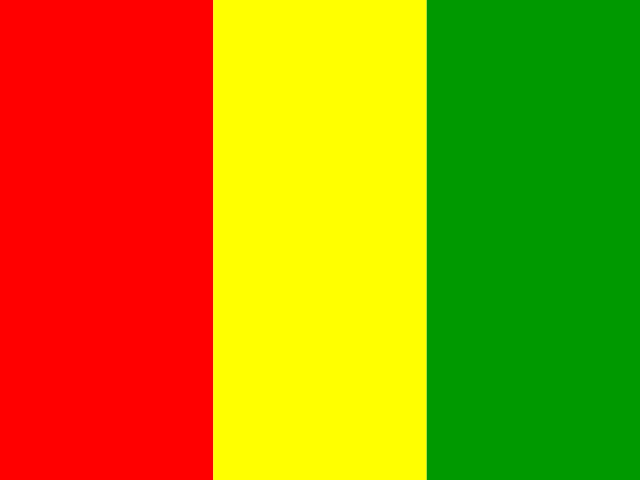
1. Which flag belongs to Guinea-Bissau?
That's the flag of Guinea-Bissau.
2. What is the capital of Guinea-Bissau?
The capital of Guinea-Bissau is Bissau.
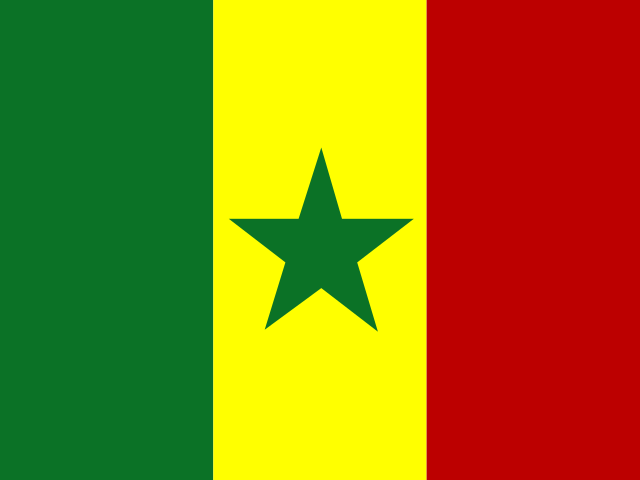
3. Which of these countries borders Guinea-Bissau?
Guinea and Senegal border Guinea-Bissau.
Keep going on the Africa quiz – Guinea-Bissau is one of 54 countries there.
More ways to practise: find Guinea-Bissau on the blank map with no borders (hard mode), or play today's Globe and the other daily puzzles.
Frequently asked questions about Guinea-Bissau
What language is spoken in Guinea-Bissau?
Portuguese is the only official language, used in government and schools, but a minority speak it fluently. The everyday common tongue is Guinea-Bissau Creole (Kriol), a Portuguese-based creole, alongside African languages such as Balanta, Fula, Mandinka and Manjak.
What currency does Guinea-Bissau use?
Guinea-Bissau uses the West African CFA franc (XOF), which it adopted in 1997 in place of the Guinea-Bissau peso. The CFA franc is shared with seven other West African countries and is pegged to the euro at a fixed rate.
What time zone is Guinea-Bissau in?
Guinea-Bissau is on UTC+0, the same as Greenwich Mean Time, all year round. It does not use daylight saving time, so in the northern summer it is one hour behind both London and Lisbon.
Which side of the road do they drive on in Guinea-Bissau?
Traffic in Guinea-Bissau drives on the right, as in Portugal and in all of its West African neighbours. Paved roads are limited, and many journeys between the coast and the islands of the Bijagós are made by boat instead.
What is the highest point in Guinea-Bissau?
Guinea-Bissau is one of the flattest countries in Africa. Its highest ground is an unnamed point of only about 300 metres in the east, near the border with Guinea, while much of the coast is low mangrove swamp cut by tidal rivers.
Why is it called Guinea-Bissau?
When Portuguese Guinea became independent it kept the name Guinea and added that of its capital, Bissau. This tells it apart from its larger neighbour Guinea, a former French colony, which is often called Guinea-Conakry for the same reason.
Quizzes with Guinea-Bissau
Often confused with
Guides that help with this
- Learn all 54 African countries in a weekLearn the coastline in order, region by region.
- Flags that look alike (and how to tell them apart)Chad or Romania? Australia or New Zealand? The flag pairs that cost quiz points.
- The 25 hardest countries to find on a mapPacific islands, Caribbean islands and landlocked Africa – where they are.