Guinea
Capital: Conakry. Guinea is one of the 54 countries in the Africa quiz.
Quick answers: What is the capital of Guinea? · Which countries border Guinea?
Facts about Guinea
- CapitalConakry
- Population15.1 million
- Area245,857 km²
- RegionsAfrica, West Africa
- LanguageFrench
- CurrencyGuinean franc (GNF)
Guinea is the 27th most populous of the 54 countries in Africa and the 31st largest by area. Worldwide it ranks 75th by population and 77th by area.
Where is Guinea?
Guinea is on the Atlantic coast of West Africa, curving around its neighbours like a crescent. Guinea-Bissau and Senegal lie to the north, Mali to the north-east, Ivory Coast to the east, and Liberia and Sierra Leone to the south. The capital, Conakry, is on a peninsula on the coast in the far west. The Fouta Djallon highlands in the interior are the source of several of West Africa's great rivers, which is why Guinea is sometimes called the water tower of West Africa.
Guinea should not be confused with Guinea-Bissau, Equatorial Guinea or Papua New Guinea – four separate countries that share the name.
How to find Guinea on the map
- Start from Sierra Leone. Sierra Leone is the small coastal country on the bulge of West Africa; Guinea wraps around it to the north and east.
- Look for the crescent. Guinea has a short coastline in the west and then bends east and south, so it looks like a boomerang.
- Guinea-Bissau is the small one above it. If the country you've picked is tiny and full of islands, that's Guinea-Bissau; Guinea is the larger country just below.
- Follow the Niger. The Niger River rises in Guinea's highlands before flowing north-east into Mali.
Flag
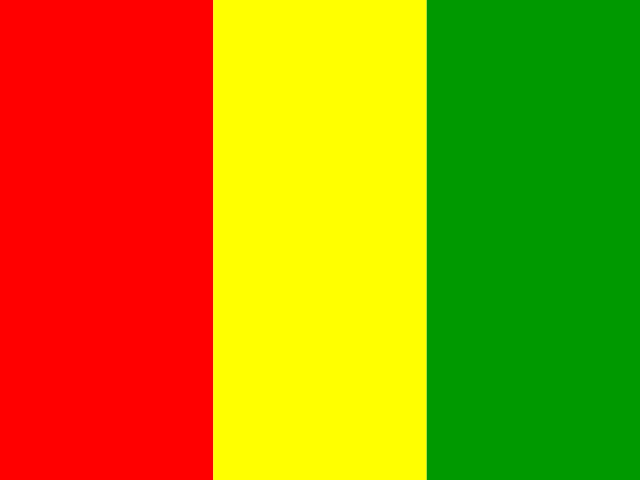
Guinea's flag is three vertical bands – red, yellow and green, with red at the hoist. The colours are the pan-African set, chosen at independence in 1958.
The flag is the exact reverse of Mali's, which runs green, yellow, red. Red at the hoist means Guinea; green at the hoist means Mali. Senegal uses the same colours as Mali with a green star in the middle, so check for the star too. Guinea's bands carry no symbol at all.
A short history of Guinea
Upper Guinea, in the north-east, lay at the heart of the great Mande world. The Mali Empire, founded by Sundiata Keita in the 1200s, drew much of its gold from the fields of Bouré in what is now Guinea, and Malinké towns along the upper Niger traded with caravans crossing the Sahara.
In the early 1700s Fula Muslims in the Fouta Djallon highlands launched a holy war and set up an Islamic state, ruled from Timbo. It became a centre of learning and lasted until the French arrived. Meanwhile the coast, home to the Susu and Baga, was drawn into the Atlantic slave trade.
The French moved inland in the late 1800s, but they met fierce resistance from Samori Touré, a Malinké leader who built the Wassoulou Empire with a disciplined army and its own gunsmiths. He fought the French for nearly two decades before being captured in 1898. By then France had declared the colony of French Guinea, part of French West Africa, and built a railway from Conakry to the Niger.
Guinea's first president, Sékou Touré, a trade unionist who claimed descent from Samori, broke sharply with France and turned to the Soviet bloc. He ruled until his death in 1984 as head of a one-party state, and thousands of opponents died in prisons such as Camp Boiro. A military government under Lansana Conté followed and lasted until his death in 2008, then came another coup and, in 2010, the country's first freely contested presidential election. The army seized power again in 2021. Between 2013 and 2016 Guinea was also at the centre of the West African Ebola epidemic, which began in its forest region.
Today mining dominates the economy. Besides bauxite, the vast iron-ore deposits of the Simandou mountains are being developed, and Guinea's rivers make it a potential hydropower supplier for the region.
Culture and daily life in Guinea
Guinea's four natural regions roughly match its main peoples: the Susu on the coast, the Fula in the Fouta Djallon, the Malinké in Upper Guinea and smaller groups such as the Kissi and Guerzé in the southern forests. Around 85 per cent of people are Muslim, and French serves as the language of schools and government.
Music is one of Guinea's great gifts to the world. Under Sékou Touré's cultural policy, every region had state-funded orchestras, and Bembeya Jazz National became one of Africa's most celebrated bands. Mory Kanté's 1987 song Yé ké yé ké was a hit across Europe, and master drummer Mamady Keïta taught the djembe to students worldwide.
Griots still sing the epic of Sundiata at weddings and naming ceremonies. Camara Laye's novel The Dark Child, about a boy growing up in Kouroussa, is one of the classics of African literature in French. In the Fouta Djallon, Fula herders and their cattle are part of the landscape, and village life still revolves around the mosque and the market.
Five facts worth knowing
- Guinea became independent in 1958, the only French African colony to vote "no" in de Gaulle's referendum on remaining within the French community.
- The Niger, Senegal and the Gambia rivers all rise in Guinea's Fouta Djallon highlands.
- Guinea holds some of the world's largest reserves of bauxite, the ore used to make aluminium, and is one of the top exporters.
- Conakry sits on the Kaloum peninsula and spreads onto the nearby Îles de Los.
- Mount Nimba, on the border with Ivory Coast and Liberia, is a UNESCO World Heritage site rich in rare species.
Culture and traditions in Guinea
- Saying hello
Long greetings with handshakes are common, in French or local languages like Pular, Malinké and Susu.
- Food and drink
Rice with peanut sauce or cassava leaf sauce, often with fish or meat.
- Festivals and traditions
Independence Day on 2 October; Eid celebrations with family meals and new clothes.
- Everyday life
Taking time to greet is important. Meals are often shared from a communal bowl using the right hand.
- Did you know?
Les Ballets Africains, founded in the 1950s, became Guinea's national ballet and toured the world.
Common mistakes
- Tapping Guinea-Bissau, the smaller country to the north with a similar name.
- Tapping Sierra Leone, which Guinea wraps around.
- Picking Mali's green-yellow-red flag instead of Guinea's red-yellow-green.
Practise with Guinea
- West Africa quiz – the zoomed-in map makes the crescent shape and its neighbours clear.
- Africa quiz – find the West African bulge and look for the country curling around Sierra Leone.
- Africa flags – sort out Guinea, Mali and Senegal, which all use the same three colours.
- Africa capitals quiz – Conakry.
- Mistake Bank – good for drilling the four Guineas until the names stop blurring.
Nearby countries
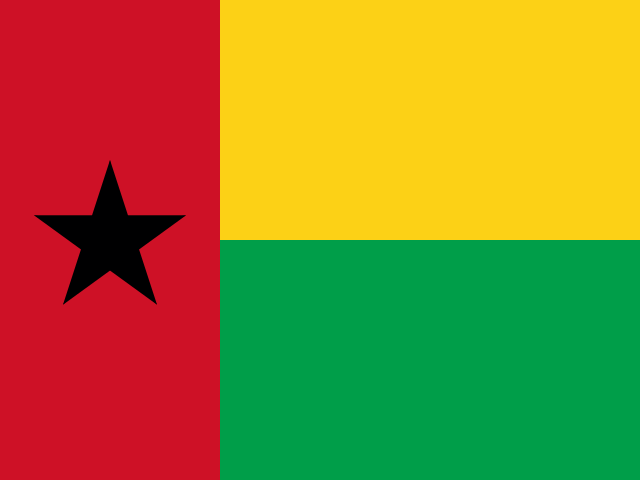 Guinea-BissauBissau
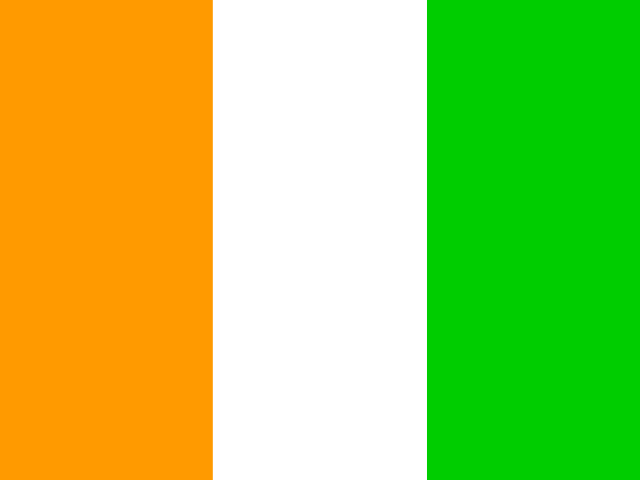 Ivory CoastYamoussoukro
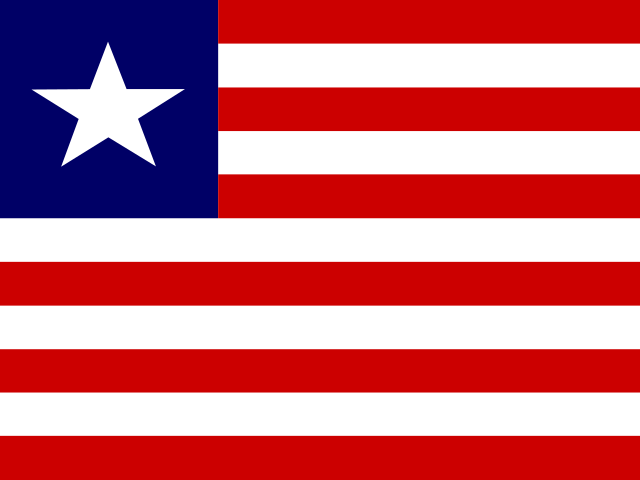 LiberiaMonrovia
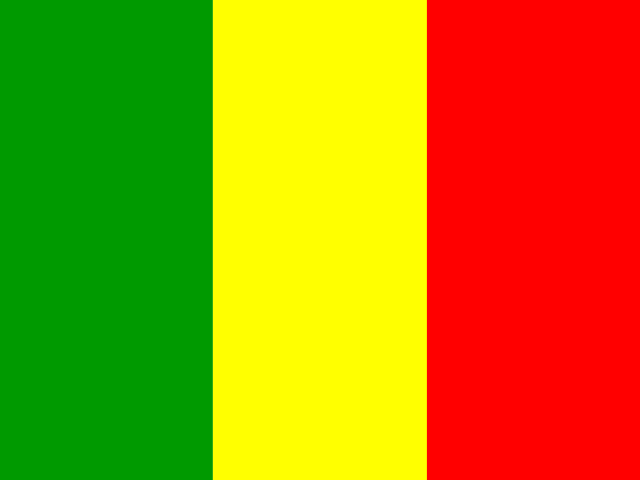 MaliBamako
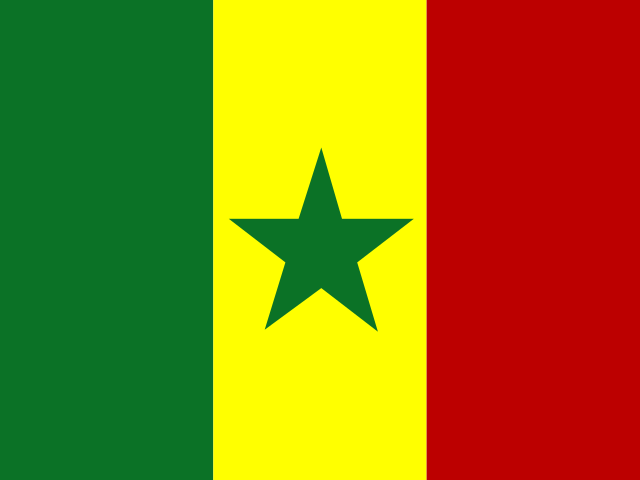 SenegalDakar
 Sierra LeoneFreetown
Quick check: how well do you know Guinea?
3 questions, no sign-up. Tap an answer.
1. Which flag belongs to Guinea?
That's the flag of Guinea.
2. What is the capital of Guinea?
The capital of Guinea is Conakry.
3. Which of these countries borders Guinea?
Guinea-Bissau, Ivory Coast, Liberia, Mali, Senegal and Sierra Leone border Guinea.
Keep going on the Africa quiz – Guinea is one of 54 countries there.
More ways to practise: find Guinea on the blank map with no borders (hard mode), or play today's Globe and the other daily puzzles.
Frequently asked questions about Guinea
What language is spoken in Guinea?
French is the official language and the language of government and education. Most people use national languages day to day: Pular (Fula) in the Fouta Djallon, Malinké in Upper Guinea and Susu on the coast, where Susu also serves as the common language of Conakry.
What currency does Guinea use?
Guinea uses the Guinean franc (GNF). Unlike most of its French-speaking neighbours, Guinea left the franc zone in 1960 and does not use the CFA franc, so its currency is not pegged to the euro and its value floats.
What time zone is Guinea in?
Guinea is on UTC+0, the same as Greenwich Mean Time, throughout the year. It does not observe daylight saving time, so its clocks match those of neighbouring Senegal, Mali, Sierra Leone and Liberia.
Which side of the road do they drive on in Guinea?
Vehicles in Guinea drive on the right-hand side of the road, as in France and in every country bordering Guinea. Many long-distance trips are made in shared bush taxis along roads that can be badly damaged in the rainy season.
What is the highest point in Guinea?
The highest point is Mount Nimba, about 1,752 metres, on the border with Ivory Coast in the far south-east. The Nimba range is a UNESCO World Heritage site, protected for its rare wildlife, including a live-bearing toad found nowhere else.
Why is Guinea called Guinea?
Guinea was a name used by Portuguese and other European sailors for the whole West African coast from the 1400s, possibly from a Berber word for the peoples south of the Sahara. Several colonies took the name, which is why four countries share it today.
Quizzes with Guinea
Often confused with
Guides that help with this
- Learn all 54 African countries in a weekLearn the coastline in order, region by region.
- Flags that look alike (and how to tell them apart)Chad or Romania? Australia or New Zealand? The flag pairs that cost quiz points.
- The 25 hardest countries to find on a mapPacific islands, Caribbean islands and landlocked Africa – where they are.