Senegal
Capital: Dakar. Senegal is one of the 54 countries in the Africa quiz.
Quick answers: What is the capital of Senegal? · Which countries border Senegal?
Facts about Senegal
- CapitalDakar
- Population18.9 million
- Area196,722 km²
- RegionsAfrica, West Africa
- LanguageFrench
- CurrencyWest African CFA franc (XOF)
Senegal is the 25th most populous of the 54 countries in Africa and the 34th largest by area. Worldwide it ranks 69th by population and 86th by area.
Where is Senegal?
Senegal is on the far western tip of Africa, facing the Atlantic Ocean. Its capital, Dakar, sits on the Cap-Vert peninsula, the westernmost point of the African mainland. To the north, the Senegal River forms the border with Mauritania; to the east is Mali; to the south are Guinea and Guinea-Bissau. The Gambia, a long thin country along the Gambia River, is almost entirely enclosed by Senegal and splits its southern region of Casamance from the rest of the country.
The Cabo Verde islands lie out in the Atlantic to the west, but they are a separate nation.
How to find Senegal on the map
- Find Africa's westernmost point. The continent bulges out into the Atlantic in the north-west; the very tip of that bulge is Dakar.
- Look for the Gambia cut. Senegal is the country with a thin horizontal strip (the Gambia) sliced into its lower half. That slice is the most reliable clue on any map.
- Mauritania is above, Guinea below. Senegal sits between the large, desert-coloured Mauritania to the north and the smaller Guinea-Bissau and Guinea to the south.
- Don't confuse it with Mauritania or Guinea. Mauritania is far larger and mostly Sahara; Guinea curves around further south-east.
Flag
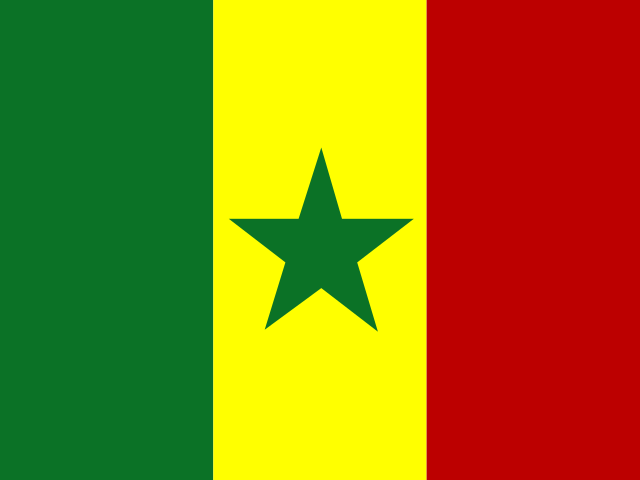
Senegal's flag is a vertical tricolour of green, yellow and red with a green five-pointed star in the centre of the yellow band. The colours are the pan-African set, and the layout is the same as Mali's flag next door – Mali's has no star. Guinea uses red, yellow, green in the opposite order. Cameroon has green, red, yellow with a yellow star on the red.
So: vertical green-yellow-red with a green star in the middle means Senegal.
A short history of Senegal
The lands along the Senegal River were part of some of West Africa's great states. The kingdom of Takrur, on the middle river, was one of the first in the region to adopt Islam, around the 1000s, and later fell under the influence of the empires of Mali and then the Songhai. Further south and west, the Jolof Empire united the Wolof-speaking peoples from the 1300s, before breaking up in the 1500s into smaller kingdoms such as Kayor, Baol, Walo and Sine.
Portuguese sailors reached the coast in the 1440s, followed by the Dutch, English and French, who fought over trading posts. The French founded Saint-Louis on an island at the mouth of the Senegal River in 1659, and it became their main base in West Africa. Gorée, Rufisque and Dakar developed around it. From 1848 the townspeople of Saint-Louis and Gorée, later joined by Rufisque and Dakar in the "Four Communes", could elect a deputy to the parliament in Paris, and their full French citizenship was confirmed in 1916 – unusual in the colonial world. Blaise Diagne became the first Black African elected to the French parliament in 1914.
Inland conquest came later and met strong resistance. Lat Dior, ruler of Kayor, fought the French railway being built across his land until his death in 1886. Under Louis Faidherbe and his successors, France pushed east, and in 1902 Dakar became the capital of French West Africa, a vast federation stretching to Niger. The thin Gambia strip inside Senegal is the result of Britain holding on to the river while France took the land around it.
Senegal became independent in 1960, first briefly joined with Mali in the Mali Federation, which broke apart after a few months. Under its first president, the poet Léopold Sédar Senghor, the country avoided military coups, and in 1980 he became one of the first African leaders to step down voluntarily. A separatist conflict in Casamance flared from the early 1980s, though it has calmed in recent years.
Today Senegal is known as one of West Africa's most stable democracies, with an economy based on fishing, groundnuts, phosphates, services and, more recently, offshore oil and gas.
Culture and daily life in Senegal
Islam is practised by the great majority, but it is organised in a distinctive way through Sufi brotherhoods such as the Mourides, Tijaniyya and Layène. Many Senegalese feel a personal loyalty to a religious guide, or marabout, and the cities of Touba and Tivaouane are major religious centres. A Catholic minority lives mainly in the south and among the Serer, and Senghor himself was Catholic.
Senegal punches far above its weight in music. Mbalax, built on the rhythms of the sabar drum, was carried around the world by Youssou N'Dour, while Baaba Maal sings in Pulaar and Orchestra Baobab mixed Afro-Cuban sounds with local styles. Griots, hereditary singers and storytellers, still keep family histories alive with the kora, a 21-string harp-lute.
Wrestling, or laamb, is the most popular sport and fills stadiums, mixing athletic bouts with drumming and mystical rituals. Football is close behind: the national team reached the World Cup quarter-finals in 2002 and won the Africa Cup of Nations in 2022. In literature and film, Ousmane Sembène, often called the father of African cinema, and Mariama Bâ, author of So Long a Letter, are known far beyond the country.
Five facts worth knowing
- Dakar is the westernmost capital on the African mainland. The Cap-Vert peninsula it occupies gave its name to the Cabo Verde islands further out to sea.
- The Gambia is almost an enclave inside Senegal. The two countries briefly formed a confederation called Senegambia in the 1980s.
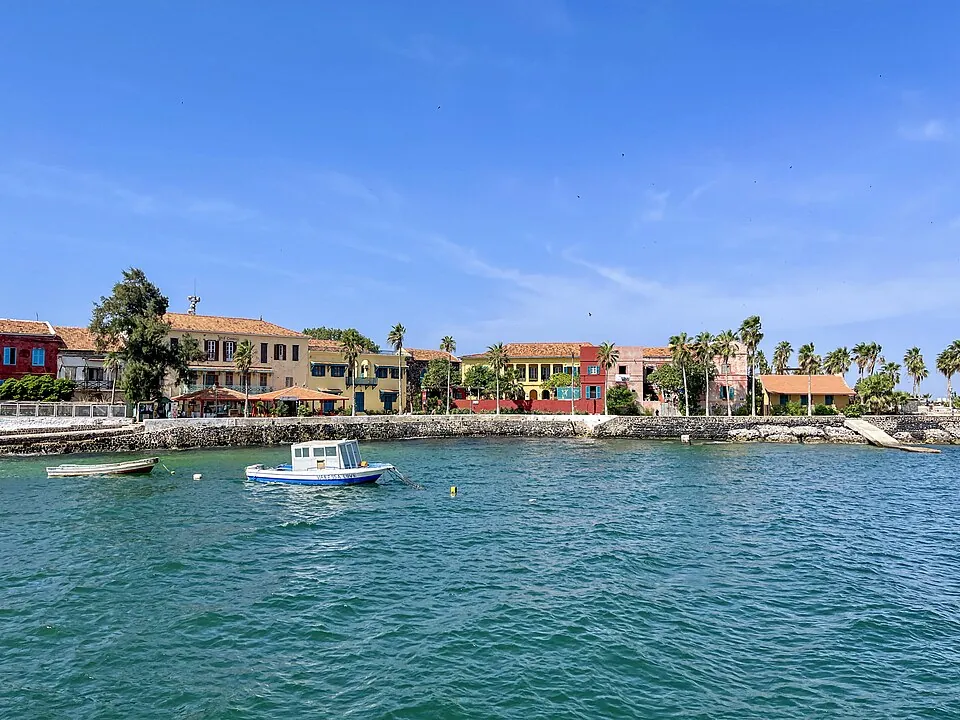
- Gorée Island, just off Dakar, is a UNESCO World Heritage Site remembered for its role in the Atlantic slave trade.
- French is the official language, a legacy of colonial rule; Wolof is the most widely spoken language in daily life.
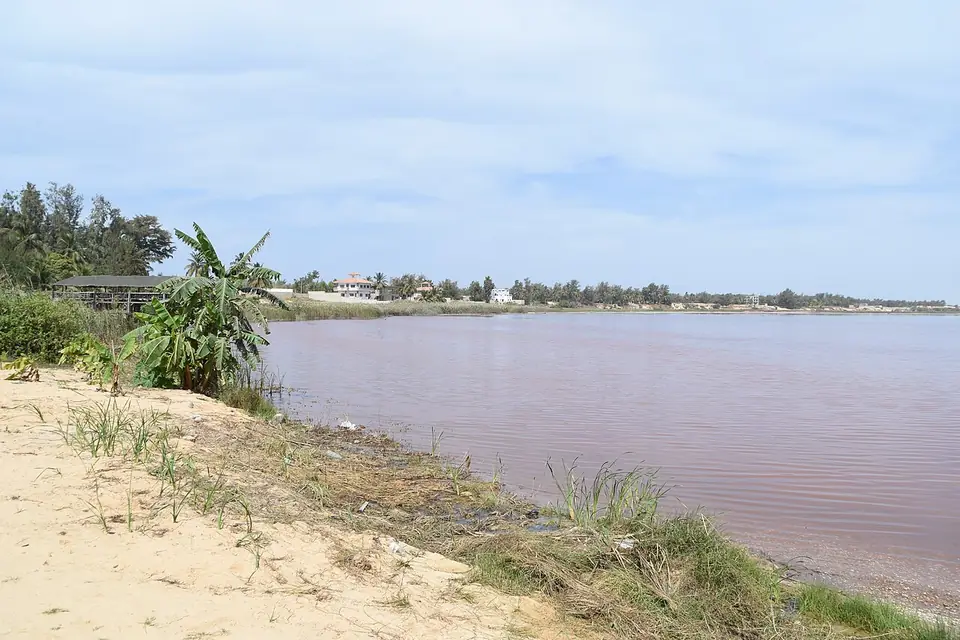
- Senegal is the home of Lake Retba, known as the Pink Lake, whose high salt content and algae give the water a pink colour.
Culture and traditions in Senegal
- Saying hello
"Nanga def?" (How are you?) in Wolof, with a handshake.
- Food and drink
Thieboudienne, fish and rice, considered the national dish; bissap, a hibiscus drink.
- Festivals and traditions
The Grand Magal of Touba is a huge pilgrimage; the Saint-Louis Jazz Festival is in spring.
- Everyday life
Teranga, meaning hospitality, is a core value. Attaya, a green tea ritual in three rounds, is a social tradition.
- Did you know?
Senegal's thieboudienne was added to UNESCO's Intangible Cultural Heritage list in 2021.
Common mistakes
- Tapping the Gambia instead of Senegal – the Gambia is the thin strip, Senegal is everything around it.
- Tapping Mauritania, the big country to the north.
- Picking Mali's flag in the Flags quiz – remember the star in Senegal's middle band.
Practise with Senegal
- West Africa quiz – the region zooms in on the bulge, and the Gambia slice makes Senegal unmistakable.
- Africa quiz – the westernmost mainland country, right at the tip of the bulge.
- Africa flags – practise the vertical green-yellow-red group: Senegal, Mali, Guinea.
- Africa capitals quiz – Dakar.
- Mystery Country – an outline with a thin notch cut out of the lower half is Senegal every time.
Nearby countries
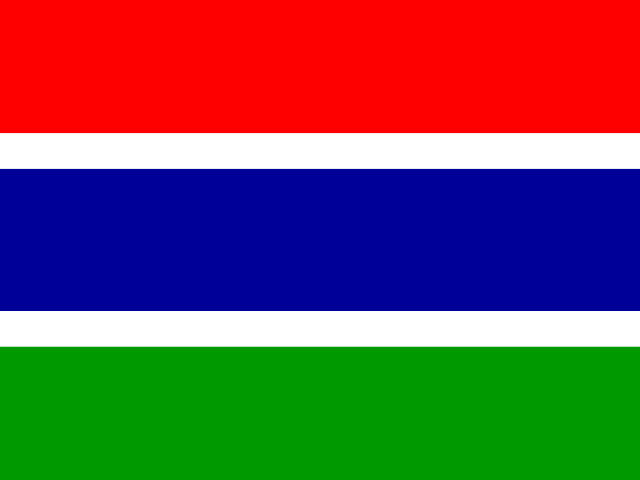 GambiaBanjul
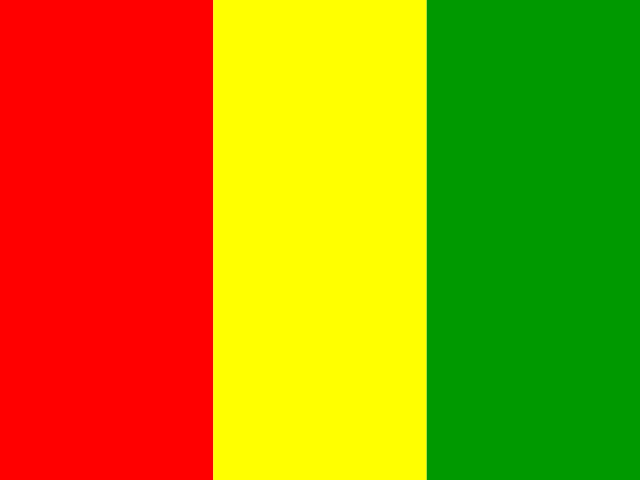 GuineaConakry
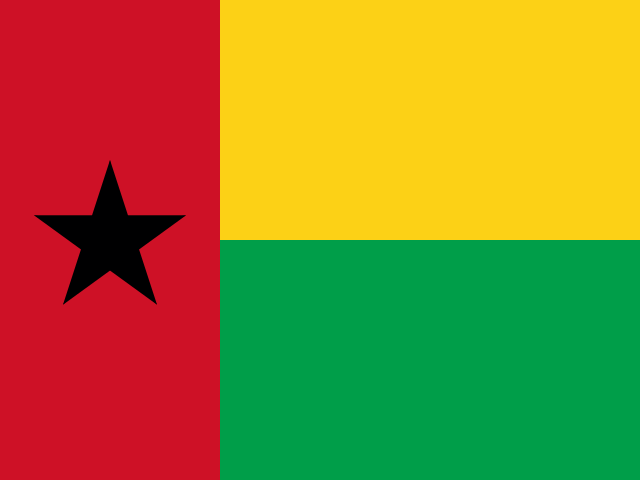 Guinea-BissauBissau
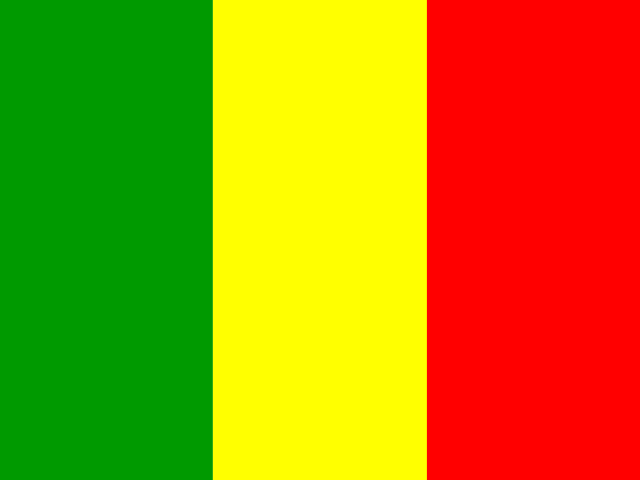 MaliBamako
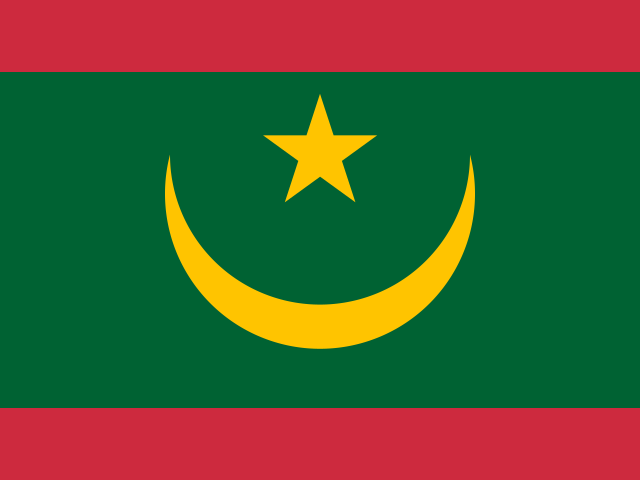 MauritaniaNouakchott
Quick check: how well do you know Senegal?
3 questions, no sign-up. Tap an answer.
1. Which flag belongs to Senegal?
That's the flag of Senegal.
2. What is the capital of Senegal?
The capital of Senegal is Dakar.
3. Which of these countries borders Senegal?
Gambia, Guinea, Guinea-Bissau, Mali and Mauritania border Senegal.
Keep going on the Africa quiz – Senegal is one of 54 countries there.
More ways to practise: find Senegal on the blank map with no borders (hard mode), or play today's Globe and the other daily puzzles.
Frequently asked questions about Senegal
What language is spoken in Senegal?
French is the official language, used in government and schools. Wolof is the most widely spoken language and the everyday lingua franca, especially in cities. Pulaar, Serer, Jola and Mandinka are among several national languages also used.
What currency does Senegal use?
Senegal uses the West African CFA franc, code XOF, shared with seven other countries in the West African Economic and Monetary Union. It is pegged to the euro at a fixed rate of 655.957 francs per euro.
What time zone is Senegal in?
Senegal uses Greenwich Mean Time, UTC+0, all year, with no daylight saving time. Because Dakar lies so far west, sunrise and sunset come late by the clock.
Which side of the road do they drive on in Senegal?
Senegal drives on the right, like France and the other countries of former French West Africa. Its busiest road, a toll motorway, links Dakar with the new airport at Diass and the city of Thiès.
What is the highest point in Senegal?
Senegal is mostly low and flat. Its highest point is an unnamed hill in the far south-east, near the borders with Guinea and Mali, at about 650 metres, in the foothills of the Fouta Djallon highlands.
What is Senegal famous for?
Senegal is known for teranga, a Wolof word for hospitality that is central to national identity, and for thieboudienne, a dish of fish and rice listed by UNESCO in 2021. The old colonial town of Saint-Louis and Niokolo-Koba National Park are also World Heritage Sites.
Quizzes with Senegal
Often confused with
Guides that help with this
- Learn all 54 African countries in a weekLearn the coastline in order, region by region.
- Flags that look alike (and how to tell them apart)Chad or Romania? Australia or New Zealand? The flag pairs that cost quiz points.
- The 25 hardest countries to find on a mapPacific islands, Caribbean islands and landlocked Africa – where they are.