Kuwait
Capital: Kuwait City. Kuwait is one of the 48 countries in the Asia quiz.
Quick answers: What is the capital of Kuwait? · Which countries border Kuwait?
Facts about Kuwait
- CapitalKuwait City
- Population4.9 million
- Area17,818 km²
- RegionsAsia, Middle East
- LanguageArabic
- CurrencyKuwaiti dinar (KWD)
Kuwait is the 39th most populous of the 48 countries in Asia and the 40th largest by area. Worldwide it ranks 127th by population and 153rd by area.
Where is Kuwait?
Kuwait is a small country at the northern end of the Persian Gulf, squeezed between Iraq to the north and west and Saudi Arabia to the south. Its eastern side is coastline on the Gulf, including the deep inlet of Kuwait Bay, around which the capital, Kuwait City, is built. The country covers around 17,800 square kilometres – smaller than Wales – and is almost entirely flat desert.
Several islands belong to Kuwait, the largest being Bubiyan in the north-east and Failaka at the mouth of Kuwait Bay.
How to find Kuwait on the map
- Start from the Persian Gulf. Follow the Gulf north-west to its top end. The small country on the western shore at the very head of the Gulf is Kuwait.
- Look below Iraq. Kuwait is tucked into the corner where Iraq meets Saudi Arabia and the sea.
- Don't confuse it with Qatar or Bahrain. Those are further down the Gulf's western shore; Kuwait is the one at the top.
- Find the bay. Kuwait Bay is a distinct bite out of the coastline, visible at Middle East zoom.
Flag
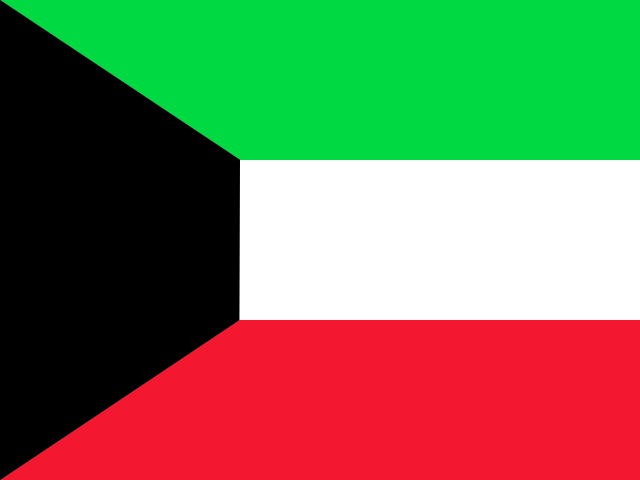
Kuwait's flag has three horizontal bands – green, white and red – with a black trapezoid at the hoist. The colours are the pan-Arab set drawn from a poem describing Arab deeds as white, battlefields as black, meadows as green and swords as red. It was adopted in 1961, the year of independence from Britain.
The United Arab Emirates uses the same four colours with a vertical red bar instead of a black trapezoid. Jordan and Palestine use a red triangle with black on top. The black trapezoid on the left is Kuwait's signature.
A short history of Kuwait
Long before oil, the head of the Gulf was a stopping point for traders. Around 4,000 years ago Failaka Island was part of the Dilmun civilisation, which linked Mesopotamia with the Indus Valley, and archaeologists have found its temples and stamp seals there. For many centuries afterwards, though, the mainland was home mainly to nomadic Bedouin.
Modern Kuwait began in the early 1700s, when clans from central Arabia settled around a small fort on the bay. The name comes from the Arabic for "little fort". In the mid-1700s the settlers chose the Al-Sabah family to manage their affairs, and that family still rules. Kuwait grew into a busy port, famous for its wooden dhows, pearl diving and long-distance trade with India and East Africa.
To protect itself from the Ottomans, Kuwait signed an agreement with Britain in 1899 that gave London control of its foreign affairs. At the Uqair conference of 1922 British officials fixed Kuwait's border with the Sultanate of Najd, later part of Saudi Arabia, creating a "neutral zone" that the two countries divided in the 1960s. The pearl trade then collapsed in the 1930s, when Japanese cultured pearls flooded the market.
Oil was struck at Burgan in 1938, and exports began after the Second World War. Within a generation Kuwait changed from a mud-brick town into a modern city with free healthcare and education. Independence came in 1961, Iraq immediately claimed the country, and British troops briefly returned to deter it. In 1962 Kuwait adopted a constitution creating an elected parliament, the National Assembly, which became unusually powerful for the region, although it has been suspended more than once. Women won the right to vote and stand for election in 2005.
The Iraqi occupation of 1990–91 ended with retreating troops setting fire to more than 600 oil wells, which burned for months. Today Kuwait is a wealthy welfare state that invests its oil income abroad through one of the world's oldest sovereign wealth funds. Foreign workers make up the majority of the population.
Culture and daily life in Kuwait
Arabic is the official language, spoken in a Gulf dialect, and English is widely used in business. Islam is the state religion; most citizens are Sunni with a sizeable Shia minority, and churches serve the many foreign residents. Society is shaped by large extended families and by tribal and merchant traditions.
The sea still runs through Kuwaiti identity. Sailors' songs called fijiri, sung to drums and hand claps, recall the hard months spent pearl diving, and a restored dhow fleet and maritime museum keep the memory alive. Kuwait was an early cultural leader in the Gulf: its television dramas and plays, many starring the comic actor Abdulhussain Abdulredha, were watched across the Arab world, and the long-running magazine Al-Arabi reached readers from Morocco to Iraq.
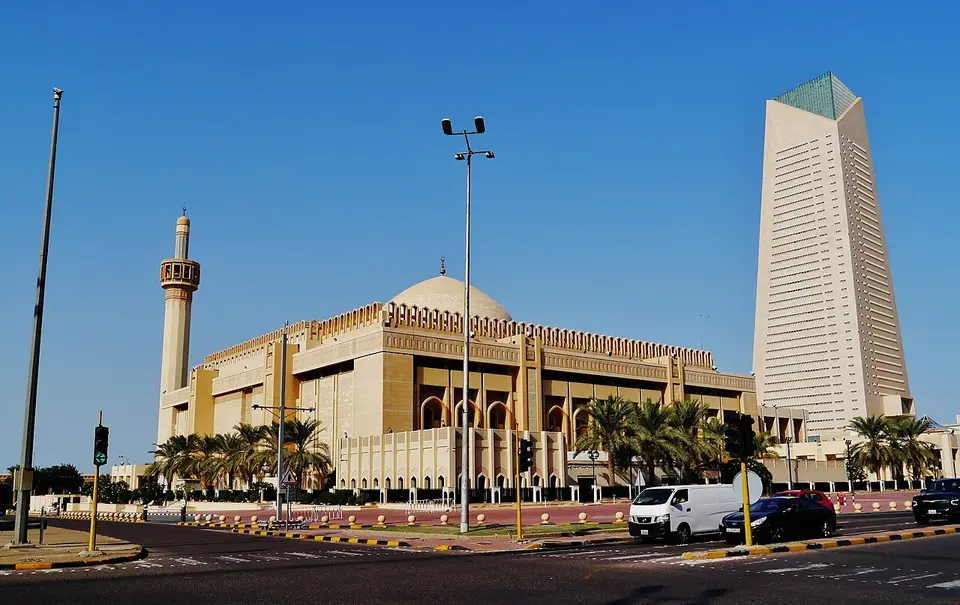
Modern landmarks include the Sheikh Jaber Al-Ahmad Cultural Centre and the Grand Mosque. Football is the main sport, and Kuwait played at the 1982 World Cup. Falconry and camel racing remain popular pastimes, and evenings are spent in malls, cafés and seaside walks once the summer heat eases.
Five facts worth knowing
- Kuwait holds some of the largest oil reserves in the world, and oil provides the great majority of government revenue.
- Iraq invaded Kuwait in August 1990, triggering the Gulf War; a US-led coalition liberated the country in February 1991.
- The Kuwaiti dinar is one of the highest-valued currency units in the world.
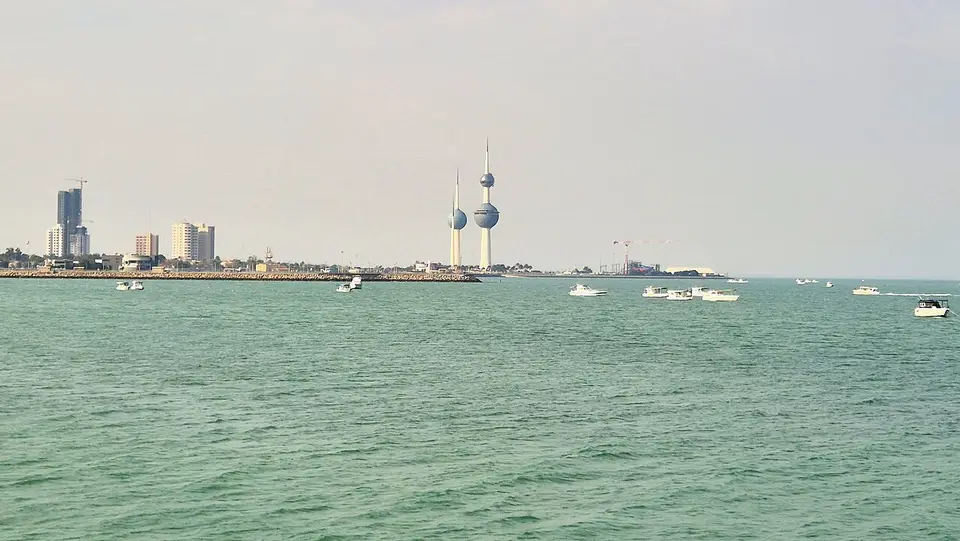
- The Kuwait Towers, three distinctive water towers with blue-green spheres, are the national landmark on the Kuwait City waterfront.
- Failaka Island was once a Greek settlement, founded by Alexander the Great's successors and called Ikaros.
Culture and traditions in Kuwait
- Saying hello
"As-salamu alaykum" with a handshake, usually between people of the same gender.
- Food and drink
Machboos, spiced rice with chicken, lamb or fish; Arabic coffee served with dates.
- Festivals and traditions
National Day on 25 February and Liberation Day on 26 February; Eid celebrations.
- Everyday life
Diwaniyas, regular social gatherings in homes, are a key part of life. The weekend is Friday and Saturday.
- Did you know?
The Kuwaiti dinar is the world's highest-valued currency unit.
Common mistakes
- Tapping Qatar, another small Gulf state, further south.
- Tapping Bahrain, the island state between Qatar and Saudi Arabia.
- Choosing the UAE's flag in the Flags quiz – look for the trapezoid, not a vertical bar.
Practise with Kuwait
- Middle East quiz – the zoomed-in map is the fair way to find a country this size.
- Asia quiz – find the Persian Gulf and go to its northern tip.
- Asia flags – learn the pan-Arab family: Kuwait, UAE, Jordan, Palestine, Sudan.
- Asia capitals quiz – Kuwait City.
- Mystery Country – a small, roughly square shape with a bay bitten out of the east side.
Nearby countries
 IraqBaghdad
 Saudi ArabiaRiyadh
Quick check: how well do you know Kuwait?
3 questions, no sign-up. Tap an answer.
1. Which flag belongs to Kuwait?
That's the flag of Kuwait.
2. What is the capital of Kuwait?
The capital of Kuwait is Kuwait City.
3. Which of these countries borders Kuwait?
Iraq and Saudi Arabia border Kuwait.
Keep going on the Asia quiz – Kuwait is one of 48 countries there.
More ways to practise: find Kuwait on the blank map with no borders (hard mode), or play today's Globe and the other daily puzzles.
Frequently asked questions about Kuwait
What language is spoken in Kuwait?
Arabic is the official language, and Kuwaitis speak a Gulf Arabic dialect. Because foreign workers make up most of the population, English is widely used in business and shops, and Hindi, Urdu, Malayalam, Tagalog and Bengali are often heard.
What currency does Kuwait use?
Kuwait uses the Kuwaiti dinar (KWD), divided into 1,000 fils. It is the most valuable currency unit in the world, worth more than three US dollars. Its value is managed against an undisclosed basket of currencies rather than a single peg.
What time zone is Kuwait in?
Kuwait is on UTC+3, Arabia Standard Time, all year. It does not use daylight saving time, so its clocks match those of Saudi Arabia, Bahrain, Qatar and Iraq.
Which side of the road do they drive on in Kuwait?
Kuwait drives on the right. Kuwait City's road system is built around a series of ring roads, numbered from the First Ring Road near the centre outwards, crossed by long radial motorways.
What is the highest point in Kuwait?
Kuwait is very flat, and its highest point is only about 300 metres above sea level, an unnamed spot in the far west near the Saudi and Iraqi borders. The most notable ridge, Jal az-Zor, runs along the northern shore of Kuwait Bay.
Is Kuwait a rich country?
Yes. Kuwait sits on some of the world's largest oil reserves, and oil money pays for free healthcare, education and generous jobs for citizens. Its sovereign wealth fund, set up in 1953, is one of the oldest and largest in the world.
Quizzes with Kuwait
Guides that help with this
- Oceans, seas, rivers and mountainsThe physical map: seas around each continent, the big rivers and ranges.
- Flags that look alike (and how to tell them apart)Chad or Romania? Australia or New Zealand? The flag pairs that cost quiz points.
- The 25 hardest countries to find on a mapPacific islands, Caribbean islands and landlocked Africa – where they are.