Mongolia
Capital: Ulaanbaatar. Mongolia is one of the 48 countries in the Asia quiz.
Quick answers: What is the capital of Mongolia? · Which countries border Mongolia?
Facts about Mongolia
- CapitalUlaanbaatar
- Population3.6 million
- Area1,564,110 km²
- RegionsAsia, East Asia
- LanguageMongolian
- CurrencyMongolian tögrög (MNT)
Mongolia is the 41st most populous of the 48 countries in Asia and the 7th largest by area. Worldwide it ranks 132nd by population and 18th by area.
Where is Mongolia?
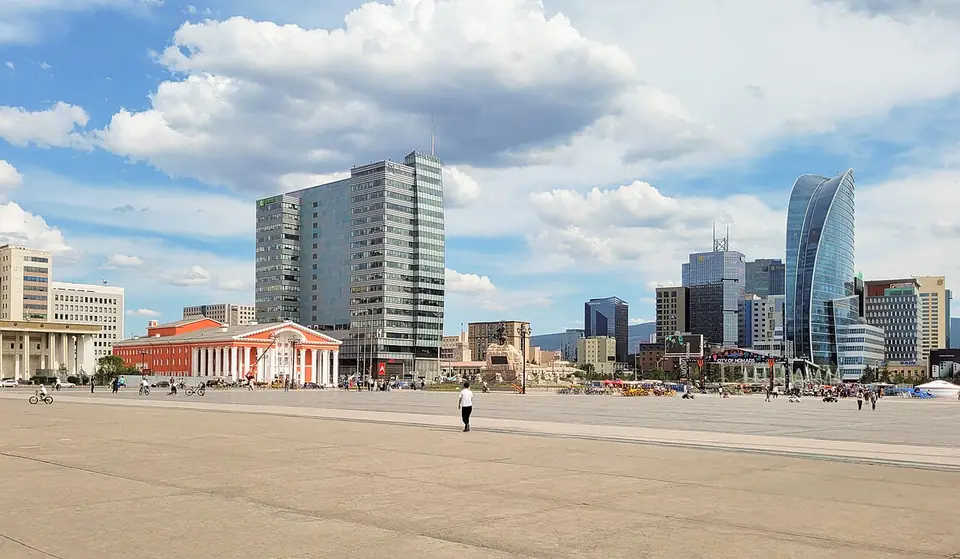
Mongolia is the big landlocked country wedged between Russia and China in the heart of East Asia. Russia runs along its entire northern border and China wraps around the south, east and west, so Mongolia touches only those two neighbours. Ulaanbaatar, the capital, is in the north-central part of the country, home to roughly half of all Mongolians. Most of the rest of the land is steppe, mountains and the Gobi Desert in the south.
On a world map, look for the bulge of China and then the long line of Russia above it. The oval-shaped country sandwiched between them is Mongolia.
How to find Mongolia on the map
- Start from China. Mongolia is the large country sitting on top of China's northern edge, like a hat.
- Then check Russia. If the country you've found touches Russia along its whole northern side and China along everything else, you've got it.
- Look for the shape. Mongolia is wide and roughly oval, noticeably bigger than most people expect – it's larger than Iran or Peru.
- Don't confuse it with Kazakhstan. Kazakhstan is further west, between Russia and the Central Asian "-stans", and touches the Caspian Sea. Mongolia touches no sea at all.
Flag
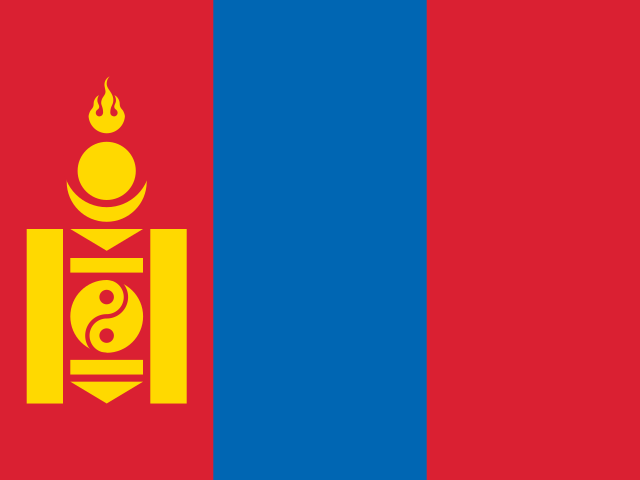
The Mongolian flag has three vertical bands: red, blue, red. In the hoist-side red band is a yellow symbol called the Soyombo, a stack of shapes including a flame, a sun, a crescent moon and a yin-yang symbol. The blue centre band represents the eternal blue sky.
Nothing else in the Asia flags set looks quite like it. If you see red-blue-red vertical stripes with a tall golden emblem on the left, that's Mongolia.
A short history of Mongolia
For thousands of years the grasslands of Mongolia were home to nomadic herders who moved with their horses, sheep and camels. From these steppes came a series of powerful confederations, beginning with the Xiongnu around the 3rd century BC, whose raids pushed Chinese dynasties to build early sections of the Great Wall. Turkic and Uyghur khaganates followed in later centuries.
Early in the 13th century a warlord named Temüjin united the feuding Mongol tribes and took the title Genghis Khan. His armies, and those of his sons and grandsons, conquered lands from Korea to Hungary. His grandson Kublai Khan ruled China as the Yuan dynasty, but after it fell in 1368 the Mongols withdrew to the steppe and split into rival groups. In the late 1500s Mongol rulers adopted Tibetan Buddhism, which reshaped society and filled the land with monasteries.
In the 1600s the Manchus, who ruled China as the Qing dynasty, brought the Mongols under their control. They divided the territory into an outer part, today's country, and an inner part, which remained in China. When the Qing fell in 1911, Outer Mongolia declared independence under the Bogd Khan, a Buddhist leader. With Soviet backing, revolutionaries led by Damdin Sükhbaatar took power in 1921, and in 1924 the Mongolian People's Republic became the world's second communist state.
For seven decades Mongolia was closely tied to Moscow. In the late 1930s a purge destroyed most monasteries and killed tens of thousands of monks and others. Herds were collectivised, and the Cyrillic alphabet replaced the old Mongolian script. China formally recognised Mongolia's independence after a referendum in 1945.
Peaceful protests in 1990 ended one-party rule, and Mongolia adopted a democratic constitution in 1992. Since then, mining of copper, coal and gold, including the vast Oyu Tolgoi mine in the Gobi, has driven the economy, while many families still live by herding.
Culture and daily life in Mongolia
The ger, a round felt tent that can be taken down and moved in a few hours, is still home to many families, and even parts of Ulaanbaatar are ringed by ger districts. Horses are at the heart of the culture; children learn to ride very young, and there is a saying that a Mongol without a horse is like a bird without wings.
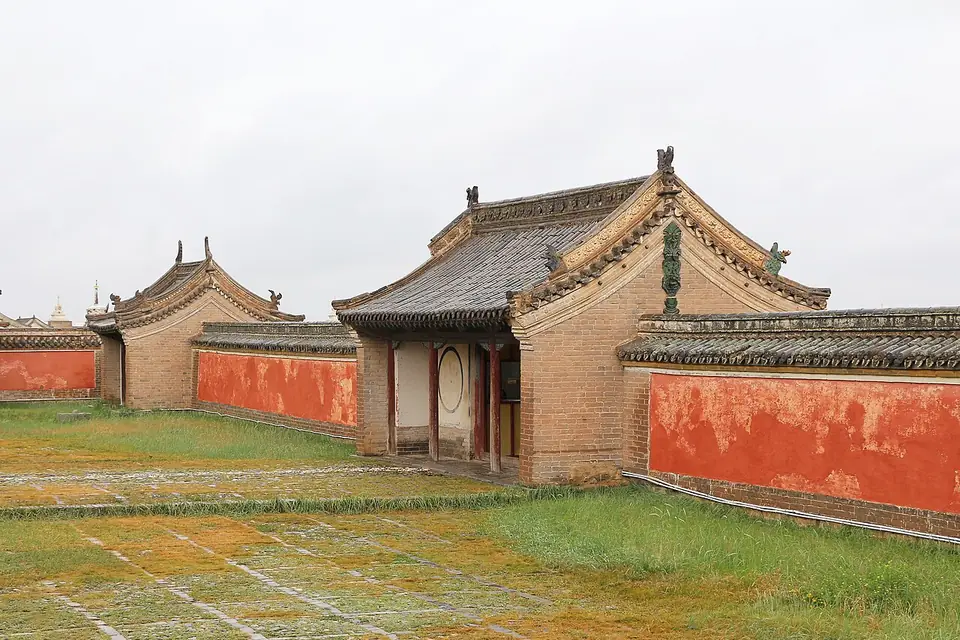
Mongolian is written in Cyrillic, but the traditional vertical script is again taught in schools and appears on official seals and banknotes. Most people who follow a religion are Tibetan Buddhists, and Gandan Monastery in Ulaanbaatar is the country's main monastery. Shamanist beliefs remain alive, especially in the north, and roadside stone cairns called ovoo are circled by travellers for good luck.
Music has a sound found nowhere else. Khöömei, or throat singing, lets a singer produce two notes at once, and the morin khuur, a two-stringed fiddle topped with a carved horse head, is the national instrument. The 13th-century Secret History of the Mongols is the oldest surviving work of Mongolian literature. Wrestling is the most admired sport, and Mongolian wrestlers such as Hakuhō have become champions in Japanese sumo.
Five facts worth knowing
- Mongolia is the most sparsely populated sovereign country in the world – about 3.6 million people spread across more than 1.5 million square kilometres.
- It is the largest landlocked country that doesn't border a landlocked sea; only Kazakhstan, which touches the Caspian, is a bigger landlocked state.
- Ulaanbaatar is often cited as the coldest national capital on Earth, with winter temperatures regularly dropping below −30 °C.
- The Gobi Desert in the south is shared with China and is one of the world's richest sites for dinosaur fossils, including the first dinosaur eggs ever found.
- Genghis Khan founded the Mongol Empire here in 1206, which went on to become the largest contiguous land empire in history.
Culture and traditions in Mongolia
- Saying hello
"Sain baina uu?" (Are you well?) is the classic greeting; at Tsagaan Sar, people grasp each other's forearms.
- Food and drink
Buuz, steamed meat dumplings, and airag, fermented mare's milk; salty milk tea (suutei tsai) is served everywhere.
- Festivals and traditions
Naadam (from 11 July) features wrestling, horse racing and archery; Tsagaan Sar is the Lunar New Year.
- Everyday life
In a ger, guests move clockwise and accept offered food with the right hand. Many people still live a nomadic herding life.
- Did you know?
Mongolia is the world's most sparsely populated sovereign country, with about 2 people per km².
Common mistakes
- Tapping Kazakhstan – both are large, landlocked and next to Russia, but Kazakhstan is far to the west.
- Tapping Inner Mongolia, the Chinese region just across the border, which is part of China and not on the quiz.
- Underestimating the size – some players look for a small country and skip right over it.
Practise with Mongolia
- Asia quiz – once you've found China and Russia, Mongolia is the oval between them.
- East Asia quiz – a small set, so Mongolia is hard to miss.
- Asia flags – the Soyombo emblem is unique; learn it once and you'll never miss it.
- Asia capitals quiz – Ulaanbaatar.
- Mystery Country – a wide, rounded outline with a flat-ish southern edge against China.
Nearby countries
Quick check: how well do you know Mongolia?
3 questions, no sign-up. Tap an answer.
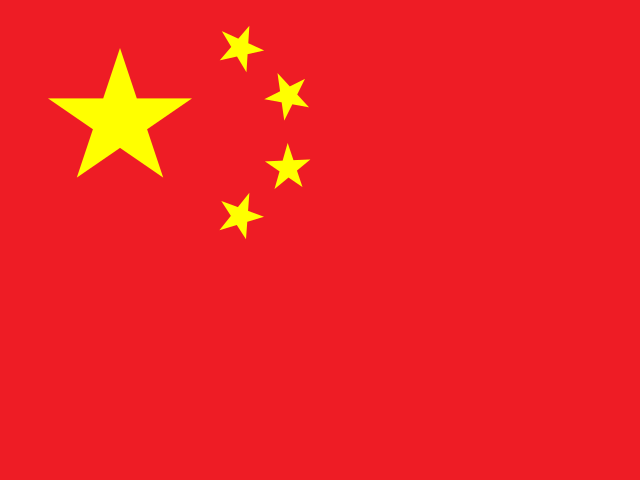
1. Which flag belongs to Mongolia?
That's the flag of Mongolia.
2. What is the capital of Mongolia?
The capital of Mongolia is Ulaanbaatar.
3. Which of these countries borders Mongolia?
China and Russia border Mongolia.
Keep going on the Asia quiz – Mongolia is one of 48 countries there.
More ways to practise: find Mongolia on the blank map with no borders (hard mode), or play today's Globe and the other daily puzzles.
Frequently asked questions about Mongolia
What language is spoken in Mongolia?
Mongolian is the official language, and the Khalkha dialect is the standard. It is written in Cyrillic, adopted in the 1940s, but the traditional vertical Mongolian script is being revived alongside it. Kazakh is the main language in the western province of Bayan-Ölgii.
What currency does Mongolia use?
Mongolia uses the tögrög (MNT), often spelled tugrik. It was introduced in 1925, and its banknotes show Genghis Khan and the revolutionary hero Damdin Sükhbaatar. Coins are rarely used because of their very low value.
What time zone is Mongolia in?
Most of Mongolia, including Ulaanbaatar, is on UTC+8, the same as Beijing. The three westernmost provinces – Bayan-Ölgii, Uvs and Khovd – use UTC+7. The country does not currently use daylight saving time.
Which side of the road do they drive on in Mongolia?
Mongolia drives on the right, but many of its cars are second-hand imports from Japan with the steering wheel on the right. Outside towns, much travel is still on dirt tracks across the open steppe.
What is the highest point in Mongolia?
Khüiten Peak, in the Tavan Bogd massif of the Altai Mountains, is Mongolia's highest point at about 4,374 metres. It stands where Mongolia, China and Russia meet, surrounded by glaciers in the country's far west.
What is Naadam?
Naadam is Mongolia's national festival, held every July. It centres on the "three games of men": wrestling, horse racing and archery. The horse races cover up to about 30 kilometres across the steppe, and the jockeys are often children. UNESCO lists it as intangible cultural heritage.
Quizzes with Mongolia
Guides that help with this
- Oceans, seas, rivers and mountainsThe physical map: seas around each continent, the big rivers and ranges.
- Flags that look alike (and how to tell them apart)Chad or Romania? Australia or New Zealand? The flag pairs that cost quiz points.
- The 25 hardest countries to find on a mapPacific islands, Caribbean islands and landlocked Africa – where they are.