Nepal
Capital: Kathmandu. Nepal is one of the 48 countries in the Asia quiz.
Quick answers: What is the capital of Nepal? · Which countries border Nepal?
Facts about Nepal
- CapitalKathmandu
- Population29.6 million
- Area147,181 km²
- RegionsAsia, Central & South Asia
- LanguageNepali
- CurrencyNepalese rupee (NPR)
Nepal is the 20th most populous of the 48 countries in Asia and the 27th largest by area. Worldwide it ranks 52nd by population and 93rd by area.
Where is Nepal?
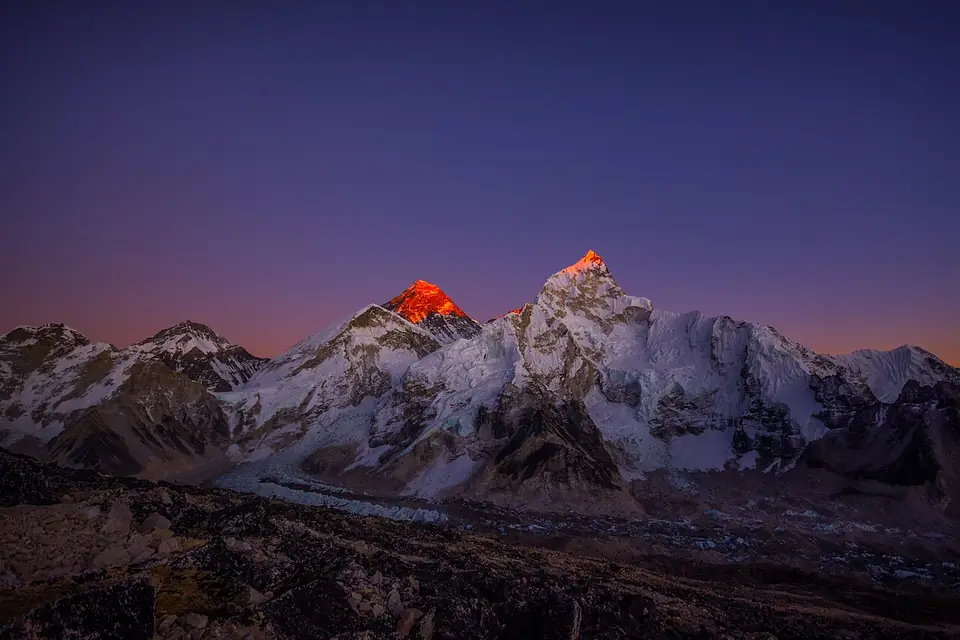
Nepal is a landlocked country in South Asia, squeezed between two giants: China (the Tibet region) to the north and India to the south, east and west. It runs along the southern side of the Himalayas and contains Mount Everest, the highest point on Earth, on its border with China. Kathmandu, the capital, is in a valley in the centre of the country.
On a world map, find India and look at its northern edge. Nepal is the long, slim country lying along that edge, between India and China, with Bhutan a little further east.
How to find Nepal on the map
- Start from India. Nepal sits on top of India's northern border, roughly halfway along it.
- Then find China. Nepal is the strip between the two; it touches no one else.
- Look for the shape. Nepal is a long rectangle tilted slightly, running from north-west to south-east.
- Don't confuse it with Bhutan. Bhutan is the smaller country further east along the same India-China border, separated from Nepal by a narrow piece of India.
Flag
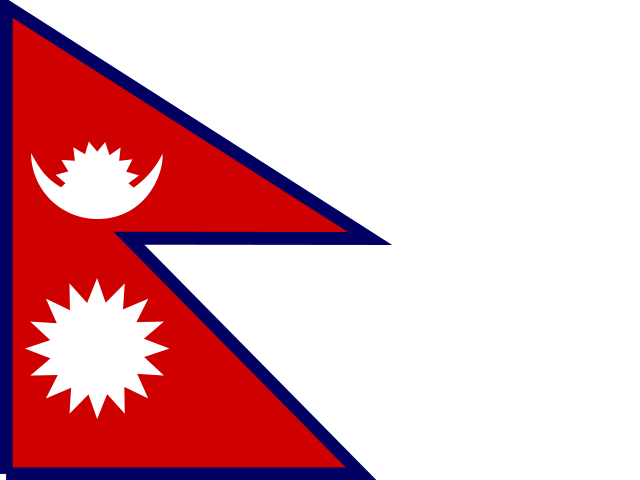
Nepal's flag is the only non-rectangular national flag in the world. It is made of two stacked crimson triangles (pennants) with a dark blue border. The upper triangle holds a white moon and the lower one a white twelve-rayed sun.
There is nothing to confuse it with. If the flag isn't a rectangle, it's Nepal.
A short history of Nepal
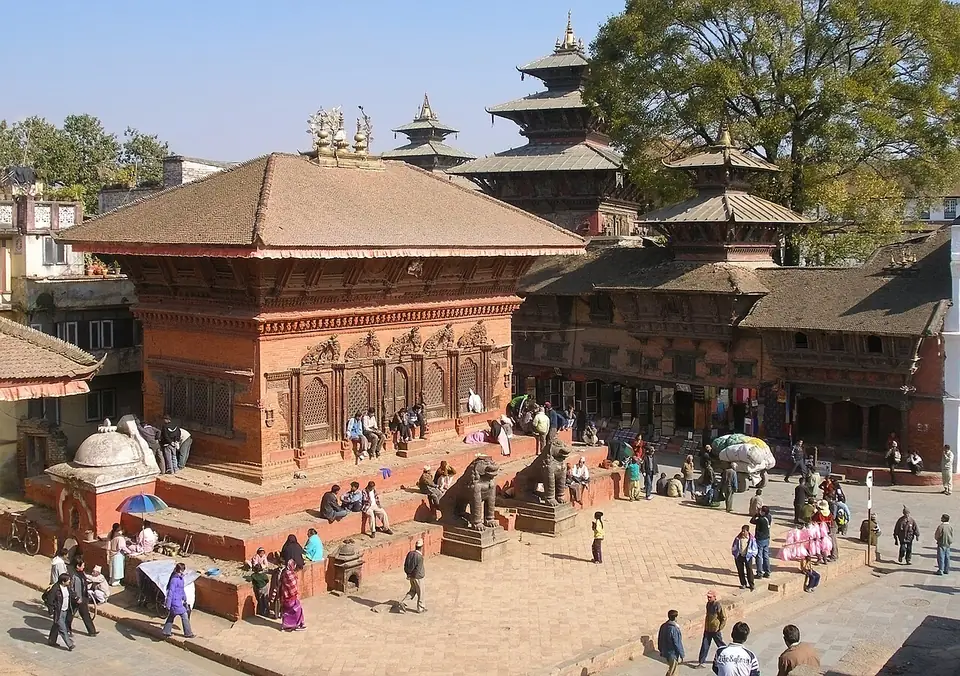
The Kathmandu Valley has been the centre of Nepal's history for over two thousand years. Early rulers known as the Kirata were followed by the Licchavi dynasty, which governed the valley from around the 4th century AD and left inscriptions and temples, including the early shrine at Changu Narayan. Trade routes between India and Tibet passed through the valley, bringing wealth and both Hindu and Buddhist influences.
From the 12th century the Malla kings ruled the valley. In the 1400s their kingdom split into three rival city-states – Kathmandu, Patan and Bhaktapur. Competition between them produced the palaces, pagoda temples and royal squares that now fill the valley. Beyond it, the hills were divided among dozens of small principalities.
In the 1760s Prithvi Narayan Shah, king of the small hill state of Gorkha, conquered the valley and made Kathmandu his capital. His successors pushed the kingdom east and west until it stretched from Sikkim to the Kumaon hills of today's India. Expansion ended with the Anglo-Nepalese War of 1814–16. The Treaty of Sugauli cost Nepal around a third of its land, and fixed much of its present shape. Britain was impressed by Nepal's soldiers and began recruiting them as Gurkhas, a tradition that continues.
In 1846 Jung Bahadur Rana seized power in a massacre at the royal court. For the next century, the Rana family ruled as hereditary prime ministers while the kings were kept as figureheads, and the country was largely closed to outsiders. A revolt in 1951 restored the king's authority and opened Nepal to the world. Elected government was short-lived, and in 1960 the king imposed the partyless panchayat system. Protests in 1990 brought back multi-party democracy.
A Maoist insurgency from 1996 to 2006 cost thousands of lives, and in 2001 much of the royal family was killed by the crown prince in a palace shooting. After mass protests, the monarchy was abolished in 2008, and a new federal constitution with seven provinces followed in 2015. Today Nepal relies on farming, tourism and money sent home by workers abroad, and is developing its large hydropower potential.
Culture and daily life in Nepal
Nepal is home to more than a hundred ethnic groups and many languages. Nepali, written in the Devanagari script, is the national language, but Maithili, Bhojpuri, Tharu, Tamang and Newari are also widely spoken. The Newars are the original people of the Kathmandu Valley, and their craftsmen created much of its art, from carved wooden windows to bronze statues.
Most Nepalis are Hindu, and Buddhism is the second-largest religion, but the two often blend, with many people worshipping at both temples and stupas. Pashupatinath, on the Bagmati River, is one of the holiest Hindu temples in South Asia, while the great white dome of Boudhanath is a centre for Tibetan Buddhists. In Kathmandu, a young girl is chosen as the Kumari, a living goddess, who appears at festivals.
The Sherpa people of the Everest region became famous through mountaineering. Tenzing Norgay reached the summit with Edmund Hillary in 1953, and Sherpa climbers still guide most expeditions. Traditional crafts include thangka scroll paintings and hand-knotted carpets. The khukuri, a curved knife, is a national symbol. Cricket and football are the most popular sports, and the poet Laxmi Prasad Devkota is a much-loved figure in Nepali literature.
Five facts worth knowing
- Eight of the world's fourteen peaks above 8,000 metres are wholly or partly in Nepal, including Everest, Kangchenjunga, Lhotse, Makalu, Cho Oyu, Dhaulagiri, Manaslu and Annapurna.
- Nepal was never colonised. It stayed independent through the British era in India and was a kingdom until 2008, when it became a republic.
- The country has enormous vertical range: from lowland plains (the Terai) under 100 metres to Everest at 8,849 metres, all within about 200 km north to south.
- Lumbini, in southern Nepal, is the birthplace of Siddhartha Gautama, the Buddha, and is a UNESCO World Heritage site.
- Kathmandu Valley holds seven World Heritage monument zones, including the historic squares of Kathmandu, Patan and Bhaktapur.
Culture and traditions in Nepal
- Saying hello
"Namaste" with palms pressed together is the usual greeting.
- Food and drink
Dal bhat, lentil soup with rice and vegetables, eaten twice a day by many, and momo, steamed dumplings.
- Festivals and traditions
Dashain (Sept/Oct) is the biggest festival, followed by Tihar, the festival of lights; Holi is in spring.
- Everyday life
Remove shoes before entering homes and temples, and walk clockwise around stupas. Eat and pass items with the right hand.
- Did you know?
Nepal's flag is the only non-rectangular national flag in the world, made of two stacked triangles.
Common mistakes
- Tapping Bhutan – both are small Himalayan kingdoms (or ex-kingdoms) between India and China.
- Tapping Bangladesh, which is also next to India but is at sea level on the Bay of Bengal.
- Tapping the Indian state of Sikkim, which sits between Nepal and Bhutan.
Practise with Nepal
- Asia quiz – the slim country along India's northern border.
- Central & South Asia quiz – a smaller map that makes the Nepal-Bhutan distinction clear.
- Asia flags – the only flag that isn't a rectangle.
- Asia capitals quiz – Kathmandu.
- Indian States – useful context: Nepal borders Uttarakhand, Uttar Pradesh, Bihar, West Bengal and Sikkim.
- Mystery Country – a tilted rectangle; once you know it, it's one of the easiest in Asia.
Nearby countries
Quick check: how well do you know Nepal?
3 questions, no sign-up. Tap an answer.
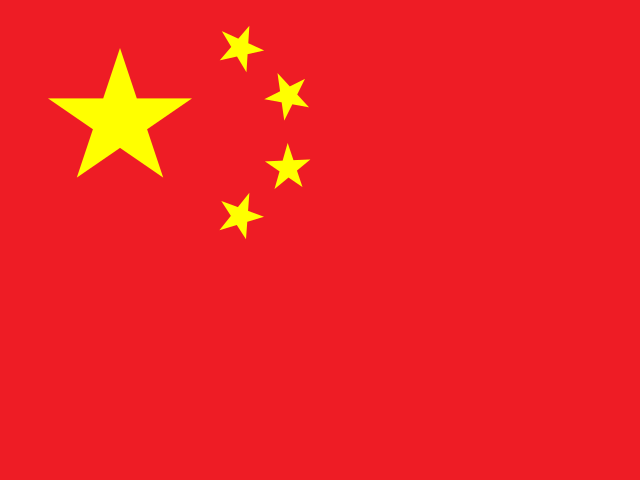
1. Which flag belongs to Nepal?
That's the flag of Nepal.
2. What is the capital of Nepal?
The capital of Nepal is Kathmandu.
3. Which of these countries borders Nepal?
China and India border Nepal.
Keep going on the Asia quiz – Nepal is one of 48 countries there.
More ways to practise: find Nepal on the blank map with no borders (hard mode), or play today's Globe and the other daily puzzles.
Frequently asked questions about Nepal
What language is spoken in Nepal?
Nepali is the official language, written in the Devanagari script, and it is the common language between Nepal's many communities. Over 120 languages are spoken in total; Maithili and Bhojpuri are widely spoken on the southern plains, and Newar, Tamang and Sherpa are among the languages of the hills and mountains.
What currency does Nepal use?
Nepal uses the Nepalese rupee (NPR), divided into 100 paisa. It is pegged to the Indian rupee at a fixed rate of 1.6 Nepalese rupees to one Indian rupee, which reflects the very close trade links between the two countries.
What time zone is Nepal in?
Nepal is on UTC+5:45, one of only a few countries with a 45-minute offset. It is 15 minutes ahead of India and does not use daylight saving time.
Which side of the road do they drive on in Nepal?
Nepal drives on the left, as in India. Mountain roads are often narrow, unpaved and prone to landslides in the monsoon, so many trekkers fly to small airstrips such as Lukla instead.
What is the highest point in Nepal?
Mount Everest, called Sagarmatha in Nepali, is the highest point in Nepal and on Earth at 8,849 metres. Nepal and China announced this height jointly in 2020 after new surveys, since the summit lies on the border between them.
Where was the Buddha born?
According to Buddhist tradition, Siddhartha Gautama, the Buddha, was born in Lumbini in southern Nepal, near the Indian border. A pillar erected by the Indian emperor Ashoka in the 3rd century BC marks the site, which is now a UNESCO World Heritage site and pilgrimage centre.
Quizzes with Nepal
Often confused with
Guides that help with this
- Oceans, seas, rivers and mountainsThe physical map: seas around each continent, the big rivers and ranges.
- Flags that look alike (and how to tell them apart)Chad or Romania? Australia or New Zealand? The flag pairs that cost quiz points.
- The 25 hardest countries to find on a mapPacific islands, Caribbean islands and landlocked Africa – where they are.