Thailand
Capital: Bangkok. Thailand is one of the 48 countries in the Asia quiz.
Quick answers: What is the capital of Thailand? · Which countries border Thailand?
Facts about Thailand
- CapitalBangkok
- Population71.6 million
- Area513,120 km²
- RegionsAsia, Southeast Asia
- LanguageThai
- CurrencyThai baht (THB)
Thailand is the 11th most populous of the 48 countries in Asia and the 13th largest by area. Worldwide it ranks 20th by population and 50th by area.
Where is Thailand?
Thailand is in the heart of mainland Southeast Asia. It borders Myanmar to the west and north-west, Laos to the north-east, Cambodia to the south-east and Malaysia at the southern tip. The country has two coastlines: the Gulf of Thailand on the east and the Andaman Sea on the west. Bangkok, the capital, sits near the head of the Gulf, on the Chao Phraya River.
The shape is the easiest way to recognise it. Thais say it looks like an elephant's head: the broad northern part is the head, and the long, thin strip running south down the Malay Peninsula is the trunk.
How to find Thailand on the map
- Start from the Gulf. The Gulf of Thailand is the large bay tucked into the mainland south of China; Thailand wraps around its north and west sides.
- Look for the elephant's head. The country has a wide top and a narrow tail reaching down towards Malaysia.
- Don't confuse it with Vietnam. Vietnam is the long S-shaped strip on the far eastern coast; Thailand is further west.
- Don't confuse it with Myanmar. Myanmar is bigger, stretches further north towards China, and faces the Bay of Bengal.
Flag
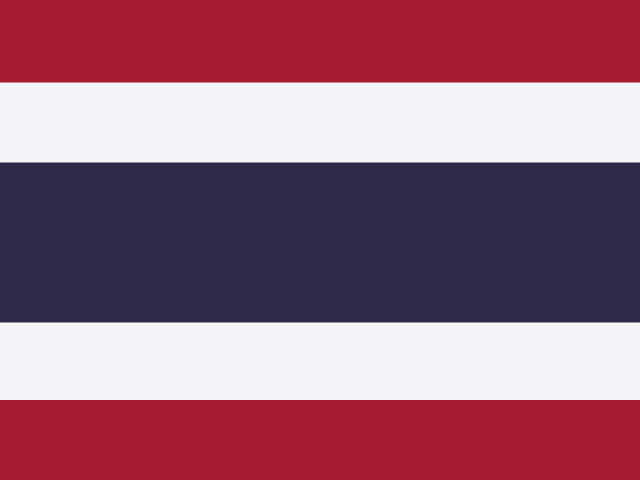
The Thai flag has five horizontal bands: red, white, blue, white, red. The blue band in the middle is twice as tall as the others. Red stands for the nation, white for religion and blue for the monarchy. It was adopted in 1917.
Costa Rica is the main lookalike: the same five bands with the colours swapped, blue on the outside and red in the middle. If the thick central stripe is blue, it's Thailand; if it's red, Costa Rica.
A short history of Thailand
Rice farming and bronze working began early in what is now Thailand; the site of Ban Chiang in the north-east is a UNESCO World Heritage Site for its prehistoric pottery and metalwork. In the first millennium AD, Mon kingdoms spread Buddhism across the central plains, while the Khmer Empire of Angkor ruled much of the north-east, leaving temples such as Phimai.
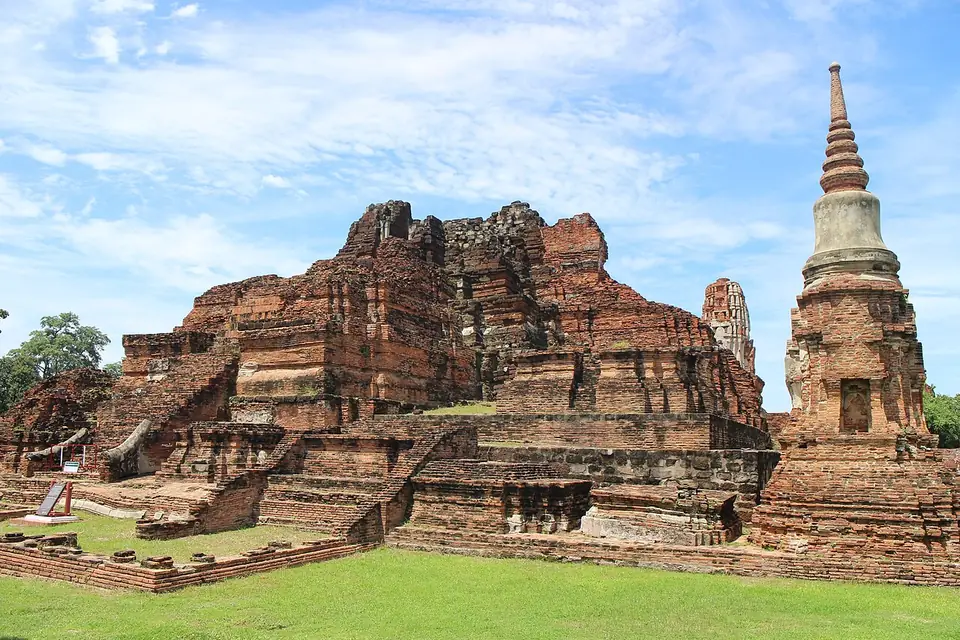
Tai-speaking peoples moved south from what is now southern China and, in the 13th century, founded kingdoms of their own. Sukhothai is seen as the first Thai kingdom, and its king Ramkhamhaeng is credited with creating the Thai script. In the north, the kingdom of Lanna was founded with Chiang Mai as its capital. From 1351, Ayutthaya grew into a wealthy trading city that welcomed merchants from China, Japan, Persia and Europe. A Burmese army destroyed it in 1767. A general named Taksin rallied the kingdom, and in 1782 the Chakri dynasty, which still reigns, moved the capital to Bangkok.
In the 19th century Kings Mongkut and Chulalongkorn modernised the country with railways, schools and a reformed government. To keep the British and French at bay, Siam gave up claims to Laos and western Cambodia to France and to several northern Malay states to Britain between 1893 and 1909. Those losses largely set Thailand's present borders.
A revolution in 1932 ended absolute monarchy. During the Second World War Thailand allied with Japan, while an underground Free Thai movement worked with the Allies. During the Cold War it became a close US ally, and in 1967 ASEAN was founded in Bangkok. Politics has been unstable, with many military coups since 1932. King Bhumibol reigned for 70 years until 2016, becoming a powerful national symbol.
Today Thailand is one of Southeast Asia's largest economies, with major car manufacturing, farming exports and one of the world's biggest tourism industries.
Culture and daily life in Thailand
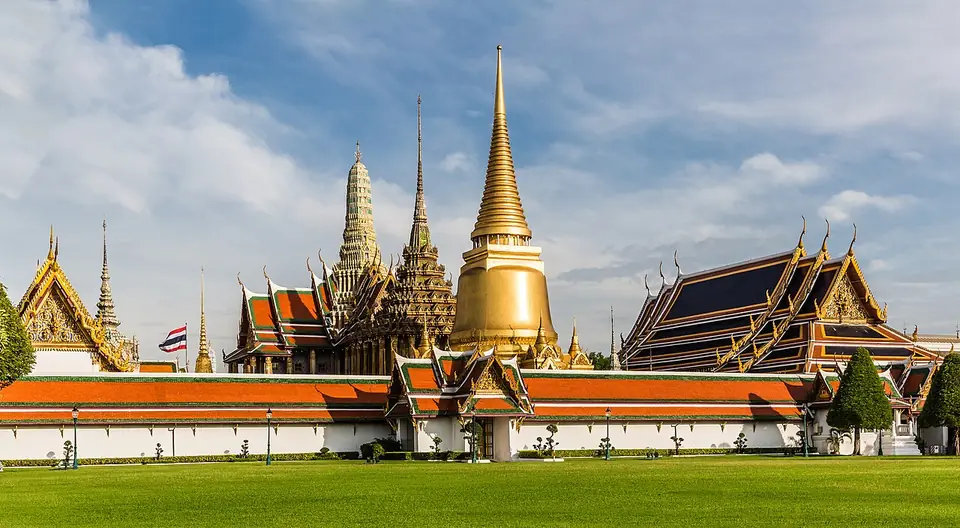
Thai is a tonal language with its own script, derived from Khmer writing. Regional dialects differ widely: people in the north-east, called Isan, speak a language very close to Lao, and in the far south many people speak Malay. More than nine in ten Thais are Theravada Buddhists. Many young men spend time as monks, and almost every village has a wat, or temple. Wat Phra Kaew in Bangkok houses the Emerald Buddha, the country's most sacred image.
The Ramakien, the Thai version of the Indian Ramayana epic, is painted on temple walls and performed in khon, a masked dance drama. Popular music includes luk thung, country songs about rural life, and mor lam from Isan. Muay Thai, the fighting art of kicks, knees and elbows, is the national sport. Thai massage is listed by UNESCO as cultural heritage.
Many homes and businesses have small spirit houses outside, where offerings are left daily. Thais value sanuk – the idea that life should be fun – and the easy-going phrase "mai pen rai", meaning "never mind".
Five facts worth knowing
- Thailand is the only country in Southeast Asia never colonised by a European power. It served as a buffer between British Burma and French Indochina.
- The country was called Siam until 1939. The name Thailand means "land of the free".
- Bangkok's full ceremonial name is one of the longest place names in the world.
- Thailand is one of the world's largest rice exporters, grown mainly on the central plains around the Chao Phraya River.
- The narrowest part of the Malay Peninsula, the Kra Isthmus, is in southern Thailand, only around 44 km across at its thinnest.
Culture and traditions in Thailand
- Saying hello
The wai: palms pressed together with a slight bow, and "Sawasdee" (hello).
- Food and drink
Pad thai, stir-fried rice noodles; tom yum, a hot and sour soup; mango sticky rice.
- Festivals and traditions
Songkran water festival for Thai New Year (13–15 April); Loy Krathong, floating lanterns on rivers (usually November).
- Everyday life
Shoes come off at homes and temples. The head is considered sacred, so avoid touching people's heads or pointing feet at anyone.
- Did you know?
Bangkok's full ceremonial name is listed by Guinness World Records as the longest place name in the world.
Common mistakes
- Tapping Myanmar – the two share a long border and both face a sea to the west.
- Tapping Cambodia or Laos – at world zoom all three sit close together.
- Picking the Costa Rican flag in the Flags quiz.
- Forgetting that the thin southern strip down to Malaysia is part of the outline.
Practise with Thailand
- Asia quiz – find the Gulf of Thailand and you've found it.
- Southeast Asia quiz – the elephant's head between Myanmar and Cambodia, with the trunk down the peninsula.
- Asia flags – red-white-blue-white-red, with Costa Rica as the trap in the world set.
- Asia capitals quiz – Bangkok.
- Mystery Country – the long southern tail gives it away.
Nearby countries
Quick check: how well do you know Thailand?
3 questions, no sign-up. Tap an answer.
1. Which flag belongs to Thailand?
That's the flag of Thailand.
2. What is the capital of Thailand?
The capital of Thailand is Bangkok.
3. Which of these countries borders Thailand?
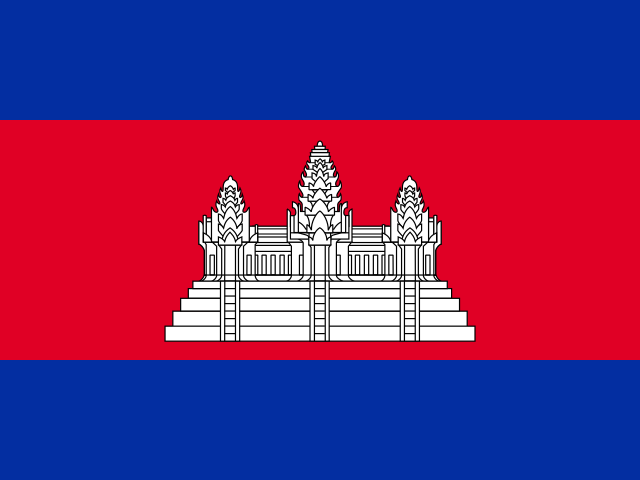
Cambodia, Laos, Malaysia and Myanmar border Thailand.
Keep going on the Asia quiz – Thailand is one of 48 countries there.
More ways to practise: find Thailand on the blank map with no borders (hard mode), or play today's Globe and the other daily puzzles.
Frequently asked questions about Thailand
What language is spoken in Thailand?
Thai is the official language and is written in its own script, which has 44 consonants. Regional varieties include Isan in the north-east, close to Lao, and Northern Thai. Malay is common in the far south, and Chinese dialects are spoken in many families.
What currency does Thailand use?
Thailand uses the Thai baht (THB), divided into 100 satang. The baht floated in July 1997, and its sudden fall set off the Asian financial crisis. Every banknote shows the reigning king.
What time zone is Thailand in?
Thailand is on Indochina Time, UTC+7, all year, the same as Vietnam, Cambodia and Laos. It does not use daylight saving time. Thailand is seven hours ahead of London in winter and six in summer, when Britain moves its clocks forward.
Which side of the road do they drive on in Thailand?
Thailand drives on the left, even though it was never a British colony. It shares left-hand traffic with Malaysia and Singapore to the south, while neighbouring Myanmar, Laos and Cambodia drive on the right.
What is the highest point in Thailand?
The highest point is Doi Inthanon in the north, at about 2,565 metres. It stands in a national park west of Chiang Mai and is named after Inthawichayanon, one of the last kings of Chiang Mai.
Has Thailand ever been colonised?
No. Thailand, then called Siam, is the only country in South-East Asia never colonised by a European power. It kept its independence by modernising and giving up border territories to Britain and France, which used it as a buffer between their colonies.
Quizzes with Thailand
Often confused with
Guides that help with this
- Oceans, seas, rivers and mountainsThe physical map: seas around each continent, the big rivers and ranges.
- Flags that look alike (and how to tell them apart)Chad or Romania? Australia or New Zealand? The flag pairs that cost quiz points.
- The 25 hardest countries to find on a mapPacific islands, Caribbean islands and landlocked Africa – where they are.