Malaysia
Capital: Kuala Lumpur. Malaysia is one of the 48 countries in the Asia quiz.
Quick answers: What is the capital of Malaysia? · Which countries border Malaysia?
Facts about Malaysia
- CapitalKuala Lumpur
- Population36 million
- Area330,803 km²
- RegionsAsia, Southeast Asia
- LanguageMalay
- CurrencyMalaysian ringgit (MYR)
Malaysia is the 19th most populous of the 48 countries in Asia and the 20th largest by area. Worldwide it ranks 45th by population and 67th by area.
Where is Malaysia?
Malaysia is in Southeast Asia and comes in two separate pieces about 600 km apart across the South China Sea. Peninsular Malaysia is the southern end of the Malay Peninsula, below Thailand and above Singapore. East Malaysia is the northern strip of the island of Borneo, made up of the states of Sabah and Sarawak, with the tiny sultanate of Brunei wedged between them and Indonesian Kalimantan below. Kuala Lumpur, the capital, is on the west coast of the peninsula.
On a world map, find the Malay Peninsula hanging down from Thailand. The bottom half is Malaysia. Then look east across the sea to the top of Borneo – that's Malaysia too.
How to find Malaysia on the map
- Start from Singapore. Malaysia is the country immediately north of it, across the Johor Strait.
- Find the top of Borneo. The northern coast of the island belongs to Malaysia, apart from the small notch that is Brunei.
- Don't confuse it with Indonesia. Indonesia holds the southern two-thirds of Borneo and all of Sumatra across the Strait of Malacca.
- Don't confuse it with Thailand. Thailand's tail runs down the peninsula, but the thicker lower part is Malaysia.
Flag
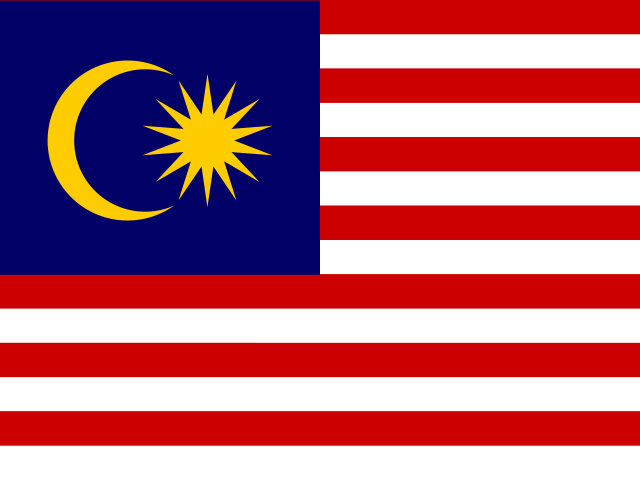
The Malaysian flag, the Jalur Gemilang, has 14 red and white horizontal stripes with a dark blue canton in the top-left corner containing a yellow crescent and a 14-pointed star. The 14 stripes and 14 points stand for the 13 states plus the federal territories. Yellow is the royal colour of the Malay rulers.
The stripe-and-canton layout is the same as the United States. The US has 13 stripes and white stars on blue; Malaysia has 14 stripes and a yellow crescent and star. Liberia has the same layout with a single white star. If you see a crescent in the canton, it's Malaysia.
A short history of Malaysia
People have lived in the region for tens of thousands of years; the Niah Caves in Sarawak hold some of the oldest human remains in Southeast Asia. On the peninsula, the Orang Asli, the "original people", are descendants of early settlers. Later the Malay Peninsula sat on the sea route between India and China, and small trading kingdoms grew up under Hindu and Buddhist influence, such as the one in the Bujang Valley of Kedah.
Around 1400 a prince from Sumatra founded Malacca on the west coast. Its rulers adopted Islam, and the port became one of the richest in Asia, controlling the busy Strait of Malacca. In 1511 the Portuguese captured it, followed by the Dutch in 1641. The Malacca sultans' heirs set up new sultanates, including Johor, and most of today's state rulers trace their lines back to this era.
The British arrived in 1786 at Penang, then took Singapore and Malacca, forming the Straits Settlements. Over the 1800s they brought the Malay states under their control one by one. Tin mining and rubber plantations drew huge numbers of workers from China and southern India, giving Malaysia its mixed population. On Borneo, Sarawak was ruled by a British family, the "White Rajahs" of the Brooke dynasty, for a century, while Sabah was run by a chartered company.
Japan occupied the whole region from 1941 to 1945. Afterwards a communist insurgency, known as the Malayan Emergency, lasted from 1948 to 1960. Malaya became independent on 31 August 1957. In 1963 it joined with Singapore, Sabah and Sarawak to form Malaysia, which explains why the country is split into two parts across the sea; Brunei chose to stay out. Indonesia opposed the new federation in a conflict known as Konfrontasi. Race riots in 1969 led to the New Economic Policy, which gave special benefits to Malays and other indigenous groups and still shapes politics today.
From the 1980s Malaysia industrialised quickly. It is now a major exporter of electronics, semiconductors, oil and gas, and one of the more prosperous countries in Southeast Asia.
Culture and daily life in Malaysia
Malaysia's population is a blend of Malays, Chinese, Indians and many indigenous peoples, particularly in Sabah and Sarawak, such as the Iban and Kadazan-Dusun. Bahasa Malaysia is the national language, but Chinese dialects like Hokkien and Cantonese, Tamil and English are heard every day, and many people slip between them in a mix nicknamed Manglish. Islam is the official religion, while Buddhism, Christianity and Hinduism are freely practised.
Each community adds its own colour. Thaipusam brings huge crowds to the Batu Caves outside Kuala Lumpur, and Penang's George Town and Malacca, both UNESCO sites, are full of Chinese shophouses and clan temples. The Peranakan, or Baba-Nyonya, descendants of early Chinese settlers who married locally, created their own cuisine and style.
Traditional arts include batik, songket cloth woven with gold thread, the shadow puppet theatre wayang kulit and the martial art silat. Badminton is a national obsession, with stars such as Lee Chong Wei, and sepak takraw, a volleyball played with the feet, is widely played.
Five facts worth knowing
- Malaysia has a rotating monarchy. The king, the Yang di-Pertuan Agong, is chosen from among nine hereditary state rulers and serves a five-year term.
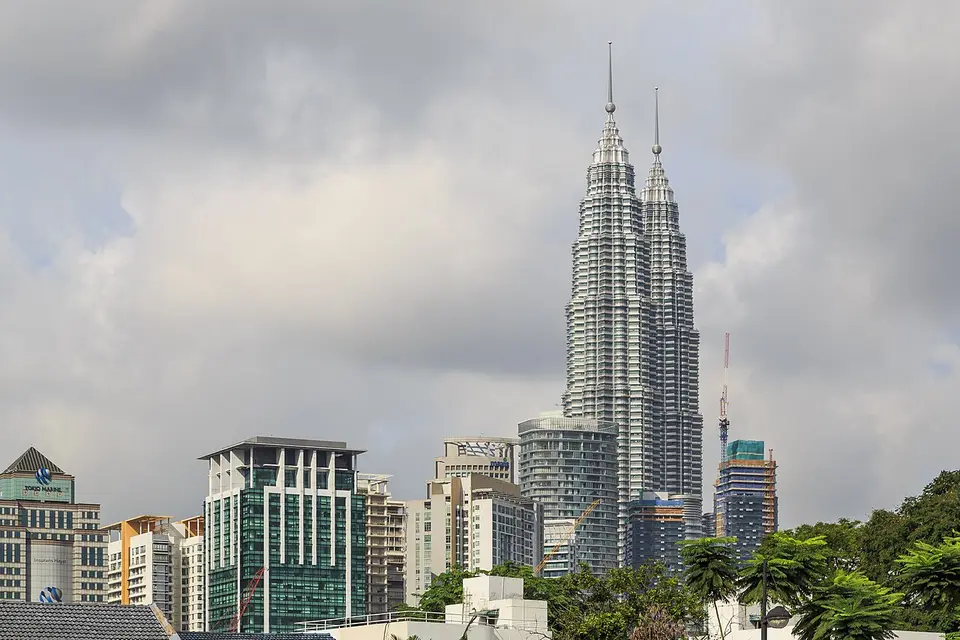
- The Petronas Towers in Kuala Lumpur were the tallest buildings in the world from 1998 to 2004 and are still the tallest twin towers.
- Singapore was part of Malaysia for two years, from 1963 to 1965, before separating.
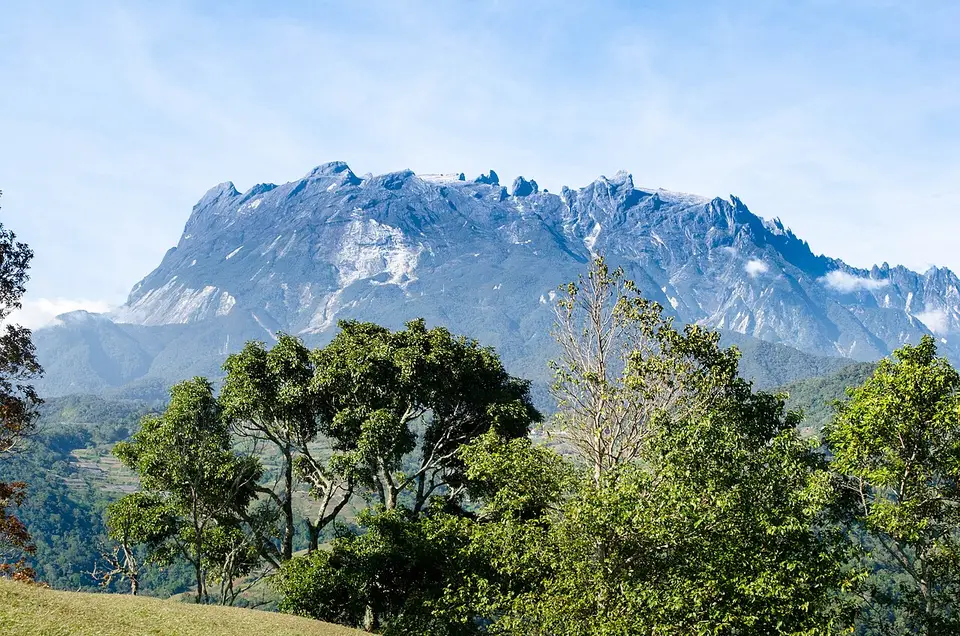
- Mount Kinabalu in Sabah, at 4,095 metres, is one of the highest peaks in Southeast Asia.
- Malaysia is one of the world's largest producers of palm oil, alongside Indonesia.
Culture and traditions in Malaysia
- Saying hello
"Selamat pagi" (good morning) is common; a light handshake, then touching the hand to the chest, shows sincerity.
- Food and drink
Nasi lemak, coconut rice with sambal, anchovies and egg, and teh tarik, sweet milky tea "pulled" between cups.
- Festivals and traditions
Hari Raya Aidilfitri, Chinese New Year and Deepavali are all national holidays; open houses welcome guests of every background.
- Everyday life
Shoes come off before entering homes. Pointing is done with the thumb rather than the index finger, and the right hand is used to give things.
- Did you know?
The Petronas Twin Towers in Kuala Lumpur were the world's tallest buildings from 1998 to 2004.
Common mistakes
- Tapping Indonesia – the shared island of Borneo is the main source of confusion.
- Tapping Thailand – the border across the peninsula is not obvious at world zoom.
- Forgetting that East Malaysia on Borneo is part of the outline.
Practise with Malaysia
- Asia quiz – the lower peninsula plus the top of Borneo.
- Southeast Asia quiz – close enough to see the Thai border and Brunei.
- Asia flags – stripes and a canton, but with a crescent and star.
- Asia capitals quiz – Kuala Lumpur.
- Mystery Country – two pieces: a peninsula and a strip along the top of a big island.
Nearby countries
Quick check: how well do you know Malaysia?
3 questions, no sign-up. Tap an answer.
1. Which flag belongs to Malaysia?
That's the flag of Malaysia.
2. What is the capital of Malaysia?
The capital of Malaysia is Kuala Lumpur.
3. Which of these countries borders Malaysia?
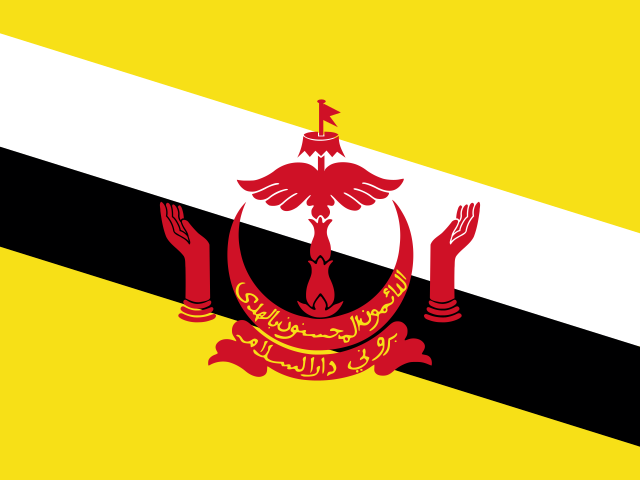
Brunei, Indonesia and Thailand border Malaysia.
Keep going on the Asia quiz – Malaysia is one of 48 countries there.
More ways to practise: find Malaysia on the blank map with no borders (hard mode), or play today's Globe and the other daily puzzles.
Frequently asked questions about Malaysia
What language is spoken in Malaysia?
The official language is Malay, called Bahasa Malaysia, written in the Latin alphabet. English is widely used in business and law. Chinese Malaysians speak Mandarin and dialects such as Hokkien and Cantonese, Indian Malaysians mostly speak Tamil, and many indigenous languages, including Iban, are spoken in Borneo.
What currency does Malaysia use?
Malaysia uses the ringgit (MYR), divided into 100 sen. The word ringgit means "jagged" in Malay, after the serrated edges of old Spanish silver dollars that once circulated in the region. The ringgit floats.
What time zone is Malaysia in?
All of Malaysia is on UTC+8, with no daylight saving time. Peninsular Malaysia moved forward 30 minutes in 1982 to share the time used in Sabah and Sarawak, so the whole country now has the same time as Singapore and China.
Which side of the road do they drive on in Malaysia?
Malaysia drives on the left, like Singapore, Thailand and Brunei, a legacy of British rule. The North–South Expressway runs the length of the peninsula from the Thai border to the causeway linking Johor Bahru with Singapore.
What is the highest point in Malaysia?
The highest point is Mount Kinabalu, about 4,095 metres, in Sabah on Borneo. Climbers usually take two days, staying overnight at Laban Rata before a pre-dawn ascent to Low's Peak. Kinabalu Park became one of Malaysia's first UNESCO World Heritage sites in 2000.
What religion is Malaysia?
Islam is the official religion, followed by about two-thirds of Malaysians, including all ethnic Malays. The constitution guarantees freedom of worship, and many Chinese Malaysians are Buddhist or Taoist, while Hinduism and Christianity are also widely practised.
Quizzes with Malaysia
Often confused with
Guides that help with this
- Oceans, seas, rivers and mountainsThe physical map: seas around each continent, the big rivers and ranges.
- Flags that look alike (and how to tell them apart)Chad or Romania? Australia or New Zealand? The flag pairs that cost quiz points.
- The 25 hardest countries to find on a mapPacific islands, Caribbean islands and landlocked Africa – where they are.