Tunisia
Capital: Tunis. Tunisia is one of the 54 countries in the Africa quiz.
Quick answers: What is the capital of Tunisia? · Which countries border Tunisia?
Facts about Tunisia
- CapitalTunis
- Population12.3 million
- Area163,610 km²
- RegionAfrica
- LanguageArabic
- CurrencyTunisian dinar (TND)
Tunisia is the 31st most populous of the 54 countries in Africa and the 35th largest by area. Worldwide it ranks 80th by population and 91st by area.
Where is Tunisia?
Tunisia is the northernmost country in Africa, on the Mediterranean coast between Algeria to the west and Libya to the south-east. It is the smallest of the North African countries, a wedge of land that narrows as it goes south into the Sahara. The capital, Tunis, is on the north coast, close to the ruins of ancient Carthage.
On a world map, look at where the Mediterranean pinches between Sicily and Africa. The African side of that pinch is Tunisia. Its northern tip, Cape Angela, is the most northerly point of the whole continent.
How to find Tunisia on the map
- Start from Sicily. Drop straight south from the Italian island across the narrow Strait of Sicily and you land in Tunisia.
- Look for the small one. Algeria and Libya are both enormous; Tunisia is the slim country squeezed between them on the coast.
- Find the Gulf of Gabès. The large bite out of the eastern coast, with the island of Djerba at its southern edge, is the easiest feature to spot.
- Don't confuse it with Morocco. Morocco is at the far western end of North Africa facing Spain; Tunisia is in the middle, facing Italy.
Flag
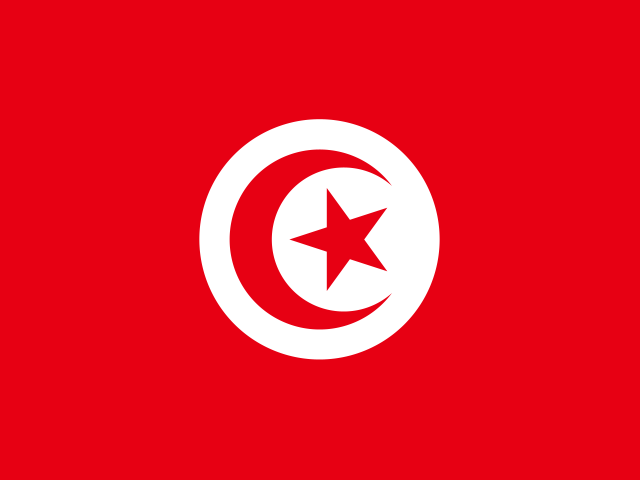
Tunisia's flag is red with a white disc in the centre containing a red crescent and a red five-pointed star. It dates from 1831 and is one of the oldest flags still in use. The crescent and star are shared symbols of the Ottoman heritage.
In the Flags quiz, the Turkish flag is the obvious confusion: it too is red with a white crescent and star. The difference is the disc – Tunisia's crescent and star sit inside a white circle, while Turkey's are placed directly on the red field.
A short history of Tunisia
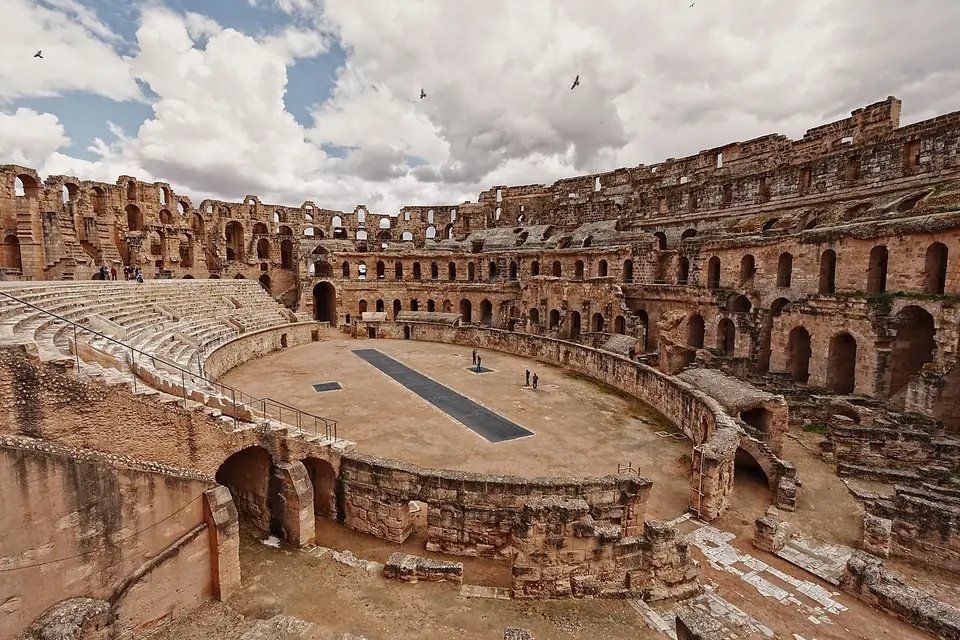
Long before any empire arrived, Berber (Amazigh) peoples farmed and herded across the land that is now Tunisia. Around the 9th century BC, Phoenician sailors from the coast of modern Lebanon founded a trading city on the Gulf of Tunis. That city, Carthage, grew into a sea power that controlled much of the western Mediterranean until Rome destroyed it in 146 BC. The Romans then turned the region into the province of Africa – the name later spread to the whole continent – and filled it with wheat farms and cities such as Dougga and El Djem, whose huge amphitheatre still stands.
Arab armies arrived in the 600s and founded Kairouan in 670 as their base. It became one of the holy cities of Islam, and from here Arabic and Islam spread through North Africa. Over the following centuries Tunisia was ruled by a string of local dynasties, including the Aghlabids and the Hafsids, who made Tunis their capital. In the 1500s the Ottoman Empire took control, but real power soon passed to local rulers known as beys, who governed with little interference from Istanbul.
Heavy debts to European banks opened the door to France, which made Tunisia a protectorate in 1881. A nationalist movement led by Habib Bourguiba and his Neo-Destour party pushed for freedom through the 1930s and 1940s. Tunisia became independent in 1956, and the following year the bey was removed and a republic declared, with Bourguiba as president. He ruled for three decades until Zine El Abidine Ben Ali took over in 1987.
Ben Ali fled the country in January 2011 after weeks of protests. Tunisia then wrote a new constitution in 2014, and the National Dialogue Quartet, a group of civil society organisations that helped steer the transition, won the Nobel Peace Prize in 2015. Politics has remained turbulent since.
Today Tunisia's economy rests on tourism along its beaches, olive oil – it is one of the world's leading exporters – textiles and car parts made for European factories.
Culture and daily life in Tunisia
Everyday speech is Tunisian Arabic, known as Derja, which is full of words borrowed from Berber, French, Italian and Turkish – a record of everyone who has passed through. Most Tunisians are Sunni Muslims, but the island of Djerba is home to one of the oldest Jewish communities in the Arab world, centred on the El Ghriba synagogue. Tunisia has long been seen as a leader on women's rights in the region: a 1956 law banned polygamy and gave women the right to divorce.
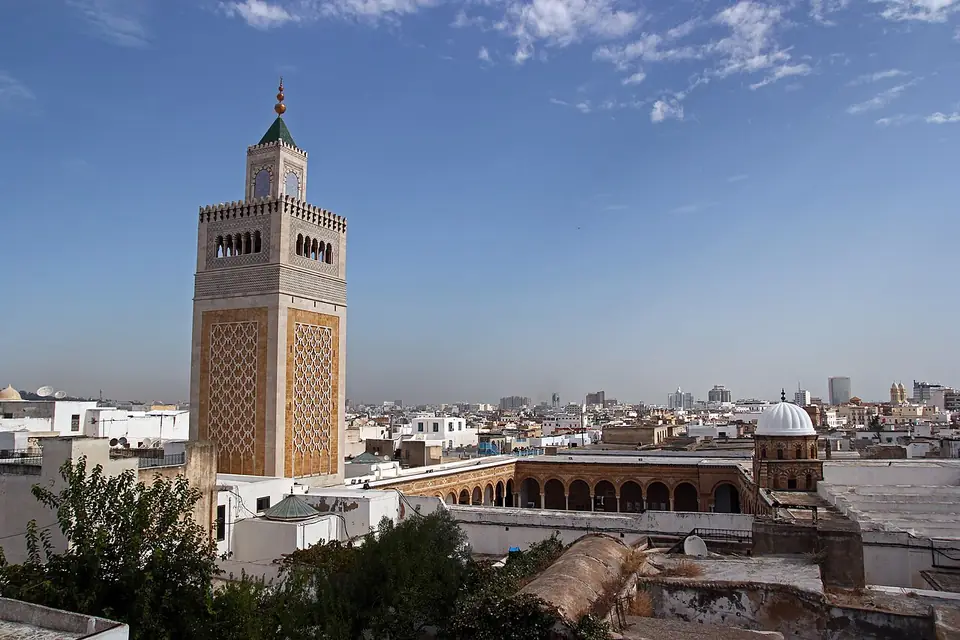
The country's best-known thinker is Ibn Khaldun, the 14th-century historian born in Tunis, often called a founder of sociology. Traditional music includes malouf, an Andalusian style brought by refugees from Spain. In architecture, the Great Mosque of Kairouan and the blue-and-white village of Sidi Bou Said, perched on a cliff above the sea, are national symbols. Craftsmen still make the red felt chechia cap in the souks of Tunis.
Football is the national passion, with fierce rivalry between clubs such as Espérance de Tunis and Club Africain. In tennis, Ons Jabeur became the first Arab woman to reach a Grand Slam final, at Wimbledon in 2022.
Five facts worth knowing
- Carthage, the ancient rival of Rome, stood just outside modern Tunis. Its ruins are a UNESCO World Heritage Site.
- Tunisia was where the Arab Spring began, in December 2010, after a street vendor's protest in the town of Sidi Bouzid.
- Parts of the original Star Wars films were shot in southern Tunisia, and the planet Tatooine takes its name from the town of Tataouine.
- Arabic is the official language, but French is widely used in business and education, a legacy of the French protectorate that ended in 1956.
- The Chott el Djerid, a huge salt lake in the south, is dry for most of the year and marks where the inhabited north gives way to the Sahara.
Culture and traditions in Tunisia
- Saying hello
"Aslema" or "As-salamu alaykum", with a handshake or cheek kisses between friends.
- Food and drink
Couscous with lamb or fish; brik, a crisp pastry with egg; harissa, a fiery chilli paste.
- Festivals and traditions
The International Festival of the Sahara in Douz (December) features camel races and desert music.
- Everyday life
Mint tea and strong coffee are part of daily life, and bargaining in souks is expected and friendly.
- Did you know?
Underground troglodyte homes in Matmata were used as Luke Skywalker's home in the first Star Wars film.
Common mistakes
- Tapping Libya or Algeria – Tunisia is easy to overshoot because its neighbours are so large.
- Picking the Turkish flag in the Flags quiz.
- Tapping Morocco, the other small-looking Maghreb country, at the opposite end of the coast.
Practise with Tunisia
- Africa quiz – the small wedge at the top of the continent, directly below Sicily.
- Middle East quiz – Tunisia appears on some wider regional maps alongside North Africa.
- Africa flags – crescent and star in a white disc on red.
- Africa capitals quiz – Tunis.
- Mystery Country – a narrowing wedge with the Gulf of Gabès bitten out of its eastern side.
Nearby countries
Quick check: how well do you know Tunisia?
3 questions, no sign-up. Tap an answer.
1. Which flag belongs to Tunisia?
That's the flag of Tunisia.
2. What is the capital of Tunisia?
The capital of Tunisia is Tunis.
3. Which of these countries borders Tunisia?
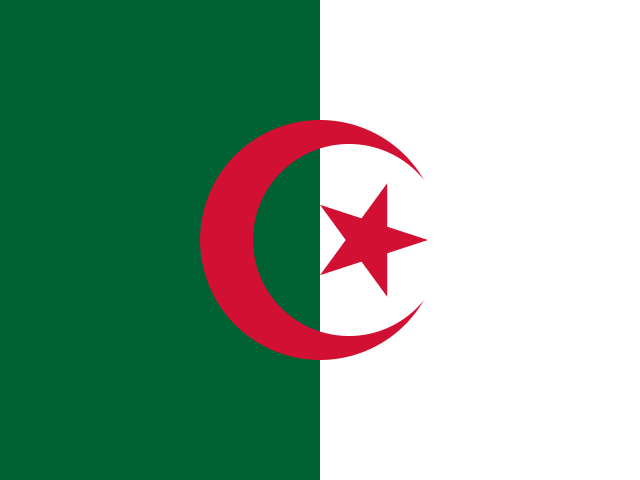
Algeria and Libya border Tunisia.
Keep going on the Africa quiz – Tunisia is one of 54 countries there.
More ways to practise: find Tunisia on the blank map with no borders (hard mode), or play today's Globe and the other daily puzzles.
Frequently asked questions about Tunisia
What language is spoken in Tunisia?
Arabic is the official language, and most people speak Tunisian Arabic, known as Derja, in daily life. French is widely used in business, higher education and the media, and Berber (Amazigh) survives in a few villages in the south and on Djerba.
What currency does Tunisia use?
Tunisia uses the Tunisian dinar (TND), which is divided into 1,000 millimes rather than 100. It is a closed currency, so it is not meant to be taken out of the country, and its rate is managed against a basket of the euro and US dollar.
What time zone is Tunisia in?
Tunisia is on Central European Time, UTC+1, all year. It has tried daylight saving time several times but has not used it since 2008. That puts it level with Paris and Rome in winter but an hour behind them in summer.
Which side of the road do they drive on in Tunisia?
Tunisia drives on the right, like the rest of North Africa. A motorway runs along the coast from Tunis towards Sfax, and shared minibuses called louages connect towns across the country.
What is the highest point in Tunisia?
The highest point is Jebel ech Chambi, at about 1,545 metres, near Kasserine on the Algerian border. It is the highest summit of the Tunisian Dorsal, the eastern end of the Atlas mountains.
What is Tunisia famous for?
Tunisia is famous for ancient Carthage, the Roman amphitheatre of El Jem and its Mediterranean beaches. Several Star Wars films were shot in its southern desert, and the town of Tataouine gave its name to Luke Skywalker's home planet, Tatooine.
Quizzes with Tunisia
Often confused with
Guides that help with this
- Learn all 54 African countries in a weekLearn the coastline in order, region by region.
- Flags that look alike (and how to tell them apart)Chad or Romania? Australia or New Zealand? The flag pairs that cost quiz points.
- The 25 hardest countries to find on a mapPacific islands, Caribbean islands and landlocked Africa – where they are.