United Arab Emirates
Capital: Abu Dhabi. The United Arab Emirates is one of the 48 countries in the Asia quiz.
Quick answers: What is the capital of the United Arab Emirates? · Which countries border the United Arab Emirates?
Facts about the United Arab Emirates
- CapitalAbu Dhabi
- Population11.5 million
- Area83,600 km²
- RegionsAsia, Middle East
- LanguageArabic
- CurrencyUAE dirham (AED)
The United Arab Emirates is the 28th most populous of the 48 countries in Asia and the 33rd largest by area. Worldwide it ranks 86th by population and 113th by area.
Where is the United Arab Emirates?
The United Arab Emirates is on the south-eastern corner of the Arabian Peninsula, on the Persian Gulf. Saudi Arabia lies to the south and west, Oman to the east, and Qatar is the small peninsula sticking into the Gulf to the north-west. Across the water to the north is Iran. Abu Dhabi, the capital, is on an island on the Gulf coast; Dubai, the largest city, is a little further up the same coast.
The country is a federation of seven emirates, of which Abu Dhabi alone covers most of the land area.
How to find the United Arab Emirates on the map
- Start from the Persian Gulf. The UAE is on the southern shore, where the Gulf narrows towards the Strait of Hormuz.
- Look between Qatar and Oman. Qatar is the thumb poking up on the west; Oman wraps around the eastern tip. The UAE is the stretch of coast between them.
- Don't confuse it with Qatar. Qatar is a small peninsula; the UAE is a longer coastal strip with a large desert interior.
- Don't confuse it with Oman. Oman is bigger and faces the Arabian Sea, but its Musandam exclave at the very tip of the peninsula is cut off from the rest of Oman by UAE territory.
Flag
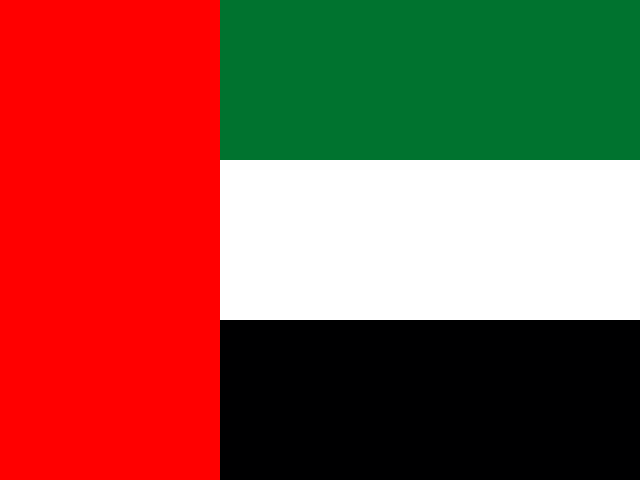
The UAE flag has three horizontal bands – green, white and black from top to bottom – with a vertical red band at the hoist. These are the pan-Arab colours, shared with Jordan, Kuwait, Sudan and Palestine. It was adopted on 2 December 1971, the day the federation was formed.
Kuwait's flag is the closest match: the same colours, but with black as a trapezoid at the hoist and red at the bottom. Jordan and Palestine have horizontal black-white-green with a red triangle. If the red hoist band is a plain rectangle and the stripes go green-white-black, it's the UAE.
A short history of the United Arab Emirates
People have lived along this coast for thousands of years. Around 2500 BC, a Bronze Age culture known as Umm an-Nar built round stone tombs and traded copper from the Hajar Mountains with Mesopotamia. In the 600s Islam reached the region, and for centuries the coast was home to fishing villages, date-palm oases such as Al Ain and Liwa, and Bedouin tribes who moved with their camels across the desert.
From the 1500s, Portuguese, Dutch and then British ships fought for control of trade routes to India. In the early 1800s the British attacked the coastal town of Ras Al Khaimah, accusing local sailors of piracy, and in 1820 they signed the first of a series of truces with the local sheikhs. Because of these agreements the area became known as the Trucial States. Britain handled their defence and foreign affairs, while the ruling families kept control at home – which is why each emirate still has its own ruler today.
For generations the main source of wealth was pearl diving. Crews spent months at sea each summer, diving without equipment for oyster beds. The trade collapsed in the 1930s, hit by cheap Japanese cultured pearls and the Great Depression, and many families fell into poverty.
Everything changed with oil. It was found offshore of Abu Dhabi in 1958, and exports began in 1962. When the federation was formed, Sheikh Zayed bin Sultan Al Nahyan of Abu Dhabi became its first president and used oil money to build roads, schools and hospitals almost from scratch. Dubai, with less oil, chose to grow as a trading hub, opening the giant Jebel Ali port in 1979 and later an airline, Emirates, in 1985.
Today the UAE is one of the richest countries in the Middle East, with an economy that has spread from oil into finance, aviation, tourism, logistics and renewable energy.
Culture and daily life in the United Arab Emirates
Arabic is the official language, and Emiratis speak a Gulf dialect. Because so many residents come from abroad, English is the everyday common language in shops and offices, and Hindi, Urdu, Malayalam and Tagalog are heard everywhere. Islam is the state religion, and the call to prayer sounds five times a day, but churches and Hindu temples also serve the large foreign communities.
Many Emirati men wear the white kandura, a long robe, while women often wear a black abaya. Nabati poetry, composed in the local dialect, is hugely popular – a television show, Million's Poet, made poets into celebrities. The traditional al-ayyala, a dance with rows of men holding bamboo canes to a drumbeat, is performed at weddings and national events.
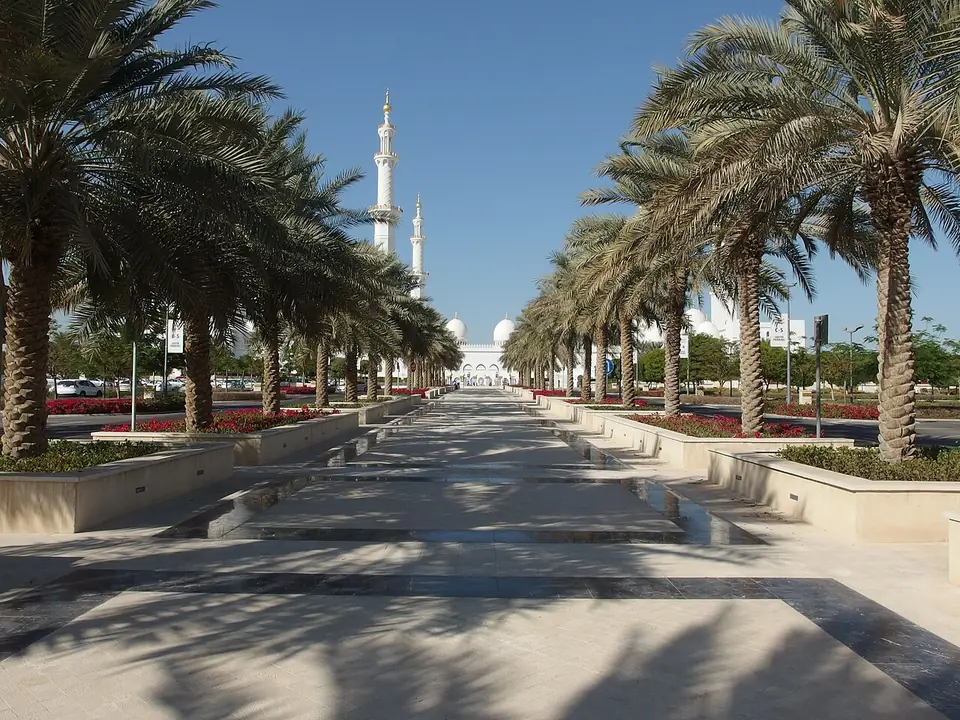
The country has embraced bold architecture, from the white domes of the Sheikh Zayed Grand Mosque in Abu Dhabi to the Louvre Abu Dhabi, the first branch of the Paris museum abroad. Camel racing, with robot jockeys replacing children, is a national sport, and Abu Dhabi hosts a Formula One Grand Prix.
Five facts worth knowing
- The UAE was formed in 1971 when six emirates united after Britain withdrew from the Gulf; Ras Al Khaimah joined in 1972.
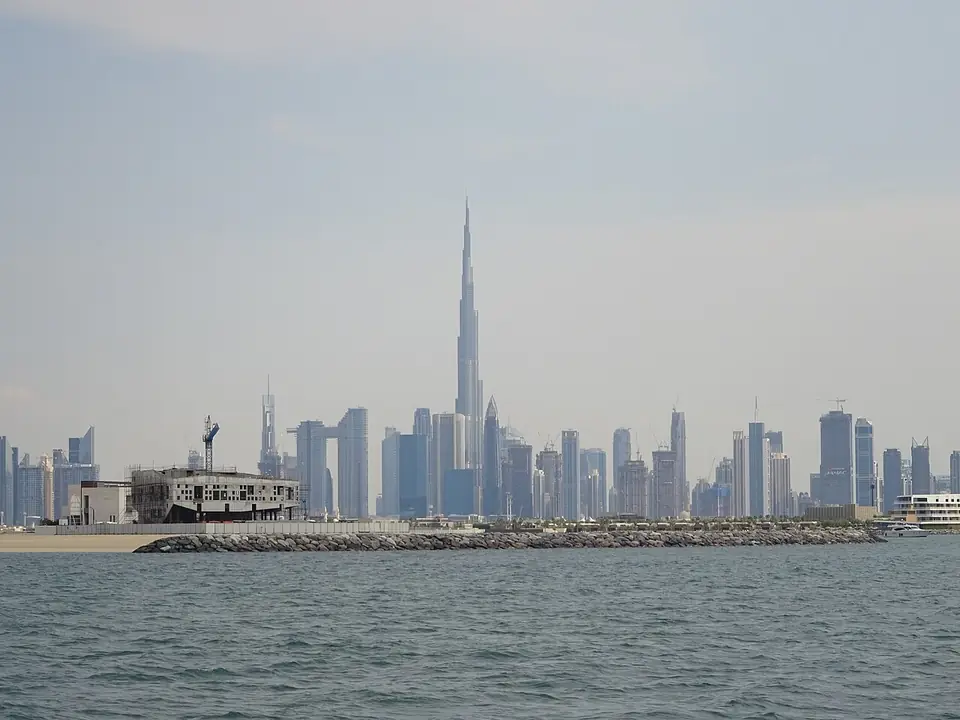
- The Burj Khalifa in Dubai is the tallest building in the world, at 828 metres.
- Most of the population are expatriates. Emirati citizens make up only around a tenth of residents.
- Fujairah is the only emirate with no Persian Gulf coastline – it faces the Gulf of Oman on the east coast instead.
- The UAE sent a probe to Mars. The Hope orbiter arrived in February 2021.
Culture and traditions in the United Arab Emirates
- Saying hello
"As-salamu alaykum" with a handshake; men and women may wait for the other to offer a hand.
- Food and drink
Machboos, spiced rice with meat or fish; luqaimat, sweet dumplings with date syrup; Arabic coffee (gahwa) with dates.
- Festivals and traditions
National Day on 2 December, with fireworks and parades; the Dubai Shopping Festival in winter.
- Everyday life
Modest dress is expected in public places such as malls. The official weekend is Saturday and Sunday.
- Did you know?
Falconry is a cherished tradition, and falcons can even be issued their own passports for travel.
Common mistakes
- Tapping Qatar – both are small Gulf states and sit side by side.
- Tapping Oman – the shared border runs through empty desert and is hard to judge.
- Picking Kuwait's or Jordan's flag in the Flags quiz.
- Assuming Dubai is the capital – it's Abu Dhabi.
Practise with the United Arab Emirates
- Asia quiz – the south-eastern corner of the Arabian Peninsula, between Qatar and Oman.
- Middle East quiz – a closer view of the Gulf, where the small coastal states are easy to tell apart.
- Asia flags – green-white-black with a red hoist band; Kuwait is the trap.
- Asia capitals quiz – Abu Dhabi.
- Mystery Country – a coastal strip with a wedge of desert behind it and Oman's exclave notched into the tip.
Nearby countries
 OmanMuscat
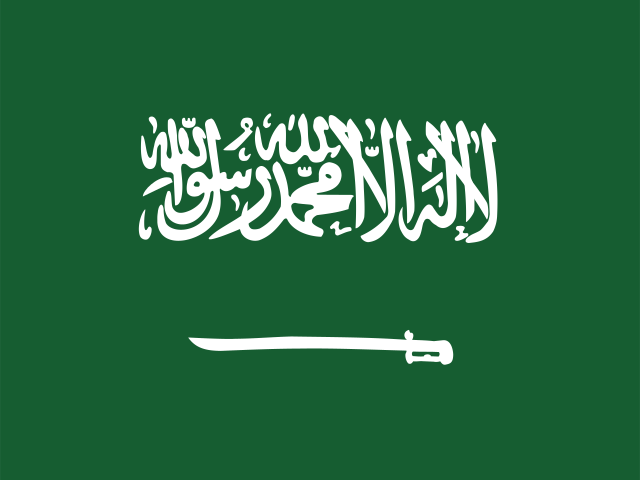 Saudi ArabiaRiyadh
Quick check: how well do you know the United Arab Emirates?
3 questions, no sign-up. Tap an answer.
1. Which flag belongs to the United Arab Emirates?
That's the flag of the United Arab Emirates.
2. What is the capital of the United Arab Emirates?
The capital of the United Arab Emirates is Abu Dhabi.
3. Which of these countries borders the United Arab Emirates?
Oman and Saudi Arabia border the United Arab Emirates.
Keep going on the Asia quiz – United Arab Emirates is one of 48 countries there.
More ways to practise: find the United Arab Emirates on the blank map with no borders (hard mode), or play today's Globe and the other daily puzzles.
Frequently asked questions about the United Arab Emirates
What language is spoken in the United Arab Emirates?
Arabic is the official language, and Emiratis speak a Gulf dialect. Most residents are foreign workers, so English is the everyday common language in business and shops, and Hindi, Urdu, Malayalam, Tagalog and Persian are widely heard.
What currency does the United Arab Emirates use?
The UAE uses the UAE dirham (AED), introduced in 1973. It has been pegged to the US dollar since 1997 at a fixed rate of about 3.67 dirhams to one dollar.
What time zone is the United Arab Emirates in?
The UAE is on Gulf Standard Time, UTC+4, all year, the same as Oman. It does not use daylight saving time. That puts it four hours ahead of London in winter and three in summer.
Which side of the road do they drive on in the United Arab Emirates?
The UAE drives on the right, like the rest of the Arabian Peninsula. Sheikh Zayed Road, the highway through Dubai, has up to 12 lanes in places and is lined with skyscrapers.
What is the highest point in the United Arab Emirates?
The highest point is on the slopes of Jebel Jais, at about 1,930 metres, in the Hajar Mountains of Ras Al Khaimah. The mountain's true summit is just across the border in Oman.
What are the seven emirates?
The UAE is made up of Abu Dhabi, Dubai, Sharjah, Ajman, Umm Al Quwain, Ras Al Khaimah and Fujairah. Each is ruled by its own royal family, and Fujairah is the only one that lies entirely on the Gulf of Oman coast.
Quizzes with the United Arab Emirates
Often confused with
Guides that help with this
- Oceans, seas, rivers and mountainsThe physical map: seas around each continent, the big rivers and ranges.
- Flags that look alike (and how to tell them apart)Chad or Romania? Australia or New Zealand? The flag pairs that cost quiz points.
- The 25 hardest countries to find on a mapPacific islands, Caribbean islands and landlocked Africa – where they are.