Vatican City
Capital: Vatican City. The Vatican City is one of the 46 countries in the Europe quiz.
Quick answers: What is the capital of the Vatican City? · Which countries border the Vatican City?
Facts about the Vatican City
- CapitalVatican City
- Population825
- Arealess than 1 km²
- RegionEurope
- LanguagesItalian, Latin
- CurrencyEuro (EUR)
The Vatican City is the 46th most populous of the 46 countries in Europe and the 46th largest by area. Worldwide it ranks 197th by population and 197th by area.
Where is Vatican City?
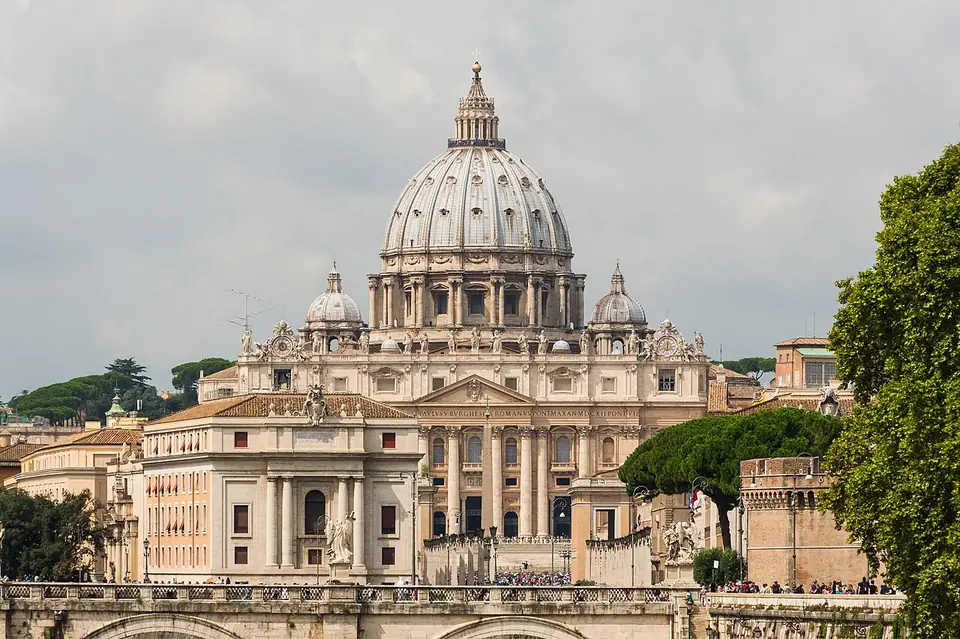
Vatican City is the smallest country in the world, a walled enclave of about 0.44 km² inside the city of Rome, Italy. It sits on the west bank of the River Tiber, on the Vatican Hill, and is entirely surrounded by the Italian capital. Its only border is with Italy, and the border is for the most part the city wall and the edge of St Peter's Square.
On a world map, the Vatican is impossible to see – it is a dot inside a dot. The way to find it is to find Rome, in the middle of the west coast of Italy, roughly level with the "knee" of the boot. The Vatican is inside that city.
How to find Vatican City on the map
- Start from Italy. Find the boot, then locate Rome about halfway down the western coast.
- Zoom in on Rome. The Vatican is on the western side of the city centre, across the Tiber from the ancient Roman forum.
- Look for St Peter's. On any detailed map the huge basilica and its oval square mark the country's eastern edge.
- Don't confuse it with San Marino. San Marino is the other microstate inside Italy, but it is a hilltop republic in the north-east, near Rimini, and about 140 times larger.
Flag
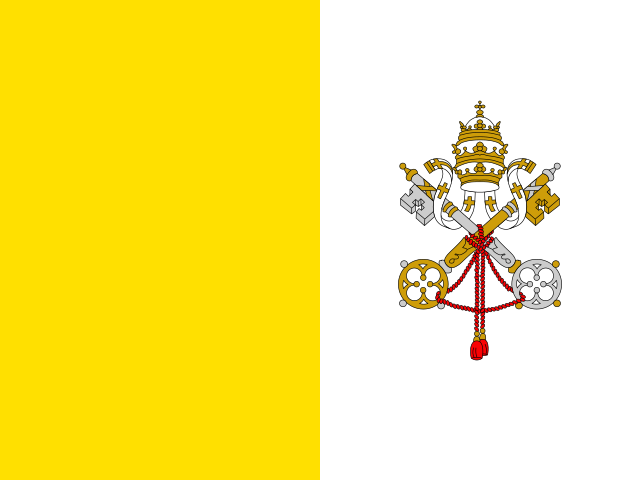
The Vatican flag is one of only two square national flags in the world, the other being Switzerland. It is divided vertically into two halves: yellow at the hoist and white at the fly. The white half carries the crossed keys of Saint Peter – one gold, one silver – tied with a red cord, beneath the papal tiara.
In the Flags quiz, the yellow-and-white vertical split is unique among national flags. If you see the crossed keys, there is no other answer.
A short history of Vatican City
In Roman times the Vatican Hill lay outside the city walls, across the Tiber. The emperor Caligula built a racing circus there, and Christian tradition holds that the apostle Peter was executed nearby in the 60s AD and buried in a cemetery on the hillside. Around 320 the emperor Constantine, the first Christian emperor, built a great basilica over the spot believed to be Peter's grave. Because Catholics regard the bishop of Rome as Peter's successor, this hill became the symbolic centre of the Church.
For most of the Middle Ages popes lived at the Lateran Palace on the other side of Rome, not at the Vatican. They also ruled a large territory in central Italy, the Papal States, which grew from a grant of land by the Frankish king Pepin in 756. From 1309 to 1377 the popes even lived in Avignon, in France. After their return, the Vatican gradually became their main home, and in the 1400s and 1500s Renaissance popes turned it into a showcase of art. The old basilica was torn down and the new St Peter's was built between 1506 and 1626, with contributions from Bramante, Raphael and Michelangelo, who designed the dome.
Italian unification ended the pope's earthly kingdom. In 1870 Italian troops captured Rome, and it became Italy's capital. The popes refused to accept this, and for almost sixty years each pope stayed inside the Vatican, calling himself a "prisoner". The dispute, known as the Roman Question, was finally settled when the Lateran Treaty created a tiny independent state, giving the Church a guaranteed base free from any government's control.
In the 20th century the Vatican hosted the Second Vatican Council (1962–65), which modernised the Church, allowing Mass in local languages instead of Latin. Today the Vatican is the seat of the Holy See, the central government of the Catholic Church, which holds diplomatic relations with most countries. Its income comes from museum tickets, donations, stamps and coins.
Culture and daily life in Vatican City
The Vatican is unlike any other country. It has no permanent citizens by birth: citizenship is given to people who work there and usually ends when the job does. Latin remains the official language of the Holy See, and even the Vatican's cash machines offer instructions in Latin, though Italian is used in daily life. The pope is an absolute monarch, elected for life by the cardinals in a closed meeting called a conclave, with white smoke from the Sistine Chapel chimney announcing the result.
Its collections are among the richest in the world. Raphael's School of Athens decorates the papal apartments, Michelangelo's Pietà stands inside St Peter's, and Bernini designed the sweeping colonnades of the square in the 1600s. The Vatican Apostolic Library and Archives hold priceless manuscripts, and the Vatican Observatory is one of the oldest astronomical institutes.
The Sistine Chapel Choir is one of the oldest choirs in the world. The Vatican also has its own post office, radio station, newspaper (L'Osservatore Romano), pharmacy and railway station.
Five facts worth knowing
- It has a population of under 1,000 people, mostly clergy, Swiss Guards and officials, making it the least populated country in the world as well as the smallest.
- The Vatican became an independent state in 1929 under the Lateran Treaty between the Holy See and Italy.
- The Swiss Guard, founded in 1506, is the papal army and one of the oldest continuously serving military units in the world; recruits must be Swiss citizens and Catholic.
- The Sistine Chapel's ceiling, painted by Michelangelo between 1508 and 1512, is inside the Vatican, as are the Vatican Museums and St Peter's Basilica, the largest church in the world.
- It is the only country whose entire territory is a UNESCO World Heritage Site.
Culture and traditions in the Vatican City
- Saying hello
A handshake and "Buongiorno" in Italian, the everyday language.
- Food and drink
No national cuisine of its own; visitors eat Roman dishes such as carbonara and supplì just outside its walls.
- Festivals and traditions
Christmas and Easter, when the Pope gives the "Urbi et Orbi" blessing to crowds in St Peter's Square.
- Everyday life
Visitors to St Peter's Basilica and the Vatican Museums must cover their shoulders and knees.
- Did you know?
The Pontifical Swiss Guard has protected the Pope since 1506, making it one of the oldest military units still in service.
Common mistakes
- Tapping San Marino, the other Italian microstate.
- Tapping Monaco, which is also tiny but on the French Riviera, not in Italy.
- Picking a different yellow-and-white flag – but there is none, so this is really about recognising the keys.
Practise with Vatican City
- Europe quiz – the hardest target on the map; find Rome and tap very precisely.
- Europe flags – the square yellow-and-white flag with the crossed keys.
- Italian Regions – the Vatican sits inside Lazio, the region around Rome.
- Europe capitals quiz – Vatican City is its own capital.
- Mystery Country – a tiny, irregular blob with the keyhole shape of St Peter's Square on its eastern edge.
Nearby countries
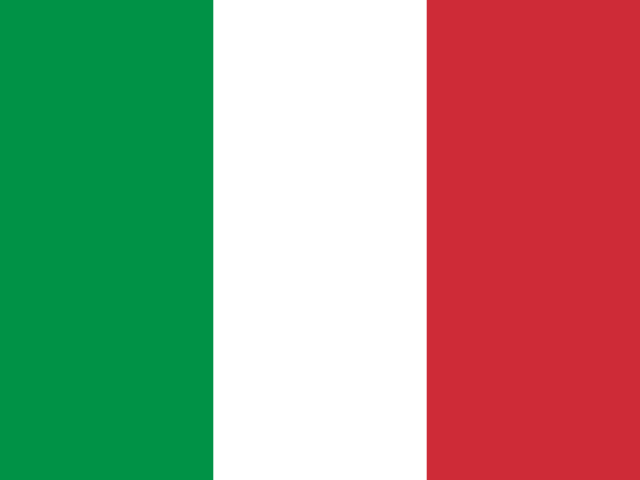 ItalyRome
Quick check: how well do you know Vatican City?
3 questions, no sign-up. Tap an answer.
1. Which flag belongs to the Vatican City?
That's the flag of Vatican City.
2. What is the capital of the Vatican City?
The capital of Vatican City is Vatican City.
3. Which of these countries borders Vatican City?
Italy borders Vatican City.
Keep going on the Europe quiz – Vatican City is one of 46 countries there.
More ways to practise: find Vatican City on the blank map with no borders (hard mode), or play today's Globe and the other daily puzzles.
Frequently asked questions about Vatican City
What language is spoken in Vatican City?
Italian is the everyday working language of the Vatican City State and its laws. Latin is the official language of the Holy See and is still used in major Church documents. Staff come from around the world, and the Swiss Guard uses German.
What currency does Vatican City use?
Vatican City uses the euro (EUR) under a monetary agreement with the European Union, although it is not an EU member. It mints its own euro coins, which are produced in small numbers and are prized by collectors.
What time zone is Vatican City in?
Vatican City follows Italian time: Central European Time, UTC+1, in winter and Central European Summer Time, UTC+2, from late March to late October. Like Italy, it changes its clocks on the last Sunday of March and October.
Which side of the road do they drive on in Vatican City?
Vatican City drives on the right, like Italy. It has only a short network of internal streets but issues its own number plates, which begin with the letters SCV or CV.
What is the highest point in Vatican City?
The highest point is on the Vatican Hill, in the gardens behind St Peter's Basilica, at about 75 metres above sea level. The dome of St Peter's rises well above it, at about 136 metres to the top of the cross.
Is Vatican City in the EU?
No. Vatican City is not part of the European Union or the Schengen Area, but its border with Italy is open, and visitors can walk into St Peter's Square without passport checks. It uses the euro under a special agreement.
Quizzes with Vatican City
Guides that help with this
- All 46 European capitals, with a memory trick for eachCapitals grouped by region, with hooks for the ones people forget.
- Flags that look alike (and how to tell them apart)Chad or Romania? Australia or New Zealand? The flag pairs that cost quiz points.
- The 25 hardest countries to find on a mapPacific islands, Caribbean islands and landlocked Africa – where they are.