Vietnam
Capital: Hanoi. Vietnam is one of the 48 countries in the Asia quiz.
Quick answers: What is the capital of Vietnam? · Which countries border Vietnam?
Facts about Vietnam
- CapitalHanoi
- Population101.6 million
- Area331,212 km²
- RegionsAsia, Southeast Asia
- LanguageVietnamese
- CurrencyVietnamese đồng (VND)
Vietnam is the 8th most populous of the 48 countries in Asia and the 19th largest by area. Worldwide it ranks 16th by population and 66th by area.
Where is Vietnam?
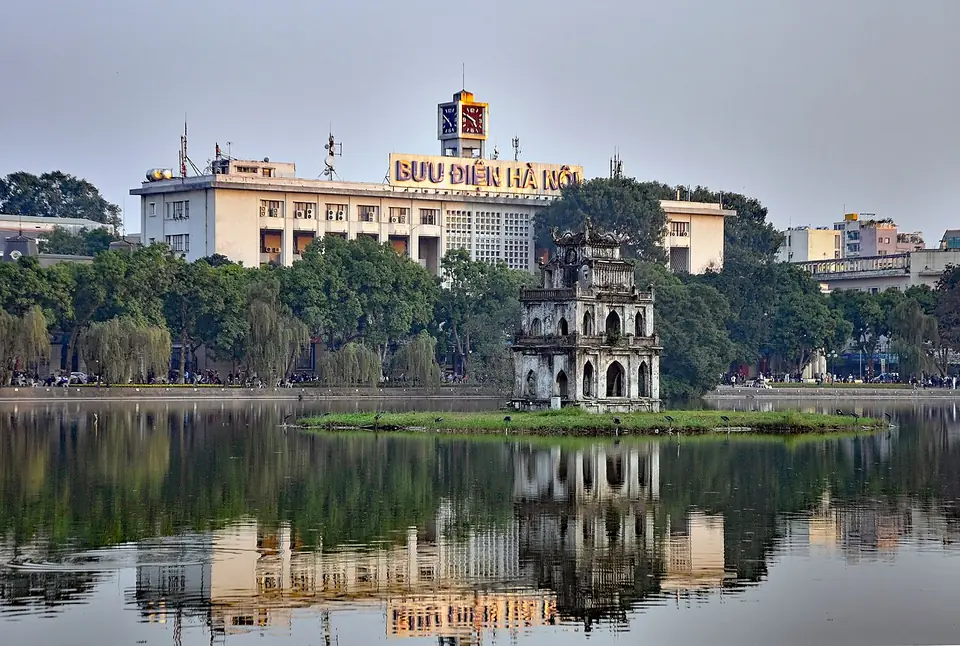
Vietnam runs down the eastern edge of mainland Southeast Asia, along the South China Sea. It borders China to the north and Laos and Cambodia to the west. The country is long and thin – about 1,650 km from north to south but only around 50 km wide at its narrowest point in the centre. Hanoi, the capital, is in the north, near the Red River delta. Ho Chi Minh City, the largest city, is in the far south near the Mekong delta.
The outline is often described as an S, or as a bamboo pole with a rice basket at each end: the two deltas joined by a narrow central strip.
How to find Vietnam on the map
- Start from China. Vietnam is the country hanging off China's southern coast, directly below Guangxi and Yunnan.
- Follow the coast south. It's the strip of land that faces the South China Sea all the way from the Chinese border down to the Mekong delta.
- Don't confuse it with Thailand. Thailand is further west, wrapped around the Gulf of Thailand; Vietnam is the one on the open sea.
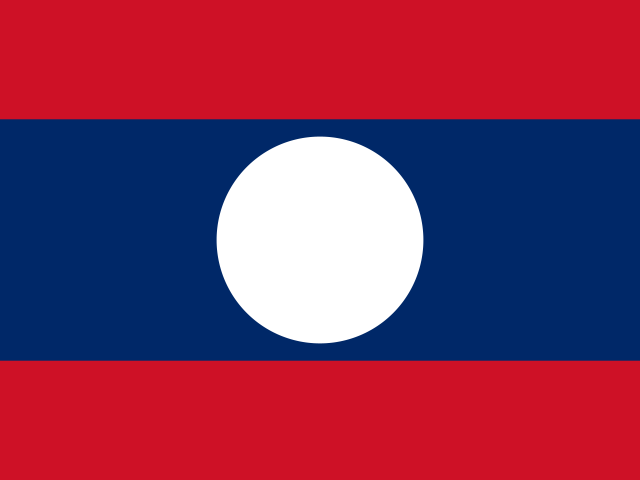
- Don't confuse it with Laos. Laos is landlocked and sits behind Vietnam, between it and Thailand.
Flag
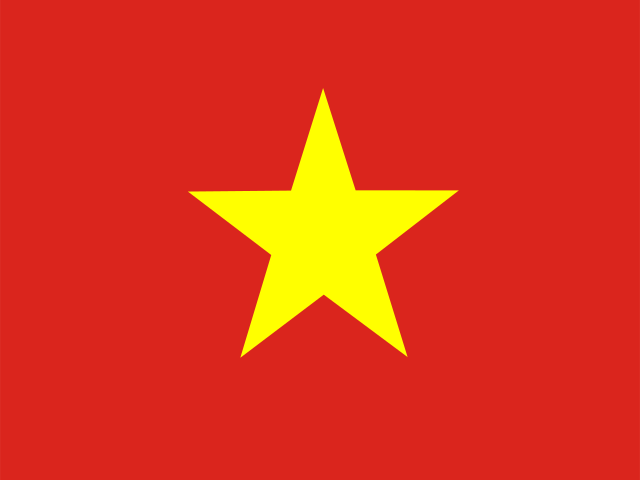
The Vietnamese flag is a red field with a single large yellow five-pointed star in the centre. Red stands for revolution, and the five points for the five classes of society: intellectuals, farmers, workers, business people and soldiers. It became the flag of the whole country after reunification in 1976.
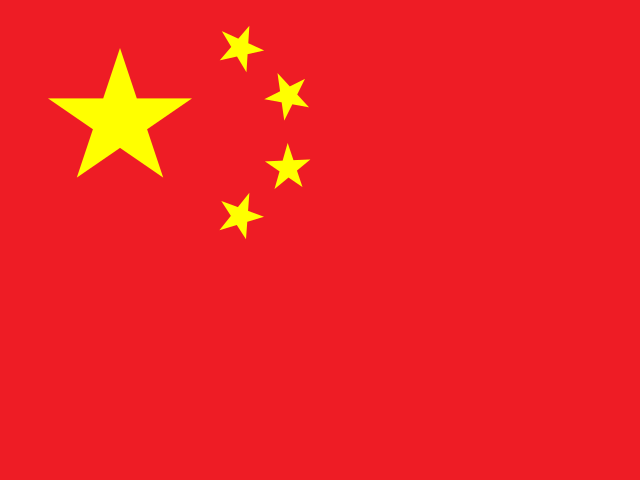
China's flag is the lookalike: also red with yellow stars, but with one large star and four small ones in the top-left corner. If there is a single star in the dead centre, it's Vietnam. Morocco has a single star on red too, but as a green outline.
A short history of Vietnam
Early Vietnamese culture took shape in the Red River delta in the north. The Bronze Age Đông Sơn culture, famous for its great decorated bronze drums, flourished there in the first millennium BC. In 111 BC the Chinese Han dynasty conquered the region, and Chinese rule lasted, with interruptions, for about a thousand years. Revolts were common – the Trưng sisters led a famous uprising in AD 40 – and in 938 Ngô Quyền defeated a Chinese fleet at the Bạch Đằng River, winning lasting independence.
Vietnamese kingdoms then expanded slowly southward over many centuries in a movement called the Nam Tiến, the "march to the south". They absorbed the Hindu kingdom of Champa on the central coast and later the Mekong delta, taken from the Khmer of Cambodia. This explains the country's long, thin S-shape. The Vietnamese also defeated Mongol invasions in the 1200s. In 1802 the Nguyễn dynasty united the whole country and made Huế its capital.
France conquered Vietnam step by step from 1858, and by the 1880s it was part of French Indochina, along with Laos and Cambodia. Japan occupied it during the Second World War, and in 1945 Hồ Chí Minh declared independence. France fought to return, but its defeat at Điện Biên Phủ in 1954 ended its rule. The Geneva Accords then split the country in two, with a communist North and an anti-communist South backed by the United States.
The Vietnam War followed. American combat troops arrived in large numbers in 1965, and the fighting killed well over a million Vietnamese. US forces withdrew in 1973, and northern troops captured Saigon on 30 April 1975; the city was renamed Ho Chi Minh City. Vietnam invaded Cambodia in late 1978, China fought a short border war against Vietnam in 1979, and many people fled by sea as "boat people".
In 1986 the government launched Đổi Mới, reforms that opened the economy to markets and foreign investment. Vietnam is now one of Asia's fastest-growing economies and a big exporter of electronics, clothing, shoes, rice and seafood, while remaining a one-party communist state.
Culture and daily life in Vietnam
Vietnamese is a tonal language with six tones in the northern dialect. It was once written with Chinese characters, and later with a native script, chữ Nôm. Today it uses an alphabet based on Latin letters, developed by Portuguese and French missionaries in the 1600s. Religion is a blend: many people follow a mix of Buddhism, Confucian values and ancestor worship, with a family altar in most homes. There are also large Catholic and Cao Đài communities.
The national literary masterpiece is The Tale of Kiều by Nguyễn Du, a long poem from the early 1800s that many Vietnamese can quote. Water puppetry, in which puppeteers hidden behind a screen move figures across a pool, began in the villages of the Red River delta. The áo dài, a long silk tunic worn over trousers, is the national dress, and the conical nón lá hat is seen in every rice field.
Huế's imperial citadel and the old trading port of Hội An are favourite sights. Lacquerware and silk painting are traditional crafts.
Five facts worth knowing
- Vietnam is one of the world's biggest coffee producers, second only to Brazil, mostly robusta beans grown in the central highlands.
- The Mekong River ends here, fanning out into the delta south of Ho Chi Minh City after flowing through five other countries.
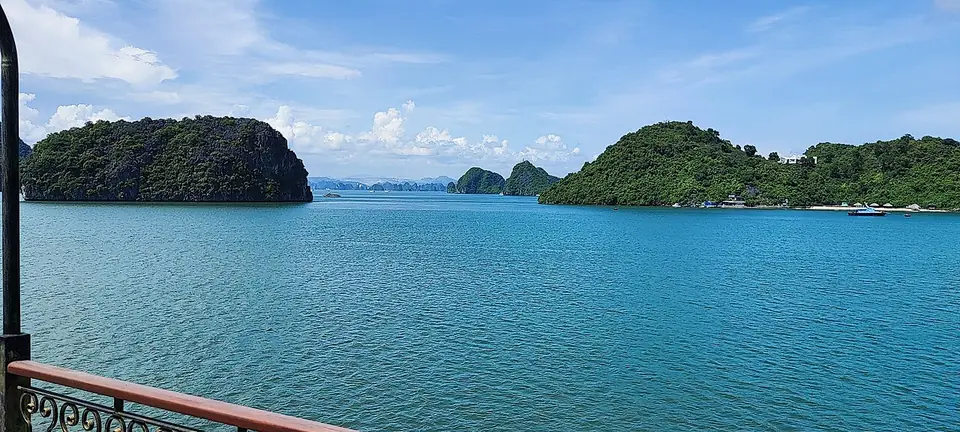
- Ha Long Bay, in the north-east, has thousands of limestone islands rising out of the sea and is a UNESCO World Heritage site.
- The country was divided into North and South Vietnam from 1954 to 1976, with the border near the 17th parallel.
- The name "Việt Nam" roughly means "the Viet people of the south".
Culture and traditions in Vietnam
- Saying hello
A handshake or slight bow with "Xin chào" (hello).
- Food and drink
Phở, beef or chicken noodle soup; bánh mì baguette sandwiches; cà phê trứng, Hanoi's creamy egg coffee.
- Festivals and traditions
Tết, the Lunar New Year (January/February); the Mid-Autumn Festival, with lanterns and mooncakes.
- Everyday life
Street life buzzes with motorbikes, and people eat and drink coffee on low plastic stools along the pavement.
- Did you know?
Vietnam is the world's second-largest coffee exporter, after Brazil.
Common mistakes
- Tapping Laos – it runs along almost the whole western side of Vietnam.
- Tapping Thailand – both are long, but Thailand's tail goes down the Malay Peninsula, Vietnam's down the coast.
- Picking China's flag in the Flags quiz; count the stars.
- Assuming the capital is Ho Chi Minh City – it's Hanoi.
Practise with Vietnam
- Asia quiz – follow China's southern coast until you reach the S.
- Southeast Asia quiz – Vietnam, Laos and Cambodia side by side, so you can learn which is which.
- Asia flags – one yellow star on red; China has five.
- Asia capitals quiz – Hanoi, not Ho Chi Minh City.
- Mystery Country – the two deltas joined by a thin waist are a giveaway.
Nearby countries
Quick check: how well do you know Vietnam?
3 questions, no sign-up. Tap an answer.
1. Which flag belongs to Vietnam?
That's the flag of Vietnam.
2. What is the capital of Vietnam?
The capital of Vietnam is Hanoi.
3. Which of these countries borders Vietnam?
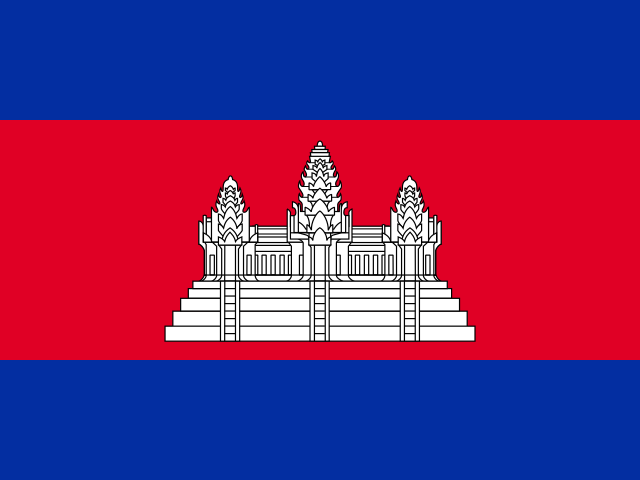
Cambodia, China and Laos border Vietnam.
Keep going on the Asia quiz – Vietnam is one of 48 countries there.
More ways to practise: find Vietnam on the blank map with no borders (hard mode), or play today's Globe and the other daily puzzles.
Frequently asked questions about Vietnam
What language is spoken in Vietnam?
Vietnamese is the official language and is spoken by most of the population. It is tonal, with six tones in the northern standard, and is written in a Latin-based alphabet with many accent marks. More than 50 ethnic minorities, such as the Tày, Hmong and Khmer, have their own languages.
What currency does Vietnam use?
Vietnam uses the Vietnamese đồng (VND). Its value is low, so prices run into tens of thousands of đồng, and the State Bank manages the rate against the US dollar within a set trading band.
What time zone is Vietnam in?
Vietnam is on Indochina Time, UTC+7, all year, the same as Thailand, Laos and Cambodia. It does not use daylight saving time. That puts it seven hours ahead of London in winter and six in summer.
Which side of the road do they drive on in Vietnam?
Vietnam drives on the right. Motorbikes far outnumber cars, and in big cities crossing the street usually means walking slowly and steadily while traffic flows around you.
What is the highest point in Vietnam?
The highest point is Fansipan, at about 3,145 metres, in the Hoàng Liên Sơn range near Sa Pa in the north-west. Known as the "Roof of Indochina", it can now be reached by cable car.
What is Vietnam famous for?
Vietnam is famous for Hạ Long Bay's limestone islands, for dishes such as phở and bánh mì, and for coffee – it is the world's second-largest coffee producer after Brazil. Its long, S-shaped coastline stretches more than 3,000 kilometres.
Quizzes with Vietnam
Often confused with
Guides that help with this
- Oceans, seas, rivers and mountainsThe physical map: seas around each continent, the big rivers and ranges.
- Flags that look alike (and how to tell them apart)Chad or Romania? Australia or New Zealand? The flag pairs that cost quiz points.
- The 25 hardest countries to find on a mapPacific islands, Caribbean islands and landlocked Africa – where they are.